
API design best practices are a production risk decision first and an endpoint naming exercise second. The strongest APIs combine predictable resource modeling, secure access, explicit compatibility rules, usable documentation, resilient operations, and automated verification, so teams can review each area before a client ever ships.
What Strong API Design Looks Like in Production
If you're leading engineering at a Series A, B, or C company, the core question isn't whether your API is “RESTful enough.” It's whether your API is easy to integrate, safe to retry, simple to govern, and clear enough that a new engineer can ship against it without a week of Slack messages. That's why API design should be treated like a product decision and a reliability decision at the same time.
The ten practices below give you a working standard for internal services, partner integrations, and customer-facing APIs. Each one comes with implementation choices, trade-offs, and hiring signals you can use when screening in-house talent or distributed teams, including LATAM hires when you need extra engineering capacity. For a mobile or backend team, the bar is the same, and a useful starting point is to build secure mobile backends with the same discipline you'd apply to public APIs.
A strong review doesn't stop at “does it work.” It asks whether the resource model makes sense, whether retries are safe, whether documentation matches reality, and whether the system can be operated under load. If a candidate can explain those trade-offs clearly, they're probably thinking like someone who can own production systems rather than just write endpoints.
Before you start hiring
Check location, salary, and hiring fit
If you are moving from research to action, start with the market basics so your hiring plan is clearer.

1. RESTful Principles with Resource-Oriented Design
REST gives teams a shared grammar: resources use URIs, standard HTTP methods express operations, APIs remain stateless, and HTTP status codes and caching semantics communicate outcomes. That consistency reduces integration errors across web and mobile clients and gives reviewers concrete conventions to inspect (Google Cloud REST guidance). Versioning, pagination, filtering, and sorting belong in the production contract too. Teams planning caching behavior can also review API versioning and caching tips.
Use plural nouns for collections, so /api/users is clearer than /api/user, and keep verbs out of resource paths. GET retrieves, POST creates, PUT replaces, PATCH partially updates, and DELETE removes. Status codes should distinguish outcomes such as 200, 201, 400, 404, and 500 (REST standards overview). Pagination limits response size, while query parameters for filtering and sorting reduce overfetching.
Practical rule: if a URL reads like an action, revisit the resource model.
Hiring teams can test this judgment with a concrete question: why choose /users/42/orders over /orders?userId=42? A strong candidate explains consumer predictability, ownership boundaries, authorization implications, and payload size rather than defending a style preference. For leaders hiring a REST or GraphQL API engineer, the reasoning matters more than memorizing REST terminology, including when shallow resources and filters are easier to govern than deep nesting.
Define the endpoint shape in OpenAPI once it is stable enough to review. Documentation and validation expose inconsistent naming or response behavior before client teams build dependencies around them. That review evidence is a useful production and hiring signal.
2. Semantic Versioning and Backward Compatibility
Versioning is where many APIs turn from product assets into support burdens. If you break a client without warning, you're not just shipping a technical change, you're creating a trust problem for every team that depends on your interface. That's why predictable versioning and explicit deprecation rules are part of the contract.
The best pattern is to define what a breaking change looks like and then enforce a minimum support window. Header-based versioning can keep URLs cleaner, but it only works if you document it thoroughly and test it rigorously. The trade-off is real, cleaner URLs versus more complex debugging for consumers, so the decision should match your audience and your support model.
A strong compatibility policy also includes migration guidance. Publishing before-and-after code samples helps teams move, and automated integration tests for every supported version catch regressions before customers do. That matters in organizations serving internal teams, partners, and public developers at the same time, because each group will move at a different pace.
A good interview signal is how a candidate reacts to a proposed breaking change. Do they ask about sunset timing, staged rollout, feature flags, and client telemetry, or do they jump straight to “just bump the version”? The former shows ownership. The latter often shows only implementation thinking.
For leaders building nearshore teams, this is also a useful hiring filter when evaluating distributed engineers in LATAM. People who have shipped versioned APIs in real production settings tend to speak in terms of compatibility budgets, deprecation notices, and support windows, not just code diffs. That's the kind of judgment you want in API-focused hiring.
3. Rate Limiting and Quota Management
Rate limiting protects availability, operating costs, and fair access. A runaway job, buggy integration, or aggressive customer can consume shared capacity and degrade every client's experience. Treat the policy as a security control and a published product contract, not merely middleware configuration.
Make the rules visible. Document limits, return relevant headers, and use Retry-After to give clients a defined recovery path. A sliding window can provide more consistent behavior than a fixed window, while tier- or workload-based quotas prevent high-volume use from overwhelming the shared baseline. Each choice should reflect capacity, latency targets, and the cost of rejected or retried requests.
Monitoring violations separates legitimate growth from abuse. It can reveal bot traffic, implementation errors, or customers who have outgrown their tier. The Cs2 Api Rate Limits guide illustrates how a high-frequency client behaves when limits are published rather than hidden. A misconfigured integration may need support and clearer documentation. A malicious burst may require blocking, authentication changes, or upstream protection.
Hidden limits turn client discovery into an outage. Published limits let clients build predictable retry and backoff behavior.
Review evidence matters during hiring. Ask candidates to show how they would test quota behavior across authenticated users, partner applications, and internal systems. Strong designs cover per-user or per-client keys, burst handling, Retry-After, observability, and a controlled process for quota increases. Candidates who connect request shaping, retries, and downstream protection to service mesh engineering demonstrate infrastructure judgment, including when retries would amplify load.
Publishing limits turns rate limiting from an outage cause into a contract clients can build against.
4. Comprehensive API Documentation and OpenAPI Specifications
An undocumented API is functionally unfinished, no matter how clean the code looks. Documentation is what turns an internal implementation into something other teams can safely use, and OpenAPI is the practical way to keep that contract machine-readable, reviewable, and testable.
The best documentation lives next to the code, not in a separate file that drifts after the first refactor. Keep the OpenAPI spec in the repo, validate it in CI, and reuse JSON Schema definitions so request and response models stay aligned. Include realistic examples, not toy payloads, because copy-paste-ready samples reduce friction during integration and onboarding.
This matters even more in distributed teams. If you're hiring across LATAM or other remote hubs, self-service docs shorten ramp-up time and reduce the number of clarification loops required before a developer can ship. That doesn't replace communication, it reduces avoidable friction so senior engineers can spend time on architecture rather than decoding undocumented behavior.
Interactive docs are worth the effort. Swagger UI or ReDoc gives developers a way to explore endpoints without guessing, and validation in CI catches drift before it leaks into support tickets. If your docs are stale, the API feels broken even when the code works.
Review rule: if a new hire can't explain the request shape, error model, and auth flow from the docs alone, the docs aren't doing their job.
A strong candidate will also ask how docs are generated, who approves changes, and whether examples are tested. Those are good signs. They show the person cares about production adoption, not just local success.
5. Error Handling and Standardized Error Responses
Errors are inevitable, but confusion is optional. The difference between a good API and a frustrating one is often the quality of the failure response, because developers need to know what failed, why it failed, and whether retrying makes sense.
A solid error payload should include an HTTP status code, a machine-readable error code, a human-readable message, and context for the failure, especially on validation errors. Use appropriate status codes consistently, and keep the response structure stable enough that clients can parse it programmatically. That's how you reduce debugging time and avoid brittle client-side branching.
The smartest teams also add a unique request ID to every error so support can trace a single failure across logs and traces. This isn't decoration, it's operational value. Without correlation, every incident becomes a guessing game between frontend, backend, and infrastructure teams.
A useful implementation pattern is to standardize the error envelope across the entire API, then document the canonical codes. Once the contract is stable, developers can build reliable retry logic and user-facing messaging without special cases everywhere. For validation failures, field-level feedback is essential because generic errors force clients to inspect logs and re-run requests blindly.
Hiring signal matters here, too. Ask candidates how they'd handle a 409 Conflict versus a 422 Unprocessable Entity, or what they would include for a broken input shape. People with real API experience usually talk about machine parsability, request correlation, and field-level clarity, not just “better messages.”
6. Authentication and Authorization Secure by Default
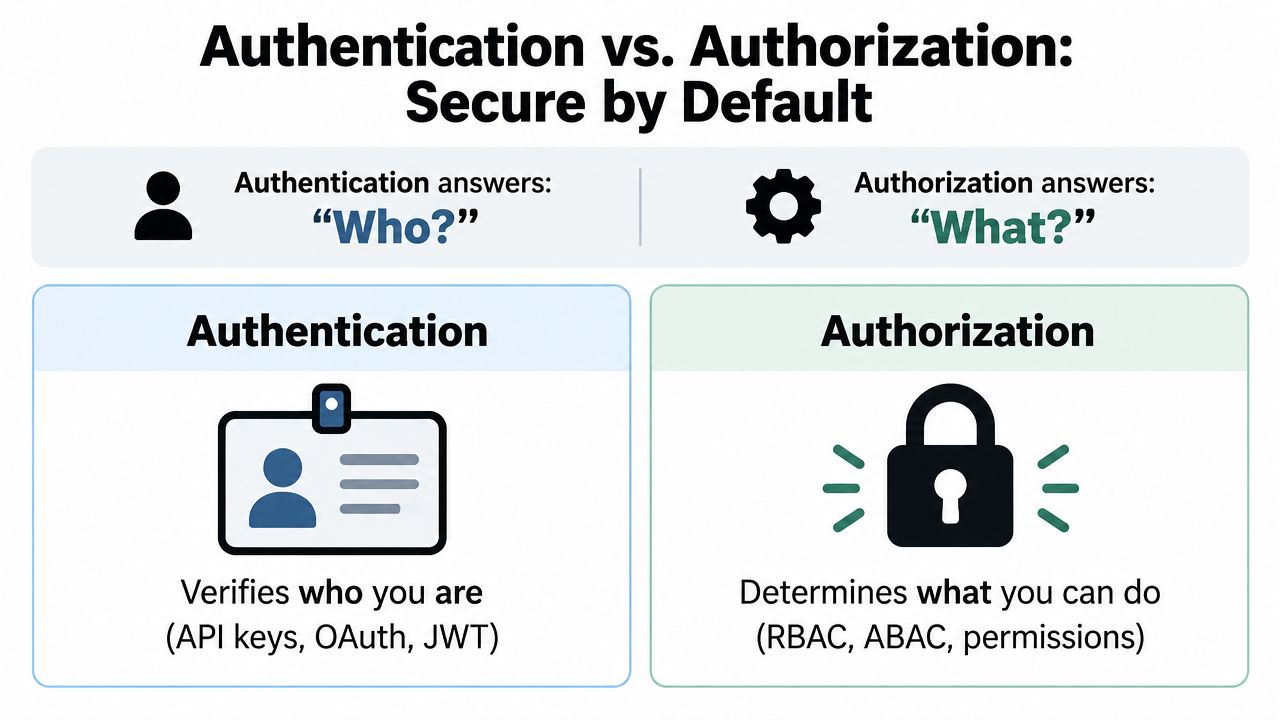
No serious API should be exposed without authentication. If an endpoint can read or change sensitive data, access must be explicit from the start, not bolted on later after a security review finds the gap. Authentication proves who is calling, authorization decides what they're allowed to do.
The baseline for simple machine-to-machine access can be API keys, but most scalable systems need OAuth 2.0 or OpenID Connect for delegated access. Authorization should be designed at the same time, usually through RBAC or ABAC, because identity without permissions is only half a control plane. For higher-security environments, more stringent signing schemes can be appropriate, but the main principle stays the same, every request must be accountable.
There's also a practical operational layer. Rate limiting per authenticated user is more useful than per IP in many systems, and access logs should include user, endpoint, method, resource ID, timestamp, and response code. Rotating and revoking keys without service disruption is also a mature product requirement, not a nice-to-have.
If a candidate treats auth as a middleware checkbox, they've probably never owned the fallout from a bad permission model.
A useful interview question is whether the candidate would ever accept passwords over an API. The right answer is no. Ask them what they'd log, how they'd scope tokens, and how they'd limit the blast radius of theft. Those answers tell you whether they understand security as an engineering system or just as a library choice. If you're building a hiring rubric, the identity and access control skill set is one of the clearest places to separate real experience from buzzwords.
7. Pagination, Filtering, and Search Optimization
Pagination is a production safeguard, not merely a presentation choice. Unbounded collection requests can trigger timeouts, memory pressure, and database strain. The API contract should define how clients retrieve large result sets before traffic exposes those failure modes.
Offset pagination is simple, but offsets can drift as rows are inserted or deleted. A client refreshing page two may receive duplicates or miss records that shifted between requests. Cursor pagination fits frequently changing collections better. Return a stable cursor token that encodes the sort key and a tiebreaker ID, so inserts between requests do not change the traversal order. Offset pagination remains reasonable for small, mostly static datasets.
Filtering and search reduce payload size and query work, but every exposed parameter expands the validation and indexing surface. The API should permit a defined set of filters, reject unsupported combinations clearly, and make the default sort order explicit.
Standardize choices that reviewers can verify in code:
Cap page size: set a documented maximum, such as 100 items, and return 400 when a client requests more.
Document allowed filters: specify types, operators, null behavior, and whether filters can be combined.
Index what you sort and filter: match indexes to real query patterns, then inspect query plans before usage grows.
Use search tools deliberately: full-text search belongs in an indexed engine or a database feature built for it. When caching layers absorb list traffic, a Redis cache engineer typically owns invalidation rules and stale-result behavior.</li>
For distributed teams, ask candidates how they would prevent filter injection, preserve cursor stability, and test query plans under changing data. Strong answers connect API parameters to indexes, latency, consistency, and failure handling. That evidence is more useful than framework familiarity when evaluating engineers, including LATAM candidates.
Caching and list refreshes also need explicit review. A candidate who can explain cache keys, cursor behavior, and stale data handling has likely supported a production API rather than only built a demo.
8. Idempotency and Request Deduplication
Retries are normal in production. Timeouts happen, networks fail, and clients resend requests that might have already been applied on the server. Without idempotency, a retry can create a duplicate payment, duplicate record, or duplicate side effect, which is how a small reliability issue turns into a customer-facing incident.
The cleanest pattern is to accept an idempotency key on mutating requests and store the key with the request result. If the same request arrives again with the same key, the API returns the original result instead of re-executing the operation. That makes POST workflows much safer when clients retry automatically after an uncertain response.
The trade-off is storage and lifecycle management. You need a clear expiration policy, a deduplication store, and a rule for what happens if the same key is reused with different parameters. A conflict response is usually the right answer there, because it tells the client the replay is invalid rather than accepting bad state.
This is one of the best areas to test an engineer's production instincts. Ask them what happens if a payment endpoint times out after the card is charged, or how they'd prevent duplicate side effects in a bulk provisioning flow. The people who've lived through real incidents will immediately talk about request hashes, stored responses, and client-generated keys.
Practical rule: if the endpoint can move money, create accounts, or send messages, idempotency should be part of the design, not a post-launch patch.
If a candidate understands why PUT, DELETE, and selected PATCH operations should also be idempotent, they're already thinking at the right level for distributed systems.

9. Monitoring, Logging, and Observability
Production APIs need structured logs, metrics, and traces from their first release. Without that telemetry, an incident investigation depends on incomplete evidence and slows containment. Good observability identifies what failed, where it failed, and whether the problem is isolated or systemic.
Make structured logging the default. Record a request ID, user or service identity, endpoint, latency, and response code in a consistent format so support and engineering can correlate events quickly. Metrics should track request rate, latency percentiles, error rate, and payload size. These measures expose different pressures, from capacity limits to unusually large responses.
Tracing becomes necessary when a request crosses service boundaries. An API call may touch a database, cache, and external dependency. A trace should show that path and its timing, allowing engineers to locate latency without searching disconnected logs across the stack. Sampling reduces storage and processing cost, but teams must retain enough detail for low-volume failures and critical workflows.
For scale-up companies, observability also provides evidence of engineering judgment. Engineers who have owned dashboards, alert thresholds, and sampling policies understand that telemetry creates operational cost as well as visibility. That combination matters in an SRE or platform-heavy API role, where the site reliability engineer (SRE) profile tests telemetry ownership and incident judgment.
Operational design should measure business outcomes as well as technical uptime. Track whether requests produce the expected state or customer action, then connect those signals to alerts and incident review. If the system cannot show whether requests succeed in the way the business expects, leadership is operating an API without reliable evidence.
10. Concurrency Control and Conflict Resolution
Shared resources create conflict. When two clients update the same record at nearly the same time, one update can overwrite the other unless the API has a way to detect stale writes. Concurrency control protects users from lost updates and protects the business from silent data corruption.
The most practical pattern is optimistic locking with ETags. A client reads a resource, gets an ETag, and sends it back on update through If-Match. If the resource changed in the meantime, the server rejects the write with a conflict response and returns the current version so the client can retry with fresh data. That's cleaner than locking the database for every edit and usually fits collaborative or high-traffic APIs better.
This approach is especially useful for profiles, content records, configuration objects, and workflow state. The trade-off is that clients must handle conflicts intentionally, which means your API and frontend teams need to align on retry behavior and merge UX. For some fast-moving resources, Last-Modified can be simpler, but it's less precise than ETags.
A good technical interview question is whether the candidate would use optimistic locking or pessimistic locking for a given endpoint, and why. A strong answer mentions update frequency, conflict likelihood, user experience, and implementation complexity. A weak answer usually talks only about database features without considering how the API behaves for clients.
If you want to hire engineers who can own this kind of problem, look for people who talk naturally about stale state, version checks, and conflict handling. Those are signs they've shipped APIs in environments where concurrency matters.
10-Point API Design Best Practices Comparison
Turn API Standards into an Engineering Advantage
A useful release-readiness review starts with the resource model. Ask whether the paths are noun-based, whether methods match semantics, whether pagination and filters are consistent, and whether the response shapes are stable enough for clients to rely on. Then move to the operational controls, auth, rate limits, idempotency, and concurrency, because that's where production risk usually appears first.
Security deserves its own gate. Check that authentication is mandatory, authorization is explicit, tokens are scoped correctly, access is logged, and revocation or rotation won't break customers. After that, verify backward compatibility, versioning policy, and deprecation timing so existing clients don't get surprised by a release they never agreed to.
Documentation and failure behavior should be reviewed together. If the OpenAPI spec is out of sync, CI should fail. If error codes aren't standardized, the team should fix that before the endpoint goes public. If observability isn't in place, the release is still incomplete because no one can troubleshoot it under load.
A compact interview checklist helps separate real API experience from theoretical familiarity:
Can the candidate explain trade-offs? Look for reasoning about REST structure, versioning, and pagination choices.
Can they design retry-safe endpoints? Listen for idempotency keys, stored responses, and conflict handling.
Can they protect data? Expect clear answers on auth, authorization, logging, and token scope.
Can they instrument production systems? Good candidates mention structured logs, metrics, and tracing without prompting.
Can they reason about distributed delivery? Strong hires can keep contracts clear for teammates across time zones and explain why documentation and review discipline matter.</li>
If your team is scaling faster than your hiring funnel, make this checklist part of architecture reviews and interview loops. It's a straightforward way to see whether a candidate can design for production, not just implement tasks in isolation. For companies building across the US, Europe, and LATAM, that discipline helps you source skill-first engineering talent with less resume noise, and GENTY recruitment can support that process through targeted hiring and RPO.
If you want help hiring engineers who can design and operate APIs well, GENTY recruitment can support your search with skill-first shortlists across LATAM. Their process is built to reduce resume overload and help teams move faster on roles that need real production judgment, not just framework familiarity.