
You walk to the elevator replaying a 45-minute interview. The hiring manager laughed at your story, called it a “great chat,” and seemed interested. None of that tells you whether you're advancing. An interview went well when the employer creates a concrete path forward, such as discussing compensation or availability, naming the next interviewer, requesting references, or setting a decision timeline. Treat warmth as background noise until one of those commitments appears.
The broader funnel explains why reaching an interview matters, but also why one pleasant conversation proves little. A typical job posting can receive about 250 resumes, while only 4 to 6 candidates may be invited to interview, according to career interview statistics compiled by Career.io. You've cleared an important filter, but the hiring team still needs evidence that it should reduce risk by moving you forward.
The First 30 Seconds After You Walk Out
You leave the building replaying every smile, pause, and encouraging comment. Ignore that first impression. The useful question is whether the interviewer created work for the hiring team that would make sense only if you remained under serious consideration.
Check the four hard signals
Did logistics become specific? A casual salary question proves little. A substantive discussion of compensation expectations, notice period, start date, relocation, or work authorization shows the team is testing whether an offer could work in practice.
Planning a hire?
Talk through the best hiring option
This article usually leads to one practical question: should you use staffing or salary guide? We can help you choose quickly.
Simple next step
Start with staffing and we will help you pick the best hiring setup.
Did someone name the next person and timing? “We'll be in touch” carries no process information. “You'll meet Priya, our VP of Engineering, next week after this round” does. Record the person, stage, and date window while they are fresh.
Did references or checks enter the conversation? Questions about references, background checks, or who can verify your work indicate that the employer is assessing what evidence it needs before deciding.
Did the interviewer place you inside the role? “You'd work with the platform team” gives context. “When you join, you'll own…” is a stronger cue because the interviewer is testing how you fit the job. Treat that wording as supporting evidence, not a substitute for a defined next step.
Write your notes before reaching the lobby. Separate observable facts from interpretation: capture the exact question, your answer, and the commitment the interviewer made. The candidate experience perspective from GENTY recruitment reinforces why this record matters. Clear communication and follow-through shape the process for both sides, while a warm conversation can leave the candidate with a misleading impression.
Practical rule: Count commitments, not smiles.
Memory magnifies warmth and loses specifics within minutes. Score the interview by what the company agreed to do, then send a follow-up that confirms any stated timing or next action.
Hard Signals vs Soft Cues and What Each Predicts
A comfortable interview can still end in rejection. Hard signals create employer-side work. Soft cues create a pleasant experience. A recruiter who asks about your notice period has introduced an operational constraint. An interviewer who laughs at your joke has shown only that the conversation felt comfortable.
The National Association of Colleges and Employers reported an average interview-to-offer rate of 47.5% in 2022, as reported in Career.io's interview statistics overview. That figure describes the overall funnel, not your personal odds after one friendly meeting. Judge your interview by evidence of progression, not by atmosphere.
The 60–80% advancement band is a practical editorial classification for clustered hard signals, not a universal hiring statistic. Do not calculate your odds from it. Use it to rank evidence: one hard signal deserves attention, several aligned signals matter more, and soft cues should support concrete progression rather than replace it.
Your follow-up should match the strongest signal. If the interviewer named a next person, confirm that stage. If compensation or start date came up, restate any agreed constraint. If references were requested, prepare them immediately. If no commitment appeared, send a concise thank-you note without treating politeness as evidence.
For a closer review of communication quality, compare the candidate's answers with the observable behaviors in GENTY recruitment's communication skills assessment guidance. Clear explanations, useful evidence, and disciplined responses help a panel score the interview. Polished rapport alone does not.
What Good Looks Like at Each Interview Stage
A signal has to match the stage. A recruiter shouldn't give the same evidence as a technical panel, and a final executive conversation shouldn't end with the same vague language as an initial screen.
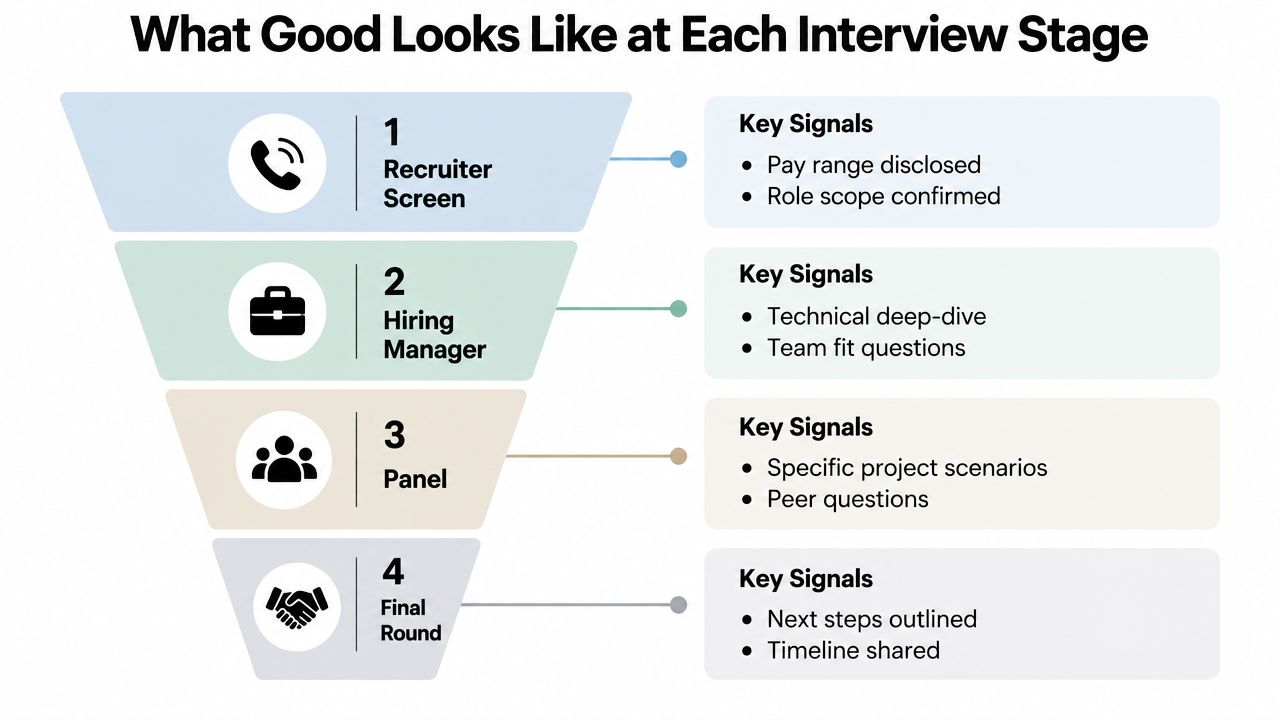
Recruiter screen
The recruiter should clarify the pay range, location expectations, employment arrangement, and core requirements. You should leave knowing the hiring manager's name and the next stage or decision window. If the recruiter only collects your resume details without explaining the role's scope or process, the conversation may be running on autopilot.
Advancement check: Can you name the next stage, the hiring owner, and the timing?
Hiring manager interview
The hiring manager should move beyond résumé verification. Strong evidence includes present-tense problem statements, a detailed discussion of team structure, ownership boundaries, and questions about your availability or start date. Ask which business or engineering problem needs attention first, then listen for whether the manager connects your experience to that problem.
Advancement check: Did the manager test how you'd operate in the actual team?
Technical or panel round
Expect scenario-based questions, probing follow-ups, and visible note-taking. A structured panel may use a rubric, ask every candidate comparable questions, and discuss how interviewers will align internally. The remote LATAM hiring process guidance from GENTY recruitment also emphasizes clarity around agendas, panel roles, evaluation criteria, and assessment expectations.
Advancement check: Did the panel gather scored evidence against the role's requirements?
Final or executive round
The final stage should include mutual assessment. The executive may explain compensation philosophy, priorities, leadership expectations, or the trade-offs behind the role. Before you leave, look for a concrete decision date, approval step, or written deliverable.
Advancement check: Did the conversation end with ownership, timing, and a defined decision path?
A long process can still be healthy if each stage adds evidence and ends with a named action. Multiple interviews are especially meaningful when they represent progression through distinct decision gates, rather than repeated conversations with no accountable owner.
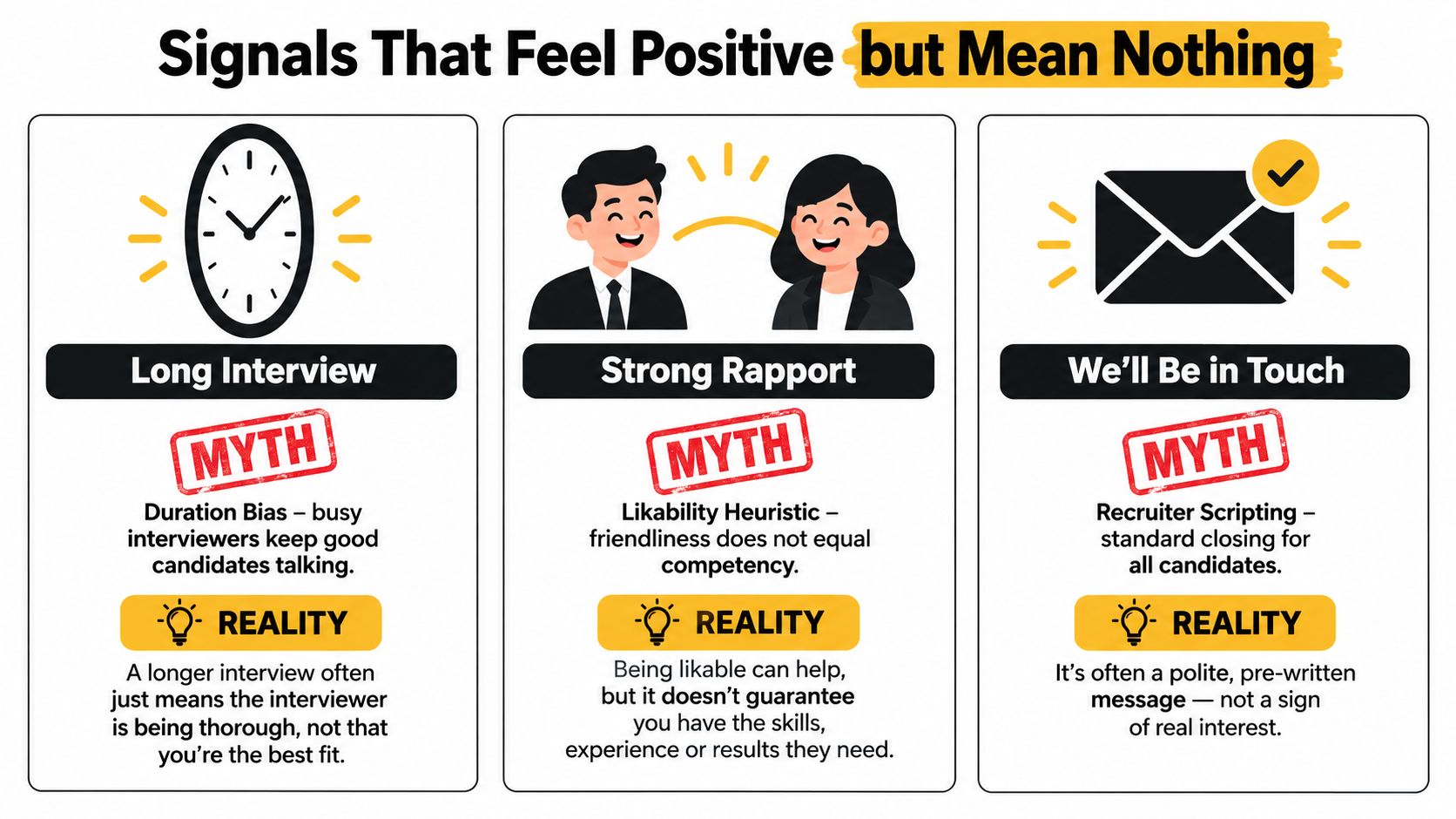
Three Signals That Feel Positive but Mean Nothing
Candidates overweight three cues because they're emotionally vivid: duration, rapport, and the closing phrase “we'll be in touch.” Each can occur when the employer has already decided against moving forward.
The interview ran long
A 90-minute conversation can end in a rejection. The interviewer may have had broad questions, a flexible calendar, or a habit of exploring every answer. Duration bias turns extra minutes into assumed interest, even though the meeting may not have produced a next interviewer, timeline, or deliverable.
Replace “Did it run long?” with “What changed because it ran long?” If the added time produced a technical deep dive, a reference request, or a scheduled follow-up, it matters. If it produced more small talk, it doesn't.
The rapport felt strong
An interviewer can be warm with every candidate. A friendly hiring manager may also have an internal favorite, a fixed scorecard, or a concern they never voiced during the conversation. The likability heuristic makes people confuse being enjoyable to speak with being the strongest match for the role.
Respect rapport, but don't use it as proof. Strong answers, relevant evidence, and a documented next stage carry more weight than shared humor.
They promised to follow up
“We'll be in touch” may be a recruiter politeness script. It's not a timeline, an owner, or a decision. Even a prompt courtesy email can be a template sent to every candidate.
Use this contrast:
Polite signal: “We enjoyed meeting you.”
Substantive signal: “We'll send the technical exercise by Thursday.”
Polite signal: “The team liked your background.”
Substantive signal: “You'll meet the CTO after the panel debrief.”
Polite signal: “We'll let you know.”
Substantive signal: “I'll update you by Friday, even if the decision is delayed.”</li>
Confidence should come from documented commitments. Keep applying until the employer gives you an offer in writing, regardless of how good the conversation felt.
Your Follow-Up Playbook After the Interview
Your follow-up should preserve momentum without sounding anxious. Send a short note the same day, wait through the stated window, then ask for a timeline if the company misses it.
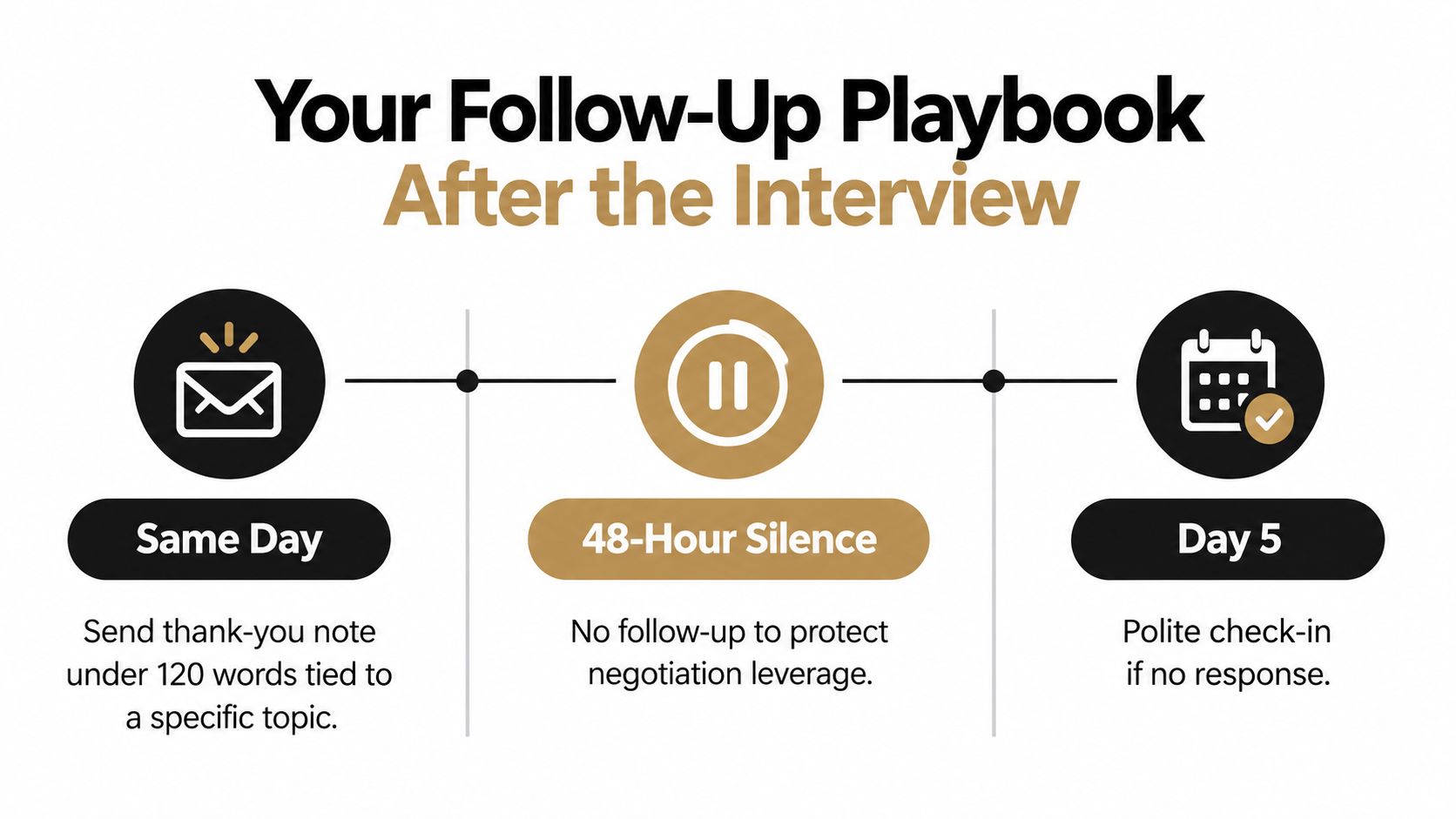
Same day
Keep the thank-you note under 120 words. Mention one specific problem discussed and connect it to a contribution you proposed. Don't repeat your résumé or write a generic paragraph about being excited.
Subject: Thank you for discussing [role]
Hi [Name],
Thanks for discussing [specific problem] today. Your point about [detail] reinforced how I'd approach the role, particularly by [specific contribution]. I'm interested in continuing the conversation and would be glad to speak with [next interviewer] or provide any additional information.Best,
[Name]
If you need to make the message more useful rather than merely polite, tools such as a LinkedIn content intelligence platform can help you research the person's public professional context before an outreach conversation. Use that information carefully. The follow-up should reflect the interview, not look like automated personalization.
The 48-hour silence protocol
If the interviewer gave you a date, wait until that window passes. If they gave no timing, don't send another message within 48 hours unless they requested something from you. This pause protects your negotiating position and prevents you from treating normal internal coordination as a signal of rejection.
Use the time to prepare for a possible technical exercise, document questions about the role, and keep other applications active. The candidate experience guidance from GENTY recruitment supports the same operational principle: clear communication works better when every message gives the other party useful context.
Day five to seven
If nothing arrives after the expected window, ask for timing rather than demanding a decision:
Subject: Checking in on [role]
Hi [Name],
I'm checking in on the timeline for the [role] process. I enjoyed discussing [specific topic] and remain interested in the opportunity. Could you let me know whether the next stage is still planned, and when I should expect an update?Best,
[Name]
Respond differently to each type of movement. A reference request deserves a fast, complete reply with relevant contacts. A second panel deserves confirmation of attendees, format, and preparation expectations. An informal call may be exploratory, so ask who will join and what decision the conversation supports.
Every follow-up should make the next step easier to say yes to, not easier to ignore.
The Hiring Manager's Side of the Same Question
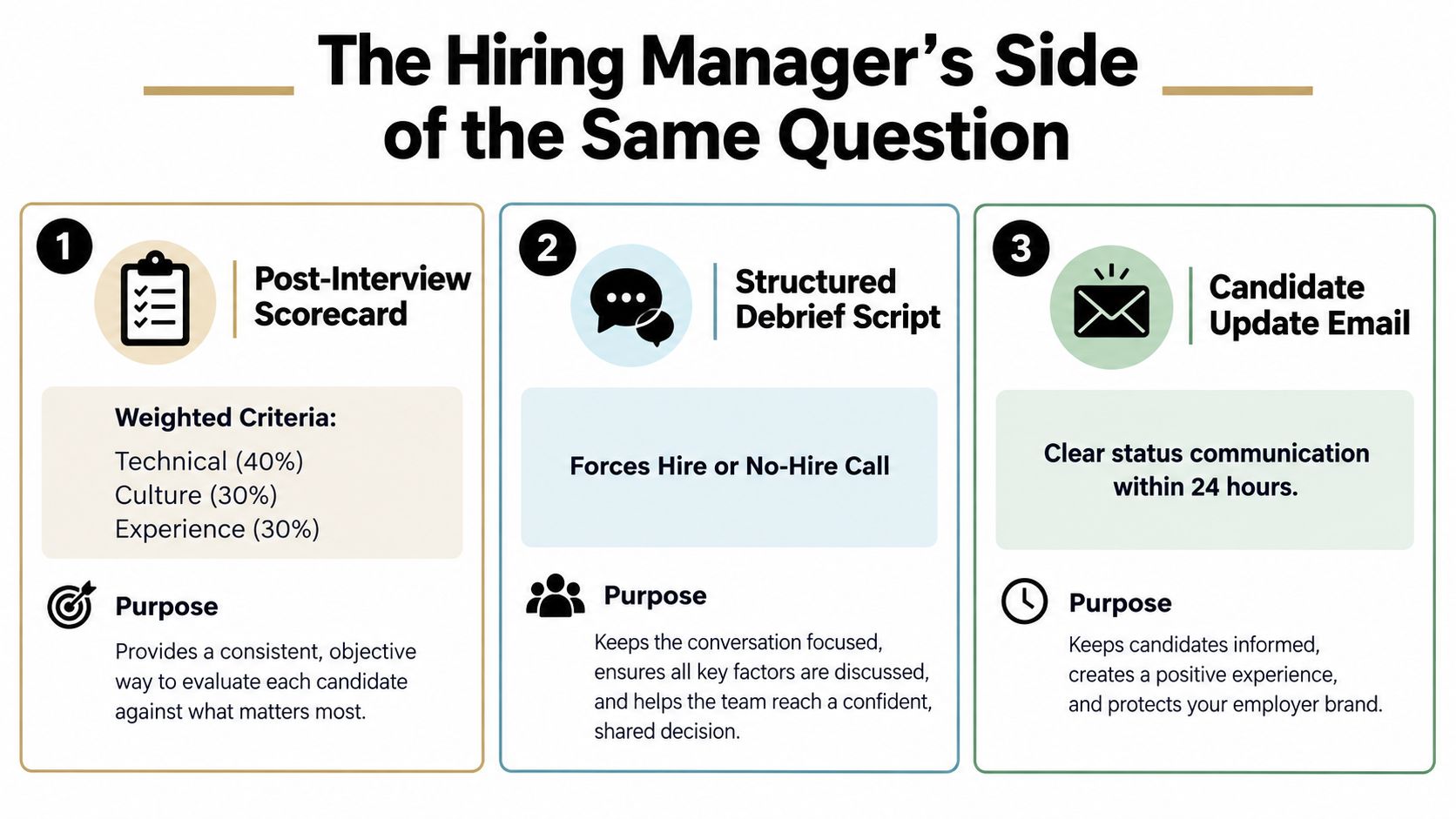
A candidate leaves the interview wondering whether the conversation felt positive. The hiring team should answer a harder question: can it defend the decision with evidence, and does the process have a specific next action? If the panel cannot name that action, it is not ready to advance the candidate.
Use a scorecard that forces evidence
A structured scorecard turns impressions into comparable evidence. Define observable criteria, ask consistent questions, and have interviewers rate independently before discussion, following structured interview scorecard guidance.
A useful post-interview template includes:
Role fit: What evidence shows the candidate can handle the core responsibilities?
Evidence quality: Which example supports each rating?
Values alignment: How did the candidate respond to trade-offs, feedback, or disagreement?
Risk factors: What remains unverified, and which next step would test it?
Decision: Hire, no hire, or advance for a stated reason.</li>
Use a defined scale such as 1–5 or 1–10, with room for specific examples. Interview scorecard guidance from Dover recommends completing the scorecard during or immediately after the interview and collecting responses before the debrief. A scorecard should reveal the decision gap, not conceal it with “strong culture fit.”
Use the hiring manager checklist for 2026 tech hiring to align scorecards and debriefs before the process advances.
Run a disciplined debrief
Each interviewer should submit an independent recommendation before the group seeks consensus. Require one or two evidence sentences for every important score, then identify the single unresolved risk that the next stage must test. Shiftbase's structured interview scorecard resource describes a process built around 5–7 relevant competencies, consistent questions, independent scoring, and evidence notes.
Then send the candidate a precise update:
Hi [Name],
Thanks again for meeting the team. We're completing the debrief for [role]. The next step is a conversation with [name and title], focused on [topic], planned for [date window]. We'll share [preparation material] beforehand and update you by [decision date].Best,
[Recruiter]
Share compensation ranges, name the hiring manager, describe the team, and confirm the next interviewer only when those details are approved. Accidental signals create false expectations. Written instructions create trust and keep distributed teams across the US, Europe, or LATAM aligned.
The One Rule to Judge By and Quick Answers
Judge every interview by one rule: it went well only when the interviewer committed to a documented next step with a date, a name, or a concrete deliverable.
That rule works across a recruiter screen, a technical round, and an executive meeting because every legitimate advancement requires coordination. Someone must schedule the next conversation, send an assessment, request references, complete an approval, or communicate a decision date. Feelings don't create that work. Commitments do.
Run this 60-second check before leaving the building or logging off:
Name: Who, specifically, is involved next?
Date: When should the next action happen?
Deliverable: What will someone send, complete, or review?
Evidence: Which answer or example did the interviewer probe most thoroughly?
Risk: What concern remains unresolved?</li>
If you can't answer at least one of the first three, ask before ending the call: “What should I expect as the next step, and when would you expect that to happen?” A serious process can answer clearly. If the answer remains vague, keep your search active.
Quick answers
How long should you wait before following up?Send your thank-you note the same day. After that, respect the stated timeline, then follow up when it passes. If no timing was provided, use the 48-hour silence protocol and check in around day five to seven.
What does a week of silence mean?It means the process has lost visible momentum. It doesn't prove rejection, but you should stop treating the role as active until the recruiter supplies a specific update. Send one concise timeline request and continue interviewing elsewhere.
Do multiple interview rounds signal advancement?Yes, when each round represents a new decision gate and the hiring odds rise as you progress. One cited historical benchmark reported a 36.89% chance of an offer after one interview, increasing to 51% after three interviews, as summarized by Zippia's job interview statistics. The number is historical and not a guarantee for your role. The operational signal is whether the company keeps assigning new stakeholders and concrete stages.
How should you interpret a lukewarm final round?Ignore the mood and inspect the process. A restrained executive may just be evaluating carefully. Ask whether compensation, priorities, references, approvals, or a decision date were discussed. If none appeared, treat the final round as unresolved rather than secretly positive.
Screenshot this rule: No documented next step means you have a conversation, not evidence of advancement.
GENTY recruitment helps tech companies build predictable interview funnels through IT recruitment, RPO, staffing, and curated nearshore hiring support, including structured evaluation and clear process coordination. If your team is losing strong candidates to vague stages or inconsistent debriefs, visit GENTY recruitment to discuss a hiring process built around evidence and explicit next steps.