
Your engineering director is six weeks into a DevOps search. Three finalists reached the system-design round, and all three failed because they could list Kubernetes objects but couldn't explain how they'd contain a production incident. The search now has a weak pipeline, an impatient product team, and a compensation range nobody benchmarked before publishing the role.
The fix isn't another tools checklist. Effective DevOps engineer hiring starts with role scope, tests incident judgment and security decisions, and moves from first conversation to signed offer in about three weeks. Senior DevOps roles take about 49 days to fill in the US and 52 days in Europe, while average offer acceptance sits at 67% across those markets, according to 2026 DevOps hiring benchmarks. Teams that compress the interview cycle have a clear advantage.
Why DevOps Hiring Feels Hard Right Now
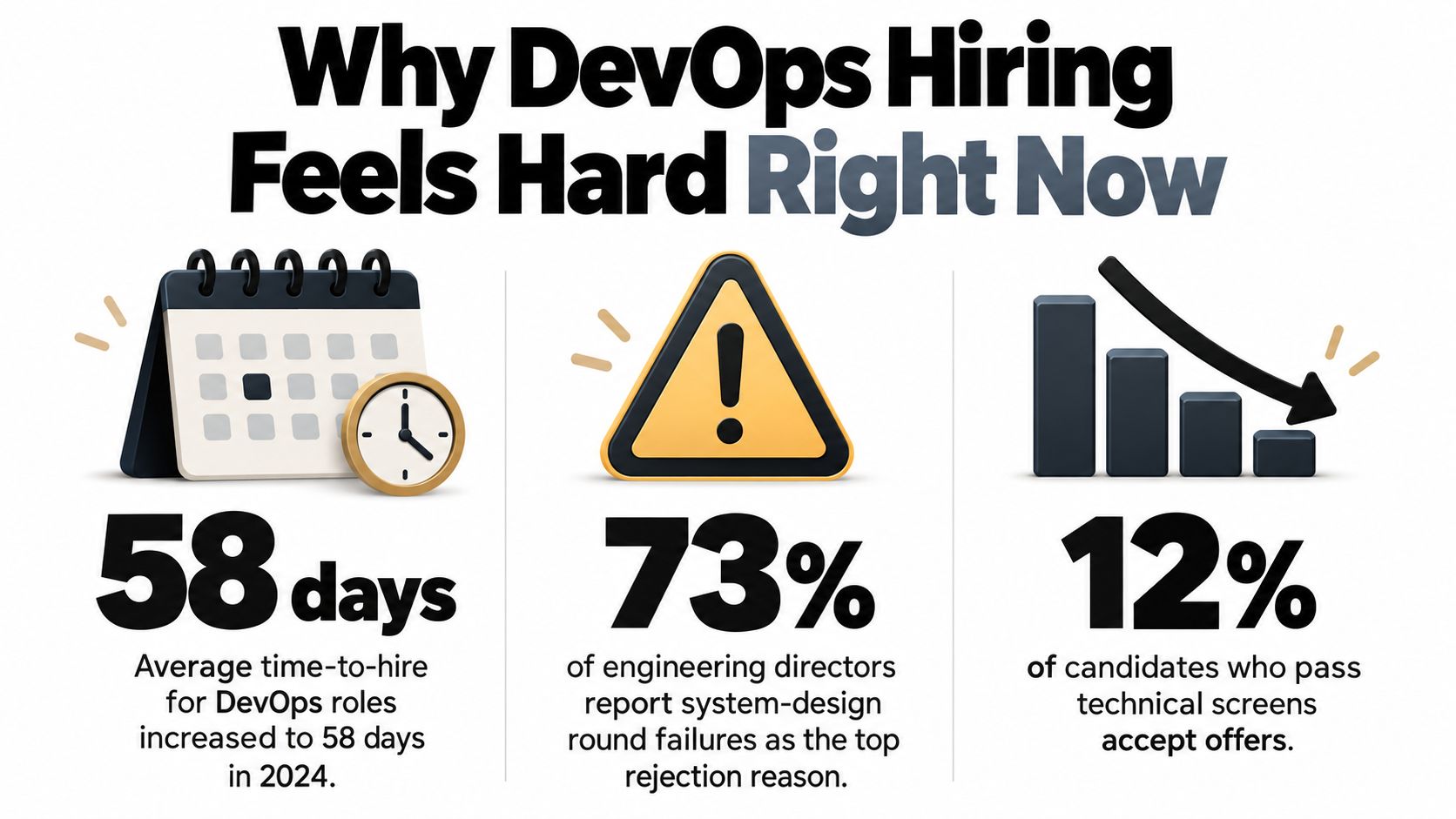
DevOps demand is broad because the role sits across infrastructure, automation, cloud operations, security, reliability, and delivery. In one 2025 analysis, 36.7% of infrastructure-related roles reviewed in the first half of the year were DevOps Engineer positions, the largest title group in that dataset. February recorded 194 positions, or 47.2% of tracked openings, before activity declined to 10 positions in June 2025, a pattern that points to concentrated hiring cycles rather than a steady flow of candidates. The market analysis gives hiring teams a practical warning, waiting until a migration or reliability problem is already blocking delivery can leave them competing for a thinner pool.
Compensation adds pressure. A 2026 summary reports a US average DevOps salary of $143,065, based on 17,034 Glassdoor submissions, while other datasets cited in the same summary put median annual pay at $116,780 and broader annual pay at $131,698. Most salaries in that comparison fall between $107,500 and $153,000. The salary data also connects hiring demand with continued investment in CI/CD, cloud operations, automation, and reliability engineering.
What do you need?
Choose the hiring path that fits
After reading "DevOps Engineer Hiring Playbook for 2026", most teams compare these options before deciding how to hire.
The three problems behind stalled searches
Role confusion comes first. Companies advertise one “DevOps” position while expecting an SRE, platform engineer, release engineer, and security specialist. Candidates interpret that as uncontrolled scope, and strong candidates leave the process before the technical round.
Tool trivia creates false confidence. A candidate might know Terraform syntax and still make unsafe changes during an outage. Conversely, an engineer with deep AWS experience shouldn't be rejected because they used GitLab CI instead of GitHub Actions.
Late compensation decisions waste the most expensive part of the search. Establish the level, location, employment model, and budget before sourcing. Then publish a range that reflects the actual responsibility.
This playbook fixes the sequence in six parts: define the role, choose the sourcing channel, assess production behavior, structure interviews, benchmark the offer, and design the first 90 days.
Defining the DevOps Role You Actually Need
Don't write the job description until the team answers one question: what breaks if this person does nothing for the next six months? If releases remain manual, you need a CI/CD and automation profile. If developers can't provision environments, you need platform engineering capability. If alerts, uptime, and on-call ownership are the problem, an SRE-leaning hire may be more accurate.
The distinction matters because DevOps, platform engineering, and SRE overlap, but they don't carry identical accountability.
DevOps engineer: owns delivery automation, infrastructure as code, cloud environments, and operational tooling.
Platform engineer: builds internal products that give developers self-service deployment and infrastructure workflows.
SRE: owns reliability practices, observability, incident response, service-level objectives, and often the on-call system.</li>
The role should still be broad enough to reflect modern production work. The DevOps Institute identifies six core functional areas: IT operations, security, infrastructure, application design and development, quality assurance, and testing in its Enterprise DevOps Skills Report. Treat that as a systems profile, not a demand for mastery of every named tool.
Build the scorecard before sourcing
Use must-have capabilities such as Linux and networking fundamentals, one thoroughly understood cloud platform, infrastructure as code, CI/CD design, observability, incident response, and security or identity decisions. Keep specific products, such as Jenkins, GitHub Actions, or Terraform Cloud, in the adaptable category unless the hire will inherit a highly specialized environment.
A Series B SaaS hiring its first senior DevOps engineer might weight infrastructure and cloud architecture at 25%, delivery automation at 20%, incident response and observability at 20%, security and identity at 15%, systems fundamentals at 10%, and collaboration at 10%. Set a pass threshold for each critical cluster rather than allowing an excellent tools score to conceal weak incident judgment.
Publish the role against this scorecard, not against an undifferentiated tool list. Teams comparing profiles against a defined scope can also use a specialized DevOps engineer hiring service when they need technical sourcing support.
Sourcing Channels and the LATAM Option
Sourcing channel should follow the work model, not recruiter preference. A US product team with complex compliance requirements may need a domestic direct hire. A team that needs same-day collaboration for incidents may prefer nearshore talent. A platform project with a defined handoff can support a more distributed search.
LATAM is a credible nearshore option for US teams because common working hours span UTC-5 to UTC-3, creating overlap with US Eastern through Pacific hours, according to nearshore hiring guidance. Colombia and Peru operate at UTC-5, Mexico commonly spans UTC-6 to UTC-8 by region, and Chile is typically UTC-4 or UTC-3. That overlap supports pair-debugging, on-call handoffs, and live incident coordination without making the entire workflow asynchronous.
The comparison isn't a verdict. LATAM can lose when a company needs a rare combination of local immigration portability, highly specific legacy tooling, or a dense local hiring network. Offshore hiring can work well for defined platform delivery, but weak overlap raises the cost of incident coordination. Domestic hiring simplifies employment and stakeholder access, but it doesn't remove competition for senior candidates.
A five-day shortlist workflow
Day one, review every profile against the scorecard and reject title-only matches. Day two, validate production ownership through questions about outages, deployment changes, and infrastructure decisions. Day three, run a focused recruiter screen that tests communication and motivation. Day four, send qualified profiles to the hiring manager with a short evidence summary. Day five, book the technical conversation.
Recruiters don't need to be production engineers, but they must distinguish “used Kubernetes” from “owned Kubernetes operations.” Ask how they test for incident response, how they verify IaC depth, and whether their shortlist notes contain evidence or just keyword matches. For teams building their own talent-monitoring workflow, this guide to open source job scrapers provides useful background on collecting job-market signals responsibly. A specialist remote developer hiring approach can also help when the company wants broader geographic reach without sacrificing working-hour overlap.
Technical Assessment That Predicts Real Performance
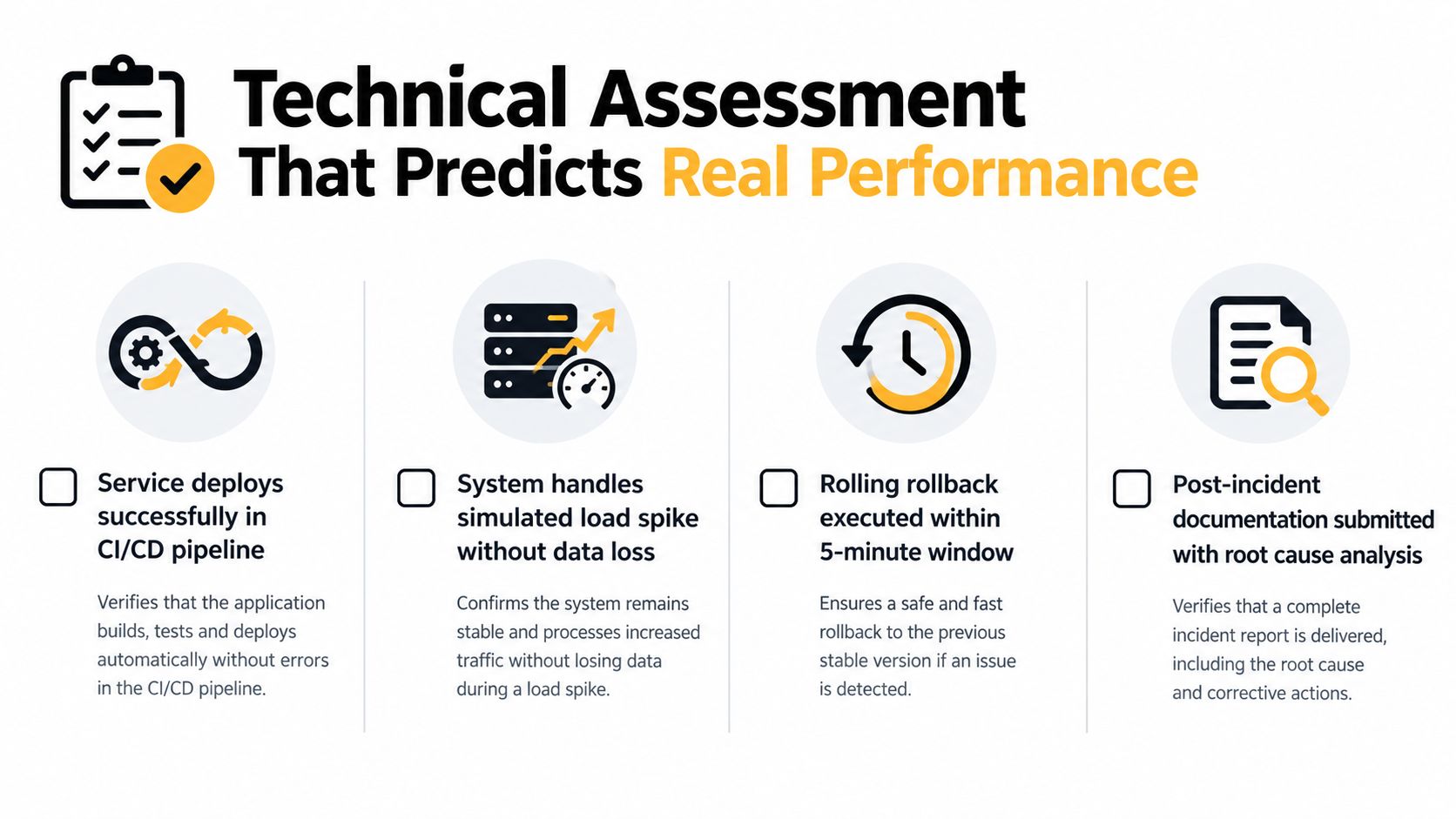
A DevOps assessment should resemble a bad Tuesday, not a certification exam. Give the candidate a service that deploys, degrades under load, and needs a controlled rolling rollback. The strongest signal is how they decide what not to change while the evidence is incomplete.
Start with a realistic environment and clear boundaries. The candidate should inspect logs, dashboards, deployment history, and pipeline output. Don't hide the answer in a puzzle. The exercise should reward safe diagnosis, reversible action, and communication.
Score behavior, not speed alone
Use four assessment axes:
Detection speed, 40%. Does the candidate identify the failing signal, confirm impact, and separate symptoms from causes?
Remediation, 30%. Do they choose a safe rollback or mitigation, protect data, and avoid expanding the blast radius?
Trade-off reasoning, 20%. Can they explain why they prefer a rollback, feature flag, capacity change, or configuration adjustment?
Written RCA clarity, 10%. Can another engineer understand what happened, what changed, and what should prevent recurrence?</li>
The percentages above are the assessment weights, not market statistics. Keep the exercise consistent for every candidate, and tell candidates what the environment contains. A candidate who asks for more telemetry is often showing better operational judgment than one who immediately edits configuration.
Include a CI task that requires debugging a failing GitHub Actions workflow rather than writing a workflow from scratch. Debugging reveals whether the candidate follows execution context, credentials, artifacts, dependencies, and environment differences. A polished template tells you far less.
Add an architecture review
Give the candidate an existing Terraform module and ask for a 30-minute critique. Look for security defaults, state handling, network exposure, cost awareness, dependency management, and blast-radius control. Don't expect a single correct architecture. Expect a clear explanation of risks and a staged improvement plan.
Reject candidates who pass trivia but freeze when logs are ambiguous. Modern hiring guidance increasingly includes cloud security, identity, troubleshooting, CI/CD, Kubernetes, and infrastructure as code, because production DevOps work requires decisions across those boundaries.
For a visual example of the assessment flow, review this technical walkthrough before adapting the lab to your stack.
Use a written rubric before the first candidate enters the process. A technical assessment framework can help teams standardize evaluation, but your scorecard must remain tied to the actual services and failure modes the hire will own.
Interview Questions That Expose Depth
Structured interviews outperform informal technical conversations because they make evidence comparable. One hiring study cited in technical recruiting literature found that 46% of new hires fail within 18 months, while only 11% of those failures were attributed to insufficient technical skills. The same source attributes 89% to factors including attitude, coachability, culture fit, and motivation, and reports that structured interviews are 34% more accurate at predicting hire quality. The hiring research summary supports a firm rule: score judgment and collaboration as deliberately as technical ability.
Run four loops, each with a defined competency and the same scoring scale from 1 to 5.
Systems loop
Ask the candidate to trace a request from the load balancer through application services, caches, queues, and the database. Then ask where they'd add caching and what failure mode that introduces. A score of 3 means they can describe the main path and identify a bottleneck. A score of 5 includes dependency behavior, backpressure, cache invalidation, observability, and a clear explanation of trade-offs.
Incident loop
Ask for a real outage they owned. Require specifics: what changed, how they detected the problem, what users experienced, what they did first, and what the team changed afterward. Candidates don't need a heroic story. They need an honest one that shows containment, learning, and respect for evidence.
Scoring rule: Reward a candidate who says “I don't know yet, so I'd check these signals” over one who invents certainty from incomplete logs.
Security loop
Ask them to compare short-lived credentials with static keys, design least-privilege IAM access, and explain how they'd rotate secrets without breaking production. Then introduce a delivery constraint, such as a release deadline or a third-party integration that requires raised access. Strong candidates explain the risk, propose a temporary control, and define how they'd remove it.
Security and identity remain under-tested in many loops, even though modern DevOps interview guidance places them beside delivery and infrastructure topics. A candidate who can secure a pipeline but can't explain incident trade-offs is incomplete. So is an operations specialist who treats security as someone else's queue.
Collaboration loop
Ask about disagreeing with a product deadline because of reliability risk. Look for respectful escalation, written context, a proposed alternative, and willingness to make a decision visible. The relevant question isn't whether the candidate always wins the argument. It's whether they can protect the system without turning every disagreement into a standoff.
Use a shared rubric and interviewer calibration. A practical collection of interview questions for technical candidates is useful only when interviewers record evidence against the same anchors.
Salary Benchmarking and Offer Strategy
Set compensation before the first interview. Current US data is dispersed: one 2026 summary reports an average of $143,065, another comparison places typical pay between $107,500 and $153,000, and Robert Half's 2026 guide gives a national DevOps Engineer range of $118,000 to $173,750. Other aggregators report $125,908 from ZipRecruiter and $134,228 from Indeed, while Indeed's reported range extends from $86,794 to $207,586. The salary comparison shows why title-only benchmarking is inadequate.
Don't copy the highest number into a requisition. Define seniority, on-call expectations, platform ownership, security responsibility, location, and equity philosophy first.
The table separates verified salary ranges from compensation elements that vary by company. Don't invent a universal equity figure for a market where employment structures differ.
A fast process matters as much as a credible offer. The benchmark cited earlier identifies teams that reach a signed offer in about three weeks as the fastest performers, while senior roles take around 49 days in the US and 52 days in Europe to fill overall. Use a pre-approved range, schedule debriefs on the same day, prepare references before the final round, and send paperwork immediately after verbal acceptance.
Offer discipline: Never make a candidate complete a long technical process before you reveal whether the budget matches the level.
For a more rigorous compensation review, a salary benchmarking service can help separate market evidence from internal assumptions.
Onboarding and the First 90 Days
A signed offer isn't a successful hire. The first 90 days determine whether the engineer gains useful ownership or spends the quarter waiting for access, learning undocumented systems, and discovering that the advertised role was inaccurate.
Use a staged ramp with clear evidence at each checkpoint.
Days 1 to 30
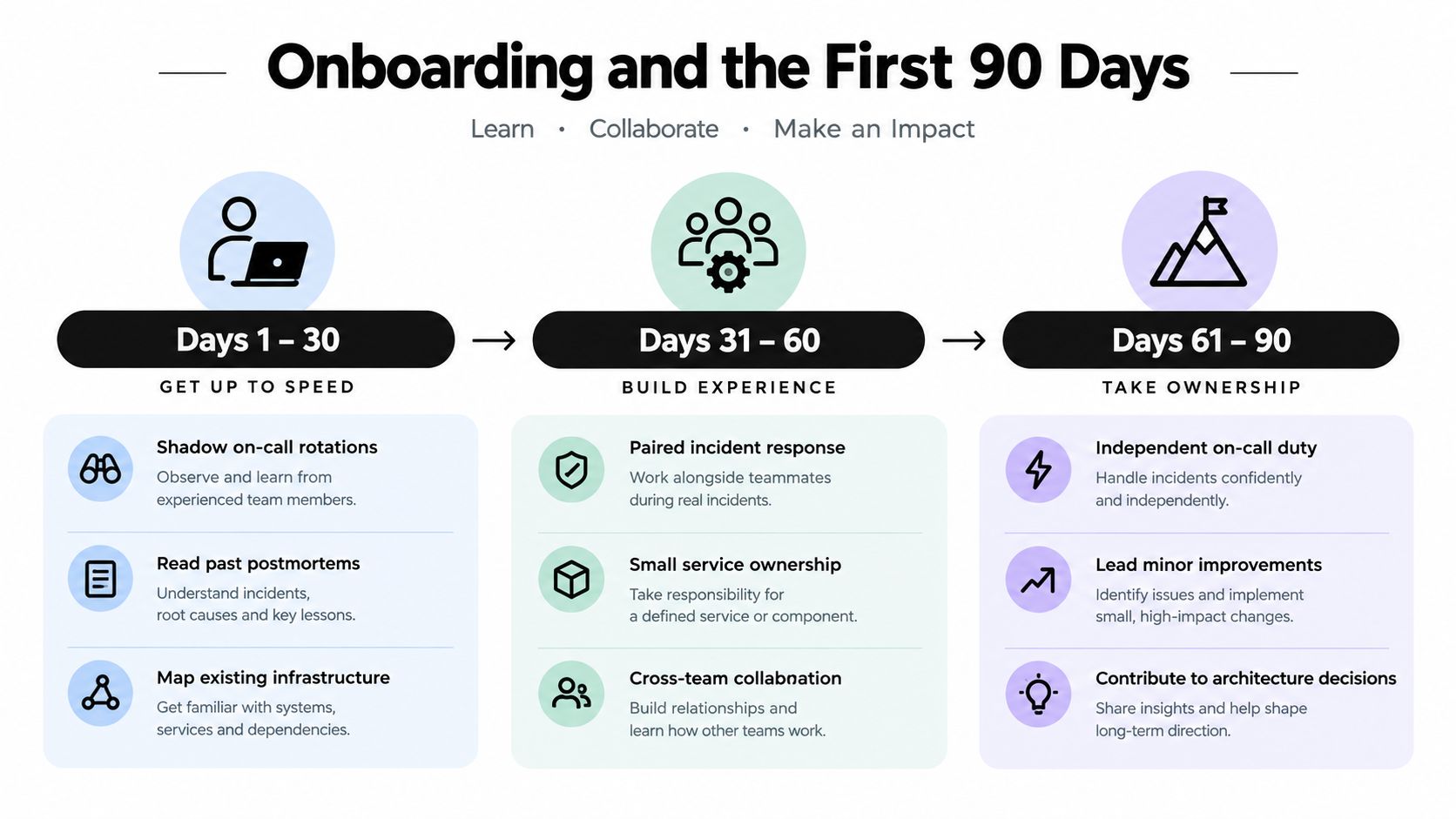
The engineer should shadow on-call, read prior postmortems, and map the current infrastructure. Give them access to repositories, dashboards, runbooks, deployment systems, and incident channels before the first week ends. Pair them with a senior engineer for two one-on-ones each week, focused on architecture context and operational decisions.
Days 31 to 60
Introduce bounded ownership. The new hire should deliver one small reliability improvement, update a runbook, and lead a blameless postmortem for a minor incident with support from the team. The manager should review how the engineer communicates uncertainty, documents changes, and coordinates with development and security.
Days 61 to 90
Move toward independent on-call duty, ownership of a service, and participation in architecture decisions. Review operational indicators such as incident follow-through, runbook quality, alert relevance, deployment safety, and progress against the agreed reliability goals. Don't impose a fabricated improvement percentage. Set the baseline during the first 30 days, then measure change against that baseline.
Manager checklist
Access: Confirm repositories, cloud accounts, observability, ticketing, and incident channels.
Ownership: Write down the service or platform area the engineer will own.
Support: Schedule architecture reviews and recurring one-on-ones.
Feedback: Review progress at days 30, 60, and 90.
Retention: Compare the actual role with what was promised during hiring.</li>
Clear onboarding helps improve employee retention because it gives the new hire context, support, and visible progress instead of leaving them to decode the organization alone. RPO support can handle recruiting logistics, credentialing coordination, scheduling, and documentation so the engineer spends early weeks on engineering work rather than administrative delays.
GENTY recruitment helps US and European startups source and evaluate DevOps engineers across LATAM, with skill-first shortlists covering CI/CD, infrastructure as code, containers, monitoring, and related production responsibilities. Visit GENTY recruitment to discuss a scoped search, salary benchmarking, or RPO support for your next infrastructure hire.