
Your recruiting team has a promising engineering pipeline, but every first-round interview becomes a scheduling exercise. A recruiter in California is matching calendars with candidates in Buenos Aires, São Paulo, or Mexico City, while a hiring manager tries to protect time for roadmap work. Asynchronous video interviews can remove that bottleneck, but only when you treat them as a structured screening process rather than a video tool.
An asynchronous video interview asks candidates to record answers to preset questions on their own time. Reviewers watch the submissions later, without a live interaction. The format works best for standardized early screening, not for every role or every candidate. Its value comes from consistent questions, anchored scoring, reliable recording conditions, and a clear human handoff to deeper interviews.
What Asynchronous Video Interviews Are
A distributed engineering pipeline can stall before technical evaluation begins. Candidates in Buenos Aires, São Paulo, or Mexico City may face limited overlapping hours with recruiters and hiring managers. Asynchronous video interviews shift the first response from a shared calendar slot to a recorded submission, but the value comes from process design, not from buying another video tool.
The candidate receives preset questions, records answers independently, and submits them for later review. Recruiters and hiring managers can assess responses at different times. The format suits standardized early screening, provided the team uses consistent prompts, anchored scoring, dependable recording instructions, and a clear handoff to deeper interviews.
What do you need?
Choose the hiring path that fits
After reading "Asynchronous Video Interviews: A Practical Guide", most teams compare these options before deciding how to hire.
The format has expanded beyond graduate recruiting because it addresses distributed hiring. A 2022 peer-reviewed study examined 2,550,105 responses from 627,999 candidates across 12,105 interview templates, showing broad adoption in recruiting (study details and completion-rate context). The same research reported a median of 10 candidates per interview, with most interviews using four to five questions. Candidates commonly had 30 seconds to prepare and two minutes to record each answer, while average total recording time reached 259 seconds across all questions (practitioner study of asynchronous interview design).
Three formats with different jobs
Teams most commonly use three designs:
Single-take one-way screening: Candidates answer each question within a fixed limit, with limited or no retakes. It is efficient, but technical friction can appear as weak communication, especially when candidates have inconsistent connectivity or audio quality.
Take-home recording: Candidates prepare more deliberately and may receive multiple attempts. The result is more polished, but it measures preparation and presentation alongside spontaneous reasoning.
Structured multi-stage async loop: The candidate completes an initial screen, technical walkthrough, or role-specific scenario before meeting the team live. This fits hiring funnels spread across time zones.</li>
AI can transcribe answers, summarize themes, and organize a reviewer queue. Keep rejection decisions with accountable humans. Transcription helps locate evidence, but it cannot reliably interpret context, accent, connectivity problems, thoughtful pauses, or eye-contact artifacts created by camera placement.
For a CTO, the decision is where recorded evidence improves throughput and where removing live interaction weakens signal. Set candidate expectations, explain how answers will be reviewed, and apply candidate experience improvement guidance. Teams building flexible assessment experiences can also review gamified lessons without limits for ideas about structured participation.
Asynchronous vs Live Video vs In-Person Interviews
The three formats solve different hiring problems. Async reduces calendar coordination. Live video preserves dialogue and follow-up. In-person interviews provide the richest environmental and interpersonal context, but they impose the most logistical cost.
A 90-minute live slot between California and Buenos Aires costs two half-days when both people need to protect travel, work, or family time around the meeting. Async removes that collision, but it doesn't remove the need for human judgment.
Async vs Live Video vs In-Person Decision Matrix
A practical format decision
Use async for high-volume early screens. It works when the same competencies must be checked repeatedly, such as debugging approach, customer communication, or motivation for a defined role. It also helps recruiters cover time zones without turning every first conversation into a scheduling project.
Use live video for system design and culture checks. Senior engineers need to clarify assumptions, respond to changing constraints, and collaborate with the interviewer. A recording can't reproduce that interaction. Live sessions also give candidates a chance to ask questions and assess the team.
Use in-person for final-stage executive or onsite-equivalent loops. If the role depends on executive influence, board communication, or close office collaboration, the additional effort can be justified.
A useful remote LATAM interview process guide can help teams decide which stage belongs in which format. Don't force one medium across the funnel. A hybrid process usually produces better evidence than a single-format process.
How the Interview Works End to End
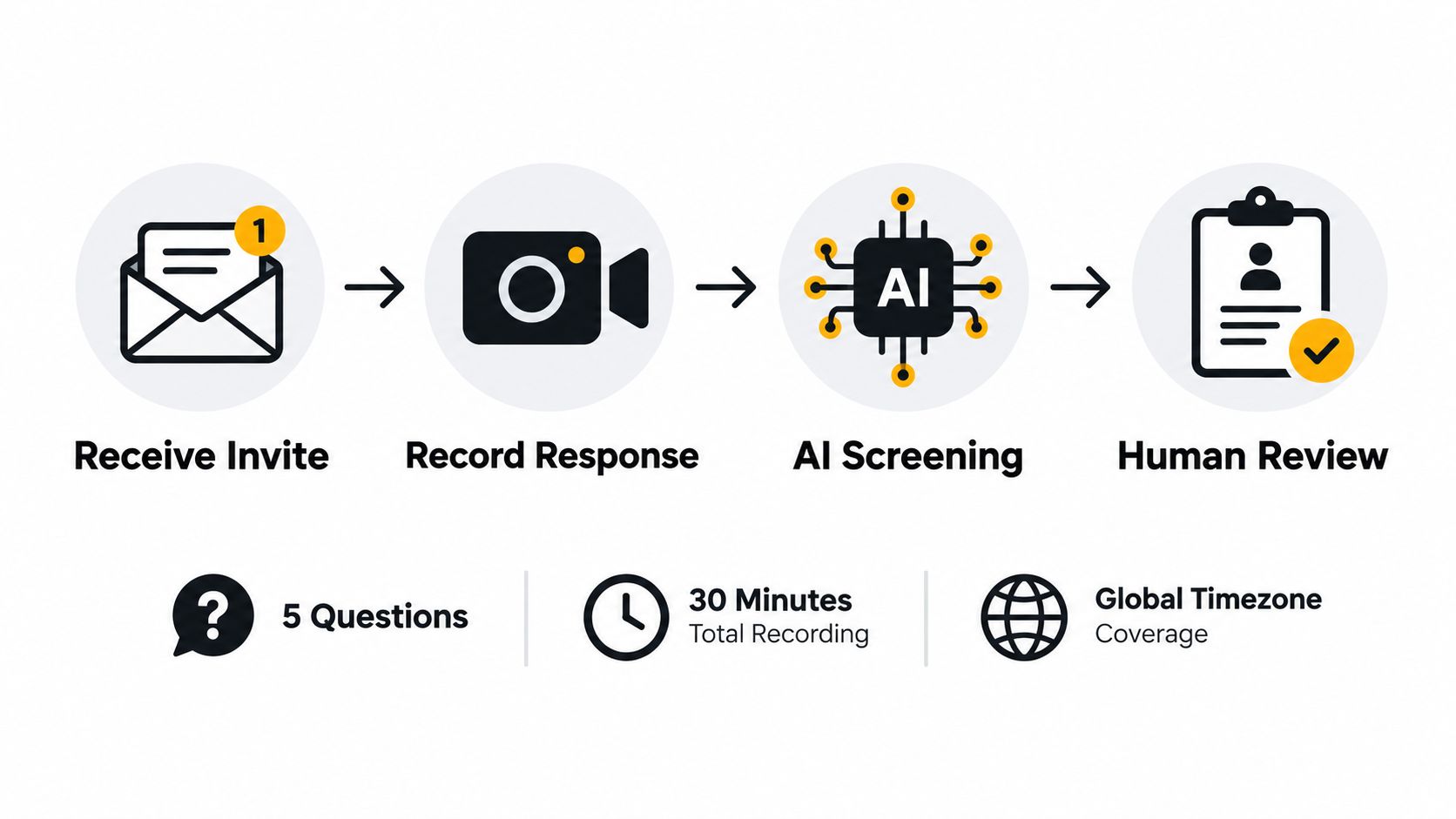
A reliable async interview starts before the invite. The recruiter and hiring manager must define the evidence they need, the candidate experience they will provide, and the review process that will produce consistent decisions. The employer creates a structured interview, sends a secure link, collects recordings, and routes them into a review queue. Candidates should know what will happen, how long answers should be, and who will see the recording.
Assign ownership before launch
The recruiter owns the invitation, consent language, deadline, reminders, and candidate support. The hiring manager owns the questions and scoring rubric. Reviewers score independently before the debrief, which prevents the first confident opinion from anchoring the group.
A practical sequence is:
Set the brief. Explain why the interview exists, how long it should take, whether retakes are available, how recordings are stored, and what happens next.
Use a compact question set. Four or five questions provide a workable structure for an early screen. Each prompt should test one named competency.
Give preparation time. A 48 to 72 hour window gives distributed candidates room to find a quiet space without leaving the funnel open indefinitely.
Control the recording experience. Define preparation time, answer limits, retake rules, and upload behavior. Mobile recording and resume-after-failure options matter when connectivity is inconsistent.
Review against evidence. Each reviewer scores the answer against the rubric and adds a short evidence note. Do not grade charisma, background decor, accent, or camera quality.
Handoff deliberately. Move suitable candidates into a live technical, role-play, or hiring-manager conversation. Async is one stage in the funnel, not the complete assessment.</li>
Keep the recording burden close to the original study's average total recording time of 259 seconds. A short, focused screen protects completion and reduces the penalty for a weak connection, shared workspace, or unfamiliar recording setup. Extend it only when the role requires deeper work. Long recordings can increase accent fatigue and encourage memorized answers.
Use these effective candidate screening steps as a process reference. Before inviting candidates, test the flow on ordinary devices and realistic home connections. A polished corporate-office demo does not prove that the workflow works for candidates in Argentina, Mexico, or Brazil. Review the process itself, not just the platform settings.
Best Practices for Recruiters and Candidates
Recruiters should design async interviews as if every unnecessary instruction will reduce completion. Candidates should treat the recording as a constrained work sample, not a performance contest. Both sides benefit when the process measures the role rather than access to a quiet studio.
Recruiter checklist
Set three to five questions: Use one question per competency. Ten prompts usually create fatigue instead of better signal.
Allow at least 48 hours: Candidates need a realistic window to arrange equipment, work around shifts, and choose a private setting.
Enable mobile recording: A webcam-only process excludes capable people whose best connection is on a phone.
Caption the prompts: Written questions should be available even when the recruiter records a video introduction. Technical jargon needs precise wording.
Review blind first: Hide names, profile photos, and environmental details where the platform permits. Score the answer before opening contextual information.
Publish the next step: Tell candidates when they'll hear back and whether a live conversation follows. Silence makes a flexible process feel transactional.</li>
For candidates in Argentina, Mexico, and Brazil, align deadlines with both US Eastern business hours and local evenings. Send technical prompts in English with a Spanish or Portuguese gloss for specialized terms when that prevents ambiguity. A noise-cancelling headset and a stable upload connection matter more than a ring light.
Candidate playbook
Start with a short environment scan. Check the camera angle, frame the face clearly, remove notification sounds, and record a test answer to confirm that speech is audible. A plain background helps the reviewer focus, but candidates shouldn't need a studio setup.
Use a simple structure for tight answers:
Situation: State the relevant context.
Task: Explain what you owned.
Action: Describe the decision and the trade-off.
Result: Give the observable outcome and what you learned.</li>
If the platform offers a short re-record allowance, use it to correct a technical failure or an unclear opening, not to chase a perfect performance. Candidates should ask for an audio-only or live alternative when connectivity, disability, caregiving, or privacy constraints make video unsuitable. Recruiters should make that request easy and non-punitive.
Teams comparing remote workflows can consult these remote hiring best practices before turning async interviewing into a default requirement.
Scoring Rubrics and Sample Questions
A recording without a rubric is just a collection of opinions. The hiring manager should define what a strong answer contains before the first candidate records, then train reviewers to score evidence rather than polish.
Use a 1 to 4 scale:
1, insufficient evidence: The answer misses the question, contains major reasoning gaps, or provides no relevant example.
2, partial evidence: The candidate identifies part of the issue but leaves important assumptions or decisions unexplained.
3, solid evidence: The response addresses the competency clearly, makes reasonable trade-offs, and stays relevant.
4, strong evidence: The candidate structures the problem, explains constraints, anticipates risks, and communicates decisions with useful precision.</li>
Add a “do not infer” column to every rubric. Reviewers shouldn't infer technical ability from accent, confidence from eye contact, or collaboration from an attractive background. The rubric should force the reviewer to write what the candidate said or demonstrated.
Sample Rubric and Questions by Role
Questions that produce usable evidence
For a senior backend engineer, ask: “Design a rate limiter for a distributed API. What assumptions would you make, and how would you handle failure?” Give 60 to 120 seconds for the initial explanation. Follow with: “A flaky CI pipeline fails only under parallel execution. Describe your debugging sequence and the evidence you'd collect.” The response should reveal method, not memorized terminology.
For an enterprise SDR, ask: “A procurement leader says your price is too high and wants to compare vendors. How do you respond?” Then ask: “Draft an opener for an account where engineering, finance, and operations may each influence the decision.” The time limit should be long enough for structure but short enough to prevent a rehearsed monologue.
Standardize the questions, time caps, instructions, and re-record count. Keep retake scheduling flexible when a candidate has a documented technical problem. Reviewers should score a sample together before they score live responses, discuss disagreements, and update the rubric only between hiring cycles.
Teams that need more question design examples can use this guide to choose effective interview questions. The goal isn't to make every answer identical. It's to make the evidence comparable.
Hidden Risks Most Guides Skip
Async interviewing isn't automatically faster, fairer, or more attractive to candidates. A field study and three controlled experiments found that applicants reported lower job acceptance intentions after asynchronous video interviews than after face-to-face interviews, driven by lower psychological comfort and reduced willingness to self-disclose. The effect was stronger among people with higher interpersonal trust propensity (research on trust and asynchronous interviews).
That result changes the operating question. If a candidate experiences the process as a surveillance gate with no human context, the company may lose the very people it wants to hire. A recruiter introduction, a short hiring-manager welcome, transparent data handling, and a clear alternative can restore some of the missing trust.
Practical rule: Use async to remove scheduling friction, not to remove the human relationship.
Technical quality creates another risk. Experimental evidence found that candidates recorded with better audiovisual quality were rated as more hirable, and instructing evaluators to ignore audiovisual quality didn't eliminate the bias. Research also found that horizontal eye-contact deviation lowered perceived social presence and reduced hirability and performance ratings, while vertical deviation didn't show the same negative effect (evidence on audiovisual quality and eye-contact artifacts).
Controls that reduce avoidable noise
Send a personal introduction: A hiring manager's short welcome explains the team and makes the recording feel less anonymous.
Allow device choice: Support desktop, tablet, and mobile recording. Don't make an expensive camera part of the assessment.
Offer an audio fallback: A connectivity or privacy issue shouldn't become an automatic rejection.
Limit visual context: Reviewers should focus on the answer, not the candidate's home, furniture, clothing, or perceived eye contact.
Audit the funnel: Compare completion and advancement patterns by device class, connection problem, and location. Investigate disparities before changing the rubric.</li>
A 2025 study adds useful nuance. Completion decisions depended on interview stakes, recording-quality problems were rare and only modestly related to ratings, and backgrounds signaling personal or protected-status cues were very rare and unrelated to evaluations. Standardized evaluation reduced sex-based differences, but not differences associated with every other interviewee characteristic (study of biasing factors in asynchronous interviews). The strongest control is disciplined completion support plus structured review, not a promise that the platform itself removes bias.
For a broader framework, this resource on competency based hiring explained is useful because it keeps assessment tied to observable job requirements. That is the right foundation for nearshore recruiting, especially when bandwidth and presentation norms vary across LATAM markets.
Implementation Checklist and Common Questions
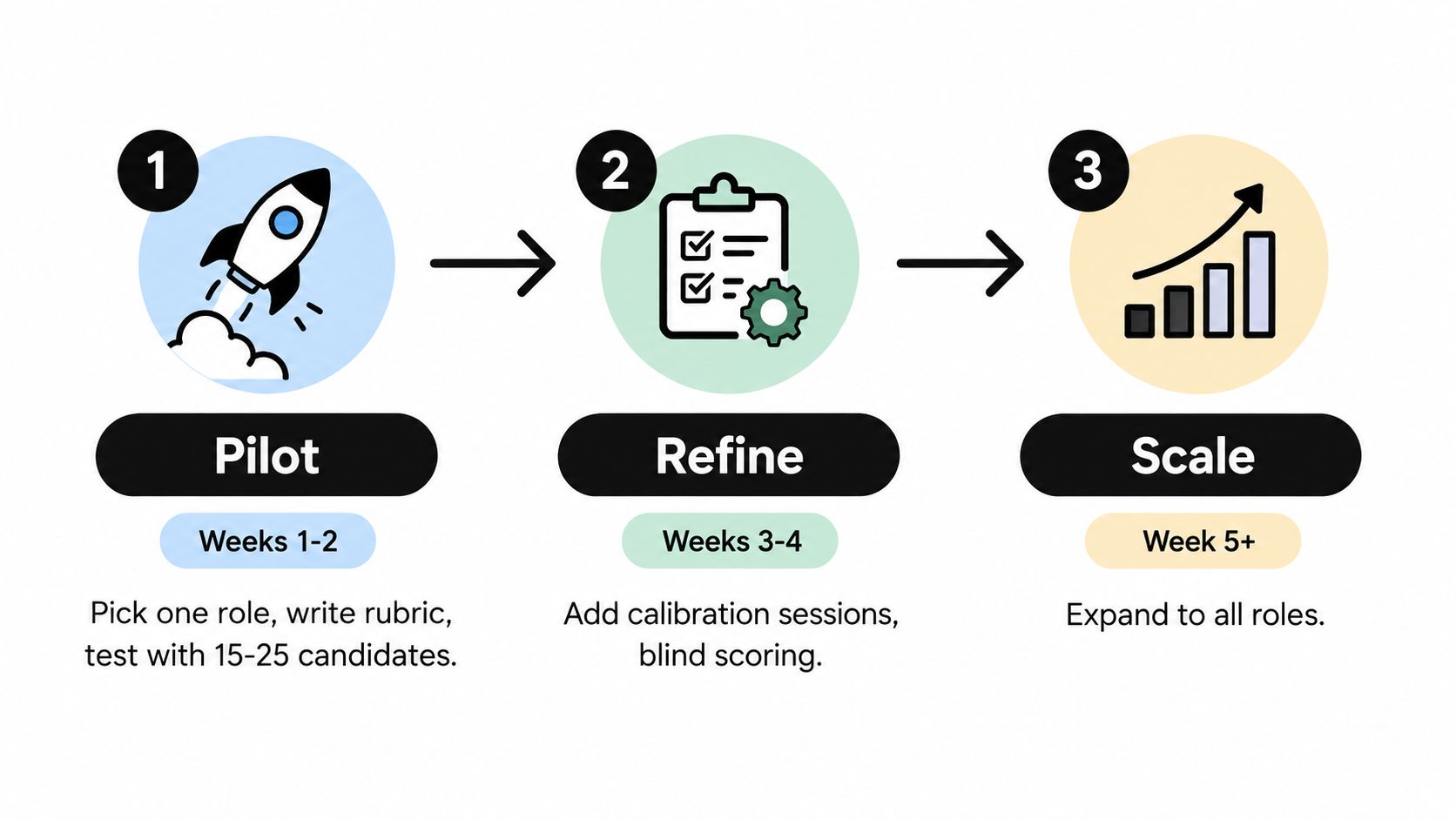
Roll out async interviewing as a controlled operating change. Don't deploy it across every role before you know whether candidates complete it, whether reviewers agree, and whether the next-stage pass rate reflects useful signal.
Weeks 1 to 2
Pick one role: Choose a repeatable position with a clear early-screen competency.
Write the rubric: Define the 1 to 4 scale, evidence requirements, and “do not infer” rules.
Pilot with 15 to 25 candidates: Keep the sample contained, and record completion issues rather than assuming they are candidate failures.
Assign owners: Recruiter owns communication, the hiring manager owns questions, and reviewers own independent scoring.
Measure completion: Track invitations, submissions, technical failures, support requests, and withdrawals.</li>
Weeks 3 to 4
Run calibration sessions: Have reviewers score the same sample and resolve interpretation differences.
Use blind first-minute reviews: Hide contextual details where feasible before reviewers score communication and role evidence.
Expand to a second role: Select a role with different requirements, such as an SDR position, to test whether the process is too engineering-specific.
Collect candidate feedback: Add a short candidate NPS question or equivalent experience measure, then read the written comments.
Fix friction first: Improve instructions, retakes, device support, and response times before adding AI features.</li>
Week 5 and beyond
Decide on AI assistance: Permit transcription or summaries only when reviewers can inspect the underlying response.
Integrate with the ATS: Store rubric scores, reviewer notes, consent records, and stage outcomes together.
Document escalation rules: Define when a candidate moves to live video, audio-only review, or recruiter support.
Review quarterly: Segment outcomes by device, connection issue, location, and completion behavior.
Retire weak questions: If a prompt produces vague or repetitive answers, replace it with a job-relevant scenario.</li>
Common questions
Is async fair across accents and home-office setups? It can be, but only when reviewers score content and reasoning rather than accent, eye contact, background, or camera polish. Provide clear prompts, device flexibility, captions, and an alternative channel.
Is AI scoring safe as a filter? Use AI for transcription, organization, and review support. Don't treat an opaque score as a standalone rejection mechanism. A human should inspect the evidence and override the system when the recording contains technical or accessibility problems.
When should we skip async? Skip it for senior IC and staff-plus roles when the first assessment depends on collaborative system design, influence, or strategic judgment. Skip it for closing-heavy enterprise AE roles when reading the room, adapting in real time, and handling live objections are central to success. Use live video or in-person assessment instead.
What about LATAM candidates with connectivity, English-confidence, or caregiving constraints? Keep a live-interview escape valve. A candidate shouldn't be penalized for choosing a different format when async creates a practical disadvantage.
GENTY recruitment supports structured IT and sales hiring across Latin America, including skill-first shortlists, RPO, fixed-fee recruitment, and talent intelligence for distributed teams. Visit GENTY recruitment to discuss an async screening design that fits your roles, reviewers, and nearshore hiring workflow.