
Your engineering team needs to hire quickly, but the internal recruiter is already managing open roles, interview scheduling, hiring-manager follow-ups, and reporting. That's where recruitment process outsourcing becomes useful. RPO is a service agreement in which an external provider manages all or part of recruiting, using its own people, technology, methods, and reporting, while your company keeps hiring approvals and compensation decisions in-house. It works best when hiring needs are repeatable, measurable, or likely to fluctuate.
For a Series A to Series C company, the practical question isn't whether an RPO provider can source candidates. It's whether the provider can operate a reliable hiring system, with clear handoffs, conversion targets, service levels, and accountability from intake through onboarding.
How Recruitment Process Outsourcing Works at a Glance
The answer to how does recruitment process outsourcing work is straightforward: you define the hiring scope, the provider builds a dedicated operating process, and both sides manage performance against agreed metrics. The provider may handle job intake, sourcing, screening, interview coordination, offer support, onboarding coordination, applicant-tracking records, and reporting. Your leaders still decide which roles to approve, which candidates to hire, and what compensation policy to apply.
RPO is different from sending a few difficult vacancies to an agency. It normally operates through a multi-month or multi-year agreement, with the provider functioning as an extension of your talent team. That structure gives a growing technology company a way to standardize recruiting without immediately adding permanent internal headcount. It also gives the business more capacity when hiring demand changes across engineering, product, sales, or customer operations.
Planning a hire?
Talk through the best hiring option
This article usually leads to one practical question: should you use rpo or it recruitment? We can help you choose quickly.
The market's scale reflects that broader role. Independent market research estimated the global RPO market at USD 7.33 billion in 2022 and projects USD 24.32 billion by 2030, representing a 16.1% CAGR in that forecast (Market.us RPO market analysis).
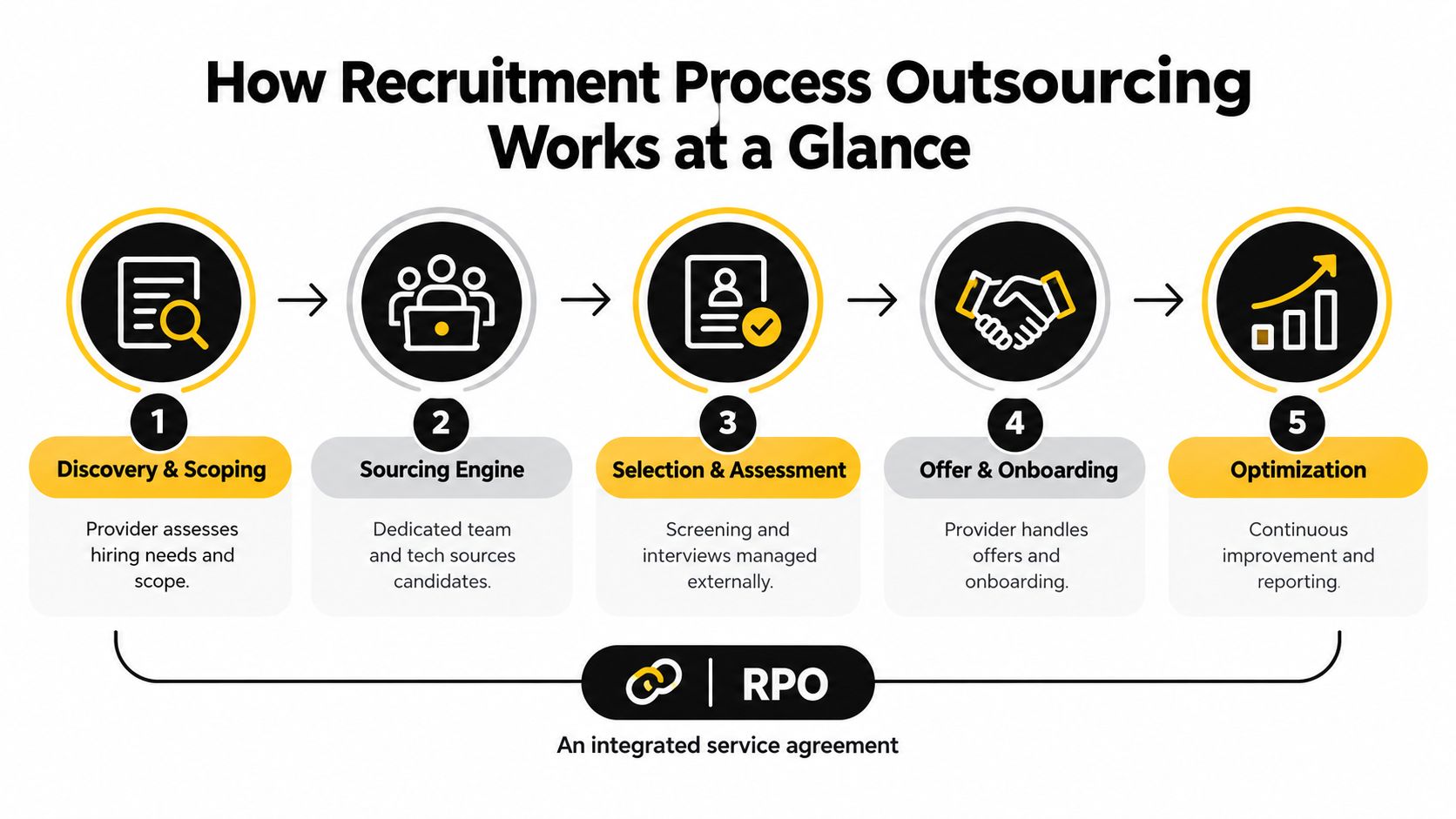
A sound program usually follows five connected activities:
Discovery and scoping, where the provider understands hiring demand, role families, geography, and decision rights.
Sourcing, using agreed channels, outreach methods, and recruiting technology.
Selection, including screening, assessments, interview coordination, and feedback control.
Offer and onboarding support, where the provider helps move accepted candidates into the business.
Optimization, using funnel data and stakeholder feedback to improve throughput and quality.</li>
For an overview of the operating model, see GENTY recruitment's RPO service. The important distinction is that RPO should be treated as a managed production system, not as outsourced resume collection.
RPO Engagement Models and When to Use Each
The right RPO scope depends on the shape of your hiring problem. A company opening a new engineering hub needs a different model from a company that has a capable internal talent team but lacks technical sourcing depth. Buying too much scope creates unnecessary cost and confusion. Buying too little leaves the bottleneck untouched.
Three practical scopes
End-to-end RPO transfers responsibility for most of the recruitment workflow. The provider can manage intake, sourcing, screening, interview logistics, offer coordination, reporting, and onboarding handoffs. This model suits organizations that need a repeatable talent acquisition function across several teams or markets.
Project-based RPO adds capacity for a defined hiring surge, product launch, geographic expansion, or hard-to-staff role family. The scope has a clear beginning and end, which limits long-term commitment while giving the company an operating team during a demanding period.
Hybrid or modular RPO outsources selected stages. You might keep hiring-manager interviews and final decisions internally while the provider owns sourcing, screening, or scheduling. This is often the lowest-risk option when the internal team has strong business partnership but weak top-of-funnel capacity.
Staffing and per-placement recruiting are transactional. The provider usually focuses on supplying people or filling specific roles, while the client retains ownership of the broader recruiting process. RPO instead uses a service agreement and operating metrics, making ownership, governance, and reporting part of the purchase. A practical comparison of adjacent models is available in this guide to recruitment outsourcing models.
Keep recruiting in-house when hiring volume is predictable, hiring managers are responsive, and your team already has reliable sourcing and reporting. Buy RPO when the process is inconsistent, demand is changing, or internal recruiters are spending too much time on coordination. Choose a blended model when you need additional capacity but don't want to surrender strategic control.
Inside the RPO Workflow From Scoping to Onboarding
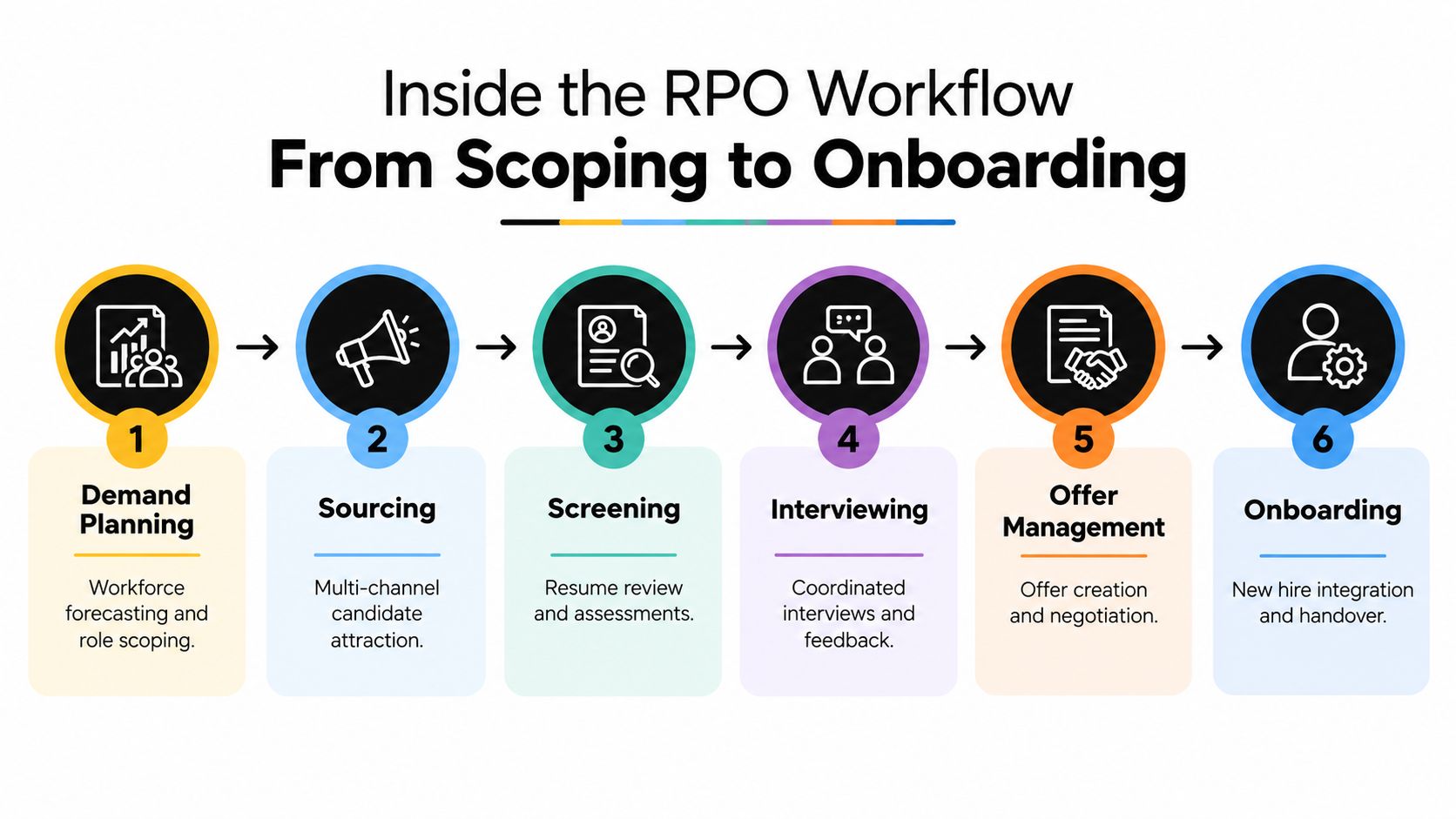
RPO works when each stage produces a usable output for the next stage. Demand planning informs requisition design. Requisition design informs sourcing. Screening criteria determine who reaches interviews, and interview feedback determines whether offers can move forward. If one handoff is unclear, the provider can generate activity without improving hiring results.
The setup period establishes the system
The provider starts by calibrating hiring demand with the client. That means confirming approved roles, expected hiring volume, job families, locations, required skills, interview ownership, and escalation paths. The team then designs requisition workflows, sourcing channels, screening criteria, interview cadence, and reporting routines.
A meaningful implementation normally needs 60 to 90 days before full recruiting throughput begins, because ATS integration, recruiter onboarding, hiring-manager calibration, compliance review, and channel setup must happen first (RPO Association implementation guidance). Treating this period as idle time is a mistake. It is when you decide how the production system will behave.
Practical rule: Align the scorecard, interview owners, and feedback SLA before the first sourcing campaign starts.
The live workflow depends on disciplined handoffs
Once a requisition is approved, the RPO team may draft or refine the job description, launch sourcing campaigns, search databases, conduct targeted outreach, and manage job advertising. Recruiters screen resumes and conduct initial assessments against the agreed scorecard. Where testing is appropriate, the provider coordinates it before the candidate reaches the hiring panel.
The provider then manages interview scheduling, candidate communication, feedback collection, background checks where included, offer preparation, and negotiation support. Your hiring manager still owns the technical judgment and final selection. The RPO team owns process control, candidate movement, documentation, and reporting.
The ATS should remain the shared source of truth. Every stage needs a defined owner, a required record, and an escalation route for stalled feedback. Teams improving an inconsistent process can also review this practical resource on how to improve your hiring process, particularly before configuring an outsourced workflow.
Onboarding completes the operational handoff. The provider may coordinate accepted-candidate communication, pre-employment steps, start-date information, and transfer to HR or people operations. The contract should specify where RPO responsibility ends, because onboarding coordination isn't the same as owning payroll, equipment, or employee integration.
SLAs Metrics and KPIs That Prove RPO Value
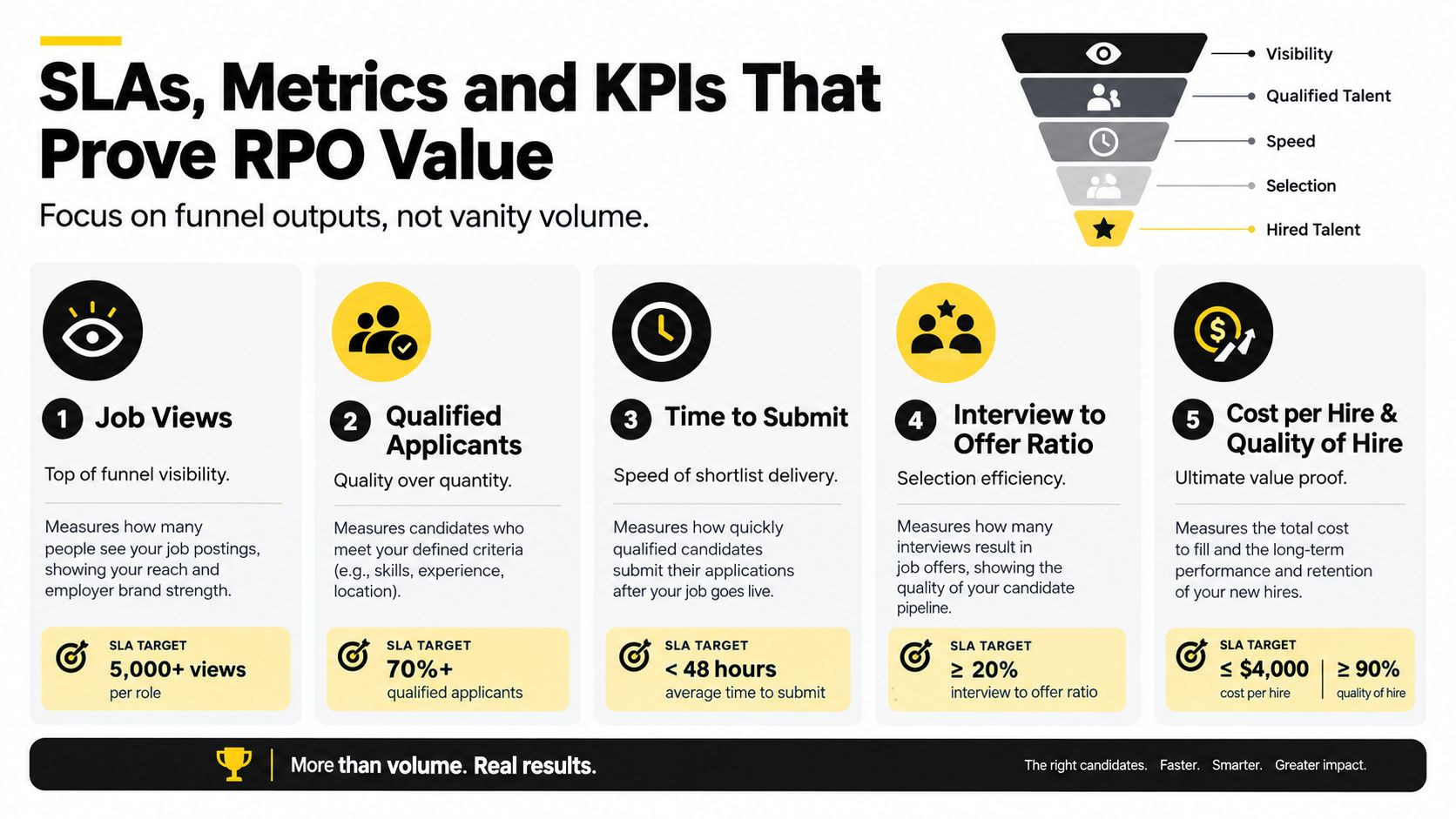
A growing company can receive plenty of resumes and still miss its hiring plan. RPO value shows up in the connection between speed, conversion, cost, and quality, not applicant volume alone. Treat the program as a managed production system: define the output, set the handoff standard, and review the economics of each funnel stage.
Service-level agreements should describe observable results and who owns each measure. Useful operating metrics include days-to-present, the time required to deliver qualified candidates to the hiring team, and days-to-accept, the period from requisition activity to an accepted offer. Add time-to-hire, cost-per-hire, candidate quality, diversity, and hiring-manager satisfaction so the provider cannot optimize one stage while weakening the rest.
Measure conversion across the funnel
A useful dashboard connects stages instead of presenting isolated totals:
Visibility: Track job views and applicants to see whether the role reaches the intended market.
Qualification: Track the CV-to-interview ratio and the share of applicants meeting the agreed scorecard.
Selection: Track the interview-to-offer ratio to expose weak screening or unclear interview standards.
Closing: Track the offer-to-acceptance ratio and days-to-accept. Slow decisions or poor offer alignment can erase strong sourcing work.
Business value: Track time-to-hire, cost-per-hire, candidate quality, diversity, and hiring-manager satisfaction.</li>
Benchmarks provide context, not automatic contractual targets. Published talent acquisition metrics place global time-to-hire commonly between 24 and 44 days and average cost-per-hire around $4,129. Executive hiring can reach $30,000 or more (RPO Association analytics guidance). For operational RPO programs, professional-role guidance commonly uses 30 to 60 days for time-to-fill, while 3 to 10 business day shortlist expectations suit simpler or highly standardized searches.
Evaluate recruiting cost ratio too: total recruiting cost divided by the total base compensation of hires. That measure captures the economics of the full process rather than comparing an RPO fee with one agency invoice.
Use a weekly dashboard for active requisitions and a monthly governance review for trends. If applicant volume rises while interview conversion, offer acceptance, or manager satisfaction falls, the system is producing activity without enough value. The time-to-fill metrics guide can support a more consistent measurement framework.
Pricing Integration and Working With Your RPO Partner
RPO pricing should match the uncertainty in your hiring plan. A fixed management fee gives you predictable operating cost and supports a dedicated team, but you may pay for capacity during a quiet period. A per-hire fee aligns payment with completed hires, yet it can encourage narrow focus on placements rather than process improvement. Hybrid pricing combines a management component with a delivery fee. Cost-plus pricing provides transparency around operating expenses but requires stronger financial governance.
Technology is changing delivery and increasing pricing pressure across North America, EMEA, and Asia-Pacific, while buyers are also seeing shifting pricing models as technology plays a larger role in RPO operations (Everest Group RPO market report). Ask providers which tools they will use, who owns the data, how ATS integration works, and whether automation supports recruiters or increases applicant volume.

Integration needs named owners
The RPO team should have a clear operating relationship with internal HR, talent acquisition, finance, legal, and hiring managers. Define who approves requisitions, who writes scorecards, who conducts technical interviews, who communicates offers, and who resolves candidate or compliance issues.
A practical cadence might include recruiter and hiring-manager check-ins for active roles, a weekly funnel review, and a monthly leadership meeting focused on SLA performance and forecast changes. The cadence matters less than the decision rights. A meeting without an owner and an escalation rule won't fix stalled feedback.
Forecasting deserves special attention. In a 2025 RPO trends report, 56% of employers reported difficulty accurately forecasting hiring requirements, while 50% were considering switching providers or bringing recruitment back in-house within 1 to 2 years. Cost ranked as the leading reason, followed by concerns about hiring speed and quality (2025 RPO trends report).
Your contract should therefore address volume changes, role-mix changes, ramp-up and ramp-down rules, data ownership, transition support, and exit clauses. A nearshore team in LATAM can help a US or European company expand recruiting coverage with closer time-zone collaboration, but the same governance requirements still apply. If you're evaluating external delivery options, review GENTY recruitment pricing alongside the service scope, not as a standalone fee comparison.
Best Practices and Checklist for RPO Success
An RPO works as a managed production system only when its outputs, handoffs, and failure points are explicit. Internal leaders retain hiring standards and business judgment, while the provider owns agreed delivery work.
Use this checklist before signing:
Define the boundary: Specify covered roles, geographies, stages, systems, and decisions.
Contract outputs: Set targets for days-to-present, days-to-accept, funnel conversion, quality, cost reporting, and hiring-manager satisfaction.
Fund implementation: Treat the 60 to 90 day setup as a delivery phase, with milestones for ATS integration, scorecards, recruiter training, and compliance.
Assign governance owners: Name the executive sponsor, operational lead, hiring-manager representatives, and escalation contacts.
Test adoption: Require agreed scorecards, feedback deadlines, interview structures, and candidate communication standards.
Plan flexibility: Document changes for hiring volume, role mix, and geographic priorities.
Protect the exit: Define data access, candidate ownership, knowledge transfer, transition support, and termination terms.
Review decision inputs: Use Talent Intelligence and salary benchmarking to test role requirements, market availability, and compensation assumptions. A recruitment process checklist for hiring remote LATAM talent can structure this review.</li>
Keep the initial scope narrow enough to manage during setup, then expand after handoffs and SLA performance are proven. Poor integration, excessive process complexity, and weak hiring-manager adoption can cause RPO engagements to fail within 18 to 24 months, according to industry commentary. Build contract terms around the operating risk, not only the recruiting activities.
GENTY recruitment provides RPO and end-to-end technical recruiting support across LATAM, including intake, sourcing, screening, interview coordination, offer support, reporting, and onboarding coordination. Visit GENTY recruitment to discuss scope, SLAs, and the operating model.