
A mid-level software engineer hired through Latin America typically costs several thousand dollars per month in all-in employer spending once salary, non-wage costs, and payroll or employer-of-record fees are included. The two biggest levers are which country we hire in and which hiring model we use (direct entity, contractor, or employer-of-record). Before extending an offer, we recommend running the budgeting checklist below or requesting a salary benchmark from a specialized LATAM recruitment agency.
TL;DR:
The IDB projects nonwage costs at 51.6% of wages in 2025, including 28.7% for mandatory employer contributions alone, before provider or recruitment fees.
Argentina and Brazil carry nonwage costs near 70%, while Mexico and Colombia generally stay below 40%; Argentina’s inflation makes annual salary budgets unrealistic.
An employer of record can start hires within days, charging 10% to 15% of salary; local entity setup takes two to six months.
Add a 10% to 15% contingency to multiyear forecasts, and review currency exposure monthly because exchange rates and inflation can shift dollar costs.
Use contractors for short term projects, but avoid employment like arrangements; direct entities may become cost effective once a country team reaches 20 hires.
Breaking Down Total Employment Cost: Salary, Non-Wage Costs, and Overhead
Base salary is only the starting line. Employer total cost follows a straightforward formula: base salary, plus non-wage costs (NWC) as a percentage of that salary, plus provider or recruitment fees, plus one-off and recurring overhead. Skipping any one of these components is the most common reason budgets fall apart mid-year.
Non-wage costs are the largest hidden variable. The Inter-American Development Bank projects the regional average non-wage cost at roughly 51.6% of wages in 2025, meaning an employee earning $2,000 a month in base salary can cost an employer closer to $3,032 before any recruitment or payroll fees are added. These costs break down into mandatory social security contributions, legally required benefits like paid vacation and bonuses, and severance provisions that vary sharply by country.
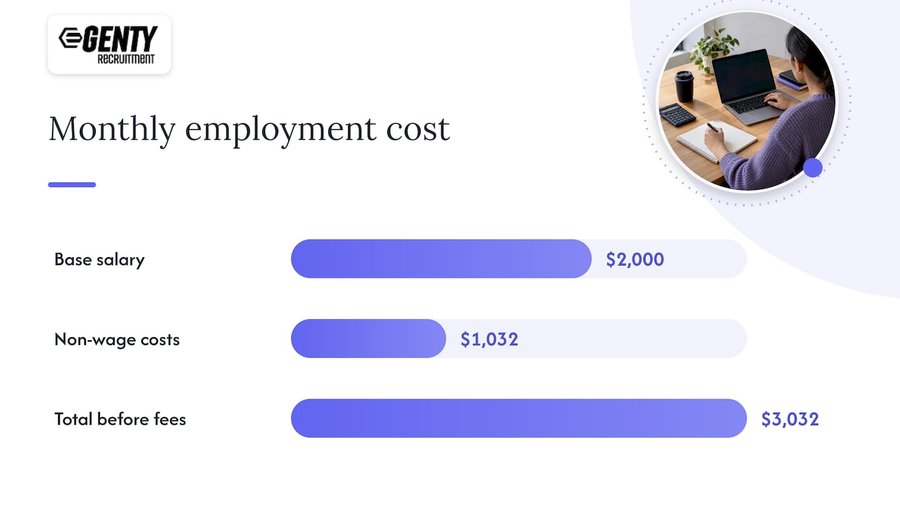
The IDB’s data show mandatory contributions alone account for about 28.7% of wages regionally, making employer social security the single largest line item in most LatAm payroll budgets, according to the IDB’s ten-year update on salaried labor costs.
What do you need?
Choose the hiring path that fits
After reading "US Tech Employers Hiring in Latin America Pay 51.6% Above Salary", most teams compare these options before deciding how to hire.
Beyond salary and statutory costs, two categories of spending round out a realistic budget:
- One-off costs: recruiting fees, laptop and equipment procurement, relocation or home-office stipends, and initial legal setup if hiring through a local entity.
- Recurring overhead: payroll provider or EOR management fees, a currency fluctuation buffer, and ongoing compliance monitoring as local labor law changes.
Finance teams that model only base salary routinely underbudget LatAm hires by 40% to 60%. Building NWC and overhead into the initial offer calculation, rather than discovering it on the first payroll run, keeps hiring plans credible with the board and with the hiring manager waiting on headcount.
Salary Bands and Non-Wage Costs in Argentina, Brazil, Mexico, and Colombia
Base salary ranges vary significantly across the four largest LatAm tech talent markets, and so does the non-wage cost layered on top of them. Argentina and Brazil carry the highest statutory burden, with IDB data placing both countries near 70% NWC, while Mexico and Colombia sit meaningfully lower, generally under 40%.
A few country-specific quirks shape how these numbers play out in practice:
- Argentina: Persistent inflation means salaries are frequently renegotiated or indexed; budgeting a single annual figure without a review clause is unrealistic.
- Brazil: The high NWC reflects mandatory benefits like the 13th salary and FGTS severance fund contributions, both fixed regardless of performance.
- Mexico: Lower statutory costs make it one of the more predictable markets for budgeting, though the IDB notes Mexico’s minimum cost of salaried labor is relatively low compared to GDP per worker, a sign of strong cost efficiency relative to productivity.
- Colombia: Base salaries trend slightly below Mexico’s at comparable seniority, with similarly moderate non-wage costs.
These bands are starting points for budget conversations, not finished offers. Role scope, specific tech stack (AI, Web3, and FinTech talent commands a premium in all four markets), and company stage will shift the actual number up or down within each band.
How Direct Hire, Contractor, and EOR Routes Change the Bill
The hiring model we choose changes the total cost structure as much as the country does. Each route carries a different mix of speed, compliance exposure, and recurring fees.
- Direct hire through a local entity: This route means absorbing the full employer NWC (social security, benefits, severance) directly, plus the legal cost of registering and maintaining a local entity. Setup can take two to six months depending on the country, making it impractical for companies that need to hire quickly.
- Independent contractor: Classifying a worker as a contractor avoids NWC and entity setup entirely, which can make it the lowest-cost option for short-term projects or proof-of-concept work. Misclassification risk is real, though, and several LatAm countries actively audit long-term contractor relationships that function like employment.
- Employer-of-record (EOR): An EOR handles local compliance, payroll, and benefits on our behalf for a monthly fee that often ranges from several hundred dollars up to around 10 to 15 percent of salary, depending on the provider and country. This route trades a management fee for speed, since hires can often start within days rather than months.
Recruitment fees sit on top of whichever employment model we choose.
Pro Tip: Run the math on a percentage fee against a fixed fee before signing with any agency. At senior engineer salary levels, a flat fee almost always wins.
Why Identical Roles Cost Different Amounts Across Countries
Three forces explain most of the price dispersion between countries for the same job title: labor law, macroeconomic conditions, and talent scarcity.
Legal drivers set the floor. Employer social security rates and severance formulas are fixed by statute, so a country like Argentina or Brazil will always carry a heavier NWC load than Mexico or Colombia regardless of how competitive the local job market is. The IDB’s blog analysis puts the regional average at employers paying roughly 50% more in non-wage costs than base wages, a gap wide enough to push some employers toward informal hiring arrangements, which the IDB flags as a policy concern but which carries real compliance risk for foreign employers.
Macroeconomic drivers add a second layer. Inflation in markets like Argentina can erode a fixed-dollar offer’s local purchasing power within months, so salary reviews there often happen twice a year rather than annually. Currency risk cuts both ways: a weakening local currency can lower our effective dollar cost, but it also pressures employees to request raises to maintain real income.
Market drivers compound everything at the senior level. Scarcity of experienced engineers in AI, Web3, and FinTech niches pushes senior salary bands up disproportionately compared to junior roles, since the supply of candidates with five-plus years of relevant experience is thin relative to demand. A company competing for the same senior Brazilian backend engineer as three other funded startups will pay closer to the top of the band regardless of what the median suggests.
- Build a 10% to 15% contingency into any multi-year LatAm salary forecast to absorb inflation and currency shifts.
- Expect senior-level offers to cluster near the top of published ranges in competitive tech hubs like São Paulo, Buenos Aires, and Mexico City.
Budgeting Checklist and a Worked Example for Total Monthly Cost
Use this checklist to turn a base salary offer into a defensible all-in number before it reaches finance for approval.
- Confirm the base salary band for the role, country, and seniority level.
- Apply the country-specific NWC percentage to get the loaded salary cost.
- Add recruitment fees (fixed or percentage) as a one-off line item.
- Add recurring EOR or payroll provider fees if applicable.
- Add a currency and inflation buffer of 10% to 15% for multi-year planning.
- Round up, not down, when the final number informs a hiring freeze or headcount cap decision.
The gap between these two countries, roughly $740 a month for an identical role, comes almost entirely from the NWC difference, not the base salary itself. That is the single clearest argument for checking country-level non-wage costs before comparing base salaries alone.
How We Benchmark Salaries and Deliver Vetted Hires
We build salary benchmarks by combining current market data, feedback from completed placements, and employer cost modeling that accounts for NWC, provider fees, and overhead specific to each country. Specialization in IT and sales recruitment across Latin America helps ensure benchmarks reflect what companies are actually paying for FinTech, AI, SaaS, and Web3 roles today, rather than generic regional averages.
Our process includes fixed-fee pricing per seniority level, with no upfront payment required before sourcing, delivery of curated shortlists within a week built from thoroughly vetted candidates matched to the specific tech stack, replacement guarantees for hires, and dedicated recruiters per vertical to ensure specialization.
Direct Employment vs. Outsourcing Agencies Beyond EOR
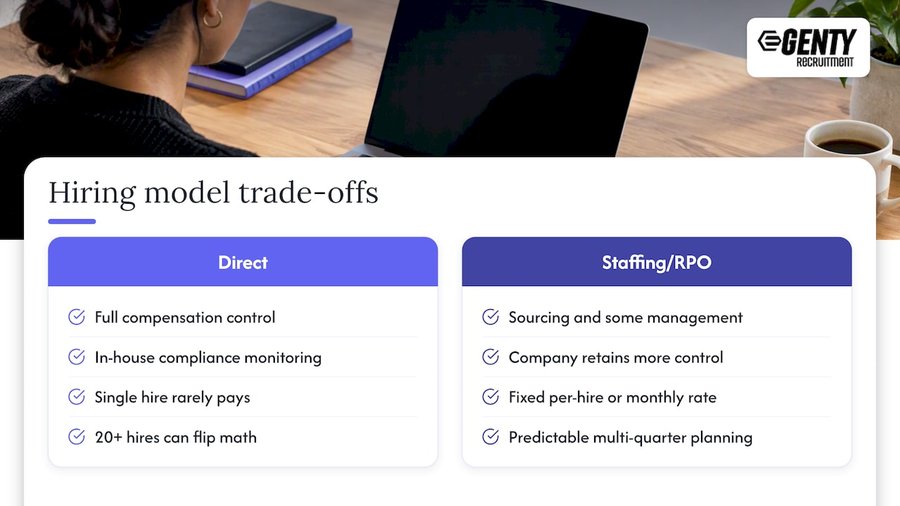
EOR services are not the only outsourcing route available, and the cost comparison against direct employment looks different depending on which model we pick. Staffing agencies and recruitment process outsourcing (RPO) providers offer a middle path: rather than becoming the legal employer of record, they handle sourcing and sometimes ongoing management while the hiring company retains more direct control over the working relationship than a pure EOR arrangement allows.
Direct employment through a wholly owned local entity gives full control over compensation structure and culture but requires absorbing every NWC line item, legal setup cost, and ongoing compliance monitoring in-house. For a single hire, this almost never pencils out financially. For a team of 20 or more in one country, the math often flips, since the fixed cost of entity setup gets spread across more salaries.
Staffing and RPO models, including ours, typically charge either a fixed per-hire fee or a monthly per-employee staffing rate rather than a percentage of salary that scales with compensation. That structure tends to be more predictable for finance teams building multi-quarter hiring plans, particularly compared to percentage-based agencies whose fees rise in lockstep with the seniority and cost of the role being filled.
For companies evaluating internal tooling to manage multiple recruitment pipelines across countries, resources like this comparison of project management tools for recruitment agencies can help operations teams keep candidate tracking organized across time zones.
The Real Cost of Employee Turnover in Latin America
Turnover costs more than the obvious recruiting fee for a replacement. Every departure triggers a new sourcing cycle, a productivity gap while the role sits open, onboarding time for the replacement, and in several LatAm countries, statutory severance payments that add directly to the cost of the departure itself.
Severance obligations vary by country and tenure, but they are rarely trivial. Brazil’s FGTS severance fund, for instance, requires ongoing employer contributions throughout employment that become payable on termination, meaning turnover cost is partly baked in from day one rather than appearing only at exit. Argentina applies similar severance logic tied to years of service and final salary.
The practical takeaway for budgeting: a role with high expected turnover, often junior positions or roles in highly competitive talent pools like senior AI engineering, should carry a higher effective cost estimate than the base salary and NWC alone suggest. Building a retention-focused onboarding process and competitive compensation review cadence tends to cost less than repeated severance and re-recruitment cycles over a two-year period.
Currency Fluctuation and What It Means for Your Hiring Budget
Paying salaries in local currency while budgeting in U.S. dollars or euros introduces a variable that many first-time LatAm employers underestimate. A local currency that weakens against the dollar can lower our effective cost, but a currency that strengthens, or a country experiencing high inflation that triggers frequent local salary increases, can erode the savings we originally budgeted for.
Argentina is the clearest example of this volatility, where high inflation regularly pushes local employers toward salary reviews every six months rather than annually, as referenced in the IDB’s cost analysis. Brazil, Mexico, and Colombia tend to see more gradual currency movement, making annual budget reviews more workable in those markets.
One practical response is to negotiate payroll or EOR contracts with a locked exchange rate or review clause, so a sudden currency swing does not silently inflate the monthly invoice between budget reviews. Companies managing multiple LatAm hires across different currencies benefit from reviewing total cost in dollar terms monthly rather than relying on the local-currency figure alone.
When Latin America Is the Right Strategic Hiring Move
Savings shrink fastest at the senior and executive level, where global demand compresses the gap. Timezone overlap with U.S. Eastern and Pacific hours is a genuine operational advantage, letting teams run daily standups and live collaboration without the handoff delays common in offshore arrangements. Our recommendation: pilot uncertain roles or short-term projects with contractors, and reserve permanent hires for roles central to the product roadmap.
— Eugene
How to Work With GENTY Recruitment on Your Next LatAm Hire
Whether the goal is a single mid-level engineer in Mexico or a full sales team in Colombia, we offer the pieces this article has walked through: salary benchmarking built on real market and placement data, fixed-fee IT recruitment for engineering and data roles, and sales recruitment for revenue teams, all delivered with curated shortlists within 7 days and no upfront payment.
- Request a salary benchmarking report before finalizing your next headcount budget.
- Book a call to discuss fixed-fee recruitment or staffing for your specific country and role.
Start at our GENTY recruitment homepage to see current services and get a benchmark tailored to your hiring plan.
FAQ
What is the average cost of hiring a software engineer in Latin America?
A mid-level software engineer typically costs between $4,250 and $4,990 a month in total employer spending once salary, non-wage costs, and provider fees are included, depending on the country. Argentina and Brazil run higher due to non-wage costs near 70% of salary, while Mexico and Colombia stay below 40%, according to IDB data.
How much do non-wage labor costs add to a LatAm hire?
Non-wage costs add a projected regional average of about 51.6% of base salary in 2025, covering social security, mandatory benefits, and severance provisions. The IDB’s ten-year update notes this figure reaches roughly 70% in Argentina, Brazil, and Peru, and stays under 40% in lower-cost markets.
Is an employer-of-record or direct hire cheaper for LatAm talent?
An EOR usually costs more per hire in management fees but saves months of entity setup time and shifts compliance risk away from the hiring company. Direct hire can be cheaper at scale, generally once a company has enough hires in one country to justify the legal setup cost, as outlined in BDO’s LATAM payroll guide.
How does GENTY recruitment price its hiring services?
Our fixed-fee recruitment starts from $2999 per hire, with staffing available from $99 per month per employee, and pricing is transparent before any work begins. Executive search and salary benchmarking pricing is available on request through our GENTY recruitment homepage.
Why does timezone overlap matter for LatAm hiring costs?
Timezone alignment with U.S. Eastern and Pacific hours reduces coordination delays and lets distributed teams run live meetings without the multi-hour handoff gaps common with offshore hiring. This overlap is one of the practical reasons nearshore hiring in countries like Mexico, Colombia, Brazil, and Argentina often delivers better day-to-day collaboration than hiring farther offshore.
Sources
- Salaried labor costs in Latin America and the Caribbean: A ten-year update
- Tables and figures for: Measuring the cost of salaried labor in Latin America and the Caribbean
- Why formal hiring costs so much in Latin America and what can be done about it
- LATAM payroll guide by BDO