

Even the most technically brilliant founders often find themselves stuck when it comes to building a high-performing remote engineering team. The global talent pool is wide, but navigating it efficiently while managing product, investors, and customers simultaneously is a genuine challenge that costs startups time and money they can’t afford to lose. Recruiters who specialize in remote tech hiring, particularly across Latin America, bring a layer of strategic value that many founders only discover after a costly hiring mistake. This guide breaks down exactly what expert recruiters do, when to use them, and why their impact goes well beyond filling open roles.
Table of Contents
- How recruiters partner with tech startups
- Balancing founder-led hiring vs. recruiter expertise
- How recruiters optimize candidate selection and fit
- The impact of AI and technology on recruiter workflows
- Why most startups misjudge the recruiter’s ROI
- Scale your tech team faster with expert recruiters
- Frequently asked questions
Key Takeaways
How recruiters partner with tech startups
Hiring top remote tech talent requires far more than posting a job description and waiting for applications. For startups targeting Latin American talent markets, particularly in Argentina, Brazil, Mexico, and Colombia, the process involves understanding local compensation norms, language dynamics, time zone logistics, and the technical expectations of candidates who want to work with globally ambitious teams. This is where recruiters step in as high-leverage partners, not just as intermediaries.
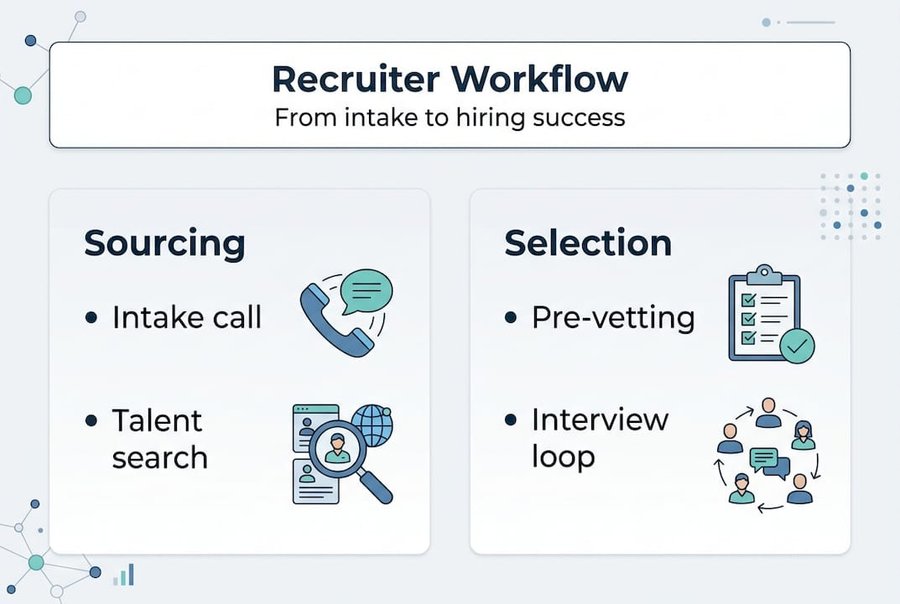
The recruiter’s involvement typically starts with a structured intake call. During this session, the recruiter works with the founder or hiring manager to define not just the technical requirements of the role, but also the cultural expectations, team dynamics, communication style, and growth trajectory the company offers. This clarity matters enormously because job descriptions that work for US-based candidates often fail to attract or excite high-caliber Latin American engineers. Recruiters who know these markets craft role postings that speak directly to what remote LATAM candidates value: professional development, team culture, meaningful work, and competitive compensation benchmarked against the local market.
Once the intake is complete, recruiters move into pipeline-building. They leverage their existing networks, sourcing tools, and regional expertise to identify candidates who are not actively job-hunting but are open to the right opportunity. This passive sourcing is a key differentiator, since the best engineers are rarely browsing job boards. Recruiters then run initial screening conversations to assess English proficiency, technical baseline, and cultural fit before a single hour of a founder’s time is spent.
What do you need?
Choose the hiring path that fits
After reading "How recruiters unlock growth for tech startups", most teams compare these options before deciding how to hire.
As technical sourcing partners, recruiters also manage interview loops limited to three rounds, handling scheduling, feedback coordination, and candidate communication throughout. This limit is intentional. Long, multi-stage interview processes are one of the top reasons strong candidates drop out before receiving an offer.
Beyond scheduling, recruiters handle offer negotiations and provide real-time market data on salaries and trends across LATAM tech markets. This intel is often unavailable to founders who are hiring in a region for the first time. Some of the most common missteps recruiters help avoid include:
- Underbidding on compensation due to unfamiliarity with local market rates
- Overloading candidates with redundant interview stages
- Writing job descriptions that emphasize US-centric culture without addressing remote flexibility
- Failing to account for local public holidays and legal employment considerations
- Losing candidates to faster-moving competitors during slow internal approval processes
The impact of HR tech on recruitment has also expanded what recruiters can do operationally, allowing them to manage larger pipelines with greater accuracy and speed. Still, the strategic guidance they offer in shaping a startup’s talent approach remains deeply human and deeply valuable.
“A great recruiter doesn’t just fill roles. They help you define what you actually need, then find someone who fits both the job and the team in ways a job posting alone never could.”
Balancing founder-led hiring vs. recruiter expertise
Understanding recruiters’ strategic functions makes it important to know when founders should lead and when recruiters should take charge. The answer isn’t binary. It depends on the role, the growth stage of the company, and the volume of hiring required.
Founders and CTOs bring something recruiters simply cannot replicate: authentic enthusiasm for the company’s mission. For senior hires, such as a VP of Engineering or a Head of Product, the founder’s ability to articulate vision, equity potential, and long-term company direction is genuinely compelling. Founders who lead senior hiring via technical outreach on LinkedIn can see 70 to 80 percent response rates when the message is personal and technically credible. That’s a powerful advantage for roles where cultural alignment and senior buy-in are critical.
However, when a startup needs to scale a team quickly, filling five to ten roles across multiple functions in a short window, founder-led hiring becomes a bottleneck. Recruiters, by contrast, are built for volume. They manage simultaneous pipelines across multiple roles, keep candidates engaged throughout longer processes, and bring pre-screened shortlists to the table so that founders only meet the candidates who are already qualified.
Here’s a practical comparison of both approaches:
A hybrid model works best for most fast-moving startups. The founder closes the senior hires after a recruiter has sourced and screened finalists, and the recruiter independently fills junior and intermediate roles with minimal founder involvement beyond a final interview. Staying current on 2025 and 2026 tech recruitment trends helps founders make smarter decisions about how to allocate their own time in the hiring process.
Here’s how a well-structured hybrid hiring model typically works:
- Define role tiers and decide which require founder involvement at the outset
- Let recruiters lead sourcing, screening, and first-round interviews for all roles
- Founders join the process at the final stage for senior positions only
- Recruiters manage scheduling, offer logistics, and negotiation across all tiers
- Review recruiter performance and pipeline health monthly to adjust strategy
Pro Tip: If you’re spending more than four hours a week personally sourcing candidates, it’s a signal that a recruiter can take that work off your plate and do it better, faster, and at greater scale.
How recruiters optimize candidate selection and fit
Having compared founder-led with recruiter-led approaches, let’s dig into how recruiters sharpen candidate selection for remote tech roles. The pre-vetting process is where the real value becomes visible, because it’s the step that most internal hiring processes skip or rush.
For startups hiring remotely across Latin America, candidate selection must account for technical skills, English communication level, time zone availability, and the specific collaboration style of the existing team. A candidate who is technically excellent but struggles to communicate asynchronously in English will create friction in a distributed team, even if their code is strong. Recruiters who specialize in LATAM markets assess all of these dimensions before presenting a candidate to the client.
The pre-vetting process typically includes an initial recruiter screen covering English proficiency and communication, a technical assessment tailored to the role’s stack and seniority level, a structured behavioral interview to evaluate team fit and remote work readiness, a reference check for candidates at the senior level, and a final recruiter review before the candidate reaches the client’s interview stage.

Here’s how this compares to a direct hiring approach:
The use of automation in recruitment has made it possible for recruiters to handle larger volumes without sacrificing quality in early screening stages. Automated scheduling tools, AI-assisted resume parsing, and structured assessment platforms all contribute to a faster, more consistent pre-vetting process.
What automation cannot replace, however, is the recruiter’s ability to read between the lines during a live conversation, to notice when a candidate is underselling their experience, or to sense that someone who looks perfect on paper might not thrive in a startup’s fast-moving environment.
Pro Tip: Keeping interview loops to three rounds or fewer isn’t just a courtesy to candidates. Research consistently shows that longer processes correlate with higher candidate withdrawal rates, meaning the best people leave before you can close them.
The impact of AI and technology on recruiter workflows
Modern hiring is increasingly tech-driven, so let’s analyze how AI platforms are changing the recruiter’s role without making them obsolete. The honest answer is that AI has made recruiters more efficient, but it has not replaced the skills that make a great recruiter valuable in the first place.
AI tools now assist with sourcing by scanning databases and social platforms to identify candidates who match a technical profile. They automate scheduling by integrating with calendars to eliminate the back-and-forth of interview coordination. They parse resumes and rank candidates based on keyword and skills matching, and they can generate initial outreach messages personalized to a candidate’s background. These capabilities are genuinely useful, and AI augmentation can save recruiters around 20% of their working time, time that is then reinvested into higher-value activities like candidate relationship management and client strategy.
For startups hiring in FinTech, AI, and SaaS, where the talent market is competitive and candidates have multiple options at any given moment, that reinvestment matters. A recruiter who isn’t spending three hours a day on calendar coordination has three more hours to build relationships with passive candidates, coach hiring managers on what a strong offer looks like, and stay current on compensation benchmarks in markets like Buenos Aires, São Paulo, and Bogotá.
The advantages AI brings to recruiter workflows include:
- Faster sourcing across multiple platforms simultaneously
- Consistent scoring of technical assessments without bias from reviewing fatigue
- Automated follow-up sequences that keep candidates engaged during longer processes
- Real-time salary data aggregation across LATAM markets
- Structured interview guides generated from role specifications
What AI cannot do is evaluate the nuance of a conversation. It cannot tell whether a candidate’s enthusiasm is genuine, whether their communication style will work in a specific team culture, or whether they have the resilience to thrive in a startup environment where priorities shift weekly.
“AI doesn’t replace the value of human connection in tech hiring. It amplifies what skilled recruiters can do, but the judgment call on whether someone is right for your team is still a deeply human one.”
This balance is especially important in fields like AI development and FinTech, where technical skills evolve rapidly and the fit between a candidate’s learning orientation and the company’s technical trajectory is often more predictive of success than current skills alone. The recruiters who leverage AI for recruitment efficiency while maintaining strong candidate relationships are the ones consistently delivering high-quality hires in competitive markets.
Why most startups misjudge the recruiter’s ROI
Here’s a perspective shaped by working closely with high-growth startups that have both succeeded and stumbled in their remote hiring efforts. The most common mistake founders make is treating recruiters as an expense rather than an investment, bringing them in only after weeks of failed direct sourcing, or using them exclusively for volume roles while mishandling their most critical senior hires.
The short-term cost of a recruitment fee feels concrete. The long-term cost of a bad hire or a six-month engineering vacancy does not, until it shows up in missed product deadlines, degraded team morale, or a competitor pulling ahead. A well-placed senior engineer from Argentina or Colombia, hired in eight weeks instead of twenty-four, generates a return that dwarfs any fee paid to place them.
The real leverage comes from combining the founder’s vision with the recruiter’s process, networks, and regional expertise. Recruiters who understand LATAM remote hiring advantages can open doors that founders operating from New York or Berlin simply cannot find on their own. They know which cities produce the strongest React or Python engineers, which universities are graduating the most capable data science talent, and which candidates in their network are genuinely ready for a global team.
Pro Tip: Instead of evaluating a recruiter by their fee, evaluate them by the quality and speed of their shortlists. A recruiter who delivers four excellent candidates in two weeks is worth far more than one who delivers twenty mediocre ones in six.
Scale your tech team faster with expert recruiters
If you’re ready to unlock the value of expert tech recruiters, here’s where to get started.
GENTY Recruitment specializes in placing pre-vetted IT and executive talent from Latin America, helping US and European startups scale their engineering, product, and data teams with precision and speed. Whether you’re building a FinTech platform, an AI-powered SaaS product, or a distributed engineering function, the right hire from the right market can change your trajectory.
From faster IT recruitment in LATAM to executive search across Latin America, GENTY provides end-to-end hiring support tailored to your growth stage and technical requirements. For teams that need data before decisions, LATAM salary benchmarking gives you the compensation intelligence to compete for top candidates without guessing. Reach out to discuss how a focused recruiting partnership can get your next hire placed faster and smarter.
Frequently asked questions
What are the main benefits of working with a tech recruiter for remote LATAM talent?
Tech recruiters handle sourcing, vetting, and negotiation end to end, providing founders with pre-qualified shortlists and market-calibrated salary insights so hiring decisions are faster and better informed.
How does AI help but not replace human tech recruiters?
AI accelerates sourcing and scheduling, but it can’t evaluate cultural alignment or communication nuance. Human judgment remains essential for assessing whether a candidate will thrive in a specific team environment.
When should founders directly lead tech hiring and when use a recruiter?
Founders are most effective for senior, vision-driven roles where personal conviction closes candidates, while recruiters excel at scaling junior and intermediate pipelines quickly and consistently.
How do recruiters adapt hiring strategies for Latin American tech markets?
Expert recruiters localize job descriptions, apply region-specific salary and compensation benchmarks, and tailor interview processes to fit the communication norms and career expectations of candidates across Argentina, Brazil, Mexico, and Colombia.