

Nearshore outsourcing, hiring pre-vetted LATAM engineers as direct employees or dedicated team members, is the right route for most U.S. and European teams that need real-time collaboration and senior technical talent without paying full U.S. headcount costs. The justification is straightforward: Argentina, Brazil, Colombia, and Mexico all offer full or near-full workday overlap with EST and PST, and nearshore engineers typically cost 40% to 60% less than an equivalent fully loaded U.S. hire.
It fits best when:
- You need synchronous standups, pairing sessions, and same-day incident response.
- You’re hiring senior cloud, DevOps, or data roles where the local talent pool is either thin or expensive.
- You want to scale a team in weeks, not the months a from-scratch local recruiting operation would take.
It’s a weaker fit when you need a single short-term deliverable handled end-to-end by an outside firm, when your budget mandate is lowest-cost-only regardless of skill depth, or when the role requires daily in-person, on-site work.
Key Takeaways
Nearshore outsourcing works best when timezone overlap, senior technical depth, and fixed-fee cost predictability all matter more than the lowest possible sticker price.
What Is Nearshore Outsourcing, Exactly?
Nearshore outsourcing, in the context this article covers, means recruiting pre-vetted software engineers, DevOps specialists, data professionals, and sales talent from Latin America to join your company as remote employees or as a dedicated team under your direction. It is not the same as contracting a business process outsourcer (BPO) to deliver a packaged service. The distinction matters because a BPO owns the process and the output; nearshore hiring means you own the roadmap, the standups, and the code, and the LATAM professional works inside your team the same way a U.S.-based hire would.
Before you start hiring
Check location, salary, and hiring fit
If you are moving from research to action, start with the market basics so your hiring plan is clearer.
Certain signals should push a CTO toward this model specifically:
- You need meaningful timezone overlap with EST or PST so daily collaboration doesn’t wait for a handoff.
- You’re trying to fill senior cloud, DevOps, or data engineering seats where U.S. supply is tight.
- You want to cut fully loaded headcount cost by roughly 30% to 50% without downgrading seniority.
- You need to add three, five, or ten engineers in a quarter, faster than building an in-house LATAM recruiting function allows.
GENTY recruitment sources across Argentina, Brazil, Mexico, and Colombia, four markets that between them cover most of the skill and cost combinations a growing engineering org needs.
What Do Nearshore LATAM Hires Actually Cost vs. U.S. Talent?
Timezone overlap is the advantage that shows up daily. Many LATAM markets sit in GMT-3 to GMT-6, which means engineers there share close to the full U.S. workday with EST and PST teams. No waiting until tomorrow for a code review, no async-only standups. Add business-fluent English, a deep bench of senior cloud and full-stack talent, and lower fully loaded costs, and the combination is hard to match through domestic hiring alone.

The numbers vary by country and role, but the pattern holds consistently:
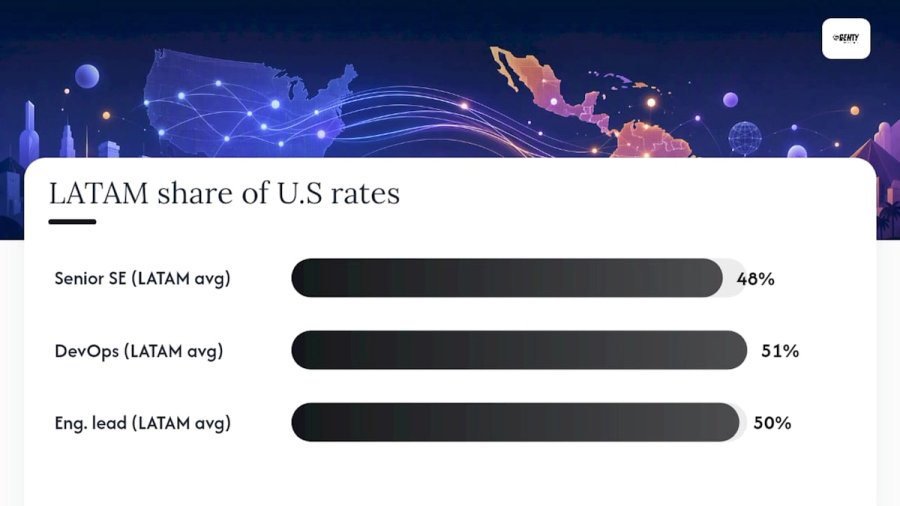
Pro Tip: Budget against the range, not the floor. LATAM rates move with local inflation and city, so a São Paulo or Mexico City senior hire will often price higher than a smaller secondary market.
Treat these as directional midpoints. As one cost comparison of LATAM markets notes, city, seniority, and currency swings can shift a quote 15% to 20% in either direction. Even accounting for that variance, nearshore hires still land roughly 40% cheaper than a fully loaded U.S. equivalent once benefits, payroll tax, and overhead are factored in.
Direct Hire, Dedicated Team, or Staff Augmentation?
Three engagement models cover almost every nearshore scenario, and each carries a different timeline.
Direct hire puts the LATAM professional on your own payroll (often through an Employer of Record), with full ownership and long-term retention incentives on your side. Expect four to eight weeks from role definition to start date once you include reference checks and offer negotiation.
Dedicated team embeds a group of engineers who work exclusively on your roadmap but sit on a partner’s payroll infrastructure. A curated shortlist can land in 7 days with the right partner, cutting weeks off the sourcing phase alone.
Staff augmentation adds individual contractors for defined stretches, useful for a product sprint or a specialized migration. Placements often move from request to start in days to two weeks.
Two moves shorten time-to-productivity regardless of model: write the role spec before sourcing begins, and use pairing-based technical tests instead of resume screens. Pairing with a local payroll or EOR partner removes the compliance bottleneck that otherwise stalls direct hires by weeks.
What Should You Check Before Extending an Offer?
A senior LATAM hire should clear the same bar as a senior U.S. hire, and the checklist below works whether you’re hiring an engineer, a DevOps lead, or a sales rep.
- Verify ownership of production systems, not just résumé bullet points about “experience with” a stack.
- Run a pairing session in your actual tech stack rather than a generic algorithm test.
- For cloud and DevOps roles, ask for infrastructure-as-code artifacts and runbooks as evidence of real ownership, not just years of tenure.
- Confirm English fluency through a live conversation, not a self-reported score.
- Run a collaboration simulation, either live pairing or an async task with a debrief, to see how the candidate communicates under ambiguity.
- Check references specifically for ownership and cross-timezone collaboration, not general performance.
- Get a signed commitment on working hours that overlap with your team’s core hours.
- Clarify the contract model in writing: employee, contractor, or agency-managed placement.
- Confirm IP assignment and NDA terms before the candidate touches source code.
- If working through a partner, get the replacement guarantee terms in writing before signing.
Payroll, Contracts, and IP: What CTOs Need to Resolve
Nearshore hiring introduces legal variables that a domestic hire doesn’t. None of the following is legal advice, but it’s the checklist worth walking through with counsel before you sign anything.
Classification comes first: contractor versus employee status carries different tax and benefit obligations in Argentina, Brazil, Mexico, and Colombia, and misclassifying a long-term hire as a contractor creates real exposure. Each of those four countries has its own mandatory benefits, payroll tax structure, and termination notice rules, so confirm the specifics for your target country rather than assuming U.S. norms translate.
On IP, lock down inventor assignment clauses and NDAs before granting repository access. Require two-factor authentication on every cloud account, and treat source-code access controls as non-negotiable from day one, the same way you would for a domestic hire.
Operationally, the fastest fix for most of this is routing employment through an Employer of Record or established payroll partner, which handles local compliance, statutory benefits, and termination rules on your behalf. Layer in background checks, appropriate insurance coverage, and a written timezone/working-hours agreement, and most of the legal risk in nearshore hiring gets resolved before the first day of work. GENTY recruitment’s staffing outsourcing overview walks through how these pieces fit together for teams new to the model.
How Do You Choose the Right Nearshore Recruitment Partner?
Not every recruitment firm vetting LATAM talent operates the same way, and the gap between a strong partner and a weak one shows up fast once candidates start interviewing.
Prioritize partners that run a skill-first vetting process, promise a defined shortlist timeline (seven days is a reasonable benchmark), provide salary benchmarking data, and charge transparent fixed fees tied to seniority level rather than a percentage that fluctuates with negotiated salary.
Ask directly:
- Can you show a sample candidate scorecard from a similar role?
- What does your technical evaluation actually test, and who administers it?
- What’s your average time from kickoff to signed offer?
- How long is your replacement guarantee, and what triggers it?
- Can you provide references from clients who hired for a comparable role?
Red flags worth walking away from: a vague description of the vetting process, sourcing that leans entirely on generic job boards, requests for large upfront payments before any candidate is presented, no written timezone commitment, and an inability to produce salary benchmarks or client case studies on request.
Pro Tip: Before signing any offer letter, request a live pairing session between the shortlisted candidate and one of your engineers on your actual stack. Thirty minutes of real collaboration reveals more than three rounds of behavioral interviews.
GENTY Recruitment’s View on Nearshore LATAM Hiring
We’ve built our process around one belief: skill-first vetting beats speed-only sourcing every time, and the two aren’t actually in tension when the process is right. GENTY recruitment delivers curated shortlists within 7 days, prices every placement on a fixed fee by seniority level, never asks for upfront payment, and backs every hire with a 3-month replacement guarantee, without sacrificing the EST/PST overlap that makes daily collaboration work.
Ready to Build Your LATAM Engineering Team?
GENTY recruitment is the alternative to slow, generalist staffing agencies for teams that need senior LATAM talent fast: a skill-first vetting process, a fixed fee that doesn’t move with negotiated salary, and no payment due until you have a shortlist worth interviewing.
The engagement runs in three steps. First, we define the role with you, seniority, stack, and timezone requirements. Second, you receive a curated shortlist within 7 days, built from candidates already vetted for technical depth and English fluency. Third, once you select a candidate, onboarding and payroll support (including EOR options where needed) get the hire productive fast, often within weeks rather than months.
Every placement carries a 3-month replacement guarantee, and we provide salary benchmarking data so you know your offer is competitive before you extend it. If you’re ready to see what a curated shortlist looks like for your open role, start with GENTY recruitment’s IT recruitment page and request a scorecard for a comparable position.
Frequently Asked Questions
Is nearshore outsourcing the same as offshoring?
No. Offshoring typically means hiring across a large timezone gap, often eight or more hours, which limits real-time collaboration. Nearshore outsourcing from LATAM keeps most or all of the U.S. workday overlapping, so standups and code reviews happen live rather than the next day.
How much can we realistically save hiring from LATAM vs. building a U.S. team?
Savings typically fall in the 40% to 60% range versus a fully loaded U.S. hire, though the exact figure depends on role, seniority, and country. Senior DevOps and cloud roles in Mexico price higher than the same role in Argentina, so model against a range rather than a single number.
Which LATAM countries should we prioritize for engineering hires?
Argentina, Colombia, Mexico, and Brazil each offer strong senior engineering talent, with SaaS, mobile, and cloud-native skills particularly deep across the region. Country choice often comes down to budget range and specific stack availability rather than one market being universally best.
Do we hire nearshore engineers as employees or contractors?
Both models exist, and the right choice depends on your headcount strategy and each country’s classification rules. An Employer of Record can convert a nearshore hire into a compliant local employee without you setting up a legal entity in Argentina, Brazil, Mexico, or Colombia.
How fast can we actually get a candidate shortlist?
With a skill-first recruitment partner, a curated shortlist can arrive within 7 days of defining the role. Direct hires typically still take four to eight weeks end-to-end once interviews, references, and offer negotiation are factored in.
Sources
Three starting points for RFP prep: the LATAM nearshore hiring playbook for vetting frameworks, the regional cost comparison for country benchmarks, and GENTY recruitment’s candidate vetting guide for assessment methodology.
- Hiring LATAM & Nearshore Developers for US Teams: The 2026 Playbook | David Gomez - Technology & Business Insights
- LatAm Vs. Eastern Europe 2026: Costs, Time Zones & Talent | General Listed