

Closing a strong candidate from Latin America is a genuinely competitive act. Tech startups and scale-ups across the US and Europe are targeting the same pool of pre-vetted, English-speaking engineers from Argentina, Brazil, Mexico, and Colombia, and the company that moves fastest with the clearest offer usually wins. The remote job offer process in this context carries more variables than a domestic hire: legal compliance through an Employer of Record (EOR), asynchronous communication across time zones, culturally aware negotiation, and a candidate experience that signals your company is serious. This guide covers each stage so you can move with precision.
Key Takeaways
Remote job offer process: what to prepare before you extend any offer
Most delays in the remote job offer process happen before the offer is ever sent. They happen in legal reviews, budget approvals, and misaligned internal expectations. Resolving these upstream saves everyone time and protects your candidate pipeline.
Choose your employment model early
The single most consequential decision you make before hiring remote LATAM talent is whether to use direct employment or an EOR. An EOR acts as legal employer in the candidate’s country, managing contracts, payroll, statutory benefits, and termination under local labor law. Direct employment requires your company to establish a legal entity in that country, which can take months. For most startups, EOR is the practical default.
Budget for the full cost picture
EOR fees range from 10 to 18% of gross salary, and employer statutory contributions vary sharply by country. Brazil sits near 38%, while Chile is closer to 3.5%. Before you draft an offer, confirm your total employer cost with your EOR partner so the number you present to candidates reflects what your finance team has actually approved.
Planning a hire?
Talk through the best hiring option
This article usually leads to one practical question: should you use staffing or rpo? We can help you choose quickly.
Simple next step
Start with staffing and we will help you pick the best hiring setup.
The following table outlines the key materials you need in place before extending an offer:
Pro Tip: Run a salary benchmark before you finalize the offer range. Gentyrecruitment provides salary benchmarking across Latin America, and presenting a number grounded in local market data signals credibility to candidates instantly.
Internally, align your legal, finance, and engineering leads before a candidate reaches the offer stage. The moment a hiring manager extends an offer verbally and then has to pull it back for budget reasons, you have permanently damaged your employer brand in a very connected talent community.
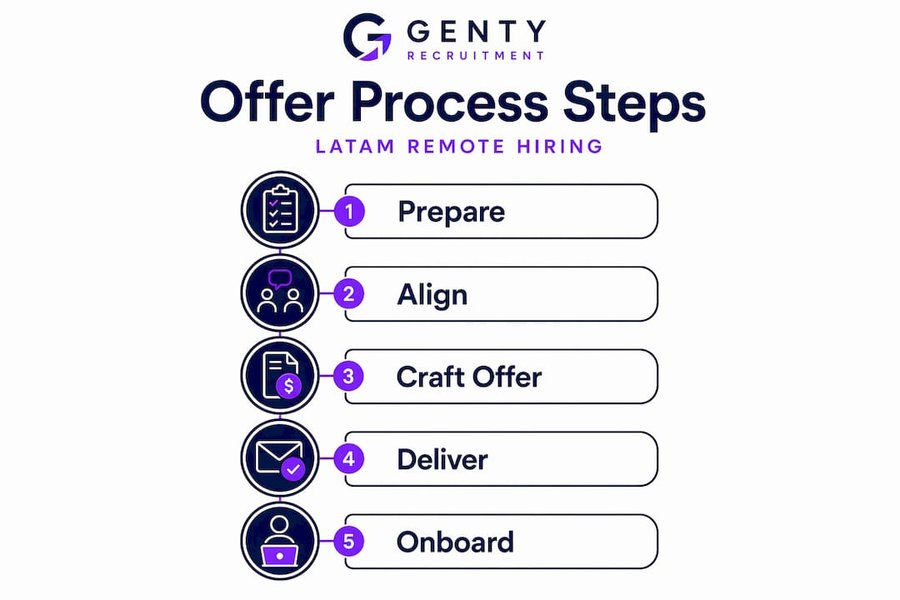
How to prepare and deliver the remote offer
Once preparation is complete, execution is about clarity, timing, and cultural awareness. The remote job offer process demands more deliberate communication than an in-office hire because you do not have body language, shared physical space, or the social pressure of an in-person meeting to carry the moment.

Craft the offer letter with specificity
Your offer letter should state the gross monthly salary in local currency with USD equivalent, clarify whether compensation adjusts for FX volatility, specify the remote work policy including expected overlap hours with your core team, and list statutory benefits alongside any company-provided perks. Vague offer letters generate follow-up questions that slow acceptance, and in high-demand markets, delay means attrition.
Deliver the offer across multiple channels
The structured sequence below reflects what actually works for remote LATAM hires:
- Send a brief async video or voice message from the hiring manager personally expressing enthusiasm for the candidate. Tools like Loom work well for this.
- Follow with the formal written offer letter via email simultaneously or within the same business day.
- Schedule a live video call within the candidate’s preferred working hours to walk through the offer, answer questions, and open negotiation.
- Provide a written summary of any verbal commitments made during that call.
- Set a clear offer expiration window, typically 5 to 7 business days, to maintain decision momentum without creating unnecessary pressure.
Written communication quality is one of the top predictors of success in remote work, which means the way you write your offer letter is also a data point for the candidate about how your team communicates day-to-day.
Pro Tip: When negotiating with LATAM candidates, recognize that many professionals in Argentina and Brazil weigh non-monetary benefits like equipment stipends, learning budgets, and clear career paths as heavily as base salary. Address these proactively rather than waiting for them to ask.
Legal and payroll compliance for remote LATAM hires
An accepted offer is only the beginning of the compliance process. The EOR handles contracts, payroll, and statutory withholdings under local labor law, but you are responsible for giving your EOR partner accurate and timely information to execute correctly.
Key compliance elements your team must manage in coordination with the EOR:
- Contract clauses: Local labor law governs termination provisions. In Mexico, for example, severance calculations are based on years of service and daily salary, not a flat notice period.
- Statutory bonuses: Mexico’s aguinaldo (annual Christmas bonus equivalent to 15 days of salary) and Brazil’s 13th salary are legally mandated. Your offer letter should reference these or they will surface as surprises later.
- FX and inflation provisions: EOR contracts should include explicit FX policies and inflation adjustment clauses, particularly for Argentina where currency volatility is structural.
- Exit clauses: Build in provisions for employee migration to a direct entity setup if your company scales to a point where establishing local presence makes financial sense.
- Payroll timing: Confirm the EOR’s payroll cut-off dates and communicate expected first payment dates to the candidate before they sign.
Pro Tip: Ask your EOR partner for a total employer cost breakdown by country before your offer is approved internally. The delta between gross salary and total employment cost can be significant, and discovering it after the offer is extended creates real problems.
Your EOR should also provide a clear onboarding timeline so you know exactly when payroll initiates and when the candidate’s first payment will land. Communicating this directly to new hires builds trust before day one.
Optimizing candidate experience and speed
Speed and respect for a candidate’s time are the two levers that most directly affect whether a top LATAM engineer accepts your offer or takes one from a competing company. The remote hiring process guide from Gentyrecruitment identifies scheduling friction as one of the top reasons strong candidates drop out mid-process.
Here is a practical sequence to protect both speed and experience:
- Send interview instructions and logistics at least 24 hours before any scheduled call. Async alternatives for time-zone constrained candidates should always be available, and late-night interview requests should never happen.
- Use async technical assessments to remove scheduling friction from the evaluation phase. Candidates complete tests on their schedule, and results are standardized across time zones without geographic bias.
- Automate interview scorecard collection. Automation workflows for scorecard delivery and escalation reminders can push submission rates above 90%, which eliminates the most common bottleneck between final interview and offer.
- Close the feedback loop within 72 hours of any interview or assessment submission. Candidates interpret silence as disinterest.
- Give candidates a named point of contact throughout the process, not a generic recruiting alias, so they know exactly who to reach if they have questions.
Pro Tip: If your team spans multiple time zones internally, designate one person as the offer coordinator. This prevents the candidate from receiving conflicting information from engineering, HR, and recruiting simultaneously.
Post-offer steps and onboarding expectations
Offer acceptance is a handoff point, not a finish line. The actions your team takes in the days between acceptance and start date directly determine whether a new hire reaches full productivity in week one or week four.
A checklist of what needs to happen after a LATAM candidate accepts:
- Initiate EOR contracting immediately. Delays in contract execution push back the payroll start date and frustrate candidates who have already resigned from their previous role.
- Ship equipment to the candidate’s home address. Granting system access and shipping equipment at least 5 business days before the start date avoids the 2 to 3 day productivity loss that comes from late hardware delivery.
- Set up system access including email, GitHub, Slack, Jira, and any internal tools, before day one.
- Assign an onboarding buddy from the team, preferably someone in a similar or adjacent role, who can answer informal questions without going through HR.
- Share your async-first culture guidelines in writing. Document key decisions before meetings, publish notes within 24 hours, and make project status visible asynchronously so new hires can orient themselves without needing a live call for every question.
Pro Tip: Create a 30-day onboarding plan specific to remote hires that includes defined check-ins at day 7, day 14, and day 30. LATAM professionals who receive structured early feedback report significantly higher job satisfaction and lower early attrition rates.
Setting clear expectations about time zone overlap is particularly important. If your core team operates in ET and the new hire is in Buenos Aires or Bogotá, define the expected overlap window explicitly in the onboarding documentation, not as an afterthought in a Slack message during week two.
My take on what most companies get wrong here
I have worked closely with dozens of tech companies navigating this process, and the pattern is consistent. Companies invest real effort in sourcing and interviewing LATAM candidates, then rush or underprepare the offer stage and lose candidates who were genuinely interested.
The most common failure is treating the offer as an administrative step rather than a critical moment in the candidate relationship. A poorly timed, vaguely worded, or legally incomplete offer tells an experienced engineer everything they need to know about how your company operates. In a market where LATAM developers excel in remote teams precisely because they are self-directed and have options, they will make a fast judgment call.
What I have found actually works is preparing the legal and payroll infrastructure before the interview process reaches its final stage, not after. This way, the moment you are ready to extend an offer, your EOR agreement is in place, your budget is confirmed, and your offer letter is ready to send within 24 hours of the hiring decision. The companies that close the best LATAM candidates are not necessarily the ones paying the most. They are the ones who communicate fastest and demonstrate operational credibility at every stage.
Async communication is not just a scheduling convenience. It is a signal. When your team sends well-written, thoughtful async messages during the offer process, you are demonstrating the same cultural values you expect from a new hire on day one.
— Eugene
Hire LATAM tech talent with Gentyrecruitment
Gentyrecruitment specializes in helping US and European tech companies hire pre-vetted LATAM talent faster, with full support across the offer, EOR contracting, and onboarding process. The team sources technically qualified, English-speaking candidates from Argentina, Brazil, Mexico, Colombia, and beyond, covering FinTech, AI, SaaS, and adjacent tech sectors. Whether you need to fill a single senior engineering role or build an entire remote squad, Gentyrecruitment handles the legal, cultural, and operational complexity so your team can focus on the work. Explore IT recruitment in LATAM and connect with the team today for a consultation.
FAQ
What is the remote job offer process for LATAM candidates?
The remote job offer process for LATAM hires involves preparing legal employment structures (typically through an EOR), crafting a culturally appropriate offer letter, delivering the offer across both async and synchronous channels, and confirming compliance with local labor law before onboarding begins.
How long should the offer stage take for remote LATAM hires?
Best practice is to deliver the formal offer within 24 to 48 hours of the hiring decision and provide a response window of 5 to 7 business days. Closing the feedback loop within 72 hours post-interview significantly reduces candidate drop-off.
Do I need an EOR to hire remote talent from Latin America?
Unless your company already has a legal entity in the candidate’s country, an EOR is the standard approach. The EOR acts as the legal employer in-country, handling contracts, payroll, and statutory benefits while you manage the day-to-day working relationship.
What should a remote offer letter include for LATAM candidates?
Your offer letter should include gross salary in local currency with a USD equivalent, remote work policy details, expected time zone overlap, statutory benefits, any company perks, start date, and an offer expiration date. Clear FX and inflation provisions are especially important for Argentina.
How can I reduce drop-off during the remote offer process?
Use async assessments to remove scheduling friction, automate scorecard collection to accelerate decisions, send the offer within 24 hours of approval, and designate a single point of contact for the candidate throughout the process.