

US and European tech companies can cut staffing costs by 40 to 60% while maintaining real-time collaboration with Latin American teams, and that fact alone challenges everything most founders assume about outsourcing. The typical assumption is that outsourcing means sacrificing quality for cheaper labor. In reality, companies outsource staffing to reduce costs significantly, access specialized technical skills on demand, and achieve the kind of organizational flexibility that a rigid in-house hiring model simply cannot provide. This article breaks down the real drivers, the real risks, and how to determine whether outsourcing staffing is the right move for your company in 2026.
Table of Contents
- The real reasons tech companies outsource staffing
- Balancing cost, capability, and agility: the evolving strategy
- Risks, misconceptions, and how nearshore staffing mitigates them
- How to evaluate if outsourcing staffing fits your company
- Our take: what most guides miss about outsourcing staffing
- Connect with talent solutions in LATAM
- Frequently asked questions
Key Takeaways
The real reasons tech companies outsource staffing
The motivations behind outsourcing staffing run deeper than a line item on a budget spreadsheet. Yes, cost is significant, but it is rarely the only factor that moves a hiring manager or founder to pursue an external staffing strategy.
Cost savings of 40 to 60% compared to US-based hires represent a compelling financial argument on their own. A senior software engineer in San Francisco or New York can command $180,000 to $220,000 in total compensation annually. The equivalent caliber of engineer in Bogotá, Buenos Aires, or São Paulo typically costs a fraction of that, without compromising technical depth or communication quality. That delta gives startups and mid-sized companies the ability to stretch engineering budgets significantly, often funding two or three additional hires for the price of one domestic role.
Beyond cost, the demand for specialized technical talent in areas like AI/ML, FinTech infrastructure, cloud-native development, and SaaS architecture has outpaced local supply in most US and European markets. Latin America has produced a substantial and growing pool of technically trained engineers, many of whom graduated from strong STEM programs and have worked with global companies for years. The LATAM tech hiring advantages in terms of skill availability are increasingly well-documented and continue to attract serious attention from engineering leaders.
What do you need?
Choose the hiring path that fits
After reading "Why companies outsource staffing: key benefits and real risks", most teams compare these options before deciding how to hire.
The core drivers, summarized:
- Cost reduction: 40 to 60% savings versus US-based equivalent roles
- Specialized skills access: immediate reach to engineers in AI, SaaS, FinTech, cloud, and more
- Scalability: add or contract team size based on project cycles without long-term employment commitments
- Time zone alignment: Latin America overlaps significantly with US Eastern, Central, and Pacific time zones, enabling real-time standups, sprint reviews, and product discussions
“Nearshoring to Latin America offers time zone alignment that offshore models in Asia or Eastern Europe simply cannot match. Real-time collaboration is a genuine differentiator for teams that need synchronous velocity.”
That time zone advantage is not a minor convenience. For engineering teams running agile sprints, the ability to resolve blockers in real time, rather than waiting 12 to 16 hours for an overnight response from a distant offshore team, has a direct impact on delivery speed. This is a key reason remote tech hiring in LATAM has accelerated sharply in recent years among US product companies.
Balancing cost, capability, and agility: the evolving strategy
Outsourcing has matured considerably since it first became a mainstream strategy in the 1990s and early 2000s. What started as a pure cost arbitrage exercise has evolved into something far more nuanced, and companies that still treat it as purely transactional are leaving significant value on the table.
Forbes notes that pure cost-cutting outsourcing erodes internal capabilities over time. When a company strips out technical functions purely to save money without maintaining knowledge transfer, strategic alignment, or quality oversight, the short-term savings get offset by longer-term fragility. Teams lose context. Product quality drifts. Innovation slows.
The more effective modern approach shifts the framing from “cheaper labor” to “access to smarter talent.” This is capability-building outsourcing, and it operates on different principles:
- Prioritize technical fit over cost alone: Select partners based on the specific stack, domain expertise, and seniority level the project actually requires.
- Integrate outsourced talent into core workflows: Treat external team members as embedded contributors, not vendors at arm’s length.
- Build knowledge bridges: Document architecture decisions, maintain shared codebases, and create onboarding paths that allow outsourced engineers to ramp quickly.
- Layer outsourcing into a multisourcing model: Many mature organizations combine staff augmentation, insourced core teams, and selectively outsourced specialty functions as a blended model.
Deloitte’s research on multidimensional sourcing confirms that leading companies are mixing outsourcing, staff augmentation, insourcing, Global Innovation Centers, and AI tooling into cohesive talent ecosystems rather than relying on any single approach.
The comparison below illustrates how pure cost-cutting outsourcing stacks up against capability-focused outsourcing:
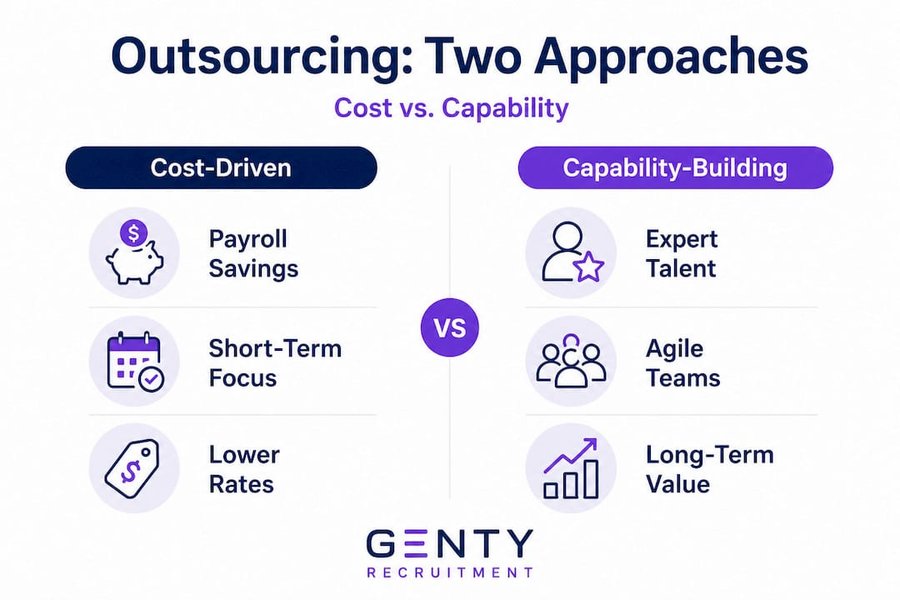
Nearshoring to Latin America sits squarely in the capability-building column when executed well. The LATAM developer strengths in cultural alignment, English proficiency, and engineering rigor make the region a strong fit for companies seeking real integration rather than arms-length task delegation.
Pro Tip: When evaluating outsourcing models, ask the partner agency how they assess cultural fit and communication skills alongside technical qualifications. A candidate who codes well but struggles with asynchronous documentation or collaborative communication will create friction in a distributed team.
Risks, misconceptions, and how nearshore staffing mitigates them
No honest treatment of outsourcing staffing omits the risks. They are real, they are worth understanding, and they are manageable when companies approach the model with the right structure.

The three most commonly cited risks are quality control, communication barriers, and dependency on external partners. These risks are well-documented and have shaped the outsourcing industry’s evolution toward more accountable, integrated models.
Quality control is a legitimate concern when vendors are selected based on price alone or when client-side oversight is minimal. The fix is structural: define clear deliverables, establish code review standards, and involve internal engineers in sprint reviews and technical assessments. When quality expectations are articulated and enforced consistently, outsourced engineers perform to those standards.
Communication barriers are most acute in offshore models with large time zone gaps and low English fluency. Nearshore staffing in Latin America dramatically reduces this risk. Countries like Argentina, Colombia, Mexico, and Brazil produce large numbers of English-proficient engineers who have worked extensively with US and European teams. Accents vary, but communication competency at a professional level is a realistic expectation when vetting through a specialized agency.
Dependency becomes a risk when companies outsource entire critical functions without maintaining any internal knowledge. The solution is thoughtful scope design: outsource specific workstreams while retaining ownership of architecture, product direction, and core IP development internally.
Common misconceptions about outsourcing staffing, and what the evidence actually shows:
- “Outsourced teams always underperform”: False in nearshore LATAM contexts where technical vetting is rigorous and time zone alignment supports real collaboration.
- “You can’t build culture with remote outsourced talent”: Evidence from companies successfully running hybrid distributed teams shows culture is built through process and intentionality, not geography.
- “Outsourcing is only for large enterprises”: Many early-stage startups use staff augmentation and LATAM staffing solutions to build their first engineering teams cost-effectively.
- “You lose IP control”: Proper contracts, NDAs, and work-for-hire agreements govern IP ownership clearly, the same as any employment arrangement.
When sourcing remote talent from LATAM, the nearshore model specifically addresses the communication and quality risks by emphasizing English proficiency assessment, structured technical evaluation, and cultural alignment screening before any candidate reaches your team.
Pro Tip: Before signing with any staffing partner, ask for examples of technical assessments they use, and verify that candidates have been tested on both hard skills (coding challenges, architecture reviews) and soft skills (written communication, async collaboration). These two dimensions together predict real-world performance far more reliably than a resume alone.
How to evaluate if outsourcing staffing fits your company
With the risks and benefits clearly mapped, the practical question becomes: is outsourcing staffing the right move for your organization right now? The answer depends on your specific context, and working through a structured checklist is more useful than following industry trends blindly.
Access to specialized skills and cost-effective scalability are the two factors that most consistently tip the analysis in favor of outsourcing for tech companies. Here is a step-by-step framework for making that determination:
<p>Identify the skills gap: List the technical roles you need to fill in the next 90 days. Note which roles you cannot fill domestically within a reasonable timeline or budget. Roles in AI, full-stack development, DevOps, and data engineering are frequently on this list.</p>
<p>Quantify the cost differential: Use current salary benchmarking data for your target role in your local market versus equivalent roles in LATAM. The gap will typically be significant, and understanding the exact numbers makes the business case concrete.</p>
<p>Assess urgency: If you need an engineer in four to six weeks rather than four to six months, outsourcing through a pre-vetting agency will almost always deliver faster than a standalone domestic search.</p>
<p>Evaluate team integration readiness: Do you have async communication norms established? Is your codebase documented well enough for an external engineer to onboard in one to two weeks? If not, build those foundations before adding outsourced team members.</p>
<p>Define risk tolerance: Consider how critical the role is to core product delivery. Highly critical roles benefit from embedded models with strong overlap. Supplementary roles can function with lighter integration.</p>
<p>Consult a specialized staffing partner: Agencies that focus specifically on technical roles in Latin America, particularly in areas like hiring Java developers in LATAM or FinTech engineering, can map your requirements to available candidate pools quickly and provide salary benchmarks, timeline estimates, and candidate shortlists before you commit.</p>
This framework works for both early-stage startups with a five-person team and mid-sized companies scaling from 50 to 200 engineers. The variables change, but the logic holds.
Our take: what most guides miss about outsourcing staffing
Here is what rarely appears in standard outsourcing guides: the companies that benefit most from outsourcing staffing are not the ones chasing the lowest hourly rate. They are the ones treating outsourcing as a talent strategy, not a procurement exercise.
When outsourcing fails, the root cause is almost always strategic, not operational. Leadership decided to outsource a function to cut costs fast, chose a vendor based on price, gave the team unclear mandates, and then wondered why quality suffered and attrition was high. That failure mode is completely predictable and completely avoidable.
The companies that get outsourcing right treat LATAM engineers the same way they treat any high-value team member: with clear expectations, real integration into the product process, and career investment. They use staffing partners not just to fill seats but to access genuine technical talent that accelerates the company’s product roadmap.
What most guides also miss is that outsourcing done strategically builds organizational capability. A well-integrated LATAM engineering team brings fresh perspective, broad platform experience from working across multiple industries, and a level of adaptability that comes from engineers who have built careers in dynamic, resource-efficient environments. These are not marginal advantages.
The Latin America hiring insights we see across our placement history consistently confirm that the highest-performing outsourced teams are the ones where the client company invested in the relationship from day one, not just the contract.
Connect with talent solutions in LATAM
Outsourcing staffing to Latin America is a concrete strategy that growing tech companies are using right now to build strong engineering teams faster and more affordably than domestic hiring allows.
If you are evaluating your options for technical hiring in Latin America, Genty Recruitment connects US and European tech companies with pre-vetted, English-speaking engineers and technical specialists across Argentina, Brazil, Mexico, Colombia, and beyond. Our process covers staffing, executive search, and salary benchmarking, giving you the data and the candidates you need to make confident decisions. Explore our LATAM tech hiring guide to understand why Latin America has become the leading region for remote technical hiring, and reach out to our team when you are ready to move from research to recruitment.
Frequently asked questions
What are the top technical roles US and European companies outsource to Latin America?
Engineering, software development, and IT specialists are the most commonly outsourced roles, driven by high technical skill availability and strong time zone alignment for real-time collaboration with US and European teams.
How does outsourcing staffing reduce costs so dramatically?
Outsourcing to Latin America reduces payroll and overhead costs by 40 to 60% compared to hiring in the US, primarily because regional salary benchmarks are significantly lower while technical qualifications remain competitive.
Does outsourcing staffing always result in lower quality?
Not necessarily. Nearshore models in LATAM emphasize rigorous technical vetting, real-time communication, and cultural fit, which together mitigate the quality risks most commonly associated with traditional offshore outsourcing.
What are the main risks of outsourcing staffing?
Quality control, communication barriers, and dependency on external partners are the primary outsourcing risks, but nearshore approaches with strong vetting and integration practices reduce their impact substantially.