

U.S. software-developer employment is projected to grow 17.9% from 2023 to 2033, compared with 4.0% across all occupations, according to the U.S. Bureau of Labor Statistics. For a Series A–C company, choose among four talent acquisition solutions: in-house for consistent demand, an agency for difficult individual searches, RPO for sustained hiring that needs operational ownership, or software when recruiters already have capacity.
The deciding question isn't which provider promises the biggest pipeline. It's who owns the handoff that's delaying your next hire, and whether their hires perform after joining.
Four Talent Acquisition Solution Types Compared
Hiring volume, role difficulty and process control should determine your shortlist. Don't buy a recruiting platform to solve a recruiter-capacity problem, or outsource sourcing when engineering managers are the bottleneck.
Talent acquisition solution types compared
Need help hiring?
See the next step after this guide
If this topic is relevant to your team, these are the most useful pages to check next.
Control requires capacity
An in-house team retains institutional knowledge: which engineering trade-offs matter, how managers assess seniority and why candidates reject offers. Its fixed cost is predictable, but adding requisitions doesn't add recruiter capacity. Roadmap hiring spikes need an explicit overflow plan.
An agency gives you focused search capacity without building a permanent function. Contingency arrangements generally tie payment to placement; retained searches fund dedicated work during the assignment. Require pipeline visibility, including outreach responses and rejection reasons, rather than accepting a weekly résumé bundle.
Outsourcing execution isn't outsourcing decisions
RPO should operate inside your applicant tracking system, with named owners for screening, scheduling, reporting and offers. HireAccountants' guide to understanding recruitment process outsourcing is useful for separating a managed recruiting function from a placement mandate.
A tech-enabled platform supports your existing team through search, scheduling and tracking. Even when software automates tasks, someone still needs to calibrate requirements, verify assessments and close candidates.
Practical rule: Buy accountable execution where you lack capacity. Buy software where capable people are losing time to administration.
Use the comparison as a first filter. Then compare the shortlisted models against total cost and the delays each provider can control.
What Each Model Costs and How to Compare Quotes
Pricing structure and cost risk by model
Treat fee percentages as quote inputs, not universal market rates. Compare identical salary bands, assessment scope, replacement coverage and payment triggers.
Calculate the crossover
Take a hypothetical contingency quote of 20% on a $150,000 base salary: the placement fee is $30,000. For three senior hires, that's $90,000.
Now assume an in-house recruiter costs $12,000 monthly, including allocated tools and sourcing spend. Over three months, that's $36,000, or $12,000 per hire if all three positions close. Against that agency quote, the recruitment-spend lines cross at 7.5 months, but this assumes the recruiter can complete the same searches without additional support.
These are planning assumptions, not market benchmarks. Repeat the calculation using your actual quotes and expected completed hires, not approved requisitions.
Add screening expenses separately. Digital Footprint Check's pricing guide can help you frame questions about background-check scope, while this guide to recruitment agency fees in Latin America supports a regional quote comparison.
The cheapest fee isn't necessarily the cheapest hiring decision. Ask engineering to identify the delivery work an empty seat blocks, then assess whether paying for earlier search capacity would remove that constraint.
Where Hiring Time Goes and How to Cut It
Median time-to-fill is 44 days for nonexecutive roles and 60 days for executive roles, according to SHRM's recruiting benchmarks; its reported stage medians appear below. That makes hiring a chain of approvals and decisions, not just a sourcing exercise.
Median delay by hiring stage
The workflow below makes those handoffs visible.
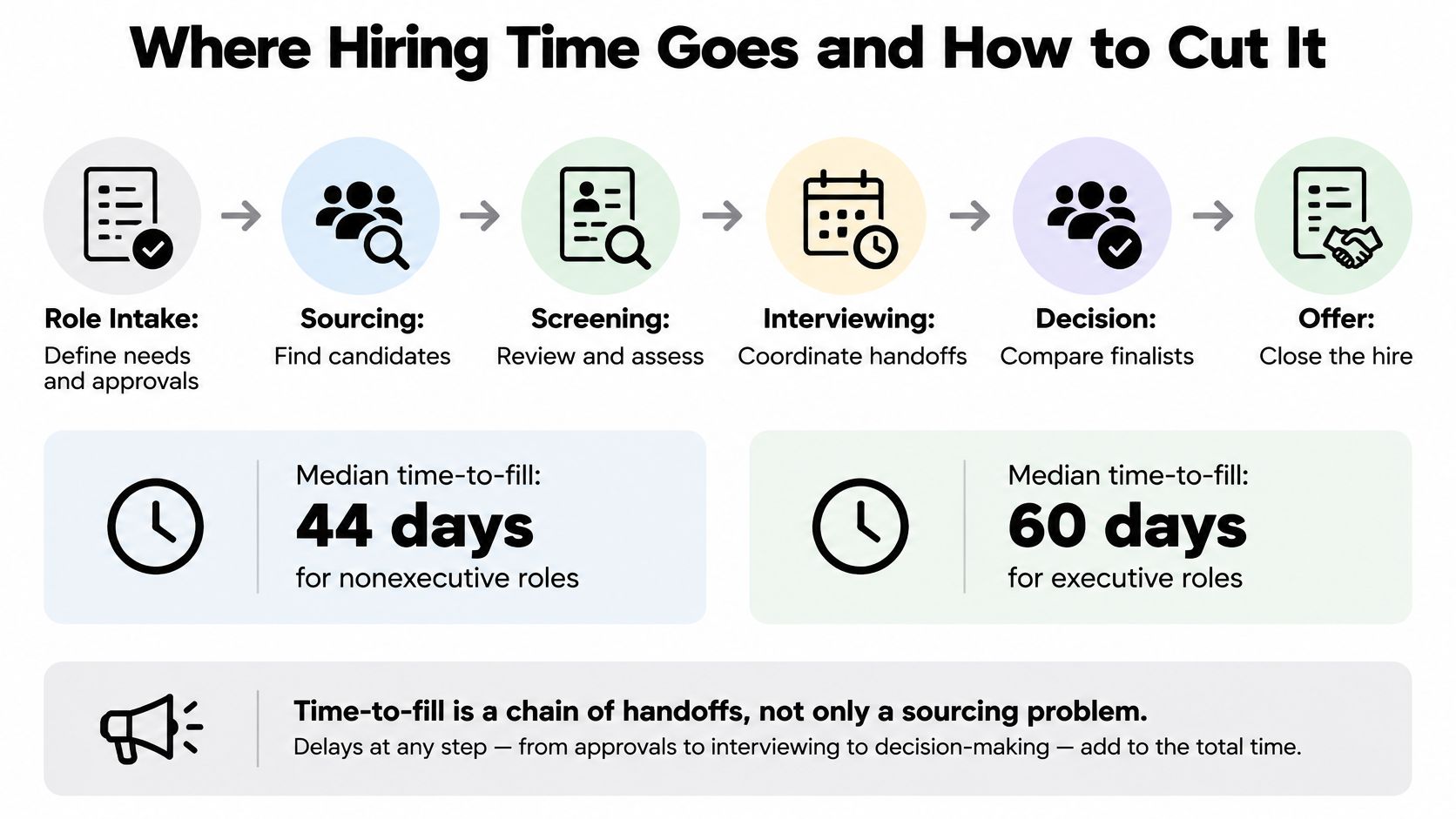
Measure waiting separately from work
The listed stage medians aren't an accounting breakdown of the overall median. Adding them and assigning the difference to sourcing would misrepresent how medians work.
Instead, record approval, screening, interview completion, decision, offer and acceptance timestamps in Greenhouse, Lever or your existing ATS. Track stage age alongside conversion: a fast screening process isn't useful if almost nobody passes the technical interview.
Configure alerts for overdue actions and name an escalation owner. A recruiter can chase feedback, but the engineering leader must protect panel capacity and enforce decision deadlines.
For nearshore technical hiring, a quickly delivered candidate pool only helps when interviewers and compensation approvers are ready. Use a consistent time-to-fill metrics framework so internal recruiters and external partners measure the same start and finish events.
What a Full Talent Acquisition Solution Covers
Think of talent acquisition as procurement for people, without treating people as interchangeable products. Requirements are the specification, sourcing is the supplier scan, assessment is the quality check, and offer management is the contracting process.
The distinction matters because a well-run search can still fill the wrong specification. Engineering must describe the work someone needs to perform, not copy the departing employee's title.
The diagram separates the candidate-facing work from its operating foundation.
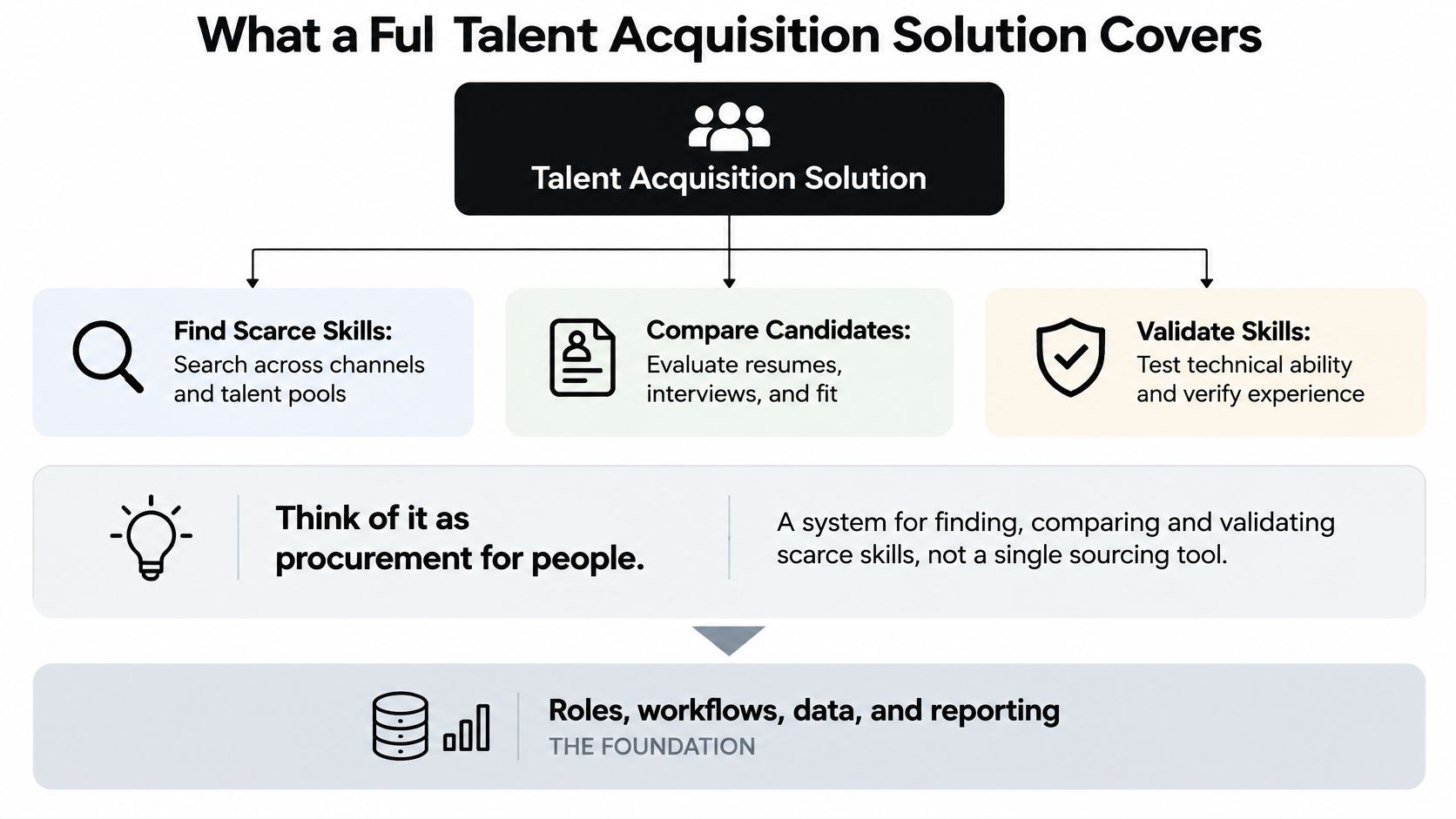
Plan capabilities before requisitions
The World Economic Forum's Future of Jobs Report 2025 found that 63% of organizations identify skills gaps as a major barrier to transformation through 2030, while 70% expect to hire people with new skills and 85% plan to prioritize upskilling. The report projects 170 million jobs created and 92 million displaced globally by 2030, with nearly 40% of on-the-job skills expected to change.
A complete solution connects these activities:
Talent intelligence and skills mapping: Identify available capabilities and distinguish essential expertise from teachable skills.
Workforce planning and salary benchmarking: Decide what to build internally, what to hire and what finance will fund.
Sourcing and structured assessment: Find candidates and compare job-relevant evidence.
Offer management and tracking: Record decisions, resolve compensation questions and transfer commitments into onboarding.</li>
You can purchase market mapping, screening, coordination and reporting. You must retain ownership of the hiring specification, acceptable trade-offs and final decision.
An RPO recruitment process can connect the execution, but leadership still owns the skills plan. A service that only fills vacancies addresses the immediate symptom, not the capability gap behind it.
Service Examples From Shortlists to Salary Benchmarks
For a fintech hiring three backend engineers and one QA automation specialist, the key question is where accountability sits at each handoff. The provider should turn the brief into a scorecard, source and screen candidates, coordinate technical assessments, manage offers, then transfer onboarding details. The hiring team still needs to make timely decisions at each stage.

End-to-end recruiting
GENTY recruitment offers technical recruiting, with initial candidate pools often delivered within three to seven days, fixed fees by seniority and a three-month replacement guarantee. These service terms give buyers a defined starting point for discussing delivery and cost.
Curated shortlists
A shortlist should show the evidence behind each recommendation. The WEF Future of Jobs Report 2025 found that 81% of surveyed employers expect to continue assessing work experience between 2025 and 2030, 48% plan skills assessments, 34% expect psychometric testing and 4% report assessing no skills.
For consistent comparisons, use behaviorally anchored questions, a standardized rubric and independent ratings before panel discussion. A meta-analysis of employment interviews covering 31 studies found average validity of 0.27 and estimated true validity of 0.38; structure was the only examined interview characteristic that significantly moderated validity.
Salary benchmarking
Set a budget for each seniority level before posting, with an offer range and clear exception rules. Salary benchmarking services should separate base salary, employment arrangement and benefits so decision-makers compare like with like.
Require every proposal to name the scorecard, its scorer and the contractual event that counts as a hire.
Choosing a Model for Your Stage and Location
Count roles per quarter. Consistent demand supports in-house capacity or RPO.
Identify difficult searches. Senior, niche roles justify a specialist agency mandate.
Set the required start date. Ask for commitments at controllable stages, not an unconditional hiring promise.
Choose your retained responsibilities. Assign final assessment, compensation approval and candidate communication explicitly.
Define location policy. Decide fully remote, hybrid or local hub before advertising.
Test budget flexibility. Establish whether finance prefers recurring capacity costs or placement-triggered spending.</li>
Match geography to the operating model
Latin America can suit distributed technical teams where working-hour overlap supports the role. U.S. collaboration is often straightforward; European overlap needs deliberate scheduling, and English communication should be assessed individually rather than assumed.
CBRE's Scoring Tech Talent 2025 reports that remote postings represented 16% of U.S. tech-talent postings and 10% in the San Francisco Bay Area by June 2025; the accompanying regional context includes an IDB analysis of more than 6.2 million digital vacancies across 15 countries, finding remote-work supply limited but recovering and concentrated in technology, data analysis and highly educated occupations.
Disclose attendance expectations before interviews. Benchmark pay against the actual location, employment arrangement, required overlap and occasional travel, and confirm who handles local employment compliance.
Broaden the competitor map
BLS projects professional, scientific and technical services employment to grow 10.5% between 2023 and 2033, versus 4.2% for total wage-and-salary employment, with software developers generating that sector's largest projected occupational gain of 163,500 jobs. Your local inbound search therefore competes with consulting and technical-services employers, not just startups.
Ask providers to map those adjacent employers. A sourcing strategy limited to recognizable software brands unnecessarily narrows the candidate pool.
Measuring Whether Hiring Quality Improves
A faster shortlist isn't proof of better hiring. Define quality of hire through observable role performance before buying automation or signing a service agreement.
From Day One's coverage of AI in talent acquisition highlights the need for human-led judgment; apply that principle through a role-specific 30-, 60- and 90-day validation scorecard.
Separate operational reporting from performance
For backend engineering, milestones might include independently shipping a reviewed change, diagnosing a production issue and owning a service improvement. Record access delays and onboarding support so you don't attribute management failures to candidate quality.
A dashboard should connect recruiting activity to these outcomes.

Keep automation in its proper role
LinkedIn's Future of Recruiting 2025 reported that 37% of talent-acquisition professionals were experimenting with or integrating generative AI, up from 27% the previous year; users reported a 20% average workload reduction, while 35% said saved time went to screening and 26% to skills assessments. These are self-reported implementation benchmarks, not a guaranteed business case.
Use AI to organize and summarize evidence, with trained reviewers making judgments. In a hypothetical comparison, both providers might deliver shortlists in five days, but only one provider's hires meet their day-90 ramp milestones.
Pay for demonstrated hiring outcomes, not just faster submission counts.
Ask every provider: How do you report outcomes, not just submissions?
Confirm the Model and Pilot One Role
Pilot a representative role before committing to a broader hiring programme. Choose a search that exposes the provider to your real assessment, compensation and scheduling constraints.
Select the shortlisted model. For ongoing volume, scope an RPO engagement; for a technical search, assess a specialist IT recruiting mandate.
Target the slowest handoff. Set a service level for the bottleneck revealed by your timestamps and name the accountable owner.
Lock the validation scorecard. Agree the early performance milestones before candidate presentation, so nobody rewrites success after the hire.
Cap spend and schedule a review. Use a hypothetical 60-day commercial checkpoint to assess execution, with the performance review following once the hire reaches day 90.</li>
Put the pilot into the contract
Request stage-level reporting, a skills-based shortlist, a fixed-fee option for the seniority, replacement terms and a salary benchmark. Confirm whether delivery windows mean an initial pool, an assessed shortlist or interview-ready candidates.
At the commercial checkpoint, review days from requisition to accepted offer if the search has closed. Don't claim a completed performance result before the hire reaches the agreed ramp milestone.
This week, send the role specification, expected quarterly hiring and location policy to the shortlisted providers. Compare accepted-offer timing and eventual ramp performance against your agreed targets; if either misses, change the operating model for the next role family rather than automatically renewing.
Steady volume still points toward in-house or RPO, and an isolated senior search toward a retained or fixed-fee agency. The pilot result should override that default.
GENTY recruitment offers technical and sales recruiting, RPO and salary benchmarking to help teams match hiring support to their operational bottlenecks. Visit GENTY recruitment with your role brief, quarterly hiring plan and location policy, and request a scoped proposal with named owners, reporting commitments and measurable hiring outcomes.