

Most recruitment agencies hiring in Latin America charge a percentage of the candidate’s first-year pay: roughly 15–25% on contingency and 25–35% on retained searches, according to Pin’s 2026 agency report. A smaller group of specialists charge a flat fee per hire instead. At GENTY recruitment, that fee starts at $2,999 per hire. This guide explains how each model works, what the fee covers, when it is due, and how to compare quotes so a CTO or founder can budget a LATAM hire accurately.
TL;DR
- Percentage fees typically land between 15% and 35% of first-year pay, depending on whether the search is contingency or retained.
- A fixed fee per seniority level keeps the cost flat as salaries rise, which matters most for senior engineers and sales leaders.
- The fee is only one line of total cost: employer burden, benefits and payroll setup in Brazil, Mexico, Colombia and Argentina sit on top.
- Check the payment trigger, the replacement guarantee window and what counts as a “replacement” before signing.
- GENTY recruitment charges from $2,999 per hire, with no upfront payment and a 3-month replacement guarantee.
The main fee models, side by side
Agency pricing for LATAM hiring falls into four structures. They differ in who carries risk and in how the cost scales with the salary of the person you hire.
The percentage ranges and the markup range come from Pin’s 2026 report on recruitment agencies. Treat them as US-market benchmarks: Latin America fees are often quoted in the same percentages but applied to LATAM salaries, and the exact rate depends on the role and the agency.
One way to see the logic of each model is through who is paid for effort and who is paid for outcome. As one explanation of agency payment models puts it in substance, contingency shifts financial risk to the agency, while retained and RPO arrangements give the employer predictable obligations in exchange for dedicated recruiting capacity.
Planning a hire?
Talk through the best hiring option
This article usually leads to one practical question: should you use rpo or it recruitment? We can help you choose quickly.
Contingency
You pay only when someone is hired. That sounds like the lowest-risk option, and it can be, but agencies working on contingency spread effort across many open roles and prioritize the searches that close fastest. Hard-to-fill roles, such as a senior DevOps engineer with Kubernetes and compliance experience, can sit behind easier ones.
Retained search
A retained firm is paid to work on your search exclusively, usually in installments. It suits executive and leadership roles where discretion and market mapping matter. The cost is higher and part of it is due before anyone is placed.
Fixed fee per hire
The fee depends on seniority band, not on the final salary. For hires in the $80,000–$150,000 range, which is common for senior engineers hired through US companies, this is where the savings are largest, because a percentage fee grows with every raise in the offer while a fixed fee does not. Our own guide to fixed fees for recruiting walks through the mechanics.
Staffing and markup
In a staffing arrangement, the agency or its local entity employs the person and bills you a monthly rate. The markup covers payroll, benefits administration and the agency’s margin. This is not a recruitment fee in the strict sense, and comparing it with a one-off fee without annualizing both is the most common mistake in budgeting.
A worked example: percentage vs fixed fee
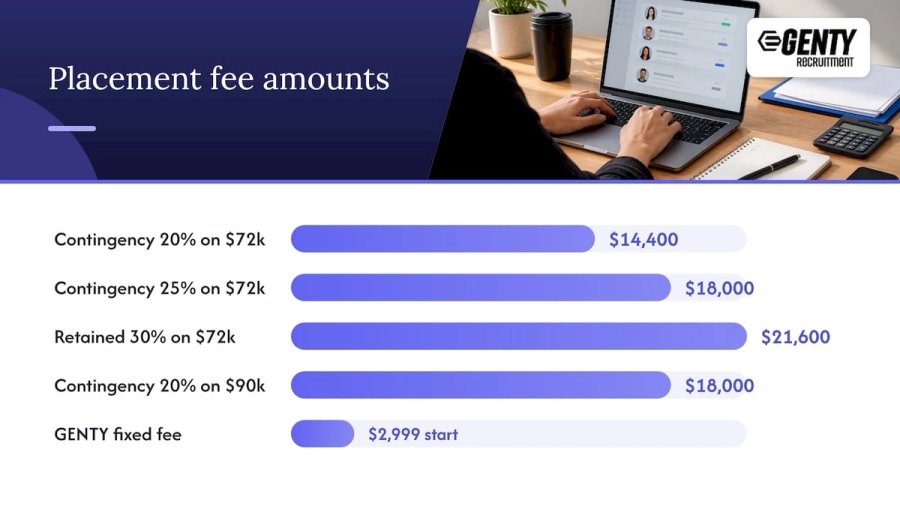
Take a senior backend engineer hired in Mexico at an offered salary of $72,000 a year. The figures below are an illustration of the arithmetic, not a market quote.
- At a 20% contingency fee, the agency invoice is $14,400.
- At a 25% fee, it is $18,000.
- At a 30% retained fee, it is $21,600.
- With GENTY recruitment, the fee for a hire starts at $2,999 one-off.
Now add a second engineer at $90,000. Percentage fees move up to $18,000 (20%) and $22,500 (25%) for that single hire, while a fixed-fee structure keeps each placement tied to a seniority band. For a startup hiring four to six engineers in a year, the gap is measured in tens of thousands of dollars, which is often the cost of an additional engineer.
The saving only holds if the shortlist quality is equal. That is why the fee should always be read next to the process: how candidates are vetted, how fast shortlists arrive, and what happens if the hire does not work out.
What a recruitment fee should include
A quote that lists only a percentage tells you very little. Before comparing agencies, ask for written answers on each of these points.
- Sourcing method. Active outreach to passive candidates, or job-board posting? Passive approaches produce more applicants and fewer qualified ones.
- Vetting depth. Technical screening by a recruiter who understands the stack, English assessment, and reference checks.
- Shortlist size and timing. How many candidates, and how many days until you see the first profiles.
- Compensation guidance. Does the agency advise on salary ranges per country, or only pass your budget along?
- Offer and negotiation support. Counteroffers are common in Brazil and Argentina, where strong engineers often hold offers from several international employers.
- Onboarding handoff. Who sets up the contract, and does the agency introduce an employer of record if you do not have a local entity?
Extra costs that sit outside the fee are usually these: assessment tools or take-home test platforms, relocation (rare in remote hiring), background checks in some jurisdictions, and the employment cost itself. Ask the agency to list each as included or excluded.
The cost that is not on the invoice: employer burden
The agency fee is a one-time cost. The larger number over a year is what you pay to employ the person. In Latin America, mandatory benefits matter: the 13th-month salary (aguinaldo in Mexico and Argentina, 13º salário in Brazil, prima de servicios in Colombia), social security contributions, severance funds and paid leave. Employer-side estimates published by AgileHRO note recurring costs such as the 13th-month payment and statutory payroll taxes in these markets.
Country rules differ in how they bite:
- Brazil: Termination is expensive under protective labor law, and misclassifying a full-time contractor (“PJ”) as an independent is a recognized compliance risk, with eSocial reporting for formal employees.
- Mexico: Dismissal needs just cause to avoid substantial severance, and the REPSE registry applies to certain outsourced-services arrangements. The BDO LATAM payroll guide covers payroll fundamentals across the region, though it is an older edition, so confirm current rates with a local payroll provider.
- Argentina: Severance exposure is high and inflation makes salary reviews frequent, so US dollar-denominated contracts need careful drafting.
- Colombia: Employer social contributions and the mandatory service bonus raise the total above base pay, while the strong Bogotá tech market makes it a favorite for teams that want US Eastern alignment.
The practical conclusion: compare agencies on fee, but compare countries on total employment cost. A $2,999 placement fee is small next to a mistake in contractor classification. Our remote staffing guide and overview of hiring costs for US tech employers go deeper on the budget side.
When payment is due and what the guarantee should say
Three contract terms decide whether a low fee is really low.
Payment trigger
The fee should be due on a clear event: the candidate’s signed offer or first day of work. Be cautious with any structure that asks for a deposit before candidates are presented. Upfront payments shift the entire risk to you, and they reduce the agency’s incentive to deliver fast.
Replacement guarantee
The window commonly runs from 30 days to 6 months. Read it for three details: whether it starts at the start date or the offer date, whether a resignation and a dismissal are both covered, and whether the replacement search is free or discounted. GENTY recruitment offers a 3-month replacement guarantee on placements.
Exclusivity and non-circumvention
Some agreements bind you to one agency for a role for 60 to 90 days, and some charge the full fee if you later hire a candidate the agency introduced. That is reasonable when the agency does real sourcing work. It becomes a problem when the clause has no end date.
Perspective: why we price per seniority level
We built our pricing around one observation from LATAM searches: the effort of finding a good engineer does not rise by 25% when the salary does. A senior platform engineer in Buenos Aires or São Paulo takes more targeted outreach than a mid-level developer, but a candidate paid $20,000 more is not 20% harder to find in proportion. A flat fee per seniority band lets a hiring manager forecast the cost of a team before the first search begins.
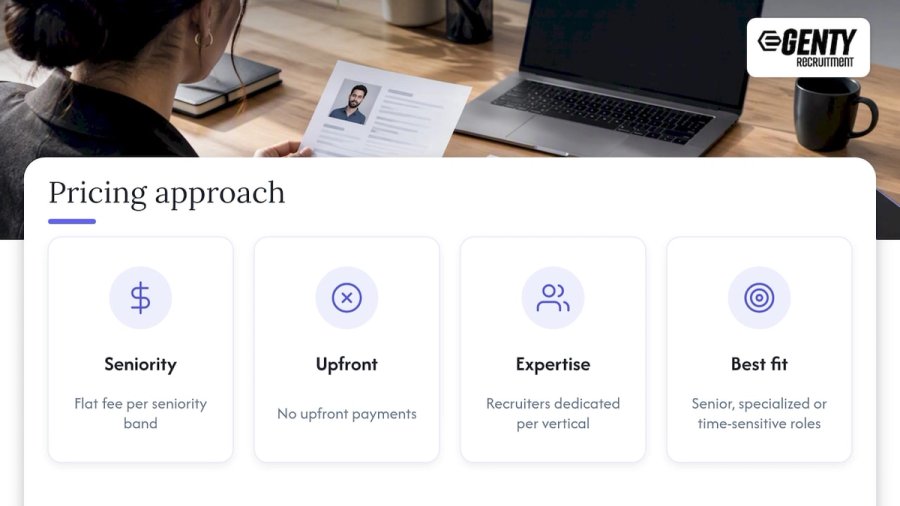
We also decline upfront payments. If a shortlist does not match your stack, you should not have paid for it. Our recruiters are dedicated per vertical (IT, sales, executive), so the person briefing a candidate on your Kubernetes migration or your SDR quota has hired for those roles before.
And we tell clients where an agency is not the right tool. If you are hiring one junior developer and have time, direct sourcing through your network may be cheaper. Agencies earn their fee on senior, specialized or time-sensitive roles, and on teams where you need several hires across Brazil, Mexico, Colombia and Argentina at once.
— Eugene
How to compare agency quotes in five steps
- Normalize to cost per hire. Convert every quote to dollars for the same target salary. A percentage fee on a $60,000 hire and on a $110,000 hire are different numbers.
- Separate recruitment from employment. Put staffing markups on a monthly basis and annualize them before comparing them with a one-time fee.
- Check the guarantee in writing. Length, trigger, and what the replacement costs.
- Ask about speed. A shortlist in days, not weeks, shortens the time a role stays open, and each open week of an engineering seat has a real cost.
- Confirm timezone fit per country. Mexico and Colombia sit on or close to US Central and Eastern time, giving near full overlap with EST. Brazil and Argentina are about two hours ahead of EST in the US winter and one hour in the summer when the US observes daylight saving time, which still leaves most of the working day shared with both EST and PST teams.
The last step is a core advantage of LATAM over other offshore regions: real-time standups, pairing sessions and on-call rotations work without anyone logging in at midnight.
Which role types justify an agency fee
- Senior and staff engineers, DevOps and data specialists. The pool of qualified candidates is smaller and mostly passive. Active outreach pays for itself. See our IT recruitment service.
- SDRs and AEs. Sales hires are judged on quota history, and vetting for English fluency and outbound discipline matters. Our sales recruitment service covers this.
- Leadership. Heads of engineering or country managers usually need a retained-style search with discretion. See executive search in LATAM.
- Volume hiring or ongoing pipeline. If you need many hires, recruitment process outsourcing may cost less per hire than repeated one-off searches. We explain it in our RPO guide.
The reverse also holds: a single junior hire, or a role you can fill from your own network within weeks, rarely justifies a fee.
What GENTY recruitment charges
We publish our pricing because buyers should not need a call to learn the order of magnitude.
- Recruitment, IT recruitment and sales recruitment: from $2,999 one-off per hire.
- Staffing: from $99 per month per employee.
- Executive search, salary benchmarking and RPO: scoped to the project, with no published price.
There is no upfront payment, shortlists arrive within 7 days, and every placement carries a 3-month replacement guarantee. If you want to build a team without managing a local entity, see our remote staffing and EOR service, or start from the GENTY recruitment homepage to brief a search.
For a closer look at the process behind the fee, read our guides on hiring remote developers and hiring remote talent from Latin America.
FAQ
What is a typical recruiter fee for hiring in Latin America?
Most agencies quote a percentage of first-year salary: about 15–25% for contingency and 25–35% for retained search, per Pin’s 2026 report. Some specialists use flat fees instead. At GENTY recruitment, a hire starts at $2,999.
Do I pay a recruitment fee and an employment cost?
Yes. The agency fee is a one-time charge for finding the hire. Salary, mandatory benefits such as the 13th-month payment, social contributions and any employer-of-record or staffing fee are separate and recurring. Staffing with GENTY recruitment starts at $99 per month per employee.
Should I pay a recruiter upfront?
We advise against it for standard hires. A fee tied to a signed offer or start date aligns the agency with your outcome. Upfront or deposit-based structures are more common in retained executive searches, and then the engagement stages should be written out clearly.
What should a replacement guarantee cover?
It should state its length, when the clock starts, and whether it applies to both resignation and dismissal, plus whether the replacement search is free. GENTY recruitment offers a 3-month replacement guarantee.
Is a fixed fee cheaper than a percentage fee?
Usually, for mid-senior and senior roles, because a percentage fee rises with salary. For a $72,000 hire, a 20% fee is $14,400 against a starting fixed fee of $2,999. Compare what the shortlist process delivers as well as the headline price.
Sources
- The State of Recruitment Agencies: 2026 Full Report, Pin
- How Do Recruitment Agencies Get Paid? Fee Models, LegalClarity
- Hire Across LATAM Without the Missteps, AgileHRO
- Payroll Guide LATAM, BDO