

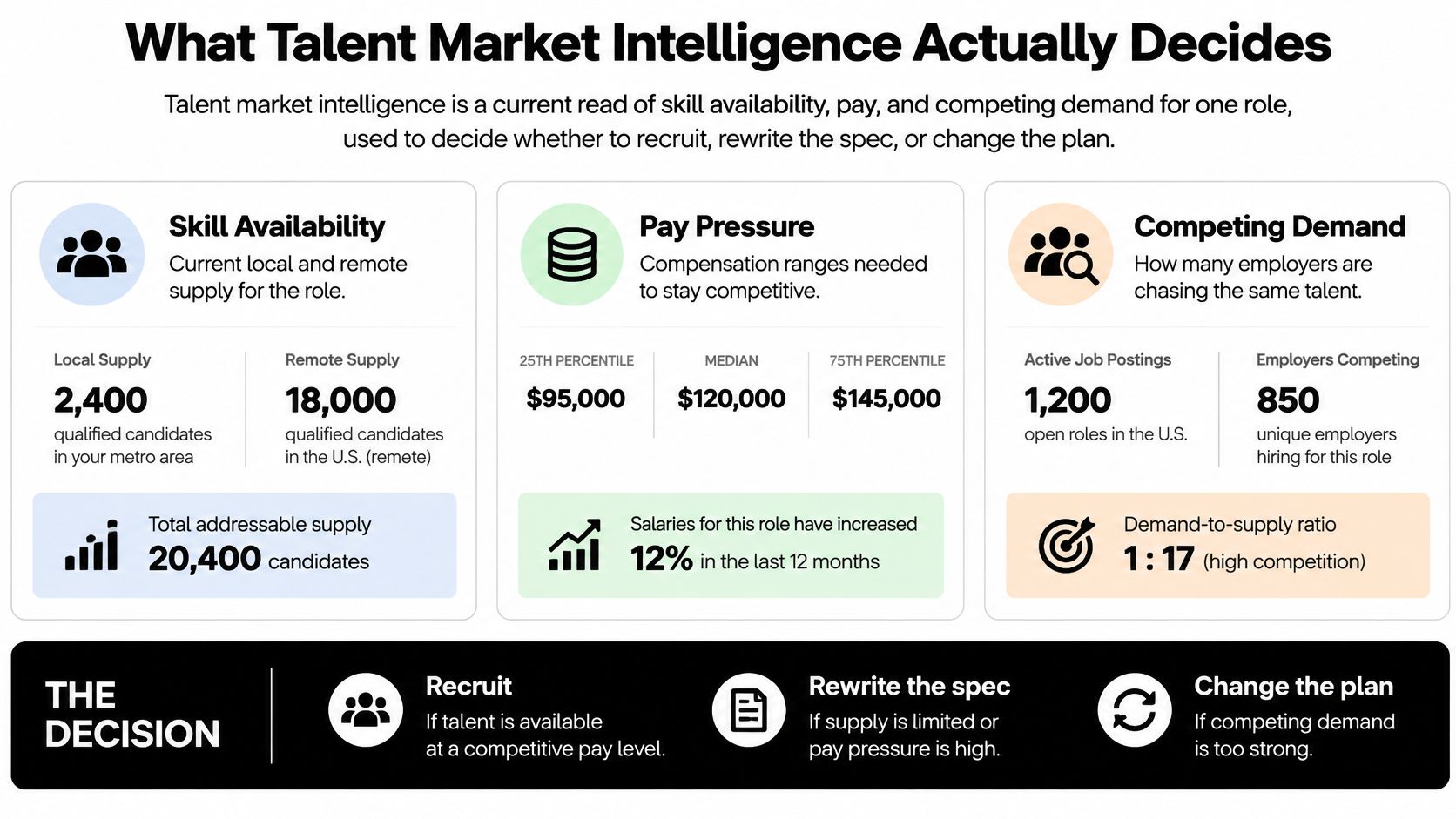
39% of workers' core skills are projected to change by 2030, according to the World Economic Forum's Future of Jobs Report 2025, based on more than 1,000 companies. Talent market intelligence is a current read of skill availability, pay, and competing demand for a specific role. It helps you decide whether to recruit, reskill, rewrite the specification, or change the location and work model, rather than keep searching against assumptions that no longer hold.
What Talent Market Intelligence Actually Decides
For a Series A–C CTO or HR director, the useful question isn't whether engineers are scarce. It's whether people with the required capabilities are available at your seniority, compensation, location, and working-hour requirements.
A job description records what your team thinks it needs. A salary survey describes what a sample of employers or workers reported. Talent market intelligence connects those inputs to a decision, then tests that decision against actual candidate responses.
The operating model has distinct inputs:
Planning a hire?
Talk through the best hiring option
This article usually leads to one practical question: should you use staffing or salary guide? We can help you choose quickly.
Simple next step
Start with staffing and we will help you pick the best hiring setup.
Turn market information into hiring outputs
A useful intelligence cycle produces:
A skills-weighted brief. Describe the work someone must deliver, the capabilities that are essential, and the tools they can learn.
A location-specific pay band. Separate candidate compensation from total employer cost, and record the employment arrangement.
A supply assessment. Include adjacent profiles that could perform the work, not just people already holding the advertised title.</li>
Say you're opening a senior platform-engineering seat. The immediate task is to establish whether you need someone to redesign infrastructure, improve deployment reliability, or maintain an established environment. Those outcomes imply different candidate pools.
Practical rule: Don't authorize sourcing until the hiring manager can explain which constraint they're willing to change if the initial market response is weak.
That makes intelligence operational. The deliverable isn't a dashboard of interesting labor-market facts; it's an explicit hiring choice with evidence and an owner.
Data Sources and Methods Behind the Numbers
Start with occupation-level evidence, overlay employer surveys, and then test the resulting assumptions against your own pipeline. Surveys describe priorities; postings describe advertised demand; neither tells you who will accept your offer.
Sources behind each talent signal
When evaluating commercial datasets, the ProfessionLens guide to professional data sources offers a starting point for comparing sourcing options. Check coverage, refresh frequency, licensing, and how records are validated before buying access.
Keep a source register beside your hiring spreadsheet. Record the population, collection period, geography, and whether each field represents observed behavior, an opinion, or a projection. Replace broad assumptions with your own qualified-candidate and offer evidence before committing to a hiring timeline.
Five Decisions One Requisition Must Settle
Take a senior platform engineer responsible for deployment reliability, infrastructure security, and developer tooling. Before sourcing, agree what evidence would make you change the plan.
The table isn't a forecast. It's a decision record that prevents the recruiter, engineering manager, and finance lead from interpreting the same weak response differently.
Signals that change a single hiring decision
Make the trade-offs explicit
For this seat, a backend engineer who has owned production infrastructure may be relevant. An SRE with experience building internal tools may also qualify. Neither should pass merely because their résumé contains Kubernetes.
Ask finance to approve alternatives, not just a single salary ceiling. A less-senior hire might fit if an existing staff engineer can retain architecture ownership; without that support, reducing seniority transfers risk to delivery.
Treat work location the same way. If the team needs overlap for incident response, specify the actual hours rather than requiring a particular city without a collaboration rationale.
Connect these choices to headcount forecasting. A requisition that only works under an untested salary assumption shouldn't become a firm delivery dependency.
A completed decision table should say what changes when the evidence disappoints, not merely describe the original hiring preference.
Scoring Skills Instead of Matching Titles
Build the platform scorecard around durable capabilities first: distributed-systems reasoning, observability, security design, and debugging. Record cloud-provider and programming-language experience separately, so familiar tools don't conceal weak engineering judgment.
The distinction is easiest to see as a layered model:
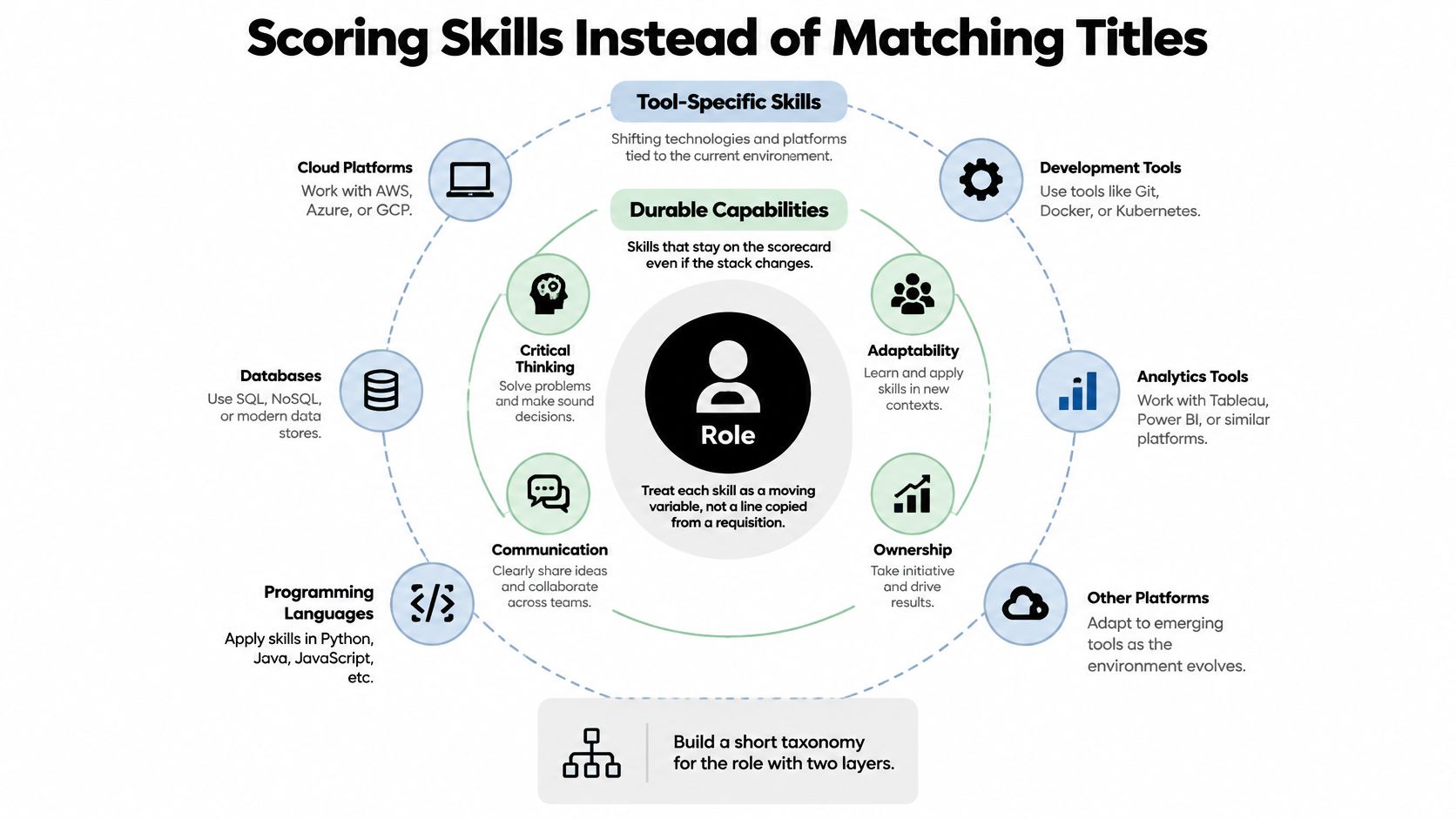
The World Economic Forum's 2025 employer survey, covering more than 1,000 companies, 22 industry clusters, 55 economies, and over 14 million workers, ranks AI and big data, networks and cybersecurity, and technological literacy as the fastest-growing skill areas, while analytical thinking remains essential to approximately 70% of companies. Those priorities support assessing reasoning alongside technical familiarity, not adding every fashionable tool to the specification.
Use separate scores, not a mysterious composite
Give each skill an internal score from low to high, using a proposed one-to-five scale:
Demand growth reflects whether relevant employers are adding the capability. Document the evidence rather than treating a trending keyword as proof.
Scarcity reflects how difficult it is to find people who demonstrate the capability at the required level.
Verification confidence reflects the strength of your assessment evidence, from résumé claims to a realistic work sample with follow-up questions.</li>
For debugging, ask the candidate to investigate intermittent deployment failures using logs, metrics, and a change history. Strong verification means they can explain competing hypotheses, choose useful checks, and revise their diagnosis when evidence changes.
Don't multiply these scores into a supposedly objective ranking. High scarcity with low verification confidence means you need a better assessment, not permission to hire on faith. Use a skills-first hiring process to keep evidence standards consistent across different backgrounds.
For an additional perspective on applying skills-based evaluation, consider this video:
Pay Gaps by Country and Role Cluster
There isn't a single Latin America discount. The remote-contract figures reported by Bloomberg Línea illustrate why country and specialization must be read together in the following table.
Remote contract pay by country and role cluster
These are averages from contracts administered through one workforce platform, with coverage restricted to roles meeting its minimum contract-count threshold. They aren't a full market census, seniority-matched offers, or total employment costs.
Build a comparable cost sheet
Before finance compares locations, add the costs and conditions the headline figure doesn't establish:
Employment structure. Separate contractor compensation from employee base pay, benefits, employer taxes, and administration costs.
Currency exposure. Record the payment currency, conversion assumptions, and who carries exchange-rate risk.
Working conditions. Specify required overlap, office attendance, on-call responsibilities, and equipment.
Role scope. Tag seniority, architecture ownership, management duties, and production accountability.</li>
For the platform seat, the relevant comparison isn't a country average against a domestic senior-engineer salary. It's the fully loaded cost of candidates capable of owning the same production responsibilities under the same operating expectations.
A lower nominal salary can create retention risk if the candidate can obtain materially better compensation for the same skill locally or internationally. Conversely, a higher contract average doesn't establish that every qualified candidate expects that amount.
Budget guardrail: Treat a country average as a research starting point, never as an offer recommendation.
Use salary benchmarking services when you need matched role, seniority, and employment-model comparisons. Share the sample limits with finance alongside the proposed band, and validate the band through candidate conversations before presenting savings as dependable.
Reading Supply When Demand Is Structural
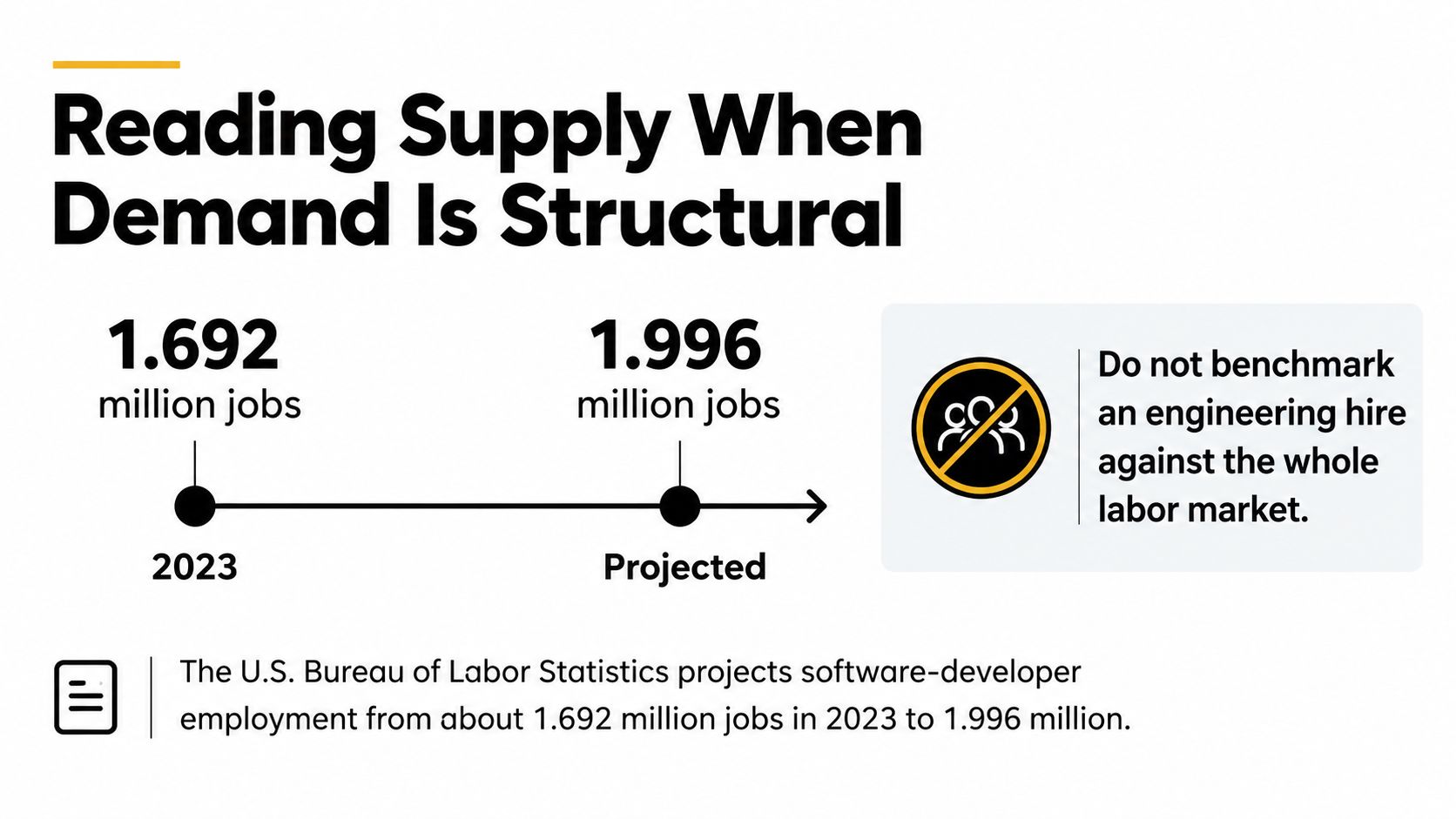
The U.S. Bureau of Labor Statistics projects software-developer employment to grow from approximately 1.692 million jobs in 2023 to 1.996 million in 2033, an increase of 303,700 jobs, or 17.9%, compared with projected growth of 4.0% for all occupations. That's an occupation-level demand signal, not a forecast for your vacancy or a direct measurement of DevOps availability.
The projected change provides context for engineering workforce planning:
Track the operating evidence
Maintain these measures in your ATS or a shared spreadsheet, segmented by seniority, specialization, and location:
Requisition age. Separate time spent waiting for approval, sourcing, interviewing, and making decisions. A slow internal process isn't evidence of scarce supply.
Offer acceptance. Record accepted offers against decided offers, along with decline reasons. Exclude pending decisions from the denominator.
Compensation movement. Compare recent candidate expectations and offer outcomes for equivalent work. Don't mix a newly senior role into an unchanged benchmark.
Qualified candidates per location. Count people who pass the agreed capability screen, and distinguish identified candidates from those willing to engage.</li>
Applicant volume alone can't tell you whether the role is fillable. A large inbox can coexist with almost no relevant production experience, while a small curated pool can contain credible hires.
If acceptance falls despite a competitive, role-matched band, investigate interview delays, leadership confidence, work policy, and competing offers. Don't assume another job advertisement will fix the problem.
Likewise, thin results for a narrow title don't establish a national shortage. Use the tech talent gap guide as context, but let your segmented pipeline determine which constraint deserves attention.
Mapping a Platform Seat Past the Job Title
Say a Series B CTO has had an ML-engineer requisition open for ten weeks. That's a hypothetical scenario, but the operational problem is familiar: the recruiter finds few matching titles, and the engineering team assumes the only remedy is more money.
The stalled search deserves a capability review before a budget increase:

ManpowerGroup's talent-shortage findings show that 72% of organizations across 41 countries report hiring difficulty; difficult skills include AI model and application development at 20%, AI literacy at 19%, engineering at 19%, and sales and marketing at 18%. The same findings rank communication, collaboration, and teamwork at 39%, professionalism and work ethic at 36%, and adaptability at 34% among sought-after attributes.
Test the substitution rather than assume it
The product requirement turns out to be a retrieval feature integrated into an existing backend. That may call for a backend, data, or platform engineer who understands retrieval evaluation, access controls, latency, and production monitoring, rather than someone specializing in model training.
Keep a genuine model-training requirement distinct. Adjacent experience isn't a substitute when the work demands capabilities the candidate can't demonstrate.
For this hypothetical search, use a proposed two-hour work sample in a sandbox matching the stack. Follow it with a systems-design discussion and a written trade-off note explaining retrieval choices, failure handling, and evaluation limitations.
The written component tests more than presentation. Can the candidate make assumptions visible, explain uncertainty, and give distributed teammates enough context to challenge a decision?
Use a talent-mapping approach for tech startups to track the original and adjacent profiles separately. Compare interview-to-onsite conversion and assessment outcomes under identical standards; otherwise, a broader search may only produce more interviews.
Choose Recruit Reskill or Redesign
Recruit externally when the team lacks a durable capability, can verify it reliably, and can engage qualified people within the available budget and work model. Reskill internally when the gap is learnable tool experience and delivery can absorb the ramp.
Redesign the seat when an adjacent profile can own the outcome, or when the package combines responsibilities that don't need to sit with the same person. Changing office requirements may also be more defensible than paying to preserve an arbitrary restriction.
Run the decision check
Freeze the required capability and work sample, not the title.
Complete the decision table using current candidate and pipeline signals.
Compare prospective locations on fully loaded cost, currency, and working-hour overlap.
Run a short market test with a curated slate. Judge first-interview fit and demonstrated capability, not résumé volume.</li>
For teams considering LATAM, GENTY recruitment is one option for skill-first IT recruitment or recruitment-process support rather than building the entire sourcing operation internally. Keep ownership of the capability standard and hiring trade-offs inside your leadership team.
Complete the decision table for one live requisition this week. Assign an owner to each missing signal and agree which evidence would trigger a change.
GENTY recruitment offers technical recruiting, RPO, and salary benchmarking to connect market information with practical hiring decisions. Visit GENTY recruitment to discuss a live role, test its compensation assumptions, and define a shortlist around demonstrated skills.