
Talent acquisition is the strategic, pipeline-building function. Recruiting is the execution layer that fills open requisitions, and the difference matters because AI adoption in recruiting reached 43% of organizations in 2025, up from 26% in 2024, while average time-to-fill sits around 63.5 days in 2025 in a market that still struggles to hire.
Most advice on talent acquisition vs recruiting is too soft. It treats the terms like branding choices, as if renaming your recruiters will somehow fix missed hires, weak candidate pipelines, or runaway agency spend. It won't.
If you're a Series B CTO, the question isn't semantic. It's operational. Are you trying to close this quarter's roles fast, or are you trying to build a hiring system that gets stronger every quarter? Recruiting solves the first problem. Talent acquisition solves the second. Strong companies need both, but not at the same level and not at the same stage.
That's the frame to use. Not a glossary. A decision framework.
Planning a hire?
Talk through the best hiring option
This article usually leads to one practical question: should you use rpo or it recruitment? We can help you choose quickly.
Why the Talent Acquisition vs Recruiting Question Matters Now
A lot of teams still use these labels interchangeably. That's a mistake. Recruiting fills requisitions. Talent acquisition builds the system that decides which requisitions should exist, where talent should come from, and how hiring quality improves over time.
SHRM defines talent acquisition as a process for attracting and recruiting the best talent available so the organization has the right people, with the right skills, in the right jobs, and working against the right requirements. Its 2024 materials explicitly describe talent acquisition as a “strategic view” in SHRM educational guidance. That definition alone should end the debate.
Why labels turn into budget mistakes
Here's what usually happens in a scaling SaaS company. Engineering opens five roles. Hiring managers want them filled yesterday. Recruiters push outbound, post jobs, chase interview feedback, and work offers. That's recruiting. It's necessary work, but if that's the whole model, the company stays reactive.
Then the same company wonders why every role feels hard, why agency dependence keeps growing, and why each new search starts from zero.
In February 2026, the U.S. had 6.9 million job openings and 4.8 million hires, with 69% of U.S. organizations struggling to recruit for full-time positions and 51% naming too few applicants as the top challenge, according to State of Talent Acquisition 2026 reporting. That's not an environment where reactive hiring works well. It's an environment that punishes teams with no pipeline strategy.
Practical rule: If every opening triggers a fresh scramble, you don't have a talent acquisition function. You have requisition processing.
Why this matters more in 2026
Three forces changed the economics of hiring. First, AI-assisted sourcing is now mainstream enough to change recruiter workflows. Second, global and nearshore hiring widened the talent map, including LATAM options for US and European tech teams. Third, tighter budgets made hiring efficiency a board-level topic, not an HR side project.
If you want a useful primer before redesigning the function, read this breakdown of talent acquisition in remote tech hiring. It's relevant because remote hiring exposes the gap between filling a role and building a system.
A tactical resource like BAMF's hiring advice is also useful here because attracting strong candidates starts before a recruiter sends the first message. Employer positioning, role clarity, and response speed shape outcomes long before the offer stage.
Side-by-Side Comparison of the Two Functions
The cleanest way to think about talent acquisition vs recruiting is to stop asking which term sounds more modern and start asking what each function is built to optimize.
Talent Acquisition vs Recruiting at a Glance
What the table means in practice
Recruiting is the frontline motion. A recruiter takes an approved role, turns it into outreach, screening, coordination, interviews, and close. If the role gets filled well and quickly, recruiting did its job.
Talent acquisition sits above that motion. It asks different questions. Should this role be hired in New York, Berlin, or Mexico City? Should you build an internal pipeline for backend engineers instead of paying repeated agency fees? Are your interview kits filtering signal or just generating noise? Could internal mobility solve part of the demand?
Workable puts the distinction: recruiting typically begins when a vacancy exists, while talent acquisition is proactive and also builds employer brand, candidate networks, and pipelines in its talent acquisition FAQ.
Recruiting without TA is a cost center chasing yesterday's job description. TA without solid recruiting execution is a strategy document nobody operationalizes.
The balance most startups actually need
Early-stage companies often overcorrect in one of two directions.
Some build no TA layer at all. They stay fully reactive, judge recruiters only on role closure, and ignore whether the pipeline is getting healthier. Others jump too early into “talent strategy” work without a disciplined recruiting engine, so they have employer brand ideas, talent maps, and vague workforce plans but still miss hiring targets.
If you're comparing adjacent hiring models, this staffing vs recruiting comparison is useful because it shows how delivery models blur once companies scale across markets. That matters even more when moving into cross-border hiring, where candidate expectations and compliance details change by country.
How the Recruiting Lifecycle Actually Works
Recruiting is the baseline process every CTO already recognizes. The mistake is assuming the process alone is the whole hiring function.
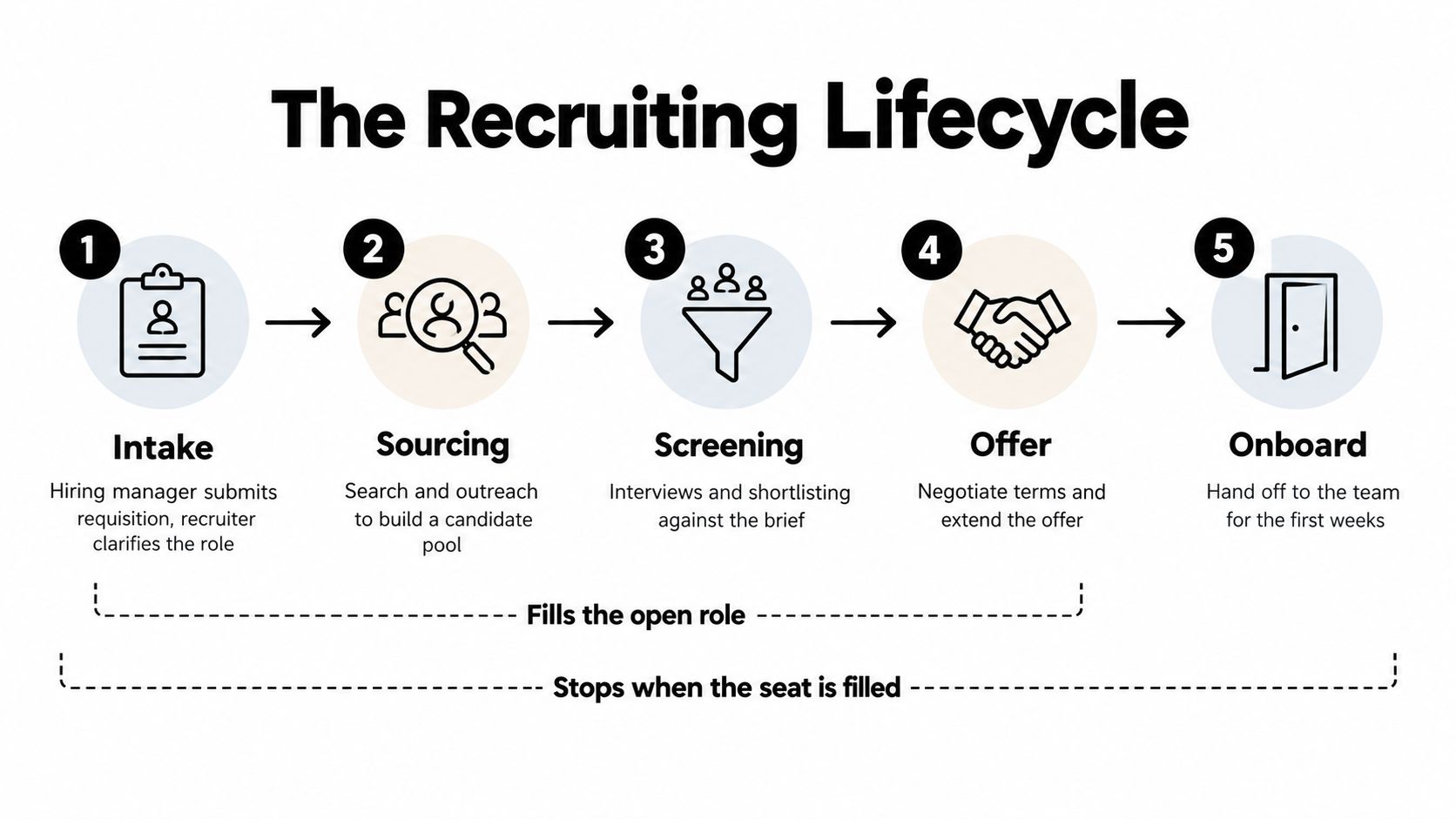
The five stages recruiters own
IntakeThe hiring manager opens a requisition. A good recruiter turns a vague request into a usable scorecard, comp range, interview plan, and job brief. A weak intake creates downstream chaos.
SourcingThe recruiter builds the candidate pool through outbound, inbound, referrals, and network search. Channel quality starts to separate average teams from serious ones.
ScreeningRecruiters assess fit against the brief, pressure-test motivation, and decide who deserves interviewer time. Poor screening floods engineering calendars with bad interviews.
OfferThis is close work. Compensation alignment, timing, objection handling, and decision speed all matter.
Onboarding handoffRecruiting usually stops once the seat is filled or handed over. That boundary is exactly why recruiting isn't the same thing as talent acquisition.
The signals that matter inside the process
You don't need vanity activity metrics. You need stage signals that show where the process is breaking.
Asymbl's overview of talent acquisition analytics gives the clean definitions: time to hire measures days from application to accepted offer, time to fill measures days from requisition opening to accepted offer, source of hire shows where hires came from, and offer acceptance rate tracks how many offers become hires in its talent acquisition analytics guide.
The useful operating view looks like this:
At intake: Was the scorecard specific enough to screen against?
In sourcing: Which channels produce qualified responses, not just raw applicants?
During interviews: How fast do interviewers move from debrief to decision?
At offer: Are declines caused by compensation, timing, or role mismatch?</li>
If you're hiring quota-carrying sales roles while building this discipline, a specialist option like SDR for hire can make sense for immediate execution. Just don't confuse role-specific recruiting support with a broader TA system.
Where talent acquisition extends the lifecycle
TA wraps around the lifecycle in both directions. Upstream, it handles workforce planning, location strategy, employer brand, and talent communities that warm future sourcing. Downstream, it looks at post-hire outcomes and asks whether the process is producing durable hires.
For remote and nearshore teams, this recruitment process checklist for remote LATAM hiring is a practical example of where recruiting mechanics end and broader hiring-system design begins.
The KPI Stack That Separates Recruiting from Talent Acquisition
If you want to know whether your company is doing recruiting or real talent acquisition, inspect the dashboard. The metric stack tells the truth faster than job titles do.
Layer one is operational execution
These are recruiter-owned metrics. They belong on a weekly dashboard and should move role by role.
Industry guidance commonly groups time to fill, time to hire, cost per hire, quality of hire, first-year attrition, source-of-hire, offer acceptance rate, candidate experience, and application completion rate as core recruitment metrics in this recruiting metrics guide. For recruiting operations, the immediate focus is on speed and conversion.
A stronger execution view also tracks stage-level ratios. Aristek notes the value of applications-to-hire, candidates-interviewed-per-offer, recruiter load versus output, and stage pass-through rates in its talent acquisition metrics overview. That's how you tell whether the problem is poor sourcing, weak screening, interviewer miscalibration, or an uncompetitive offer.
Layer two is financial control
Cost control matters once hiring volume grows beyond ad hoc recruiting.
SHRM-style cost-per-hire is straightforward: total external recruiting costs plus total internal recruiting costs divided by number of hires. A recent industry summary also cites a 2025 benchmark average of $5,475 for non-executive roles in this hiring metrics summary.
That formula is useful because it makes in-house teams, agencies, and RPO programs comparable. It also forces accountability. If recruiting cost rises every time hiring volume increases, your engine doesn't scale.
Layer three is hiring health
Talent acquisition starts. These metrics don't belong to a single recruiter closing one requisition. They belong to the leader who owns system quality over time.
KPI Ownership for Recruiting vs Talent Acquisition
Visier's strategic metric framework is useful here because it ties TA to business outcomes like revenue per employee, vacancy-day revenue loss, new-hire performance improvement, and new-hire failure rate in its strategic talent acquisition metrics article.
If you only track speed and spend, you're running recruiting. If you also track downstream hire quality and pipeline strength, you're running talent acquisition.
For a practical operating benchmark on cycle time, this guide to time-to-fill metrics is worth using with your own ATS data.
When to Invest in TA, Lean Recruiting, or RPO
This decision should follow business need, not HR fashion.
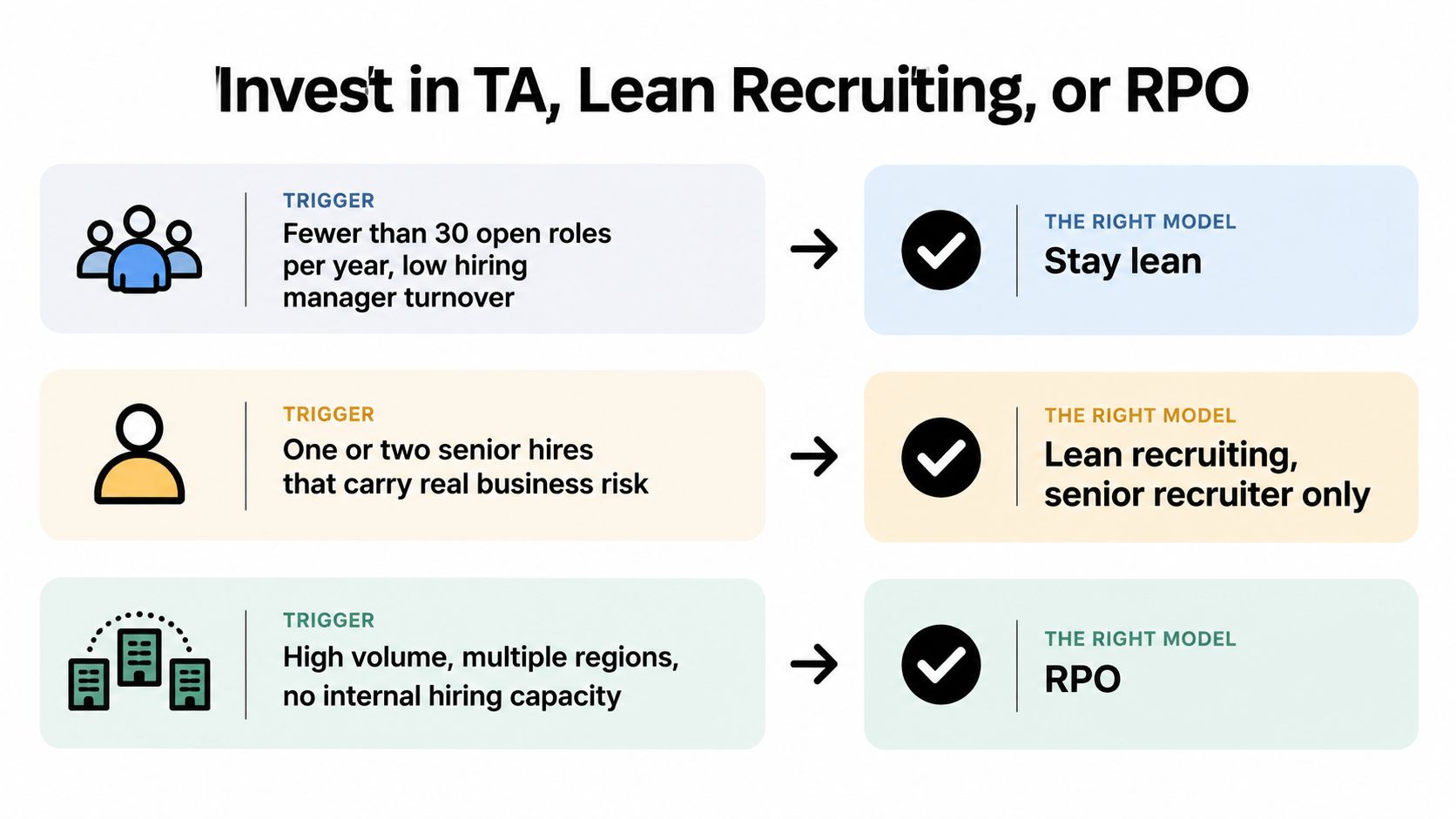
Stay lean when hiring is limited and stable
If you're hiring a small number of roles each year and most are straightforward backfills, don't build a full TA function. You'll create overhead before you create value.
A single senior recruiter, or even a fractional recruiting lead with disciplined hiring manager support, is usually enough. The job here is clean intake, fast process movement, and decent close rates.
Add a thin TA layer when complexity starts compounding
When hiring spreads across multiple teams, role types become more specialized, or you're intentionally opening new talent markets such as LATAM, recruiting alone starts to fray. You need someone to own workforce planning inputs, talent mapping, process design, and pipeline programs.
This is usually a thin TA model. One TA lead. A small recruiting team. Clear ownership boundaries. That's enough for many Series B and early Series C companies.
Use RPO when execution demand outstrips internal capacity
Some teams don't need a bigger internal org chart. They need scalable execution across regions and role families.
That's where RPO fits. It can absorb sourcing, screening, scheduling, reporting, and hiring operations without forcing you to hire a large permanent recruiting team before volume is proven. If you're exploring that route, this explanation of recruitment process outsourcing lays out the operating model clearly.
One practical option in that category is GENTY recruitment's RPO service, which handles recruiting execution across LATAM markets while an internal leader keeps ownership of hiring priorities and standards. That model is often cleaner than stitching together several contingency agencies.
The rule that saves you from premature TA hiring
If you can't explain the business outcome of a TA function in one sentence, you probably don't need one yet.
Use this checklist:
Need speed only: Fix intake, interviewer response times, and offer process before adding strategic headcount.
Need repeatable pipeline quality: Add TA ownership for talent mapping, employer positioning, and process design.
Need scale across countries or bursts of volume: Add RPO execution, keep strategic ownership in-house.</li>
A shrinking market for broad recruiter and TA titles reinforces the point. Metaview reported a 38.5% year-over-year decline in worldwide searches for recruiter/TA titles in a 2026 analysis, alongside growth in more specialist roles in its recruiting trends report. Generalist hiring teams are giving way to narrower, more accountable models.
In-House, Agency, and RPO Through the Same Lens
Most vendor comparisons miss the main issue. The right question isn't “which option hires fastest?” It's “which option supports the hiring model we need?”
In-House vs Agency vs RPO Through the TA Lens
Where each model breaks
In-house recruiting gives you control. Recruiters can calibrate directly with engineering leaders, fix broken interview loops quickly, and protect candidate experience. The downside is limited capacity. Once demand spikes, internal teams bottleneck fast.
Agencies are tactical instruments. They're useful for niche searches, executive hunts, or backfilling a sudden gap. But agencies usually optimize for placements, not for the long-term health of your pipeline or interview system. That's why agency-heavy models often produce weak reporting and little institutional learning.
RPO sits in the middle. It can run the execution layer at scale while still feeding back process data, market intelligence, and talent mapping. For cross-border growth, that's often more useful than stacking multiple agencies that all operate differently.
Agencies close roles. In-house teams build hiring capability. RPO can scale that capability without forcing a permanent internal headcount jump.
What to check for cross-border hiring
If you're hiring in LATAM, don't pick a model based only on sourcing volume.
Check for:
Timezone overlap: Can candidates and interviewers meet without process drag?
Language coverage: Do recruiters and coordinators handle bilingual communication cleanly?
Classification risk: Are you clear on contractor versus employee setup before making offers?
Reporting quality: Can the partner show funnel conversion by stage, not just resumes sent?</li>
If your need is purely role-by-role execution for engineering hires, a focused option like IT recruitment support is often enough. If the need includes process ownership, multi-role throughput, and reporting discipline, the answer shifts toward RPO.
How the Right Model Shifts at 50, 200, and 500 Employees
Headcount changes the hiring model whether you plan for it or not.
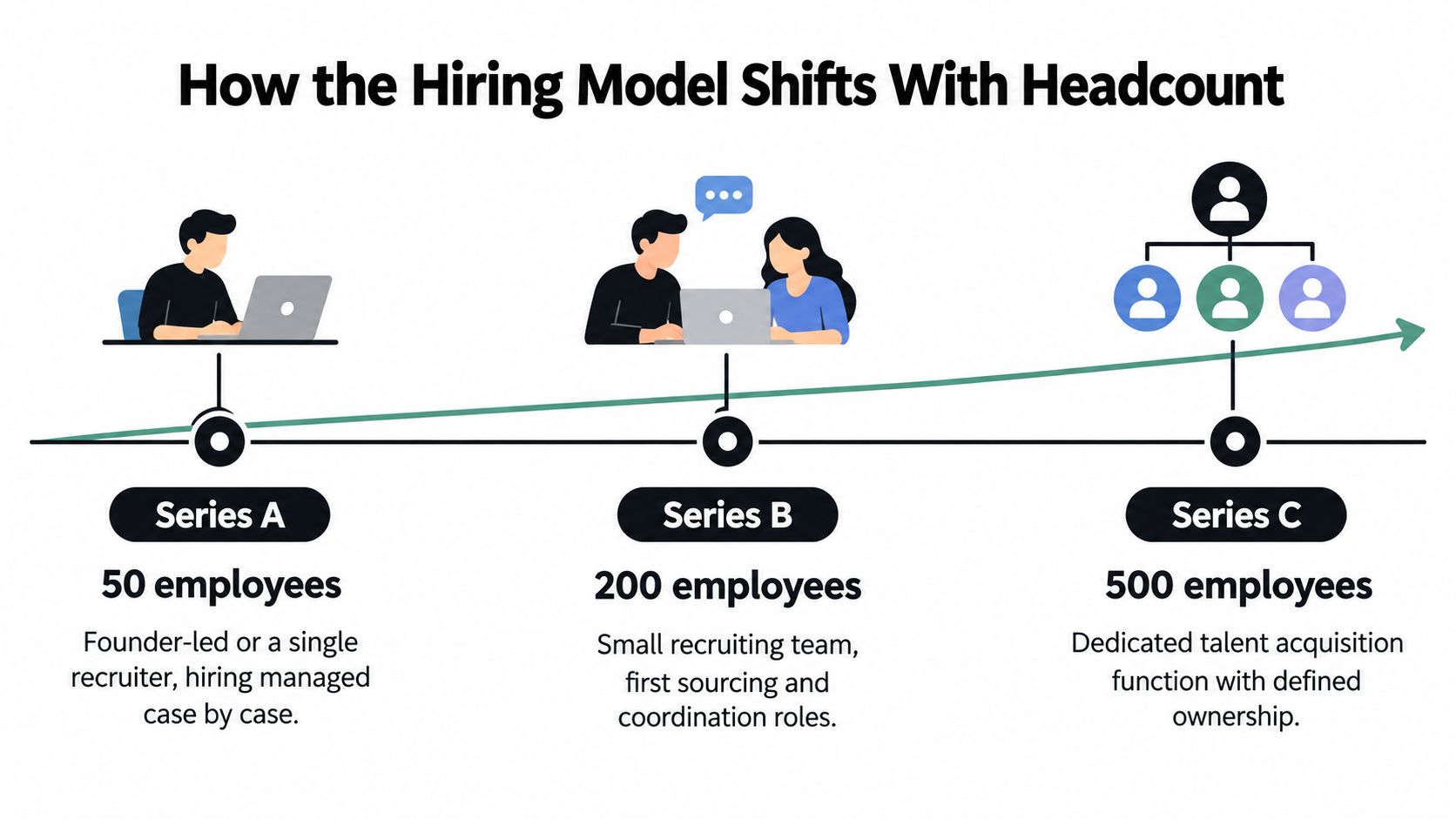
At 50 employees
Hiring is usually founder-led or handled by one recruiter. Most roles are urgent. Process maturity is low, and that's fine if role volume is small. The risk is inconsistency. Every hiring manager improvises, and candidate evaluation quality swings from role to role.
At 200 employees
Now the cracks show. One person can't source, schedule, close, and report across several teams without something breaking. Coordination work separates from recruiting work. Specialized searches become common. This is usually where the first real TA ownership appears, even if the title isn't formal yet.
The first sign you need TA isn't recruiter burnout. It's repeated hiring mistakes that your current process keeps reproducing.
At 500 employees
At this stage, talent acquisition becomes a real function. Sourcing, employer brand, analytics, and recruiting management all need defined ownership. Engineering shouldn't be improvising interview standards team by team. The hiring function now affects workforce planning, productivity, and retention, not just vacancy closure.
Skipping stages causes predictable failures. At 50 employees, overbuilding creates needless overhead. At 200, underbuilding causes missed senior hires and chaotic coordination. At 500, treating recruiting as a loose service desk usually shows up in weak offer acceptance, uneven quality bars, and poor planning across functions.
Implementation Checklist and First Move for 2026
The first move is not hiring a “Head of Talent” because the title sounds mature. The first move is instrumentation.
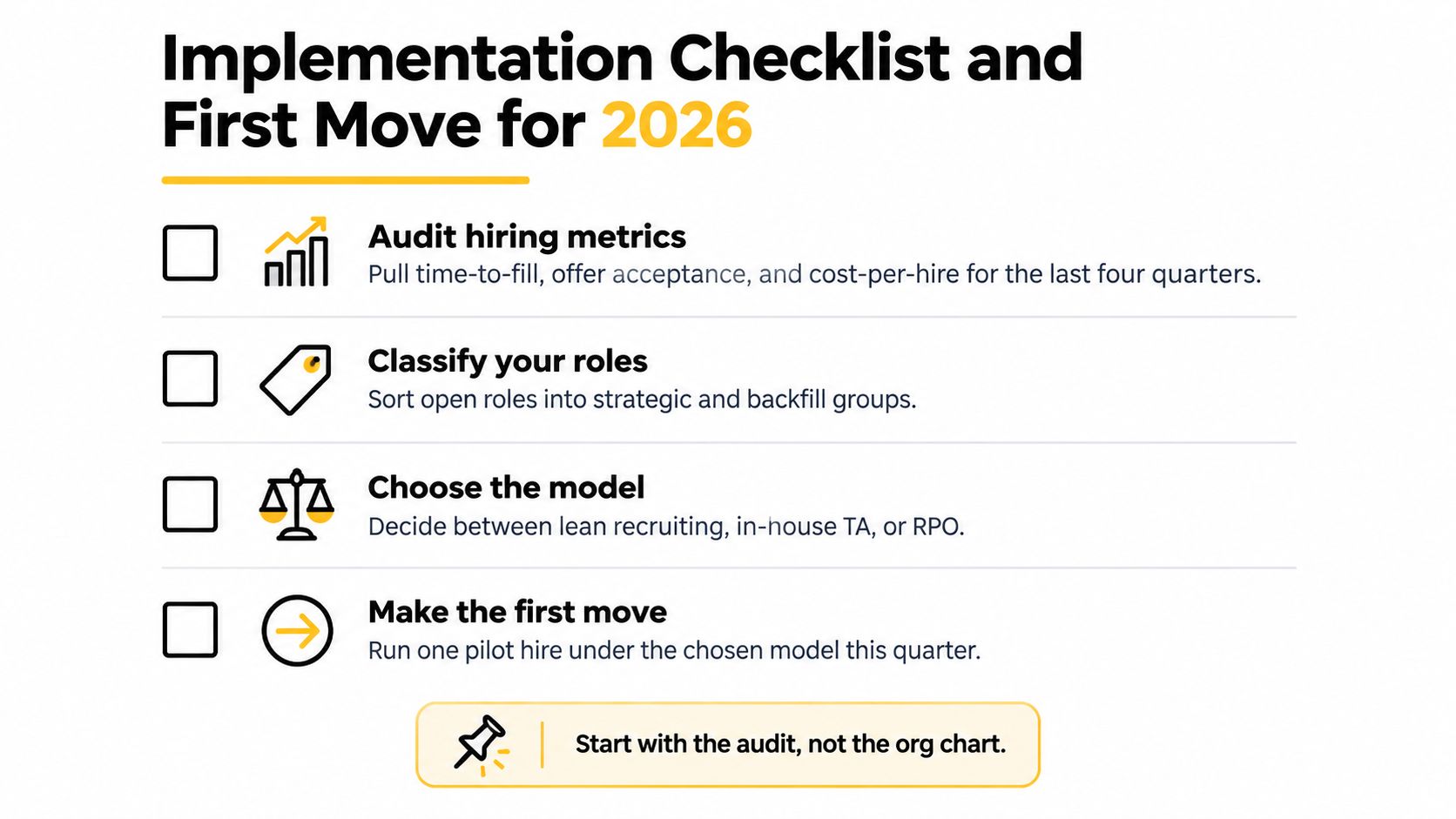
Run this checklist this quarter
Audit your current hiring dataPull time to fill, time to hire, source of hire, offer acceptance rate, and cost per hire across recent quarters.
Split roles into strategic and backfillA senior platform engineer and a replacement SDR don't need the same operating model.
Name the bottleneckIf your issue is slow interviews and vague scorecards, you need better recruiting execution. If your issue is repeated pipeline weakness across functions, you need TA ownership.
Write a one-page charterAssign owners, KPIs, budget, and delivery model. Keep it brutally clear.
The recommendation I'd give most Series A to C teams
Don't start by expanding the org chart. Start by measuring the funnel properly. Once you know where conversion breaks, you can decide whether to keep a lean recruiting model, add TA leadership, or buy execution capacity through RPO.
That sequence matters because bad instrumentation makes every later decision worse.
Start with the audit, not the org chart.
If you need one additional support path after the audit, use a defined hiring model for one role family first. Don't redesign the entire function in one move.
GENTY recruitment helps startups and scale-ups choose the right hiring model for tech and sales roles across Latin America, whether that means direct recruiting, structured pipeline support, or RPO execution tied to measurable funnel performance. If you're deciding between lean recruiting and a broader TA setup, visit GENTY recruitment and evaluate the model against your actual hiring volume, role mix, and cross-border needs.