

A solution engineer is the technical owner of the pre-sale, validating that a product works inside a prospect's environment before the contract is signed. In the closest U.S. labor category, sales engineers earned a median annual wage of $116,950 in 2023 and the role is projected to grow 5% from 2024 to 2034, which tells you this is a real revenue function, not glorified demo support.
Most hiring managers still make the same bad assumption. They treat solution engineer as one job. It isn't. A demo-first SaaS SE, a quota-carrying enterprise SE, a forward-deployed implementation SE, and an AI-integrations SE can share a title and still fail miserably if swapped.
That mismatch matters more now because the role is changing fast. A 2026 market analysis found that from Q1 2024 to Q1 2026, traditional solutions engineer postings fell 14%, while forward-deployed engineer and applied AI engineer postings rose 380% year over year in the same dataset of more than 30 SaaS companies (Perspective on solutions engineering and forward-deployed AI engineering). If you're a CTO, VP Engineering, or HR lead, the question isn't “what does a solution engineer do?” It's “which version of the role do we need?”
What a Solution Engineer Actually Does in 2026
A solution engineer owns technical discovery before the deal closes. That means uncovering requirements, mapping the buyer's environment, configuring the product to fit the workflow, and proving the thing works through demos, integrations, and proof-of-concept work (Consensus on the solutions engineer role).
Need help hiring?
See the next step after this guide
If this topic is relevant to your team, these are the most useful pages to check next.
The title hides four different jobs
Here's the blunt version. The market uses one title for four distinct hiring profiles:
Demo-heavy SE for mid-market SaaS. Strong on discovery, storytelling, and product demos.
Quota-bearing SE for enterprise sales. Strong on deal strategy, procurement friction, and technical close plans.
Forward-deployed SE for complex platforms and services-heavy products. Strong on customer-side implementation and architecture.
AI-integrations SE for model-enabled products. Strong on data flows, prompt behavior, API orchestration, and evaluation design.</li>
That's why generic job descriptions fail. The person who excels in polished Zoom demos may struggle in a role that requires sitting with a customer's engineers and untangling identity, API, and deployment issues. If you want a useful adjacent lens on role design, the responsibilities of a product development engineer are a good comparison because they show what happens when customer requirements turn into implementation constraints.
For hiring teams trying to sort adjacent titles, this breakdown of SaaS job roles for hiring managers is also useful, especially when your org keeps blurring SE, solutions architect, and technical account roles.
What the role actually covers
The practical scope usually includes:
Technical discovery: APIs, auth, data models, deployment constraints, security requirements.
Customer-shaped demos: not a canned walkthrough, but a workflow built around the customer.
POC ownership: define scope, success criteria, and handoff assumptions.
Enterprise diligence: support RFPs, RFIs, and security questionnaires when procurement gets involved.
Field feedback: push recurring objections and implementation blockers back to product and engineering.</li>
Practical rule: If your SE can't explain how your product fits into the buyer's stack, you don't have an SE. You have a presenter.
A Realistic Week in the Role
Take a quota-bearing SE at a mid-market B2B SaaS company selling a data platform to RevOps teams. Their week isn't “help sales with demos.” It's a chain of risk-reduction steps.
Monday through Wednesday
Monday starts with discovery. The SE joins the AE, asks how the prospect currently handles routing, enrichment, warehouse sync, and reporting, and identifies where the deal can die. Usually that's integration fit, security review, or workflow mismatch.
Tuesday is build day. The SE configures a demo instance around the prospect's terminology and process. Good SEs don't just show features. They replay the customer's own motion back to them in product form.
Wednesday is the technical deep dive. The IT lead or data owner asks the questions. Authentication method. API limits. Logging. Permissioning. Where the data sits. What breaks if an upstream system changes. Technical validation often revolves around concrete buyer concerns like feasibility, security, performance, workflow compatibility, and the ugly details surfaced in logs, API responses, and environment issues during trial work (DevOpsSchool blueprint for senior solutions engineers).
Thursday and Friday
Thursday is usually the POC session. The SE scopes what “success” means before the pilot runs, then works through blockers with the customer team. The better the written success criteria, the less room there is for last-minute opinion drift.
Friday is less glamorous and more valuable. The SE writes the technical win-loss recap, updates the CRM, flags product gaps, and tells the AE whether the deal is real or should be disqualified.
Most mediocre SE teams lose time in Friday silence. Nobody documents what failed, so the same objections come back next week.
A forward-deployed SE week looks different. More customer-site time, longer technical evaluations, deeper implementation work, and heavier coordination with engineering. If your team is remote and nearshore, operating cadence matters because SE work depends on fast handoffs between sales, product, and engineering. This guide on managing remote teams in tech is relevant when your SEs support distributed account teams.
The Four Variants of Solution Engineer
Treating "solution engineer" as one job is how teams make bad hires.
The title hides four different roles. If you open a req without picking the variant first, you will interview the wrong people, write the wrong scorecard, and overpay for skills you do not need.
The Four SE Variants Compared
Here is the hiring rule. Demo-heavy and quota-bearing SEs live closer to sales motion. Forward-deployed and AI-integrations SEs live closer to delivery and product reality. Those are not small differences. They change interview loops, ramp time, compensation, and who the role should report to.
Use salary data carefully. Title-level averages are noisy because companies group very different jobs under the same label. Public benchmarks can still help frame the spread. Indeed's overview of solutions engineer compensation and role expectations shows how broad the market is, especially once you mix pre-sales, implementation-heavy, and senior technical customer roles under one title.
Which company type maps to which variant
Mid-market SaaS vendors: hire demo-heavy first if the product sells through structured demos and standard integrations.
Enterprise software sellers: hire quota-bearing if the SE must defend architecture, security, and technical fit through a long sales cycle.
Platform, infrastructure, and services-heavy products: hire forward-deployed if buyers need real build work before they trust the purchase.
AI product companies: hire AI-integrations if the sale depends on data pipelines, model behavior, eval design, and production constraints.</li>
The expensive mistake is hiring for presentation skill when the job is really implementation, or hiring a strong builder when the bottleneck is executive demo control.
If you are benchmarking this role in the market, use this solutions consultant or solution engineer hiring category as the closest match.
Core Skills That Make a Strong SE
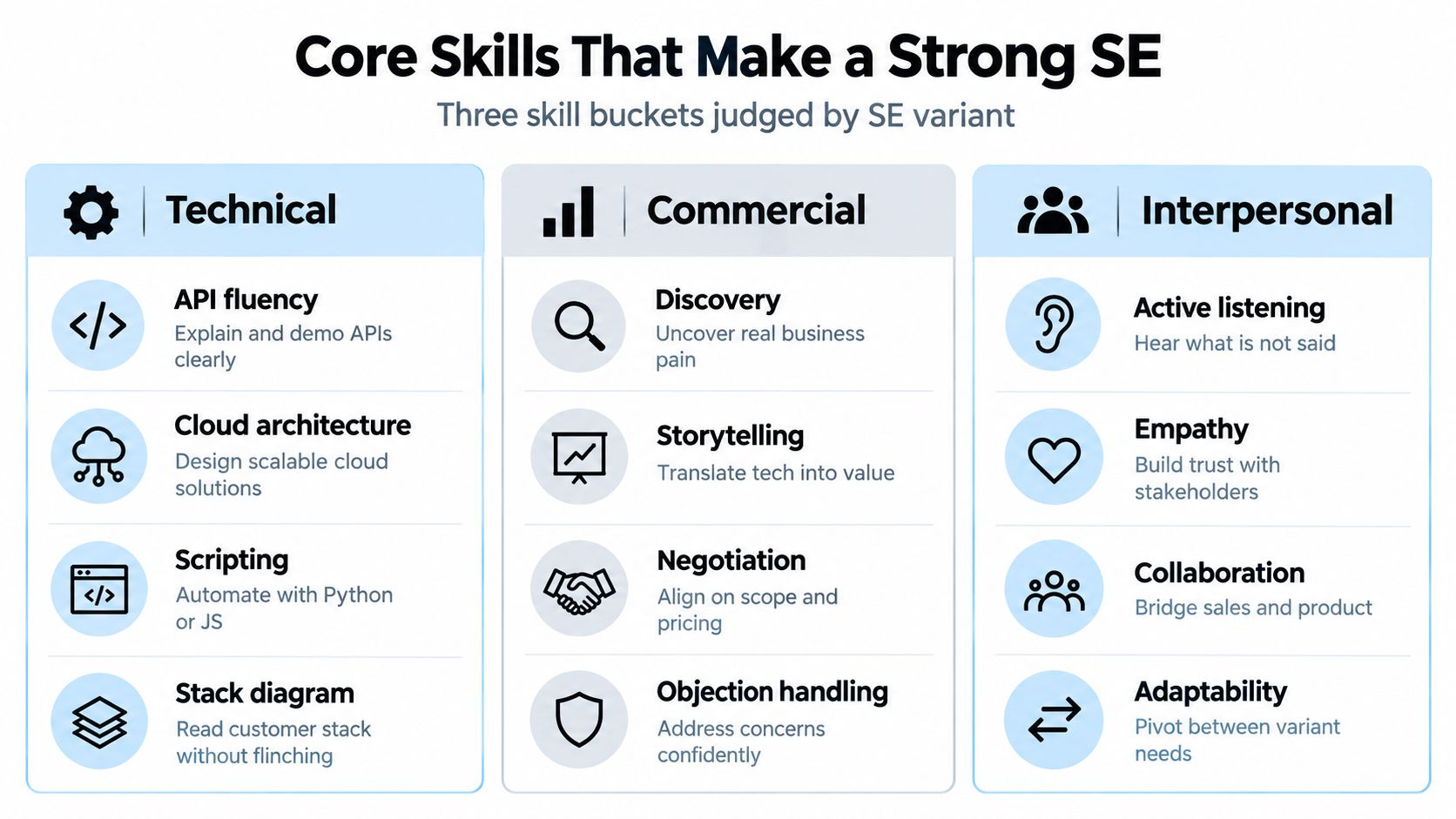
Strong SEs sit in the overlap between technical credibility, commercial judgment, and interpersonal control. Most interview loops overweight one of the three and then act surprised when the hire misses.
Here's the cleanest way to assess the role:
Technical skills
The baseline is API fluency, cloud architecture awareness, some scripting, and the ability to read a customer stack diagram without freezing. A real SE should be able to reason through auth flows, data movement, webhook behavior, and integration failure points.
Forward-deployed and AI-integrations SEs need more. They often work closer to implementation-grade architecture, and the AI variant adds prompt behavior, evaluation harness design, and cost tradeoff judgment.
Commercial skills
A strong SE knows how to qualify a deal, scope a POC tightly, and disqualify bad-fit opportunities before the team wastes cycles.
Solutions engineers are often measured on outcomes tied to demo-to-close conversion, POC win rate, technical satisfaction, and revenue influence, not just calendar activity. They also commonly define POC scope and success criteria in writing before execution, which is one of the clearest signs you're talking to a mature pre-sales operator (Outsource Accelerator glossary on solution engineers).
A candidate who says yes to every POC is dangerous. Good SEs know when to narrow scope and when to walk away.
This matters outside the SE org too. If you already invest heavily in outbound and sales development, the handoff quality has to be high. Teams building pipeline often look at adjacent hiring decisions like whether to hire cold callers because poor qualification upstream creates downstream SE waste.
Interpersonal skills
SEs translate between people who don't trust each other yet. The buyer's engineers think sales is overselling. Sales thinks engineering is blocking. Procurement wants certainty. Product wants signal, not noise.
That's why I care less about certificates and more about behavior under pressure. Can the candidate say, “I don't know, let me test it,” without losing authority? Can they send a follow-up note that an AE will use? Can they handle a room where security, legal, and an impatient VP all want different answers?
To assess that well, use a structured communication skills assessment, not just a vague “good communicator” score from the panel.
A quick visual summary helps when calibrating interviewers:
Salary, Seniority, and Where the Role Pays Best
The title is too broad to price cleanly. A demo-heavy SE, a quota-bearing SE, a forward-deployed SE, and an AI-integrations SE can all carry the same title and land in very different comp bands. If you budget them the same way, you will miss the hire or overpay for the wrong shape of talent.
What the market actually rewards
Base salary follows technical depth. Total cash follows revenue pressure. Equity follows scarcity and company stage.
That is why generic averages mislead. Public market summaries put Solutions Engineer pay anywhere from mid-market software support levels to senior pre-sales compensation. The gap is real because the job label hides four distinct roles. A demo-heavy SE usually prices closer to classic pre-sales. A quota-bearing SE gets pulled up by variable pay. A forward-deployed SE often prices like a solutions architect or light implementation lead. An AI-integrations SE can price above all three because the talent pool is smaller and the buyer risk is higher.
Use the sales engineer category as the rough floor for U.S. market planning, not the final answer. The closer the role gets to enterprise architecture, custom workflows, data access, model behavior, or pre-signature implementation risk, the less useful generic title data becomes.
Solution Engineer Salary Bands by Seniority and Region (2026)
Here is the practical rule. Pay for the hardest part of the job, not the nicest part of the title.
Use these three questions to set the band:
How much revenue does this person directly influence?
How often will they work in complex customer environments, not clean demo environments?
Are they expected to absorb implementation or integration risk before the contract is signed?
If the answer is “a lot” on all three, you are not hiring a standard SE. You are hiring expensive talent under a familiar title.
Regional strategy matters too. Tier 1 U.S. markets still pay best for enterprise-facing SEs who can handle executive buyers, security review, and ugly integrations in the same cycle. Tier 2 U.S. markets often give the best hiring economics. LATAM works well for nearshore coverage, follow-the-sun support, and implementation-adjacent pre-sales. It stops being cheap once you need rare product fluency, heavyweight enterprise credibility, or strong AI integration judgment.
If you are comparing markets seriously, use a real salary benchmarking service for customer-facing technical roles, not title averages scraped from mixed job posts. That is how you avoid underbudgeting the hard variants and overbuilding comp for the light ones.
Hiring Checklist Before You Sign the Offer
Most failed SE hires don't fail because the candidate lacked intelligence. They fail because the company hired against a stereotype.
Use this after the final interview.
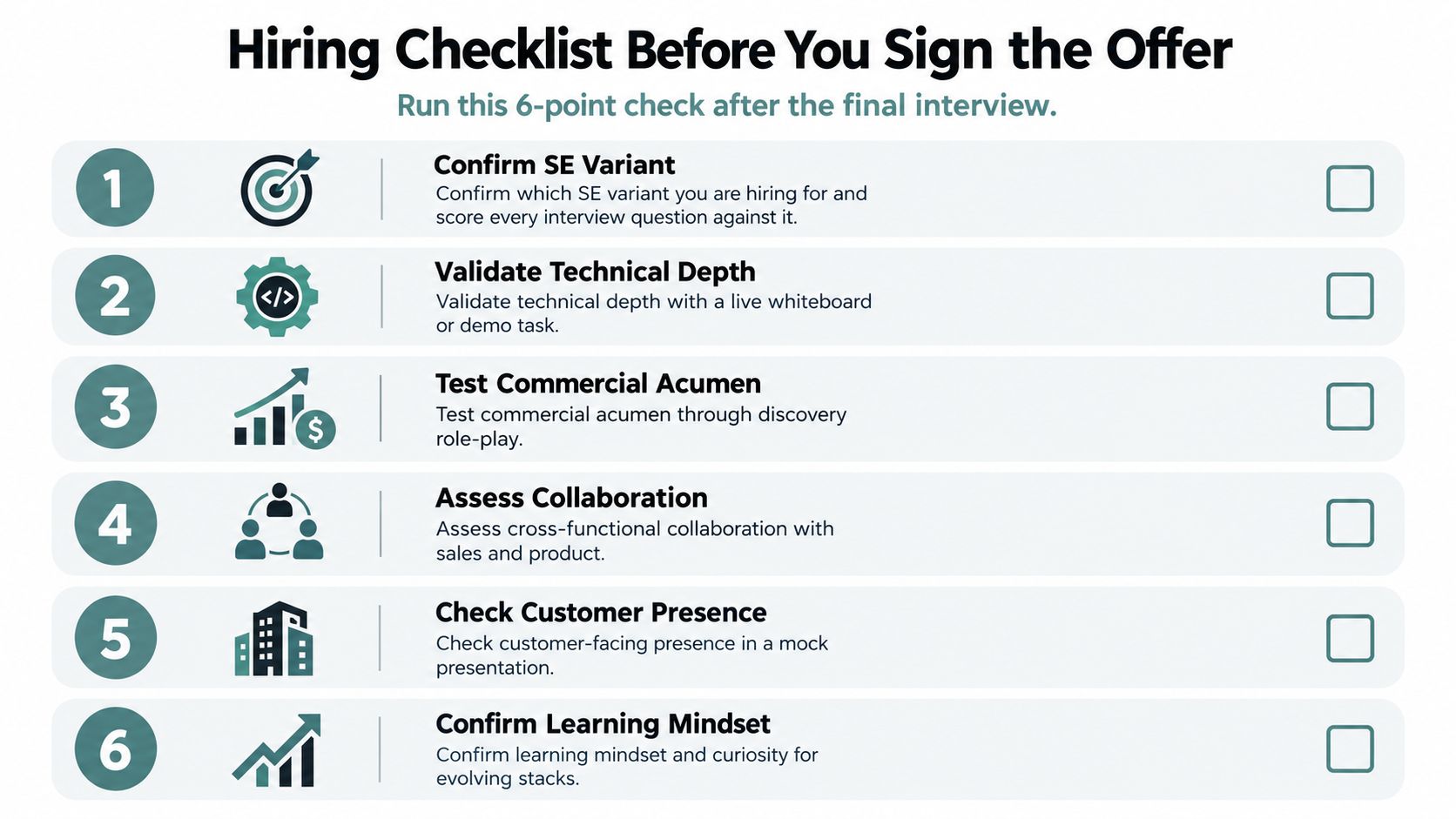
Eight checks that catch most bad hires
Confirm the variant first. Decide whether you need demo-heavy, quota-bearing, forward-deployed, or AI-integrations. Score every interview against that version only.
Make them demo a real problem. Don't accept a polished sandbox presentation. Give them a prospect scenario with messy requirements and see how they shape the flow.
Run a technical architecture read. Put an unfamiliar stack diagram in front of them and ask what they'd validate, what they'd ignore, and what would trigger a POC.
Test commercial judgment. Ask them to disqualify a deal. Weak candidates try to “save” everything. Strong ones know what not to chase.
Check references on outcomes. Ask what kinds of deals they influenced, how they handled technical blockers, and whether account teams trusted their calls.
Probe enterprise diligence. Many SEs spend real time on procurement support, including RFPs, RFIs, and security questionnaires, especially in long sales cycles where compliance and feasibility decide whether the deal advances (Onjob solutions engineer job description).
Decide comp mechanics before the offer. Quota share, bonus logic, and ramp expectations need to be explicit. Ambiguity here creates politics in the first quarter.
Write the 30-60-90 plan. Define what success looks like in discovery quality, demo ownership, POC handling, and cross-functional trust.
Hiring rule: SE interviews should look more like deal simulations than like trivia contests.
One practical option if you're building the role from scratch is to use a specialist partner that already recruits across technical and revenue functions. GENTY recruitment provides RPO services, which can help when internal recruiters don't have calibration for hybrid roles like SEs.
Why Variant Fit Is the Real Hiring Decision
The highest-value screening question isn't “does this candidate know our stack?” It's “which SE variant has this person been doing?”
The failure pattern is predictable
A demo-heavy SE often struggles when you attach revenue ownership and procurement pressure. A quota-bearing SE can hate forward-deployed work because the role becomes implementation-heavy and less deal-driven. An implementation-first profile may be brilliant with customer engineers and still underperform in executive demos.
Here's the short diagnostic I'd use in every kickoff:
What does this SE own by day 90?
What does the existing team already do well?
What gap must this hire close that nobody else can?
Variant vs. Common Failure Modes
Hire for the work the person will do on Tuesday, not the title they held on LinkedIn.
Variant fit should outrank pedigree. It should outrank logo history. In many cases, it should outrank stack familiarity too. A smart SE can learn your product. What they usually can't do quickly is rewrite their working style from deal support to customer-side implementation, or from enterprise procurement to AI evaluation design.
If your last SE hire looked strong on paper and still missed, audit the variant before you blame the recruiter or the panel.
If you're hiring a solution engineer, the hard part isn't finding “technical sales talent.” It's defining the exact variant, compensation logic, and interview bar before the market does it for you. GENTY recruitment helps startups and scale-ups hire technical and revenue-facing talent across Latin America, which is useful when you need nearshore SEs, adjacent solutions roles, or a faster benchmark on what the role should look like.