

Most hiring managers use “staffing” and “recruiting” as if they mean the same thing. They do not. Understanding the real difference between staffing and recruiting is not just a terminology exercise. It shapes how you allocate budget, how fast you fill roles, and whether you build a workforce that actually scales. Tech startups feel this most acutely, where a wrong hire or a slow process can derail a product launch. This guide breaks down what each function actually covers, where they diverge, and how to use both to your advantage.
Key takeaways
The difference between staffing and recruiting, defined
The confusion starts because both activities involve bringing people into an organization. But their scope, purpose, and ownership differ in ways that matter deeply when you are trying to build a high-performing team under pressure.
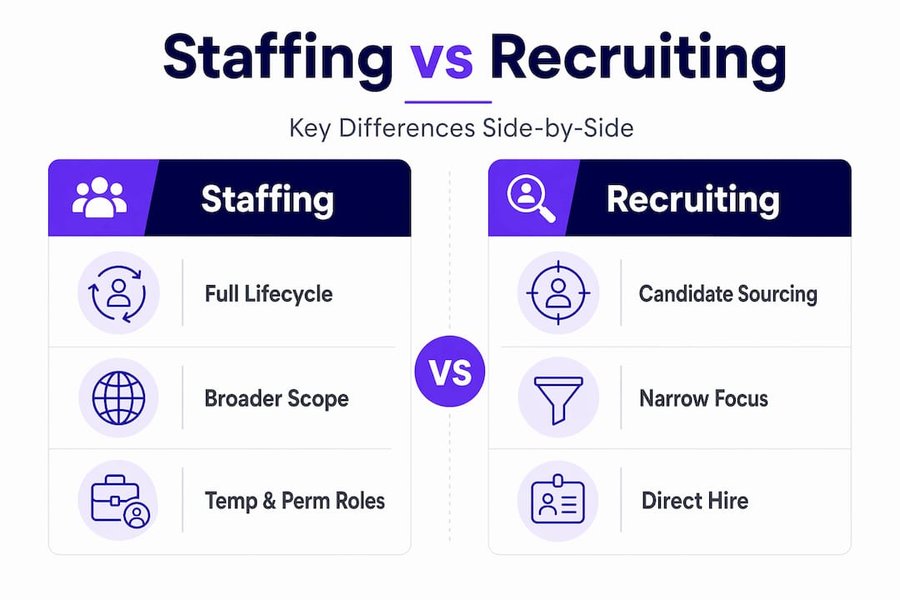
Staffing is the broader function. It covers every dimension of workforce management, from identifying organizational needs and hiring people to onboarding them, scheduling their time, ensuring compliance, and managing their ongoing development and retention. Think of staffing as the full lifecycle of how an organization acquires and manages its human resources. A company’s staffing function does not end when someone accepts an offer. It continues through every performance cycle, every contract renewal, and every transition out of the organization.

Staffing agencies extend this concept into a service model. Staffing agencies handle legal and administrative employment duties including payroll, taxes, and compliance, which makes them especially valuable for startups that need to scale rapidly without building internal HR infrastructure overnight. When you engage a staffing agency, you are not just outsourcing a search. You are outsourcing employer-of-record responsibilities and workforce administration.
Planning a hire?
Talk through the best hiring option
This article usually leads to one practical question: should you use staffing or it recruitment? We can help you choose quickly.
Simple next step
Start with staffing and we will help you pick the best hiring setup.
Key activities that fall under staffing include:
- Workforce planning and headcount forecasting
- Hiring and onboarding for temporary, contract, or permanent roles
- Training and performance management programs
- Scheduling and labor allocation across teams or projects
- Compliance and legal employment administration
- Retention programs and employee lifecycle management
Pro Tip: If you work at a seed or Series A startup, a staffing agency can serve as your de facto HR department for contract and temporary workers, handling payroll compliance while you focus on building your product team.
Staffing agencies also maintain larger candidate networks giving access to passive candidates that in-house methods rarely surface. This is one of the structural advantages you get from a mature agency relationship rather than posting on a job board and waiting.
What recruiting actually covers
Recruiting is a targeted, tactical activity nested within the broader staffing function. Its focus is sourcing, attracting, evaluating, and selecting candidates for specific open positions. Where staffing thinks about the whole workforce, recruiting thinks about the next hire and whether that person has the right skills, fit, and potential.
Recruiting focuses on attracting quality candidates for permanent roles with cultural fit, while staffing more often fills temporary or lower-level roles quickly. Recruiting firms tend to go deep on specific talent pools. A technical recruiter at a SaaS company is not just screening resumes. They are evaluating coding assessments, conducting structured competency interviews, and assessing how a candidate’s engineering philosophy aligns with the team’s existing architecture decisions.
The recruiting process typically flows through these stages:
- Job analysis and role scoping with hiring managers
- Candidate sourcing through job boards, referrals, LinkedIn, and talent networks
- Resume screening and initial qualification calls
- Technical assessments or skills evaluations
- Structured interviews and scorecard reviews
- Offer management and pre-close conversations
The difference between hiring and recruiting also surfaces here. Hiring is the transactional endpoint: extending an offer and completing onboarding paperwork. Recruiting is the entire strategic process that gets you to that point. Conflating the two causes companies to underinvest in sourcing and pipeline-building because they treat the offer stage as the whole job.
Modern recruiting increasingly relies on technology. Job boards now integrate directly with applicant tracking systems, and ATS-powered hiring workflows allow recruiting teams to manage candidate pipelines more efficiently across multiple open roles simultaneously.
Staffing vs recruiting: a side-by-side comparison
Understanding the operational differences between staffing and recruiting helps you make smarter decisions about when to use each. The table below maps the key dimensions.
The speed differential alone shapes many decisions. Staffing agencies typically fulfill temporary roles within 5 days, while direct-hire recruitment stretches to 20 to 40 days. For a tech startup running a sprint-based product cycle, that gap is not trivial. Leaving a senior backend engineer role unfilled for six weeks carries a real cost. Unfilled specialized roles can cost employers between $44,000 and $63,000 in lost productivity, which makes agency fees look considerably more reasonable in comparison.
Cost structure also diverges in ways that affect your planning. Staffing agencies charge a markup on the hourly rate of the temporary worker, typically ranging from 25% to 50% above the worker’s base pay. Recruiting firms charge a placement fee after a successful hire, usually a percentage of first-year compensation. Neither model is universally cheaper. The right choice depends on role permanence, urgency, and the strategic importance of the position.
Pro Tip: When evaluating agency fees against in-house recruitment costs, factor in recruiter time, job board spend, interview hours from your engineering team, and the productivity loss from a vacant seat. The true cost of a hire almost always exceeds the invoice.
Staffing and recruiting in tech startups
Tech startups operate under conditions that make the staffing vs recruiting distinction especially consequential. Headcount decisions happen fast. The talent market for experienced engineers, data scientists, and product managers remains competitive. And budget constraints mean you cannot afford to run the wrong process for the wrong need.
Here is how to think through the decision in a startup context:
<p>Identify the role type first. Is this a permanent position critical to your product roadmap, or a short-term need tied to a specific project or funding phase? Permanent, specialized roles warrant a full recruiting process. Short-term or contract roles are better served through staffing solutions.</p>
<p>Evaluate your timeline. If you need someone productive within two weeks, a staffing agency is the realistic path. A full recruiting cycle for a senior software engineer will not fit that window.</p>
<p>Consider cultural fit requirements. Roles with high team integration requirements, like engineering leads or product managers, need a proper recruiting process that assesses communication style, decision-making approach, and alignment with your technical culture. Staffing prioritizes speed and availability over cultural calibration.</p>
<p>Assess your compliance exposure. If you are hiring contractors across multiple states or countries, staffing agencies for seasonal or project-based needs provide workforce flexibility without permanent commitment, while also absorbing the compliance burden. For LATAM hiring specifically, this is a critical consideration.</p>
<p>Budget against vacancy cost. For specialized technical roles, 62% of hiring leaders cite lack of qualified candidates as a top obstacle. When your internal pipeline runs dry, the question is not whether to pay for external help but which type of help delivers the best outcome.</p>
The risk of conflating the two functions is real. Hiring managers who use a staffing agency for a permanent engineering hire often find the candidate is a technical fit but struggles with long-term team integration. Conversely, running a full 30-day recruiting process for a two-month contractor role wastes everyone’s time and money.
Combining both functions strategically gives you the best of both worlds. Gentyrecruitment’s work with tech startup hiring strategies shows that companies integrating staffing and recruiting into a unified talent acquisition workflow consistently outperform those treating each function as a separate, siloed process.
Best practices for integrating both functions
Getting the most from staffing and recruiting requires a deliberate approach, not just reacting to open headcount requests. These practices help you build a hiring function that is both agile and quality-driven:
- Map workforce needs quarterly. Assess your current team composition and project pipeline to determine where gaps are likely to emerge. This tells you whether you need the speed of staffing or the precision of recruiting before a role becomes urgent.
- Segment your roles by urgency and permanence. Create a simple classification system: high-urgency temporary roles go to staffing partners, high-value permanent roles go through a structured recruiting process.
- Choose your partners carefully. Internal recruitment works best for roles with flexible timelines and employer branding emphasis, while staffing agencies excel in fast, specialized, or temporary hiring. Know which mode you are in before you pick up the phone.
- Protect the candidate experience across both paths. Candidates do not know or care whether they are going through a staffing process or a recruiting process. A poor experience reflects on your employer brand either way. Set response time standards and interview process norms that apply to both channels.
- Track KPIs that reveal process health. Time to fill, quality of hire at 90 days, retention rate by source, and offer acceptance rate are all signals that tell you whether your staffing and recruiting mix is working. Review them monthly and adjust.
- Consider RPO at scale. Recruitment Process Outsourcing is cost-effective for organizations making 30 to 50 or more hires annually, consolidating fragmented agency relationships into a single workforce planning infrastructure.
Pro Tip: Resist the urge to fully automate your recruiting process. 81% of frontline recruiters worry about losing human judgment through AI over-automation. Use technology to remove administrative friction, but keep human review at every stage that involves candidate evaluation and final selection.
My take on where most hiring managers go wrong
I have seen this pattern repeatedly: a hiring manager reaches out to a staffing agency because they need someone fast, gets a technically adequate candidate, and then wonders six months later why that person is not performing at the level a permanent hire would. The problem was never the agency. It was the category mismatch.
What I have found is that most companies under-invest in the upfront decision of which process to use. They default to whoever they called last time, or they pick the option that feels fastest, without asking the right question: what does this role actually require over the next 12 months? That single question changes everything.
I am also skeptical of the trend toward treating recruiting as purely a technology problem. Tools that rank candidates by keyword match or automate first-round screens do reduce administrative volume, and there is real value there. But AI-driven hiring efficiency cannot replace the judgment call of whether a candidate’s way of thinking fits your team’s current challenge. That still requires a skilled recruiter who understands your business, not just your job description.
The future will likely see staffing and recruiting converge further, particularly as remote work expands access to global talent pools and companies increasingly hire on project-based models. The hiring managers who will perform best are those who understand the distinct strengths of each function and deploy them deliberately. Speed without quality is just turnover at scale.
— Eugene
How Gentyrecruitment handles both sides of the equation
Gentyrecruitment works with US and European tech companies that need both speed and quality from their hiring process. Whether you need a senior engineer hired and onboarded within three weeks or a contract team assembled for a six-month product build, the process combines structured technical assessment with direct sourcing from pre-vetted LATAM talent networks. For companies making consistent tech hires, IT recruitment from LATAM delivers candidates who are technically qualified, English-speaking, and ready to integrate into global engineering teams. For more flexible or project-based needs, remote staffing and EOR services absorb the compliance burden while you focus on output. For companies hiring at scale, RPO solutions consolidate the entire talent acquisition function under one accountable partner. Reach out to Gentyrecruitment to discuss which approach fits your current hiring priorities.
FAQ
What is the main difference between staffing and recruiting?
Staffing is a broad workforce management function covering the full employee lifecycle, including hiring, onboarding, compliance, and retention. Recruiting is a focused process within staffing that specifically handles sourcing, evaluating, and selecting candidates for open roles.
When should a tech startup use a staffing agency vs. a recruiting firm?
Use a staffing agency when you need a role filled quickly, on a temporary or contract basis, or when you want to outsource compliance and payroll administration. Use a recruiting firm when hiring for a permanent, specialized, or senior role where cultural fit and long-term performance matter.
How long does staffing vs recruiting take?
Staffing agencies typically fill temporary roles within 5 days. Direct-hire recruiting for specialized or senior roles takes 20 to 40 days depending on role complexity and candidate availability.
What is the difference between hiring and recruiting?
Recruiting is the full process of sourcing, evaluating, and selecting candidates. Hiring refers specifically to the final transactional steps: the offer, acceptance, and onboarding. Recruiting drives the decision; hiring executes it.
Is RPO a form of staffing or recruiting?
Recruitment Process Outsourcing is a managed form of recruiting where an external provider handles some or all of the recruiting function on behalf of a company. It becomes cost-effective at 30 to 50 or more annual hires and consolidates workforce planning data beyond what standard agencies provide.