

Most tech startup hiring managers spend their days reacting: a role opens, a search begins, weeks pass. What is talent mapping, and why does it exist? It’s the practice of continuously documenting the external talent market for roles your company will need in the next 6 to 18 months, producing named candidates, compensation benchmarks, and skill availability data before any requisition opens. It sits between workforce planning and active recruiting, giving you hiring intelligence instead of hiring panic. This article explains the talent mapping definition, how the process works, which tools support it, and how to avoid the pitfalls that stall most early attempts.
Key takeaways
What talent mapping actually means
The talent mapping definition that most HR articles offer is too narrow. They describe it as “building a candidate list.” That undersells the practice considerably.
Talent mapping is workforce intelligence that documents the external talent market for specific roles expected in the next 6 to 18 months, producing named targets, compensation data, and skill availability across competing companies. The output is not a spreadsheet of resumes. It’s a structured, living picture of who exists in the market, where they work, what they earn, and how ready they are to move.
Understanding how talent mapping differs from related terms removes a lot of confusion in practice.
Planning a hire?
Talk through the best hiring option
This article usually leads to one practical question: should you use it recruitment or staffing? We can help you choose quickly.
Simple next step
Start with it recruitment and we will help you pick the best hiring setup.
Talent mapping and market mapping solve different problems: talent mapping lists specific people for hiring execution, while market mapping offers aggregate strategic views of the landscape. Conflating the two causes teams to produce reams of competitor org data that no one ever uses to make a hire.
The relationship with workforce planning matters too. Talent mapping connects business priorities to workforce and succession planning rather than simply filling immediate openings. Workforce planning identifies which capabilities the business will need and when. Talent mapping then answers: who in the external market has those capabilities, where do they work, and what will it take to hire them? One feeds the other.
The concrete outputs of a talent map include:
- Named external candidates with contact information and LinkedIn profiles
- Readiness tiers (immediately available, open to conversations, passively employed)
- Skill supply data showing concentration of specific competencies by geography or company
- Compensation benchmarks for target roles
- A talent pipeline that can be activated when a role goes live
The talent mapping process for tech startups
Knowing what talent mapping produces is one thing. Understanding how to do talent mapping in a startup context is where most HR teams struggle. Here is a practical process that works.

1. Define the critical roles and capabilities. Start with your workforce plan, or if you don’t have one, with your 12-month hiring roadmap. Scope mapping to 10 to 15 essential capabilities that are both critical to the business and scarce in the market. For a SaaS startup, this might mean senior backend engineers, product-led growth specialists, and ML infrastructure engineers. You are not mapping every role. You are mapping the ones that, if vacant, would slow the company down most.
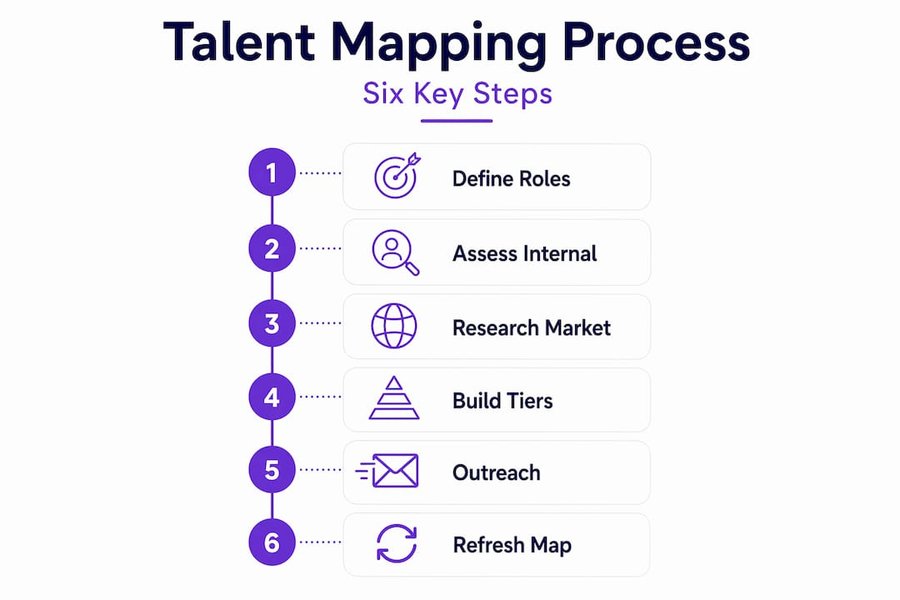
2. Assess your internal talent. Before spending resources mapping external markets, evaluate what you already have. Pairing external research with internal capability assessment drives better decisions about which roles to build internally versus source externally. A skills gap analysis of your current team tells you where the real external hiring need sits.
3. Research the external market. Identify 10 to 20 target companies where your ideal candidates currently work. Study their engineering org structures, funding rounds, growth trajectories, and any signs of instability like recent layoffs or leadership changes. Then identify specific individuals at those companies who fit your target profile. Use LinkedIn, GitHub, conference speaker lists, and technical community forums.
4. Build and maintain readiness tiers. Explicit readiness tiers help differentiate who can be hired immediately versus who needs nurturing over longer lead times. A practical tier structure: Tier 1 candidates are warm contacts who have indicated openness to new roles. Tier 2 candidates are passive but profileable. Tier 3 candidates are cold but high-potential for future engagement.
5. Activate light-touch outreach. Your map is not a static file. You need to build actual relationships with Tier 1 and Tier 2 candidates before any role opens. This means sharing relevant content, engaging on LinkedIn, attending industry events, and maintaining occasional check-ins.
6. Refresh the map on a set cadence. Monthly for Tier 1 candidates. Quarterly for the broader map. Without a refresh cadence, data ages fast, especially in tech where people change jobs every 18 to 24 months on average.
Pro Tip: Connect your talent map directly to a talent pool so that when a role goes live, your team has a pre-warmed shortlist ready within hours rather than weeks. See how this works in practice with this overview of building a talent pool for tech HR teams.
Tools that make talent mapping work
No talent mapping process scales without the right technology. The good news is that the tools most tech startups already use can support talent mapping with some configuration.
Applicant Tracking Systems (ATS) do more than manage active candidates. When set up correctly, an ATS becomes the infrastructure for your talent pipeline. You can tag candidates by role, tier, skills, and engagement date, giving you a searchable, sortable version of your talent map rather than a static spreadsheet.
AI sourcing tools identify and engage qualified candidates faster, improving quality and reducing time-to-hire. Tools that aggregate data from LinkedIn, GitHub, Stack Overflow, and technical community platforms help you find candidates you would never surface through inbound applications alone. This is particularly relevant for LATAM engineering talent, where strong engineers often have minimal LinkedIn presence but extensive open-source contributions. Learning about AI-powered sourcing workflows can show you how leading firms are integrating these tools into their talent mapping practice.
Data analytics adds a layer that most startups skip entirely. Beyond identifying individuals, analytics can show you:
- Which target companies are experiencing attrition spikes (a signal that their talent is more open to moves)
- How compensation bands for specific roles have shifted over the past 6 months
- Where the highest concentration of a specific technical skill exists geographically
- Which sourcing channels produce the highest-quality profile matches
Pro Tip: Don’t invest in a dedicated talent mapping platform before you’ve mapped at least two critical roles manually. The discipline of doing it by hand teaches you what data actually matters before you automate it.
The combination of ATS infrastructure, AI sourcing, and market analytics is what transforms talent mapping from an occasional research project into a continuous hiring intelligence function. Understanding broader IT recruitment trends helps you see where the technology is heading and where to prioritize your tooling investment.
Common talent mapping pitfalls
Most talent mapping efforts in tech startups fail for predictable reasons. Knowing them ahead of time is most of the solution.
<p>Treating the talent map as a CRM. Confusing talent mapping with tooling or a simple CRM stalls the effort immediately. A CRM stores contact history. A talent map is an analytical discipline with a defined scope, a refresh cadence, and decision-relevant outputs. If your “talent map” doesn’t answer the question “who would we call tomorrow if this role opened today,” it’s a contact list, not a talent map.</p>
<p>Mapping too broadly. Early-stage talent maps fail by being overly broad, leading to stale data no one trusts or uses. Mapping 5 to 10 key roles delivers more actionable outcomes. Resist the temptation to map every role in your org chart. Focus on the roles that are hardest to fill and most critical to business continuity.</p>
<p>Not integrating outputs into decisions. A talent map that gets updated quarterly but never informs a hiring decision is wasted effort. Every time a role opens, your team should consult the map first. If it’s not part of the workflow, it won’t stay current, and it won’t get used.</p>
<p>Neglecting candidate relationships. Treating talent maps as living relationship assets with ongoing outreach enables fast, effective hiring when roles open. A name on a spreadsheet without any relationship history is not a pipeline. It’s a cold list.</p>
<p>Skipping workforce planning integration. Talent mapping without a business forecast behind it produces research with no direction. If you don’t know which capabilities the company will need in 12 months, you can’t decide which roles to map today.</p>
Benefits of talent mapping for tech startups
The importance of talent mapping becomes obvious when you look at what changes operationally once the practice is in place.
The most direct benefit is shorter time-to-fill. When a role opens and you already have a tiered list of warm candidates, your search starts days into the process rather than at zero. This is especially significant for senior technical roles where average time-to-fill in 2026 regularly exceeds 60 days for companies hiring reactively.
The benefits of talent mapping extend well beyond speed:
- Better candidate quality. Proactive relationship-building means candidates already know your company before any formal process starts. That reduces drop-off and increases offer acceptance rates.
- Compensation accuracy. Ongoing market research keeps your salary bands current, so you’re not losing candidates late in the process because your offers are 15% below market.
- Competitive intelligence. Understanding where talent concentrates, which companies are growing their engineering teams, and where attrition is happening gives you a genuine market advantage.
- Agility. When market conditions shift quickly, as they do constantly in tech, a maintained talent map lets you activate hiring in days rather than weeks.
- Alignment with business strategy. Because talent mapping starts with workforce planning, every hiring decision connects to a business priority rather than an ad-hoc reaction.
For startups scaling from 50 to 200 employees, these advantages compound. Each new hire into a pre-mapped role arrives faster, better prepared, and better compensated, reducing early attrition and increasing team productivity.
My perspective on talent mapping’s real value
I’ve watched companies approach talent mapping in two very different ways, and the gap in outcomes is stark.
The teams that treat their talent map as a living relationship asset, refreshing it monthly and actually reaching out to Tier 1 candidates before roles open, hire faster and lose fewer offers. The teams that build a beautiful map in a spreadsheet and update it once a quarter never seem to use it when it matters. The tool is not the problem. The discipline is.
What I’ve found most counterintuitive is that bigger maps are almost always worse. When I’ve seen startup HR teams map 30 roles at once, they produce a document that ages immediately and paralyzes everyone. Narrowing to 5 to 10 near-term critical roles creates a map that people actually trust and consult. Less scope, more rigor, more impact.
The other thing I’d push back on in conventional thinking: talent mapping is not a standalone HR function. It only works when it’s tightly integrated with whatever workforce planning process the business already runs, even if that process is just a quarterly conversation with the CEO about headcount. Without that business-level input, talent mapping becomes research for its own sake. With it, hiring becomes a genuinely proactive capability instead of a perpetual emergency.
The startups that understand this distinction don’t just hire better. They build a genuine competitive advantage in talent markets where everyone else is still posting job descriptions and waiting.
— Eugene
How Gentyrecruitment supports your talent mapping strategy
Talent mapping is most powerful when your external market intelligence is accurate and current. That requires deep knowledge of specific talent pools, compensation benchmarks, and candidate availability across geographies. For tech startups hiring across the Americas and Europe, that depth of knowledge takes years to build in-house.
Gentyrecruitment specializes in IT recruitment for LATAM tech talent, combining AI-powered sourcing with structured candidate assessment to deliver pre-vetted engineers, product specialists, and technical leaders from Argentina, Brazil, Mexico, Colombia, and beyond. The candidates we deliver are English-speaking, technically qualified, and already assessed against the role profiles tech startups typically map. Whether you’re building your internal talent mapping practice or need an external partner to accelerate your pipeline for FinTech, AI, or SaaS roles, Gentyrecruitment’s pre-vetted LATAM talent sourcing gives you a shortlist in days, not months. Reach out to discuss how we can complement your hiring strategy.
FAQ
What is talent mapping in simple terms?
Talent mapping is the process of researching and documenting the external talent market for roles your company expects to hire in the next 6 to 18 months, producing named candidates, readiness tiers, and compensation data before any job opens.
How does talent mapping differ from succession planning?
Talent mapping focuses on external candidates and market intelligence for future hiring, while succession planning identifies and develops internal employees to fill leadership roles. The two practices complement each other but serve different purposes.
How often should a talent map be updated?
Tier 1 candidates (actively warm) should be reviewed monthly, while the broader map should be refreshed at minimum quarterly. Tech talent markets move fast, and data older than six months loses reliability quickly.
What roles should a tech startup prioritize for talent mapping?
Focus on 5 to 10 roles that are both hardest to fill and most critical to your roadmap, typically senior engineers, specialized technical leads, and product roles where a vacancy would directly slow delivery.
Can a small HR team realistically maintain a talent map?
Yes, if the scope stays narrow. A two-person HR team managing a well-maintained map of 6 to 8 critical roles can execute this effectively, especially when supported by an ATS and AI sourcing tools to automate candidate identification and outreach tracking.