

The tech talent gap is projected to cost the global economy over $5.5 trillion by the end of 2026, yet most hiring managers still treat it as a simple headcount problem. It is not. Understanding what is tech talent gap really means requires separating two distinct issues: not enough people and not enough people with the right skills. These are fundamentally different problems that demand different responses. This guide breaks down the root causes, the real-world consequences, and the hiring strategies that actually close the gap, so you can make faster, smarter decisions about where your recruiting budget goes.
Key Takeaways
What the tech talent gap actually means
Most people hear “tech talent gap” and picture a shortage of developers. The reality is more specific and more disruptive than that. The gap describes a structural mismatch between the skills organizations need and the skills available in the workforce, at any given moment. 72% of employers globally report difficulty filling open tech roles, and the primary driver is skills mismatch, not a lack of applicants.
This distinction matters for how you respond. A volume problem calls for more sourcing channels. A skills mismatch calls for precision in role definition, assessment methodology, and workforce development.
Nowhere is this clearer than in cybersecurity and AI. 60% of organizations now identify skills gaps as their primary workforce problem, overtaking headcount shortages as the central concern. And the consequences are not abstract: 27% have experienced security breaches directly attributable to workforce capability gaps. When your team does not have the right skills, the risk materializes in operational failures, not just slow hiring timelines.
Before you start hiring
Check location, salary, and hiring fit
If you are moving from research to action, start with the market basics so your hiring plan is clearer.
The skills in highest demand are shifting quickly. Hiring managers are seeing acute shortages in these areas:
- Generative AI and machine learning engineering, where role definitions themselves are still being written
- Cloud security architecture, as infrastructure moves off-premise at scale
- Rapid incident response, where response time expectations have compressed dramatically
- AI model governance and risk assessment, a function that barely existed three years ago
Understanding the tech skills gap explanation at this level of specificity is what separates organizations that close the gap from those that chase it.
What causes talent gap: the real drivers

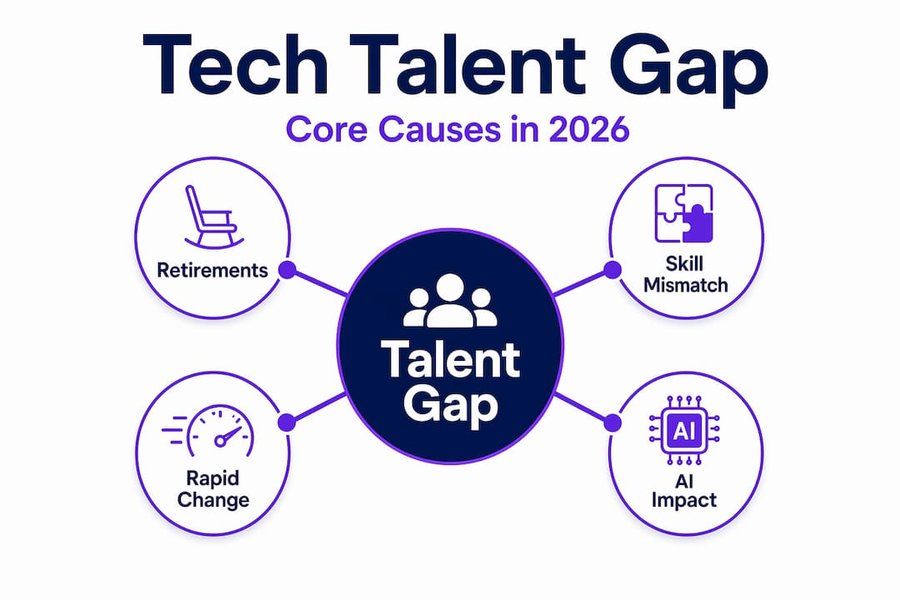
The tech workforce challenges companies face today are not the result of one trend. They compound. And some of the most damaging causes are the least discussed.
The Silver Exit
Senior technical professionals are retiring or exiting the workforce at accelerating rates. The Silver Exit reshapes talent pipelines in ways that go far beyond a vacant seat. What leaves with a 20-year veteran is not just their output. It is their judgment, their institutional memory, their ability to mentor junior staff through ambiguity. Replacing that with a new hire takes years, not months.
Teams that lose senior engineers often find themselves in a hollowed-out state: technically staffed but operationally thin. Knowledge transfer processes are rarely formalized until after the loss occurs.
The precision problem in hiring
Organizations frequently reject qualified candidates because job descriptions and applicant tracking systems are not calibrated to current skill terminology. Static keyword filtering excludes qualified applicants who use different but equivalent terminology. A candidate with deep experience in threat modeling may never surface in a search filtered for “penetration testing” if those terms do not overlap in the system.
This is not a sourcing failure. It is a precision failure. 59% of cybersecurity hiring managers report they do not fully understand the generative AI skills they are hiring for. That knowledge gap at the hiring level directly produces misaligned job descriptions and wasted screening cycles.
Rapid skills velocity
44% of workers’ core skills are expected to change by 2027, with AI and tech literacy leading the shift. The pace at which required skills evolve has outrun both educational pipelines and corporate training budgets. Universities take years to update curricula. Hiring managers post job descriptions using skills frameworks that were current 18 months ago.
Pro Tip: Audit your open tech roles against current practitioner communities, not last year’s job postings. Reddit engineering forums, GitHub repositories, and conference talk abstracts reveal what skills are actually in use, before those skills appear in textbooks or job boards.
AI as both cause and accelerant
AI is simultaneously the source of new skill demands and a potential tool for workforce development. AI-enabled upskilling programs can accelerate career growth when properly integrated, but organizations that deploy AI for productivity without investing in the workforce skills needed to operate it responsibly are widening the gap faster than they close it.
Strategies for addressing skills shortage
Addressing the tech talent gap requires more than posting better job listings. The most effective organizations combine recruitment precision, internal development, and ecosystem engagement. Here is how these approaches compare:
The organizations seeing the best results are not choosing one of these. They are running several in parallel, with clear ownership for each.
Pro Tip: When partnering with vocational centers or bootcamps, define the specific competencies you need in advance and co-design assessments with the program. Graduates who complete a curriculum built around your requirements arrive far more ready than those who go through a generic program.
Only 24% of organizations have clearly communicated career paths for their technical staff. That absence drives turnover and discourages internal candidates from pursuing skill development. Fixing that structure is cheaper than replacing the employees who leave because of it. Understanding talent shortage at an organizational level starts here.
The coordination failure that underlies the tech talent gap is systemic. Companies wait for universities to produce the right graduates. Universities wait for industry signals. Bootcamps fill the gap but lack scale. The organizations that stop waiting and start co-investing in talent pipelines gain a compounding recruiting advantage over those that remain passive. You can explore how current recruitment trends are reshaping this dynamic across the industry.
How to execute tech hiring effectively
Knowing how to bridge the tech gap in practice is where strategy meets execution. The following steps are ordered by impact, not complexity.
<p>Rewrite your job descriptions from practitioner input. Pull technical requirements directly from your best-performing current employees, not from templated descriptions. Ask them what they actually do weekly, which tools they use, and what knowledge gaps on their team slow them down. That intelligence produces descriptions that attract qualified candidates and screen out poor fits earlier.</p>
<p>Expand sourcing visibility beyond traditional job boards. Static applicant tracking systems miss qualified candidates by design. Add sourcing channels that index on demonstrated capability: GitHub contributions, technical community forums, conference speaker lists, and professional networks in non-US markets. The hidden costs of bad hiring compound quickly when poor sourcing visibility produces weak candidate pools.</p>
<p>Build structured screening that tests for real tasks. Replace qualification-based filtering with competency-based screening. A short, relevant technical task reveals far more than a resume keyword match and reduces the bias introduced by institutional name recognition.</p>
<p>Formalize knowledge transfer before you need it. When a senior engineer gives notice, the window for structured knowledge transfer is narrow. Build documentation, pair programming rotations, and mentorship assignments into standard operating procedure, not exit protocol. This is one of the core lessons from managing Silver Exit dynamics in high-growth teams.</p>
<p>Prioritize global and remote talent pools with intention. Accessing remote LATAM teams gives US and European companies exposure to technically qualified, English-speaking professionals in compatible time zones. Global talent is not a fallback option. It is a deliberate sourcing strategy that consistently outperforms purely local pipelines in both speed and cost efficiency.</p>
Pro Tip: When building pipelines in new geographies, use salary benchmarking data specific to that market. Applying US compensation frameworks to LATAM candidates either overprices the search or signals a lack of market knowledge, both of which damage your employer brand in that region.
My take on the talent gap after years in this field
I have watched companies spend enormous recruiting budgets chasing the same small pool of candidates on the same platforms, convinced the problem is volume. It rarely is. In my experience, the organizations that struggle most with the tech talent gap have a precision problem hidden inside a volume complaint. They post broad requirements, filter on credentials that do not predict performance, and then wonder why their pipeline stays thin.
What I have found actually works is starting from the inside out. The first question is not “how do we find more candidates?” It is “do we actually know what skills this role requires, and can we recognize them when we see them?” Most teams cannot answer that with confidence, and that gap at the assessment level is where the real bottleneck lives.
The Silver Exit issue is the one I think most leaders underestimate. Losing a senior engineer is not a headcount event. It is an institutional knowledge event. I have seen teams that replaced a departing architect with three junior hires and still fell behind for 18 months because no one could make the architectural decisions that person used to make in a hallway conversation.
On AI, my take is nuanced. AI in recruitment is genuinely useful when it improves precision, not just when it increases volume. Using AI to surface candidates who match demonstrated capabilities, rather than keyword lists, is a meaningful advantage. Using it to flood your ATS with unvetted resumes is a different thing entirely.
The most encouraging shift I see is hiring managers who think of the talent gap as a systems problem and not a market condition. That reframe changes everything about how they recruit, develop, and retain.
— Eugene
How Gentyrecruitment helps you close the gap
Gentyrecruitment works directly with US and European tech companies facing the exact challenges described in this article: skills mismatch, slow pipelines, and limited sourcing visibility. The agency specializes in IT recruitment across Latin America, delivering pre-vetted, English-speaking candidates within five business days of a search kickoff. Every candidate goes through structured technical assessment, so you are reviewing people who have already demonstrated the skills your role requires, not self-reported experience on a resume. For teams that need pre-vetted remote tech talent without the overhead of an extended search, Gentyrecruitment’s process combines AI-driven sourcing with hands-on recruiting judgment to produce shortlists that actually convert. Salary benchmarking across Argentina, Brazil, Mexico, Colombia, and nine additional countries is included to keep offers competitive and realistic.
FAQ
What is the tech talent gap in simple terms?
The tech talent gap is the difference between the technical skills employers need and the skills available in the workforce. It is a structural mismatch, not simply a shortage of people, with 72% of employers reporting difficulty filling roles for this reason.
What causes the tech talent gap?
Key causes include the rapid evolution of required skills outpacing education, the departure of senior professionals with institutional knowledge, and hiring systems that filter out qualified candidates due to imprecise role definitions. Only half of workers have access to adequate training to keep pace with changing requirements.
How does the tech talent gap affect businesses?
Beyond slow hiring timelines, the gap creates direct operational risk. 27% of organizations have experienced security breaches tied to workforce capability gaps, and the broader economic impact is projected to exceed $5.5 trillion globally by end of 2026.
How can companies close the tech talent gap?
The most effective approach combines precise role definition, expanded sourcing into global talent markets, competency-based screening, internal upskilling programs, and structured mentorship to retain institutional knowledge. No single tactic closes the gap alone.
Is the tech talent gap getting worse?
The gap is intensifying as AI and cloud technologies create new skill demands faster than workforce development programs can respond. 44% of workers’ core skills are expected to shift by 2027, compressing the window for organizations to adapt their hiring and development strategies.