
Product engineering is the end-to-end, cross-functional discipline that designs, builds, tests, launches, and continuously improves a product across its full lifecycle. One market estimate valued the global product engineering services market at USD 1,263.50 billion in 2024, with a projection of USD 1,814.15 billion by 2030 at a 6.4% CAGR (Grand View Research).
Your team may already be shipping software, yet still struggle to learn from customers, prioritize the right work, or keep ownership after launch. A feature moves from product to design to engineering to QA, then disappears into a support queue. Each handoff adds delay and makes accountability less clear.
For a Series A to C company, that operating model can become expensive. Product engineering treats the product as a system owned by a cross-functional team, not as a collection of tickets assigned to developers. The distinction affects how you plan work, define roles, evaluate candidates, and decide whether nearshore hiring can extend your capacity.
What Is Product Engineering in Simple Terms
Product engineering means building the complete product experience, not merely writing the code behind an individual feature. The team connects customer problems, product decisions, interface design, architecture, implementation, testing, deployment, and improvement. Its work continues after release because production behavior and user feedback shape what gets built next.
Planning a hire?
Talk through the best hiring option
This article usually leads to one practical question: should you use it recruitment or staffing? We can help you choose quickly.
Simple next step
Start with it recruitment and we will help you pick the best hiring setup.
A useful analogy is a restaurant. Traditional feature delivery can resemble asking a chef to prepare individual dishes from a fixed list. Product engineering is closer to owning the restaurant experience, including the menu, kitchen layout, ordering process, food quality, customer reactions, and changes made after observing what guests do.
That difference changes the central question. Instead of asking, “Did engineering finish the specification?” a product engineering team asks, “Did we solve a valuable customer problem reliably, and what evidence tells us what to improve next?”
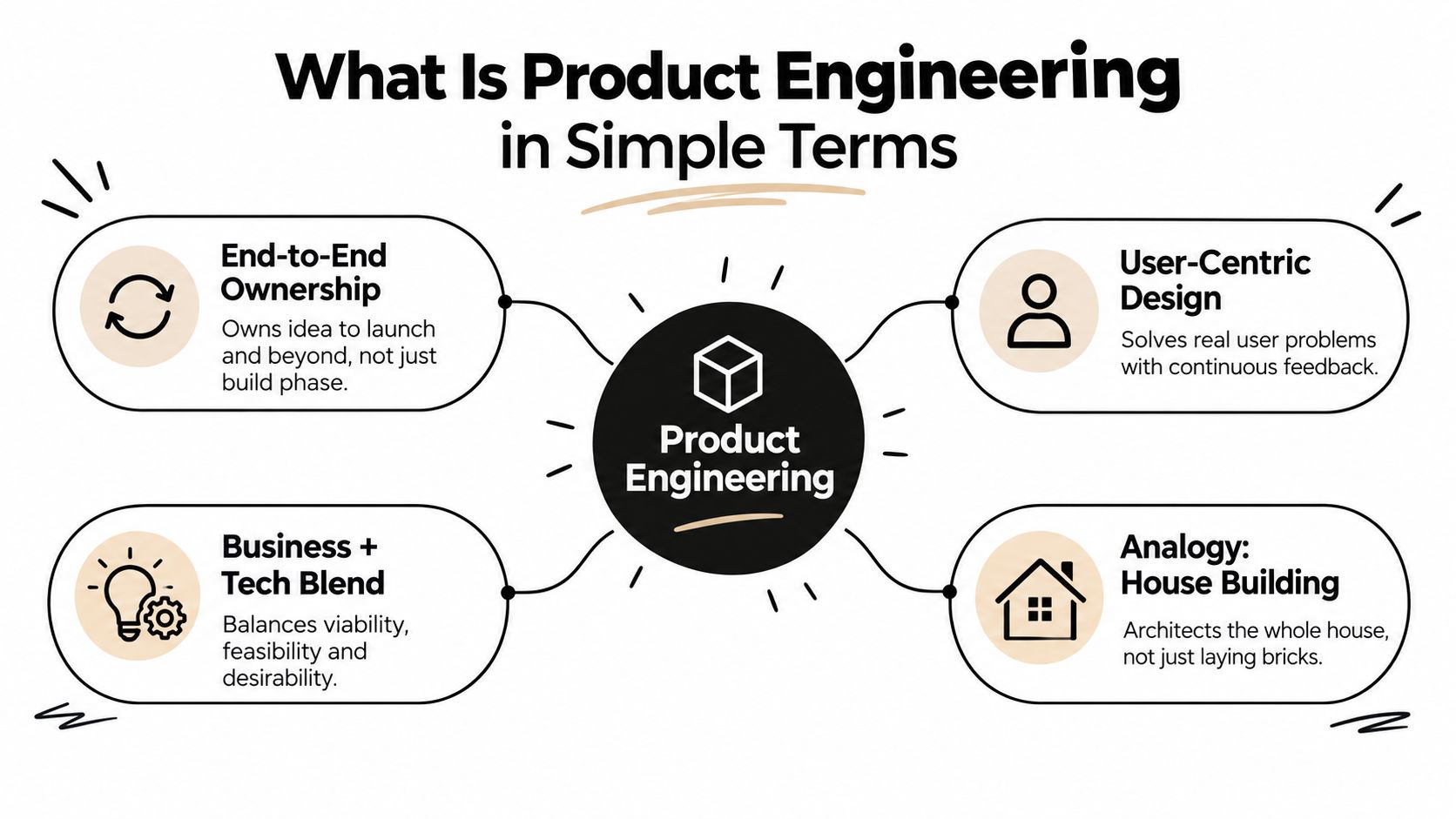
The four ideas that make the model different
End-to-end ownership: The team participates from discovery through post-launch maintenance. It doesn't hand the product away once code reaches production.
User-centered decisions: Customer interviews, usability observations, support conversations, and product data influence priorities.
Business and technical judgment: Engineers understand feasibility and operational risk, while product and design partners understand desirability and commercial value.
Continuous improvement: Launch is a learning point, not the finish line.</li>
A house-building comparison makes the boundary even clearer. Software engineering may focus on laying strong bricks, while product engineering also asks whether the house has the right rooms, supports the people living in it, remains safe, and can be adapted later.
For founders and technical leaders, the digital product founder handbook offers useful context on how product engineering connects product thinking with technical execution. Companies building distributed teams can also examine SaaS recruitment in LATAM when they need engineers who can work across delivery and customer feedback loops.
How Product Engineering Works Across the Full Lifecycle
Product engineering works as a loop, not a conveyor belt. The team moves from an opportunity to a tested release, observes what happens in use, and feeds those findings into the next discovery cycle. PTC describes the discipline as connecting people, processes, and technologies from concept through retirement, including ideation, requirements, architecture, prototyping, validation, launch, and lifecycle management (PTC's product engineering overview).
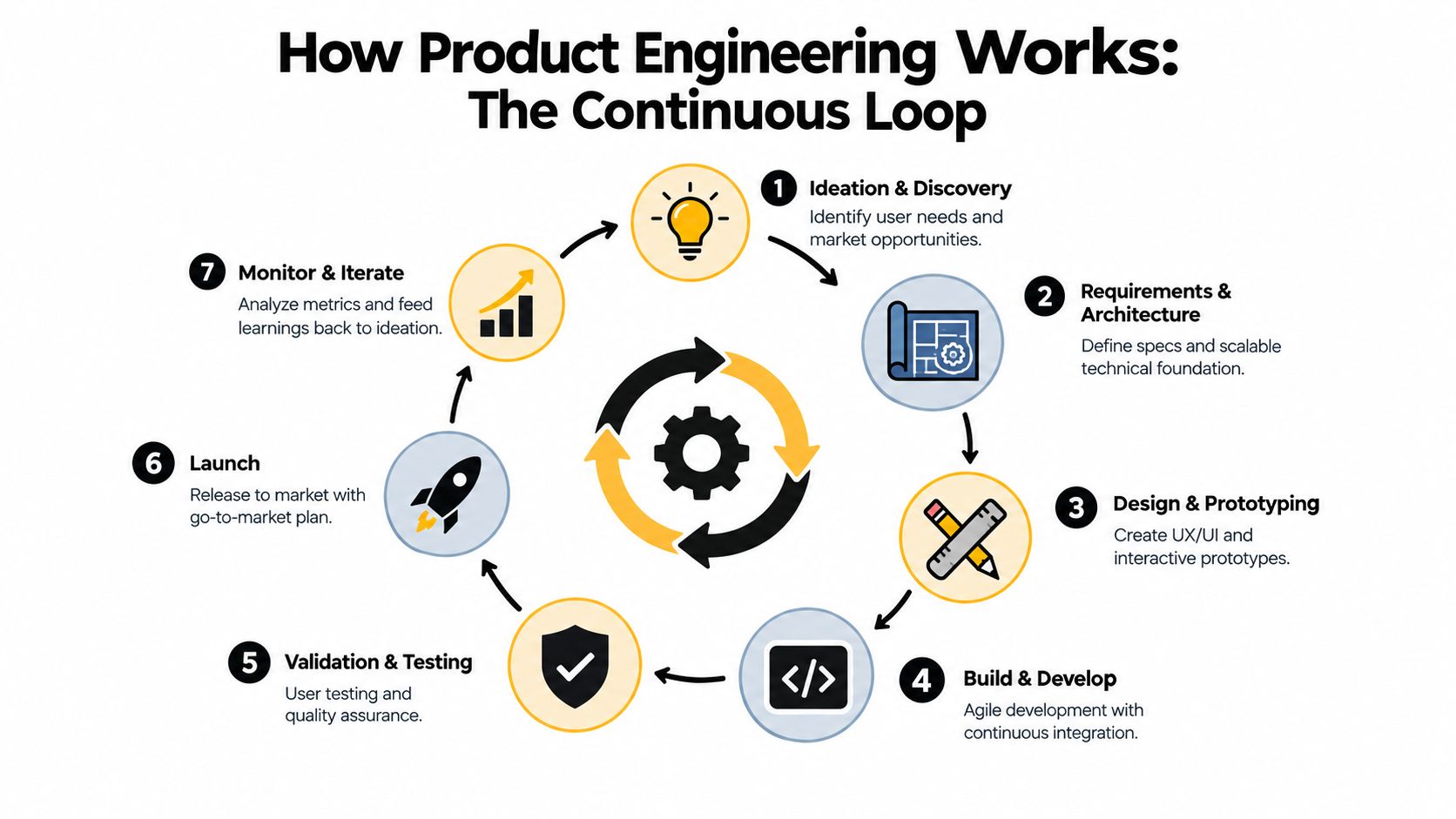
Seven connected stages
Ideation and discovery: The team identifies a user problem, market opportunity, or operational constraint. Discovery should clarify who experiences the problem and why it matters before the team commits to a solution.
Requirements and architecture: Product and engineering translate the problem into useful constraints, acceptance criteria, data needs, and a technical foundation that can support the intended direction.
Design and prototyping: Designers and engineers create flows, interface concepts, and interactive prototypes. Early prototypes expose confusing workflows before the company pays the full cost of implementation.
Build and development: Engineers implement the selected approach, integrate it with existing systems, and keep the work deployable through practices such as continuous integration.
Validation and testing: Quality assurance, automated tests, user testing, security review, and operational checks establish whether the product works for real users and real conditions.
Launch: The team releases the capability with the required communication, instrumentation, documentation, and support preparation.
Monitoring and iteration: The squad examines usage, errors, support signals, and direct feedback. Those observations influence the next round of discovery.</li>
The SDLC lifecycle provides a complementary technical view across planning, analysis, design, development, testing, deployment, and maintenance. Product engineering adds a product and customer lens to that lifecycle, so the team doesn't optimize only for implementation completion.
A handoff-heavy model often separates the people who made the original decision from those who operate the result. A product engineering squad carries context forward from prototype to production support. That continuity can reduce misunderstanding, expose trade-offs earlier, and shorten the distance between user feedback and engineering action.
Teams that need a more detailed vocabulary for planning can use Figr's guide to product development stages. The important operating decision is not whether every stage needs a separate department. It's whether one accountable team can preserve the reasoning, quality standards, and customer context across the loop.
Product Engineering vs Software Engineering vs Product Management
The three functions overlap, but they don't answer the same management question. Product engineering asks whether the team can turn a customer and business problem into a reliable product outcome. Software engineering concentrates on technical implementation. Product management concentrates on direction, prioritization, and value.
Where leaders create confusion
A software engineer can deliver excellent code without owning whether the feature solves the right problem. A product manager can define a compelling opportunity without being responsible for architecture or production behavior. Product engineering brings those perspectives into one operating unit, while preserving specialist accountability.
That doesn't mean every engineer must conduct customer research or that every product manager must design distributed systems. It means each person participates early enough to influence decisions and stays connected long enough to learn from the outcome.
The distinction matters when writing job descriptions. Calling a role “product engineer” while measuring only ticket throughput creates a traditional software role with a broader title. Calling a software engineer “end-to-end” without providing product access creates an accountability mismatch.
For readers comparing modern full-stack expectations with product ownership, Webtwizz's AI app builder full stack insights can help clarify how broad technical capability differs from cross-functional product responsibility. If the gap is primarily roadmap ownership, a focused SaaS product manager hiring profile is more appropriate than asking engineers to absorb an undefined product function.
Inside a Product Engineering Squad Roles and Responsibilities
A product engineering squad is usually a mission-driven, cross-functional unit. One commonly described structure includes a single Product Manager, a single Engineering Lead, and roughly 3 to 6 engineers, with roles such as Product Designer, Business Domain Specialist, and Data Analyst added when the mission requires them (Rico Surridge's product engineering squad role overview).
The exact structure should follow the product problem, not a staffing template. A payments squad may need strong risk and domain input. An analytics product may need data expertise close to discovery. A workflow product may benefit from a designer who can test information architecture before engineers build it.
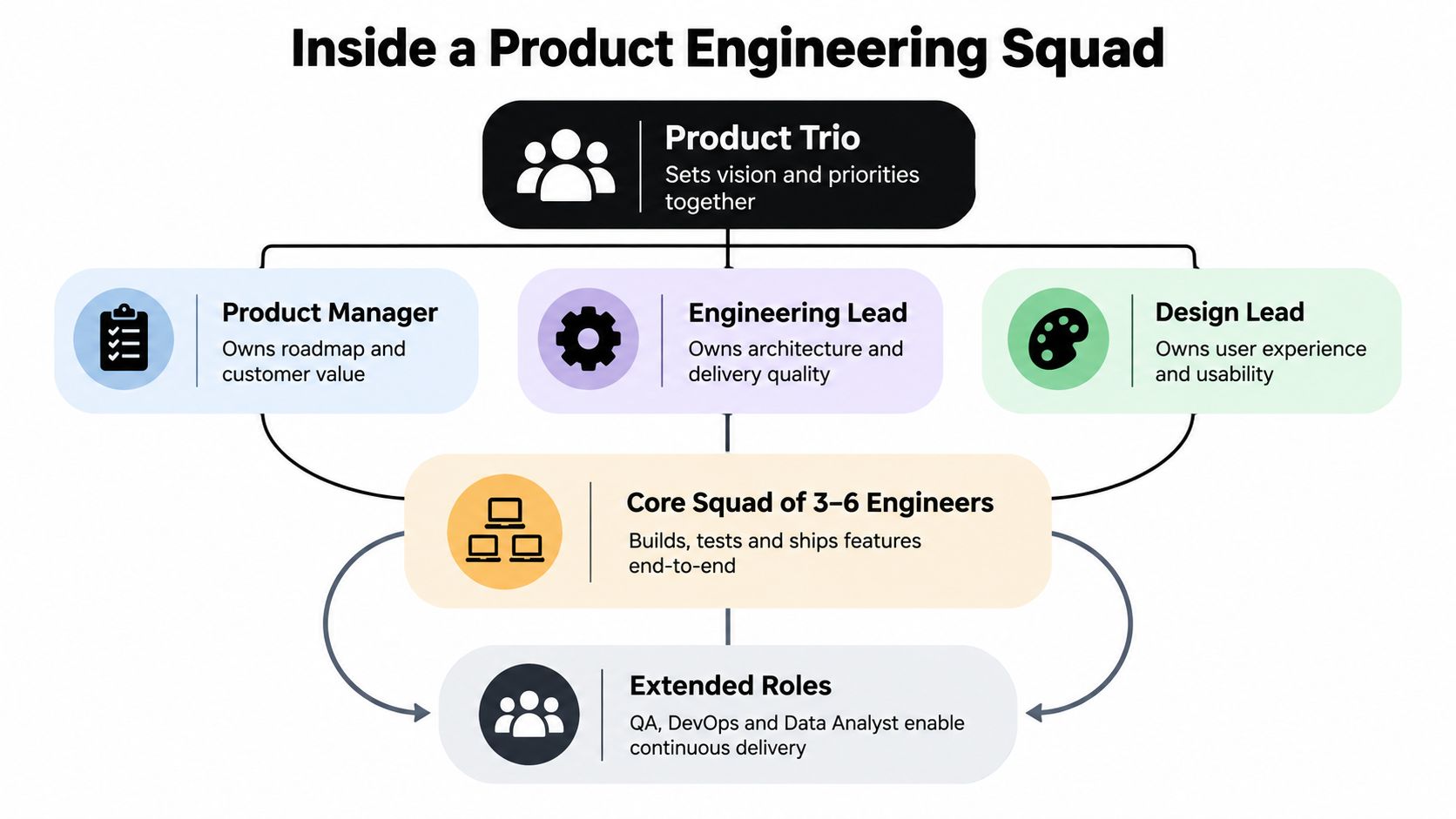
The core responsibilities
The Product Manager owns the customer and business problem, maintains prioritization, and makes trade-offs visible. They shouldn't operate as a ticket dispatcher. Their job is to keep the squad focused on the outcome and ensure the team can explain why the work matters.
The Engineering Lead owns technical direction, delivery quality, architecture decisions, and engineering risk. They create the conditions for engineers to ship safely while making technical constraints understandable to product and design partners.
The engineers build, test, operate, and improve the product. Strong candidates show more than coding ability. They can clarify ambiguous requirements, identify failure modes, explain trade-offs, and stay engaged when production feedback challenges the original plan.
Design and domain roles strengthen discovery and validation. A Product Designer may test flows with users. A domain specialist may identify compliance or workflow constraints. A Data Analyst may help the squad decide what to measure and how to interpret behavior.
Practical rule: Give the squad a mission, a decision boundary, and access to customer evidence. Without those three things, “cross-functional” becomes a meeting schedule rather than an operating model.
For leadership hiring, the difference between a technical lead and a senior individual contributor needs careful definition. GENTY's guide to technical lead roles is a useful reference when separating architecture ownership, people leadership, and delivery accountability.
When to Choose a Product Engineering Model and Its Benefits
A Series A to C company may begin with a clear feature request, then discover that customer behavior, technical constraints, and market needs change during delivery. Product engineering fits this situation because one team learns, builds, releases, and improves the product as evidence arrives.
Traditional software development is often the better operating model for work that is tightly specified, isolated, and implementation-led. A bounded integration, routine infrastructure upgrade, or defined migration with clear acceptance criteria may need disciplined engineering without a full discovery-to-iteration squad.
A practical decision test
Choose product engineering when several conditions apply:
The problem is still moving: Customer needs or market expectations may change while the team builds.
The interface affects value: Adoption depends on workflow, usability, trust, or behavior, not technical availability alone.
Architecture shapes strategy: Technical choices determine which product directions the company can support later.
Feedback must change priorities: User research, support signals, or production behavior can alter the roadmap.
One team can own the loop: The company can give a squad authority to discover, build, release, and improve.</li>
The staffing implication is important for Series A to C leaders. Product engineering does not mean hiring every specialty into one large department. It means forming a small cross-functional unit with enough product, design, and engineering capability to make decisions without waiting for separate teams at each stage. Add specialist support when compliance, data, security, or domain knowledge requires it.
The benefits are operational. A squad can resolve ambiguity before it becomes rework. Engineers understand the customer context behind technical decisions, while product managers receive feasibility feedback while options remain open. Designers can test a workflow before the team invests in a polished implementation. This shortens the distance between a hypothesis and evidence, though it also requires clear ownership and decision boundaries.
Use traditional development when the main risk is execution against a known target. Use product engineering when the larger risk is building the wrong target or making technical choices that restrict future options.

For distributed teams, offshore versus nearshore hiring should be assessed through collaboration hours, communication, product context, and management overhead, rather than salary alone. The right model depends on how much customer learning the work demands and how closely the team must coordinate.
How to Hire Product Engineering Talent for Startups and Scale-Ups
Start with the mission, not the title. Define the customer problem, the product surface, the systems the squad owns, its release responsibilities, and the decisions the new hire can make. Then decide whether you need a Product Manager, Engineering Lead, full-stack engineer, designer, or a combination of capabilities.
Screen for lifecycle ownership. Ask candidates to describe a product decision they changed after customer feedback, a production issue they helped investigate, and a technical trade-off they explained to a non-engineering partner. Strong answers show evidence of judgment, not just familiarity with frameworks.
A hiring checklist
Write the squad charter: State the mission, users, owned systems, and expected collaboration with adjacent teams.
Test discovery thinking: Give the candidate an ambiguous customer problem and ask what they'd learn before proposing a solution.
Test technical judgment: Explore architecture, reliability, security, testing, and the cost of changing direction.
Test iteration behavior: Ask how they'd interpret conflicting feedback after launch and decide what to change.
Assess communication: Include product, design, and engineering interviewers who can evaluate clarity across disciplines.
Define success early: Track whether interviews produce relevant signal, whether new hires contribute to discovery, and whether the squad can move from learning to safe release without unnecessary handoffs.</li>
LATAM can be a natural nearshore hiring option for US and European companies that want compatible working hours and access to engineers who can collaborate directly with product teams. A structured remote developer hiring process can help leaders evaluate communication, autonomy, and product judgment alongside technical skill.
For external support, GENTY recruitment provides curated technology and sales talent, IT recruitment, RPO, and salary benchmarking for companies hiring across Latin America. Visit GENTY recruitment to discuss a product engineering search, define the squad profile, and build an interview process around end-to-end product ownership.