

Salary benchmarking is the structured comparison of a role's pay against external market data, matched by job content, seniority, and geography, not just by job title. For a US Software Developer, a market distribution may show $105,210 at the 25th percentile, $135,980 at the median, and $171,980 at the 75th percentile, but none of those figures automatically determines an individual offer.
Your recruiter has brought you a salary recommendation, the hiring manager wants approval, and the candidate's expectations may not match your budget. The difficult question isn't, “What does this job pay?” It's, “Which market data describes this job, in this location, under this employment model, with this level of responsibility?”
That distinction matters even more when a US or European technology company hires across borders. A defensible benchmark turns fragmented salary information into a range you can explain, budget, and revisit. A weak benchmark creates false precision and forces recruiters to negotiate without a clear compensation policy.
The Core Question Behind Every Hiring Offer
A CTO or HR director usually encounters benchmarking at a practical moment. A new requisition is ready, finance asks for a hiring budget, and someone needs to approve the first offer before the search begins.
Planning a hire?
Talk through the best hiring option
This article usually leads to one practical question: should you use salary guide or it recruitment? We can help you choose quickly.
Simple next step
Start with salary guide and we will help you pick the best hiring setup.
Salary benchmarking is the structured comparison of an organization's pay for a defined role against external labor-market data and internal job requirements. The comparison only becomes useful when the jobs match on factors such as occupation, seniority, geography, industry, employer size, and scope. The US Bureau of Labor Statistics illustrates the scale behind credible market data through its Occupational Employment and Wage Statistics program, which produces estimates for approximately 830 occupations using employer information. Its methodology combines six semiannual survey panels collected across a three-year period and represents roughly 1.1 million establishments. The BLS employment and wage data methodology shows why one anecdotal offer or a single online salary result shouldn't define a company's pay band.
Titles alone fail because companies use them inconsistently. “Senior React Developer” might describe an individual contributor building interface components, a technical owner responsible for architecture, or a staff-level engineer coordinating several teams. Geography changes the result again. A title lookup may place a US role and a Brazilian role beside each other while ignoring local labor supply, currency, benefits, tax treatment, and employment structure.
Why the title is only a starting point
A title can help locate a job family, but it can't establish equivalence. Two people with the same title may have different decision authority, technical depth, customer exposure, or ownership of production systems.
A useful benchmark therefore answers five questions:
What does the person own?
How difficult is the role to fill?
Where does the work take place?
How will the person be employed?
What does the stated pay include?
For executive roles, the same discipline applies, although the data usually requires closer attention to incentives, equity, governance, and company stage. A resource such as Benely's guide to benchmark executive compensation can help leaders distinguish executive benchmarking from a simple salary lookup.
The practical output isn't a magic number. It's a documented range, a target position within that range, and an explanation for exceptions. Companies that need help estimating the broader hiring economics can also review how much it costs to hire a developer, then separate recruiting cost from compensation cost before approving headcount.
What a Valid Benchmark Actually Compares
A valid benchmark matches the job itself before it compares pay. Compensation professionals commonly use five matching inputs to prevent a superficially similar role from distorting the result.
Consider a mid-level Backend Engineer working with Node.js and carrying roughly three years of experience. A generic software-engineering median from the wrong market may look attractive, but it may describe a different occupation, geography, or employment arrangement. The benchmark becomes useful only after the company defines what “mid-level” means internally and identifies the market where it will recruit.
The five inputs that shape the result
A job-family framework can make the first input more consistent. We Are Distributed's job families resource is one reference point for organizing work by function rather than relying on inconsistent employer titles.
The pay definition must remain visible
Published wage figures aren't universal measures of total compensation. In the BLS OEWS framework, wages include straight-time gross pay, guaranteed pay, cost-of-living allowances, incentive pay, commissions, production bonuses, and tips. They exclude overtime, severance, shift differentials, nonproduction bonuses, employer benefits, and tuition reimbursements. Annual figures are calculated using a standard 2,080-hour work year. BLS technical information on wage definitions explains why a salary comparison needs a clear pay definition.
That distinction matters for a contractor or an employee hired through an employer-of-record arrangement. A higher contractor cash figure may replace benefits, payroll taxes, paid leave, or severance protections. Treating it as identical to employee base salary can create an offer that looks competitive but isn't comparable.
The same discipline applies to currencies. Convert the figures consistently, record the source date, and state whether the result reflects base pay, total cash, or total rewards. A benchmark report should preserve each assumption so a finance partner can reproduce the conclusion.
For a startup building this process internally, a specialized salary benchmarking service can supplement general survey data with role, country, and seniority matching. The service doesn't remove the need for internal judgment. It gives that judgment a clearer evidence base.
Turning Wage Data Into Salary Bands With Percentiles
A market dataset becomes actionable when the company converts its distribution into a policy. The 25th, 50th, and 75th percentiles provide a practical structure. The 25th percentile describes a lower market position, the 50th percentile is the median, and the 75th percentile represents an upper market position.
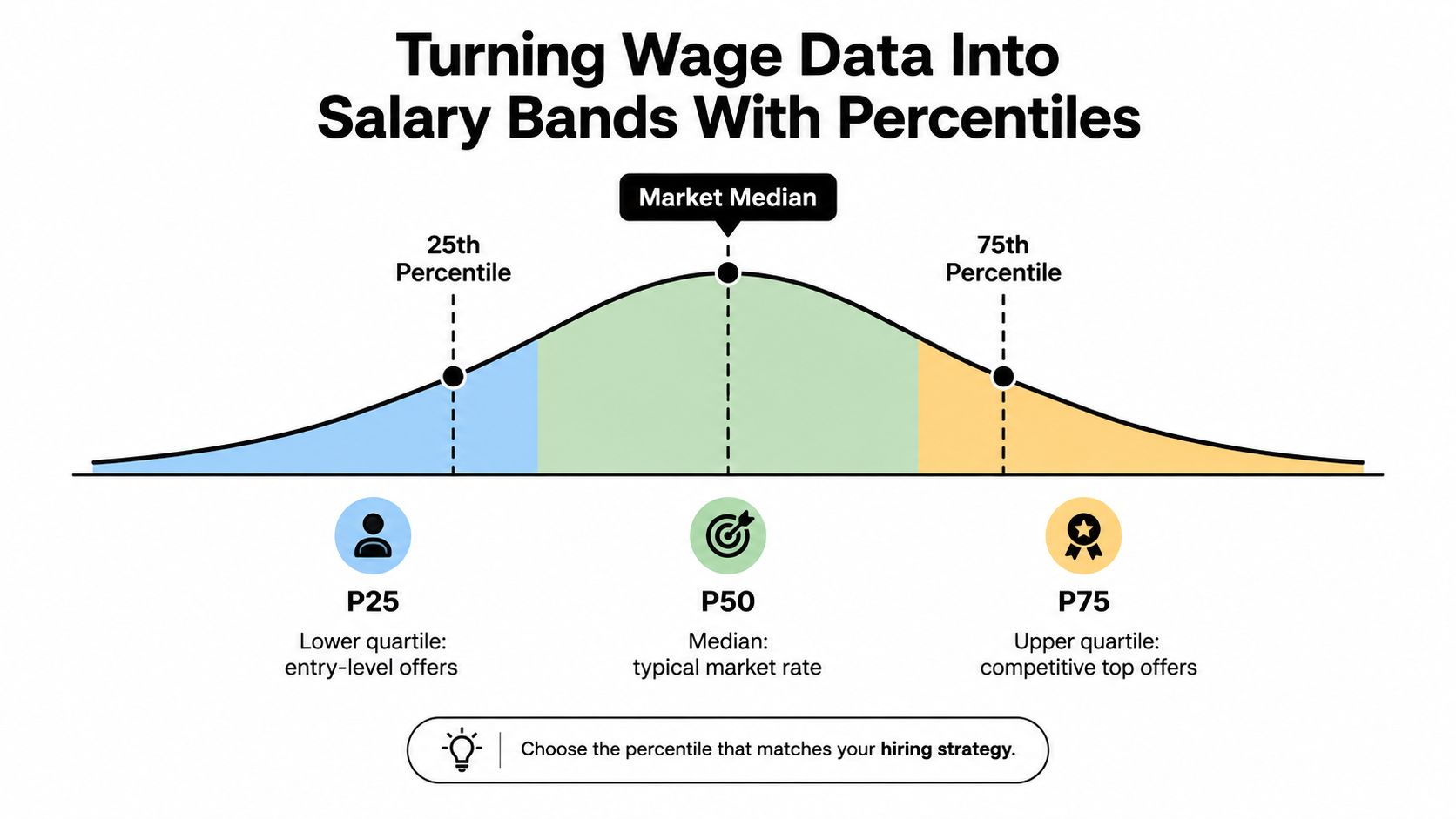
The BLS Software Developer estimates make the idea concrete. For May 2025, the national distribution reported $82,460 at the 10th percentile, $105,210 at the 25th, $135,980 at the median, $171,980 at the 75th, and $214,670 at the 90th percentile. The published Software Developer percentile data describes an occupational distribution, not a guaranteed salary for a particular senior engineer, technology stack, company stage, or benefits package.
Percentile selection is a business decision
The data doesn't tell you which percentile to choose. Your compensation philosophy does.
The 25th percentile may protect budget and work for roles with a wider supply of qualified candidates, particularly when the company provides meaningful equity or benefits. The trade-off is a smaller margin when competitors make offers.
The 50th percentile is a defensible default for a company seeking market-aligned pay without committing to the highest cash position. It gives hiring managers a reference point while leaving room to place candidates based on demonstrated capability.
The 75th percentile can support scarce or retention-critical roles. It may improve the company's ability to compete for specialized talent, but it raises fixed cost and doesn't guarantee acceptance if the role, manager, or product is unattractive.</li>
Policy rule: Choose a percentile before reviewing the candidate, not after the candidate anchors the negotiation.
A company may target the median for a broadly available role and the upper quartile for a specialized infrastructure position. It can also use different positions for hiring and retention. The mistake is treating the 75th percentile as a ceiling. For a role that protects a critical system or requires rare expertise, the upper quartile may be the deliberate target.
The band still needs internal progression rules. A candidate near the bottom should meet the role's core requirements, while someone near the top should bring broader scope, scarce skills, or a stronger record of independent impact. GENTY's salary benchmarking insight for Latin America is relevant when the same percentile logic must be applied across different local markets.
The final band should state its currency, pay components, target percentile, role match, market, and source date. Without those labels, a precise figure can still compare unlike populations.
Why LATAM Benchmarking Is Its Own Matching Problem
A senior engineer in São Paulo and a senior engineer in Austin may work on similar products, but they aren't automatically part of the same compensation market. The right comparison depends on local talent supply, city, language requirements, remote-work expectations, employment structure, and the package attached to the role.
A US company hiring in Latin America should normalize at least these fields:
Purchasing power can provide context, but it isn't a substitute for labor-market pricing. A candidate may compare your offer with local employers, regional multinationals, and US companies recruiting remotely. The relevant question is what comparable employers pay for comparable work, not what the same amount buys in another country.
Why the discount model breaks
The common shortcut is to take a US benchmark and subtract a fixed discount. That approach assumes the entire difference represents savings available to the employer. It ignores local competition, candidate expectations, exchange-rate movement, benefits, and the premium attached to scarce technical skills.
A recent LATAM compensation report illustrates the gap between incumbent pay and candidate expectations. For Q4 2025, engineers had median current salaries of approximately $60,000 and expected salaries of $72,000, a 20% gap. The same report showed sharp differences in US comparisons by specialty, including approximately $78,000 versus $187,000 for back-end engineers and $72,000 versus $240,000 for full-stack engineers. The Q4 2025 LATAM salary survey demonstrates why a single cross-border discount can't describe the market.
A flat reduction can place an offer below the relevant local percentile while still appearing inexpensive to a US finance team. The likely result is a smaller qualified pool, more negotiation, and a greater risk that the candidate accepts a competing offer.
For a practical discussion of regional hiring variables, see the comparison of US and LATAM developer salaries, time zones, and productivity. The decision should be framed as market matching, not as extracting a geographic discount.
How Benchmarking Shapes Fixed-Fee Recruiting and RPO
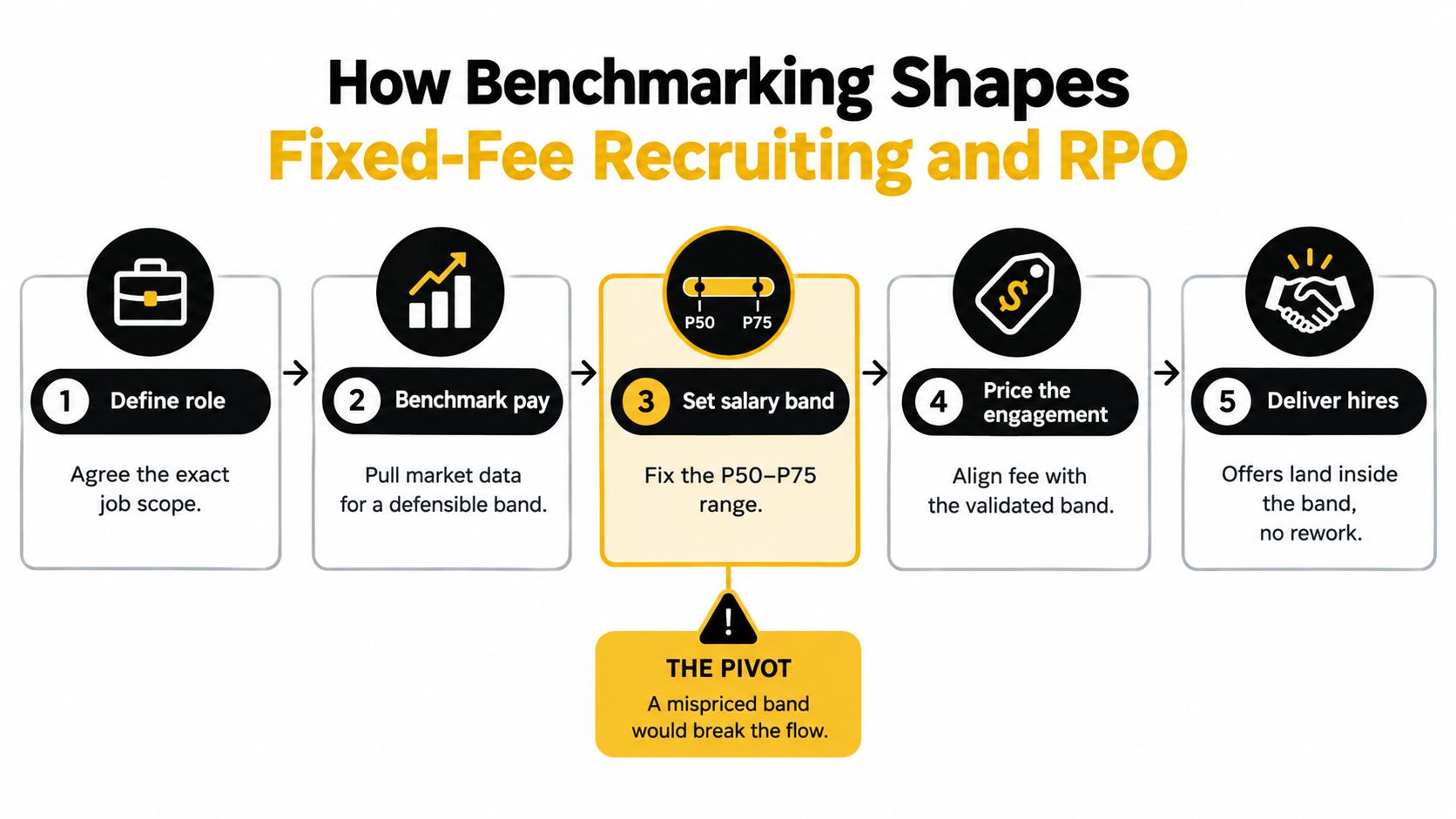
A recruiting partner working on a fixed fee needs a realistic compensation band before sourcing begins. If the band is too low, the recruiter spends time presenting candidates who won't accept. If it's too high, the company pays more than necessary and may create internal compression.
The benchmark affects the engagement in three practical ways.
First, it filters the search. A recruiter can discuss expectations early and focus on candidates whose requirements fit the approved market position. That doesn't eliminate negotiation, but it reduces avoidable mismatches.
Second, it anchors the offer. The hiring team knows whether it is targeting the median, the upper quartile, or another documented position. The recruiter can explain the offer in relation to role scope and package components instead of improvising from the candidate's first number.
Third, it clarifies replacement risk. If a candidate declines or leaves during a replacement period, both parties can review whether the role, offer, and market assumptions were aligned. A documented band can't prevent attrition, but it makes the commercial discussion more evidence-based.
Fixed fee versus RPO
A fixed-fee search usually applies the benchmark to a defined requisition. The company approves the role, band, and engagement terms, then the recruiter sources against those constraints. The trade-off is simplicity. The model works well when the role is specific and the hiring volume is limited, but a mispriced band can stall the entire search.
An RPO engagement uses the benchmark as an operating standard across a broader hiring program. The provider can apply the same role architecture, percentile policy, and offer logic to multiple searches while feeding market feedback back into workforce planning. The trade-off is governance. Leaders need agreed definitions, approval paths, and regular reviews so the process doesn't drift.
Operational rule: Price the recruiting engagement after validating the compensation band, not before.
A benchmark also helps finance compare recruiting models fairly. The recruiting fee is only one part of hiring cost. Salary, employer obligations, benefits, equity, replacement terms, and internal interview time should remain separate line items. GENTY's fixed-fee recruiting overview provides context for evaluating that structure alongside the compensation decision.
Misconceptions That Lead to Mispriced Offers
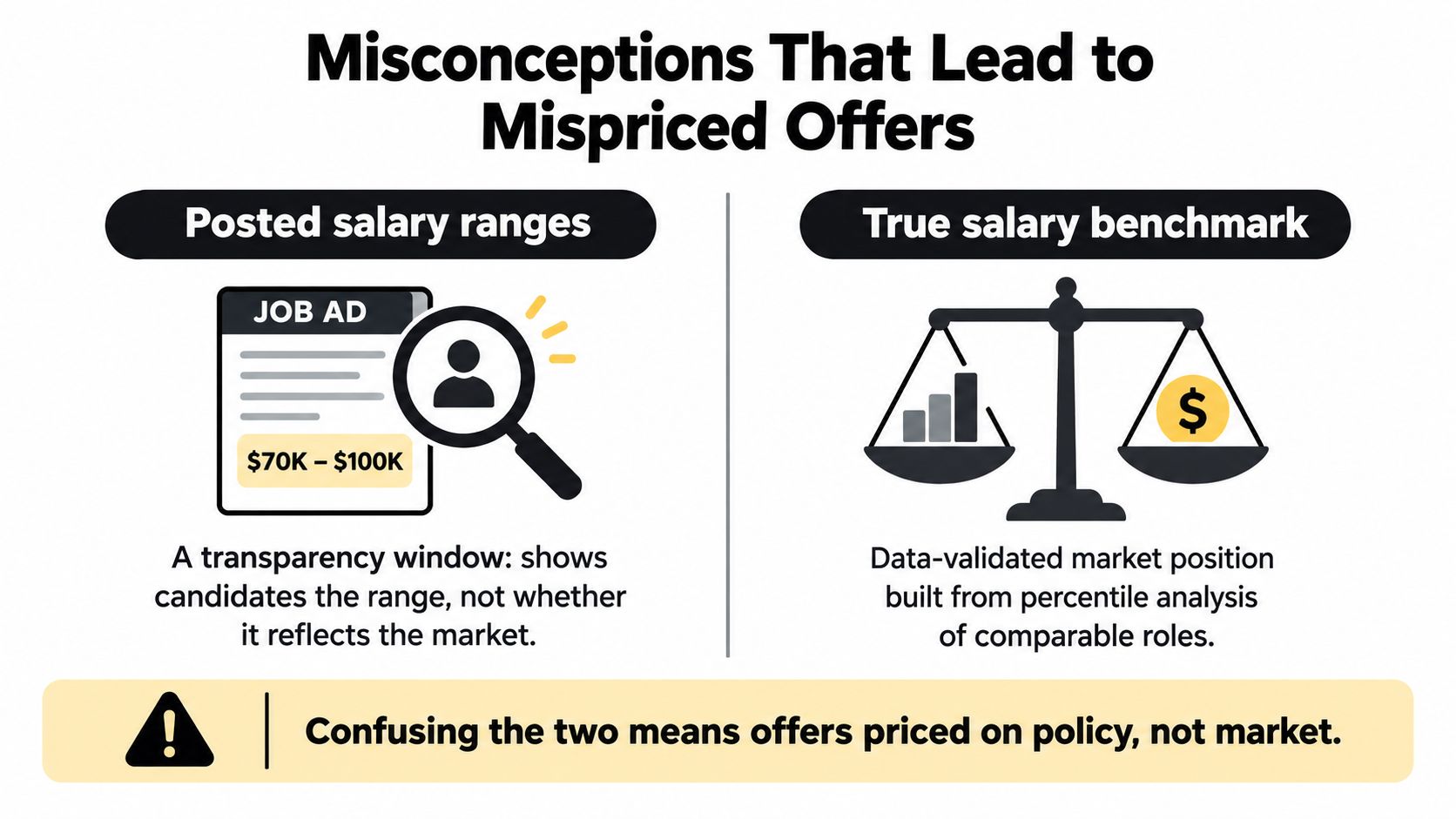
Pay transparency and salary benchmarking solve different problems. A posted range tells candidates what the company is prepared to pay. It doesn't prove that the range matches the local market, reflects the actual role scope, or explains how a candidate will be positioned within it.
A Cornell analysis of roughly 10 million US job postings found an average disclosed range of $38,108, with a standard deviation of $66,437. Related research found that broad ranges affected application and negotiation behavior, while adding the employer's typical starting salary and the factors determining final pay largely eliminated observed gender differences. The Cornell analysis of pay-range transparency supports a more useful standard: publish a range with an explanation, not just two endpoints.
The second misconception is that geographic savings automatically create a hiring advantage. A lower nominal salary can still be uncompetitive if it falls below the relevant local market position or fails to account for contractor premiums and benefits.
A company should audit its offer logic with two questions:
Transparency test: Can a candidate understand how role level, skills, location, and package components determine placement within the range?
Market test: Can the hiring team explain which comparable roles and local data support the range?</li>
If the answer to either question is no, the company has a policy statement, not a reliable benchmark.
A Practical Benchmark Checklist for Your Next Hire
Run this checklist before opening the requisition:
Define outcomes and scope. Write down the systems, decisions, stakeholders, and results the person will own. Match the role by content, not title.
Set the market. Specify country, city, currency, and whether the role is remote, hybrid, or location-bound.
Choose the employment model. Decide whether the comparison is for a direct employee, employer-of-record arrangement, or contractor.
Collect comparable data. Use at least two relevant sources where possible, and document source date, role mapping, geography, and pay definition.
Select the percentile. Choose the 25th, 50th, or 75th position according to hiring difficulty, retention risk, company stage, and budget.
Normalize total rewards. Separate base pay from variable compensation, equity, benefits, taxes, leave, and contractual protections.
Test the range. Ask whether the band can attract the intended talent and remain consistent with existing employees.
Document exceptions. Record why a candidate sits above or below the target position.
Review the assumptions. Revisit the band when the market, role scope, employment model, or hiring geography changes.</li>
The process works when every figure answers the same question: what does this comparable person earn under comparable conditions? That matching discipline is the difference between a salary number and a defensible compensation decision.
GENTY recruitment offers LATAM salary benchmarking by country, role, and seniority, alongside IT recruitment, fixed-fee hiring, and RPO support. Visit GENTY recruitment to discuss a market-matched pay band and a hiring plan for your next technical or sales role.