

A nearshore senior engineer in Mexico or Colombia can cost $66,000 to $106,000 annualized, compared with $160,000 to $220,000 for an equivalent senior engineer in San Francisco, New York, or Toronto, according to La Pieza's 2026 LATAM developer salary guide. That saving is meaningful, but it isn't the core offshore vs nearshore decision.
The deciding factor is how much live collaboration the role requires. Nearshore teams typically provide 6 to 8 hours of shared business time with US teams, while offshore models often provide only 1 to 3 hours, according to Altiam CX's analysis of time-zone alignment. For product engineering, DevOps, and roles tied to rapid feedback, nearshore usually wins. For modular work with clear specifications and tolerant handoffs, offshore can still be the smarter financial choice.
The practical answer for most Series A to C companies isn't offshore or nearshore. It's a hybrid hiring design, with nearshore engineers embedded in collaboration-heavy workflows and offshore specialists handling work that can move asynchronously.
The Core Tradeoff Between Offshore and Nearshore
Hourly savings attract attention, but workflow design determines whether those savings survive delivery. Regional salary data places senior developer compensation at about $4,000 to $7,000 per month for US companies hiring across LATAM, compared with $11,000 to $16,000 per month in the US, based on Nexus LAT's 2026 developer salary guide. A separate Hireslink talent report states that hiring in Latin America can cost 50% to 70% less than an equivalent US hire at the same seniority.
Before you start hiring
Check location, salary, and hiring fit
If you are moving from research to action, start with the market basics so your hiring plan is clearer.
The deciding question is how the role works. A product squad that waits overnight for clarification can turn a small decision into a multi-day loop. A code review that arrives after the originating engineer has logged off can delay testing, deployment, and acceptance, even when the engineers are highly capable.
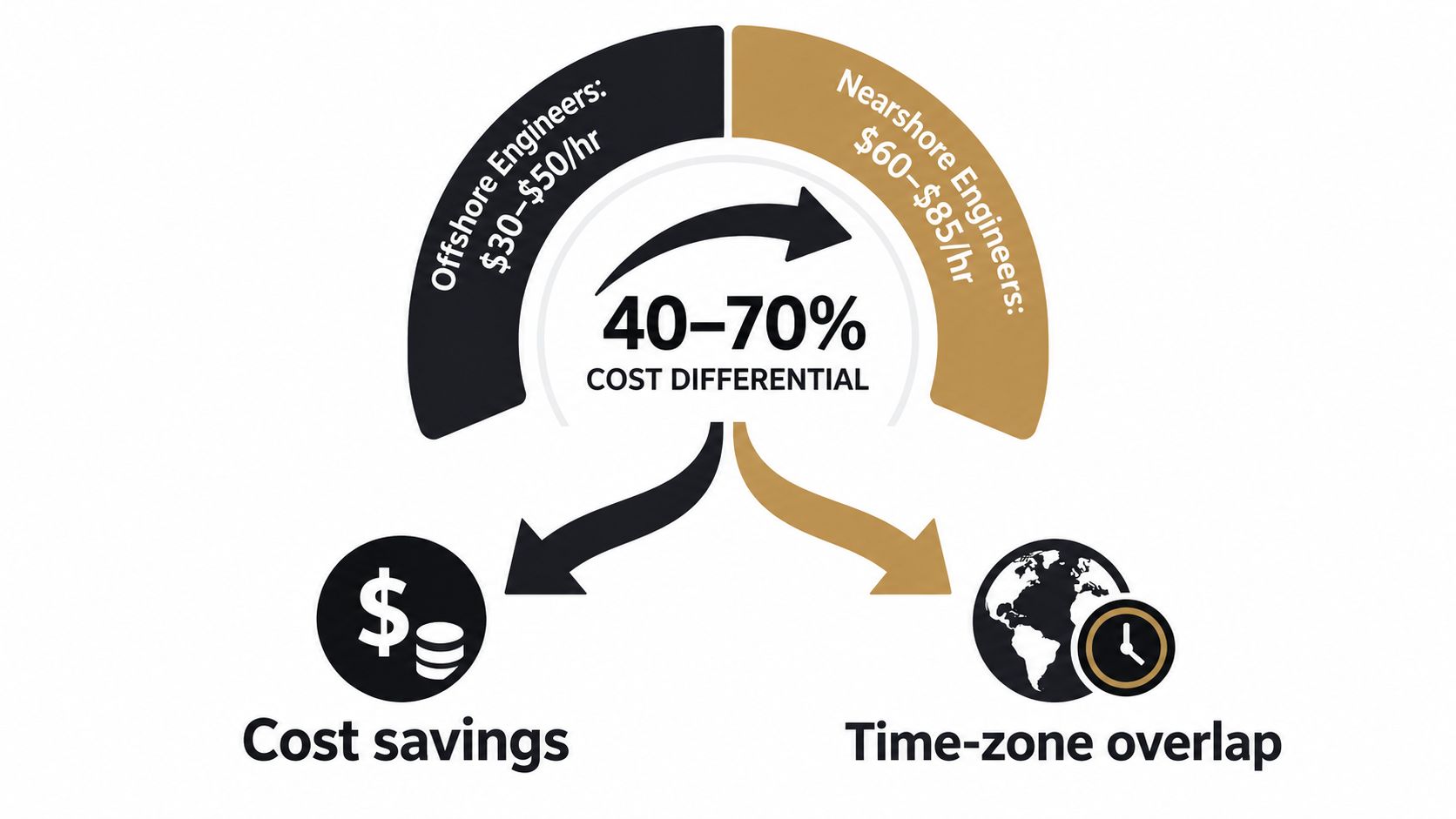
The cost of a slow feedback loop
Nearshore delivery to US teams typically supports 6 to 8 hours of shared business-time overlap, while offshore models often provide only 1 to 3 hours. Altiam CX reports that nearshore teams can complete feature iteration cycles in 1 to 2 weeks, compared with 3 to 4 weeks for offshore teams, while low time-zone alignment can reduce effective sprint time by 20% to 40%.
Choose nearshore for product engineering, design decisions, pairing, same-day reviews, and incident response. Choose offshore for modular work with clear specifications, written acceptance criteria, and limited dependency on live discussion. A hybrid split usually gives Series A to C companies the strongest operating design: nearshore engineers handle collaboration-heavy product roles, while offshore specialists complete async-friendly work.
Practical rule: Choose geography by workflow. Compare rates only after you know how much synchronous work the role demands.
For a broader view, review this global outsourcing analysis. The central question is direct: which team can make the next correct decision fastest without creating management drag?
What Offshore and Nearshore Actually Mean
Offshore hiring places a team in a distant country or region. For a US company, that may mean Asia, including India or the Philippines, or a distant delivery location in Eastern Europe. The model usually offers lower labor costs and access to large talent pools, but the team may work through a significant time-zone gap.
Nearshore hiring places the team in a nearby country or region with meaningful working-hour overlap. For US companies, LATAM is the common nearshore option. For European companies, nearby Eastern European countries or other regions with compatible working hours may serve a similar function.
The terms describe geography and operating proximity, not the quality of the engineers. An offshore engineer isn't automatically less capable, and a nearshore engineer isn't automatically better. Recruiting standards, technical assessment, team leadership, documentation, and security controls still determine delivery quality.
What these models are not
Offshore doesn't necessarily mean handing an entire project to an external vendor. A US company can directly manage an offshore engineer, hire through an Employer of Record, or work with a dedicated delivery partner. Nearshore also isn't the same as freelance contracting. A nearshore engineer may be a full-time employee, an EOR-employed team member, a contractor, or part of a staff-augmentation arrangement.
Neither model replaces in-house product strategy. Your CTO or VP Engineering still needs to own architecture decisions, roadmap priorities, security standards, and delivery accountability. External teams extend execution capacity. They shouldn't become a substitute for clear internal ownership.
Three engagement structures commonly sit inside either model:
Staff augmentation: You add individual engineers to an existing team and manage their day-to-day work.
Dedicated team: A provider supplies a stable group with defined leadership, technical responsibilities, and delivery processes.
EOR-employed model: An Employer of Record manages local employment, payroll, benefits, and statutory obligations while your company directs the work.</li>
The nearshore outsourcing overview from GENTY is useful when separating the location decision from the employment and management structure. Treat those as two decisions, not one.
Side-by-Side Comparison Across the Decision Criteria
The right comparison starts with the role and its workflow, not the country or hourly rate. Offshore usually wins for modular work that can move through written specifications and asynchronous handoffs. Nearshore is the stronger choice when engineers must operate inside an existing product team, resolve ambiguity quickly, and share context throughout the day.
Cost matters, but workflow determines value
Nearshore compensation remains below major US markets, while offshore hiring often offers a lower headline cost and broader scale. Those savings can disappear when unclear requirements create rework, delayed decisions require extra management coverage, or teams wait for the next overlapping work window.
Budget should therefore follow the work design. Pay a premium for nearshore collaboration when engineers shape requirements, work directly with product and design, or handle incidents that need fast escalation. Choose offshore for well-scoped services, test automation, data processing, migrations, and other deliverables with clear inputs and measurable outputs.
Language and engineering quality are not automatic regional advantages. Require a technical screen, a structured communication exercise, and references for every candidate. Nearshore may provide closer day-to-day cultural alignment for US teams, while offshore can provide greater scale for narrowly defined programs.
Compliance requires active diligence in both models. Review employment classification, intellectual-property assignment, data residency, access controls, dispute jurisdiction, and termination terms before a candidate joins. A remote staffing agency for distributed engineering teams can coordinate recruiting and operational details, but your legal team must approve the employment structure and data arrangements.
The practical recommendation is a split model. Put collaboration-heavy product roles, technical leads, and incident-facing DevOps work nearshore. Put modular, documented, async-friendly work offshore when the delivery process can absorb fewer live conversations. The role determines the model, and the workflow determines whether the cost difference produces real value.
Why Time-Zone Overlap Determines Delivery Outcomes
Time-zone overlap determines how quickly a team can clarify work, review decisions, and resolve blockers. A nearshore team in Colombia or Mexico can discuss a requirement with a US product manager, share an implementation update, and address a blocker within the same business day. A distant offshore team may handle the same sequence through written handoffs across separate working windows.
Nearshore delivery to US teams typically provides 6 to 8 hours of shared business time, while offshore models often provide 1 to 3 hours, as documented by Altiam CX. That overlap supports live standups, code reviews, pairing, backlog clarification, and same-day escalation without requiring engineers to work permanently at night. Compare regional tradeoffs in this salary, time-zone, and productivity analysis for US and LATAM developers.
Three role clusters matter most
Collaboration-heavy product engineering belongs nearshore. Product engineers work through ambiguous requirements, shifting priorities, design tradeoffs, and stakeholder feedback. Documentation supports that work, but a short conversation often prevents several days of building the wrong interpretation.
Infrastructure and DevOps also gain from overlapping hours. An infrastructure change can affect deployment pipelines, observability, access controls, and incident response. When production requires a live bridge, a nearby team reduces late-night scheduling and makes escalation more practical.
Modular, async-friendly work remains a strong offshore candidate. Data migration, test automation, well-defined ETL pipelines, mature component rebuilds, and other bounded deliverables can proceed through written specifications, pull requests, and acceptance tests. These roles need capable engineers, but they do not require every stakeholder to be online together.
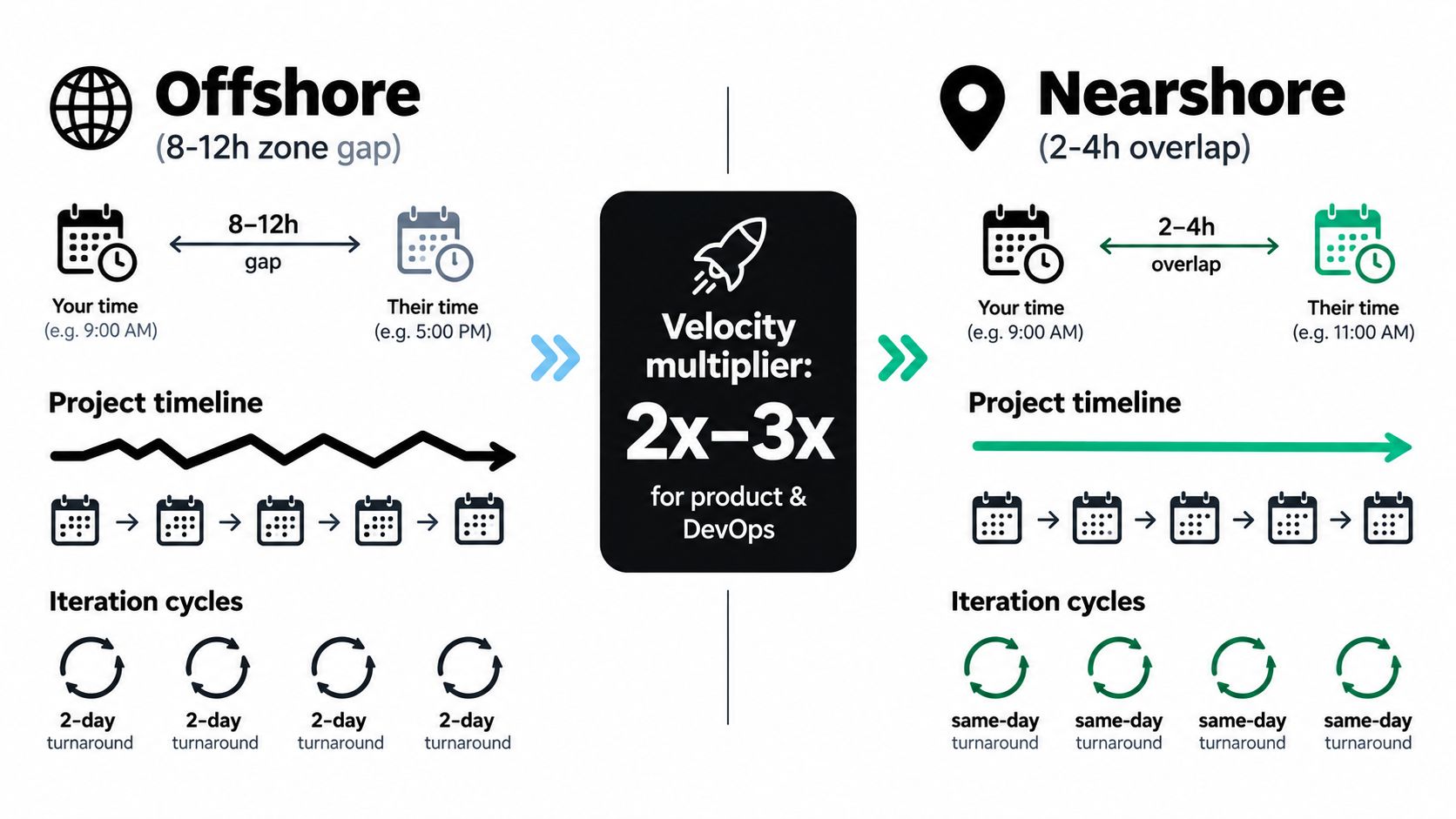
Overlap compounds across the sprint
Altiam CX reports that nearshore teams can complete feature iteration cycles in 1 to 2 weeks, compared with 3 to 4 weeks for offshore teams, and that time-zone misalignment can reduce effective sprint time by 20% to 40%. The operating lesson matters more than the benchmark. Each unresolved question creates another handoff, and each handoff increases the risk of context loss.
Shared hours are an operating asset for teams that ship through rapid feedback.
AI tools narrow part of the asynchronous gap. Copilot-style assistants can reduce routine implementation effort, while recorded demos and automated standup summaries preserve context. They do not resolve design disagreement, production incidents, or high-stakes decisions that require people to work together. For those workflows, nearshore overlap improves delivery. Offshore remains the better fit when the work is modular, documented, and easy to evaluate asynchronously.
Legal, Compliance, and Communication Risks by Region
Cross-border hiring creates obligations that geography doesn't remove. Before choosing a region, decide where intellectual property will be assigned, which entity employs the engineer, where disputes will be resolved, and whether customer or production data can legally leave its current jurisdiction.
LATAM can be operationally attractive for US companies, but buyers still need country-specific counsel. Mexico, Brazil, and Colombia each require careful treatment of IP assignment and employment classification. Brazil and Mexico can create contractor-versus-employee misclassification exposure when a contractor works under conditions that resemble a local employee relationship. Argentina's data framework may align more comfortably with European privacy expectations in some contexts, but the buyer must assess the actual data flow and contract.
Eastern Europe can offer strong proximity for European teams, particularly where EU-aligned privacy requirements apply. The compliance picture becomes more complicated in jurisdictions affected by sanctions, contractor restrictions, or political instability. A company shouldn't treat Eastern Europe as a single legal market.
Asia offers deep technical capacity, but data localization, contract enforcement, and IP controls vary sharply by country. China can raise data-residency questions. India may provide strong contractual structures in many engagements, while buyers still need to examine practical IP enforcement and access controls. Philippines engagements require a specific review of data-privacy obligations and vendor governance.
Your contracts should address source-code escrow, jurisdiction for disputes, payroll or EOR employment, tax-treaty exposure, data residency, and production access. A 2026 hiring compliance guide for HR leaders can help structure the questions, but it shouldn't replace legal advice for regulated work.
Communication style also affects risk. A team that avoids direct disagreement may accept an unclear requirement without raising it. A team that gives highly direct feedback may need guidance on review tone. Set expectations for standups, pull requests, escalation, and incident command before the first sprint.
Matching the Hiring Model to Your Stage and Stack
The right model depends on what your engineers must do together. Four common scenarios make the distinction clear.
A Series A SaaS company scaling rapidly
A startup growing from eight to thirty engineers in eighteen months needs product decisions to travel quickly between founders, product managers, designers, and engineers. Nearshore LATAM is the stronger default because founders can pair with engineers, resolve requirements during the working day, and adjust priorities without creating an overnight queue.
The startup should still protect internal ownership. Keep architecture, roadmap authority, and engineering standards with the core leadership team. Add nearshore engineers to stable squads rather than creating a remote island that receives tickets without context.
A US enterprise adding bounded module capacity
A mature enterprise with established architecture and detailed delivery practices can use offshore India or Vietnam for well-bounded work. ETL pipelines, test automation, legacy screen remediation, and repeatable maintenance tasks can move effectively when acceptance criteria, interfaces, security rules, and review ownership are explicit.
This model works when the enterprise has enough internal capacity to document the work and review outputs. If the internal team is already overloaded, offshore savings can disappear through clarification and coordination overhead.
A European company hiring beyond its domestic market
An EU company seeking cost efficiency should first examine nearshore options within the EU, including Portugal, Poland, or Romania, and then consider LATAM locations such as Argentina or Uruguay where working-hour compatibility may still support collaboration. The legal structure matters as much as the location. GDPR obligations, data-processing agreements, IP ownership, and employee classification need review before hiring.
Hiring teams also need a consistent candidate experience across borders. Resources explaining how employers handle applications can help HR leaders evaluate communication, status updates, and decision timelines as part of the operating model.
A fully asynchronous product company
An async-first company with documented specifications, strong automated testing, limited meetings, and disciplined written communication can push more work offshore. The model becomes particularly effective when engineers receive stable requirements and can submit independently testable work.
Don't choose offshore merely because your company uses Slack and records meetings. Ask whether teams resolve ambiguity asynchronously. If product managers routinely change requirements through live conversations, the organization isn't as async as its handbook suggests.
Why a Hybrid Split Beats a Single Model
A single geographic policy is easy to administer and often wrong for the work. Product engineering, platform operations, data engineering, QA, and support don't share the same collaboration profile, so they shouldn't automatically share the same delivery location.
Put nearshore engineers inside work that benefits from same-day interaction:
Product squads: Use nearshore talent for full-stack development, product engineering, and roles that work closely with design and product management.
Embedded DevOps: Keep platform engineers near the teams that need rapid deployment, observability, and incident decisions.
Design-heavy code paths: Favor overlap where requirements change through frequent review and user feedback.</li>
Put offshore capacity behind work that can tolerate asynchronous execution:
Data migration: Define schemas, validation rules, and rollback procedures before implementation.
QA automation: Give the team stable environments, test conventions, and measurable acceptance criteria.
Mature component rebuilds: Separate well-understood modules from areas still undergoing product discovery.
AI labeling and repetitive processing: Use offshore capacity where tooling and written quality controls can govern the workflow.</li>
The economics compound in two directions. Nearshore overlap can reduce repeated clarification across sprint cycles. Offshore rate advantages can reduce the cost of modular work across months of headcount. A hybrid model captures both without forcing every engineer into the same coordination pattern.
AI will narrow the gap for some roles. Automated documentation, code assistants, asynchronous summaries, and stronger test generation make written handoffs more useful. They won't remove the friction from live design, cross-functional prioritization, or incident response.
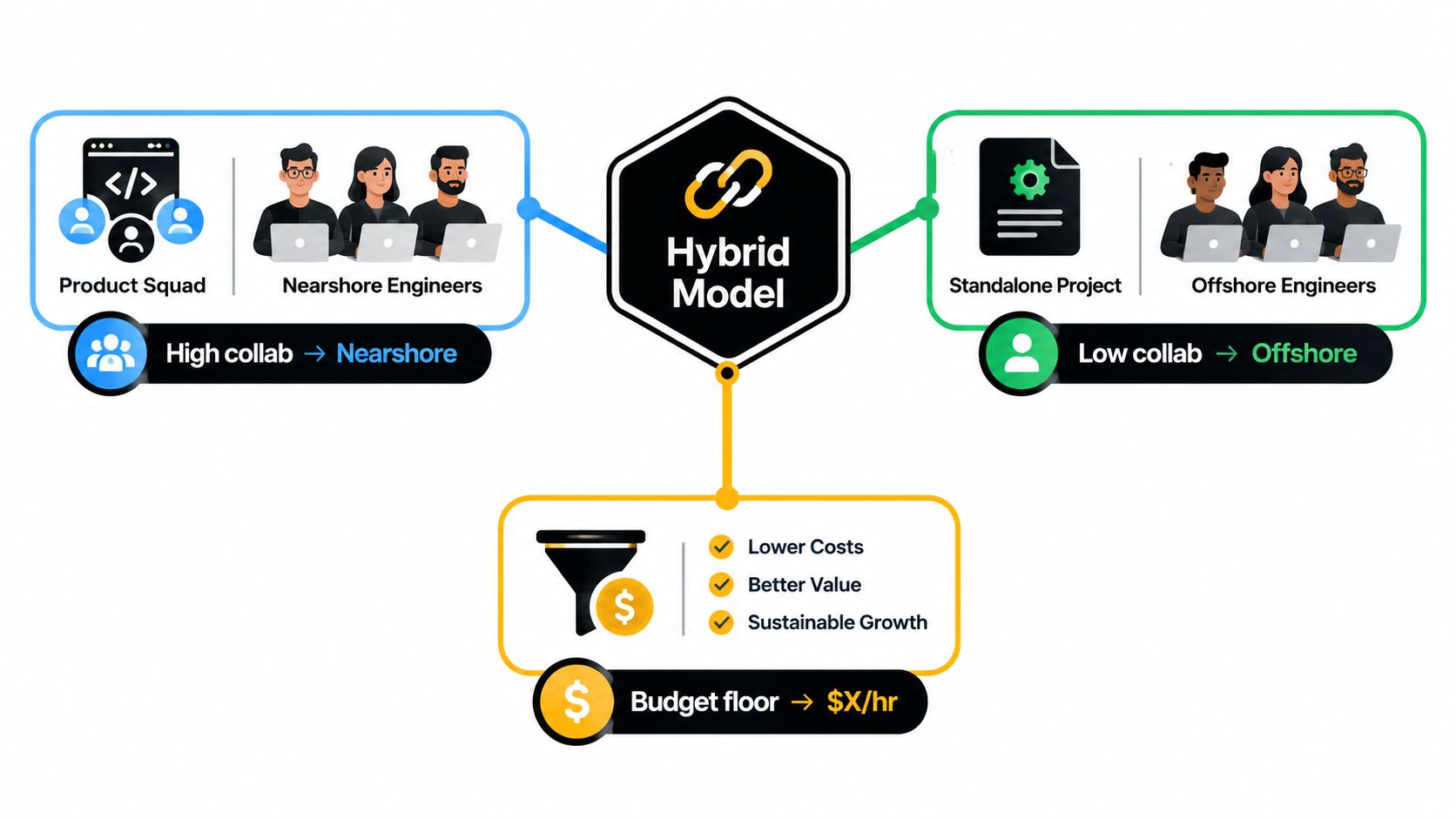
Management principle: Segment by collaboration intensity, not by a company-wide preference for cheap or nearby labor.
Implementation Checklist and Final Recommendation
Run this checklist in one planning meeting before you brief recruiters or vendors:
Classify each role by collaboration intensity. Mark whether the engineer needs live pairing, daily stakeholder access, incident participation, or mostly independent execution.
Map required working-hour overlap. Specify the hours when product, design, security, and engineering leadership must be available together.
Set a budget floor. Use regional salary benchmarks, then reserve room for recruiting, employment, compliance, management, and replacement costs.
Shortlist locations by role. Compare at least two nearshore regions and one offshore region against the same technical and legal criteria.
Pilot the operating model. Run a 30-day pilot with clear sprint, review, quality, and communication measures.
Review after one quarter. Keep the model if delivery improves, change the split if the workflow creates repeated handoff problems.</li>
A recruitment partner such as GENTY recruitment can combine sourcing, technical vetting, payroll setup, compliance coordination, and contractor-to-EOR transitions under one engagement. Its IT recruitment service and RPO service are relevant when an internal team needs structured hiring capacity rather than a list of unqualified resumes.
For most US tech companies, default to nearshore LATAM for core product and DevOps work, then add offshore capacity for modular, well-documented scope. Revisit the split annually as AI tools change the cost of asynchronous delivery. Stop optimizing for the cheapest hour and start optimizing for the fastest reliable release.
GENTY recruitment helps US and European companies build nearshore engineering and sales teams across Latin America through skill-first sourcing, technical vetting, and structured shortlists. Visit GENTY recruitment to discuss the right offshore vs nearshore split for your roles, workflow, and hiring plan.