

Talent shortages are no longer a short-term disruption. They are a structural constraint shaping how companies plan, compete, and grow. The benefits of global hiring go well beyond filling open roles: they include access to deeper talent pools, stronger operational resilience, measurable cost advantages, and teams whose diversity demonstrably drives better decisions. 57% of HR professionals plan to hire globally within the next year, citing talent pool expansion as the primary driver. If you are evaluating international recruitment as a strategic move, this article lays out exactly what you gain and how to make it work.
Key takeaways
1. Access to a larger and more diverse talent pool
The most immediate benefit of global hiring is the ability to source candidates from a far broader pool than any single country offers. When a SaaS company in New York or Amsterdam limits its search to local applicants, it competes for the same engineers as every other firm within commuting distance. Expand that search to Latin America, Eastern Europe, or Southeast Asia, and the available pool multiplies many times over.

Nearly half of new hires on global employment platforms in 2024 came from emerging markets, reflecting growing confidence among HR leaders in the quality and reliability of international candidates. This is not just a volume story. Different markets produce meaningfully different technical backgrounds, problem-solving approaches, and domain expertise. A fintech company hiring engineers from Brazil and Argentina gains candidates who have often navigated complex regulatory and payment infrastructure environments, which is directly applicable expertise.
The diversity dimension carries its own business case. Companies with high cultural diversity report better innovation outcomes, stronger decision quality, and measurably higher business value. Cultural diversity is not symbolic. It changes how teams frame problems, which assumptions they challenge, and which solutions they generate.
What do you need?
Choose the hiring path that fits
After reading "Benefits of Global Hiring for Business Leaders in 2026", most teams compare these options before deciding how to hire.
- Access to specialized skills unavailable in domestic markets
- Exposure to different technical traditions and engineering cultures
- Stronger pipeline for roles that are chronically underrepresented locally
- Reduced dependence on a single labor market prone to supply shortages
Pro Tip: When assessing international candidates, evaluate communication style and collaboration habits alongside technical skills. A candidate who is highly capable but unaccustomed to async work in distributed teams will need structured onboarding to integrate effectively.
2. Operational advantages and the follow-the-sun model
One of the underappreciated global workforce advantages is what happens to your operations when team members span multiple time zones. The follow-the-sun model, where work passes between regional teams at the end of each local workday, creates a continuous operational loop. A customer issue raised at 5 PM Eastern can be addressed by a team in Europe during their morning and resolved before the US team returns.
The follow-the-sun approach delivers faster case resolution, reduced on-call burnout, and measurable business resilience because no single region carries the operational load alone. For companies running software products, infrastructure, or customer support at scale, this is a structural advantage that is hard to replicate without international hiring.
Implementing this model effectively requires deliberate design. Teams need:
- Clear handoff protocols that define what information transfers between shifts
- Defined ownership rules so no task falls through regional gaps
- Shared documentation practices that make context accessible across time zones
- Overlap windows for real-time collaboration on complex issues
Pro Tip: Build at least a one-hour overlap window between regional teams for synchronous communication. Pure async handoffs work for routine tasks but break down when decisions require judgment calls or context that does not fit neatly into a ticket.
Effective handoff design between time zones is what separates a high-performing distributed team from one that constantly rereworks tasks. The operational benefits of hiring abroad are real, but they require process investment to capture.
3. Cost efficiencies and competitive compensation strategies
Cost reduction is one of the most commonly cited merits of international hiring, and it is legitimate when approached correctly. Salary benchmarks vary significantly across markets. Senior software engineers in Colombia or Mexico earn competitive, market-rate salaries that are substantially lower than equivalent roles in San Francisco or London, without any reduction in technical quality.
The important distinction is that global compensation is not simply paying less. It means paying correctly for each market. Benefits expectations vary significantly by country due to local norms and statutory requirements. A compensation package that is competitive in one market may fail to meet legal minimums in another. Getting country-specific benefits right from day one protects both compliance and retention.
Global employment platforms and specialized recruiters simplify compliance and compensation management considerably, handling local payroll, statutory benefits, and employment contracts in each country. This removes one of the primary barriers that historically kept mid-sized companies from hiring internationally.
- Payroll cost savings of 40–60% on equivalent technical roles in many LATAM markets
- Reduced overhead from remote work structures
- Access to salary benchmarking data to compete effectively in each target market
- Elimination of office infrastructure costs for distributed roles
4. Enhanced employee engagement and retention
One of the less obvious global talent benefits is what global hiring does for retention. Distributed teams built around remote work, autonomy, and flexible structures consistently outperform traditional office-bound environments on engagement metrics. 90% of employees on globally distributed teams reported feeling satisfied or engaged at work, and 95% said they would recommend their company as a great place to work.
These numbers reflect something real about how people respond to trust-based work arrangements. When employees are hired for their skills and given ownership over how they deliver results, they invest more deeply in the work. This matters disproportionately in tech, where high-performing engineers and sales professionals have abundant alternatives and respond quickly to poor management environments.
Retaining international talent requires intentional support structures:
- Regular one-on-one communication between managers and remote team members
- Clear career progression frameworks that apply equally regardless of location
- Recognition systems that do not default to proximity bias
- Cultural integration programs that acknowledge and celebrate different backgrounds
“Employees who feel trusted and supported across borders are not just engaged. They become advocates for the company, and that advocacy is one of the strongest recruitment assets you can build.”
Sustaining value from global hiring requires well-executed compensation and compliance strategies from the outset. The engagement advantage disappears quickly when international hires encounter inconsistent treatment or poorly structured onboarding.
5. Strategic growth and innovation through diverse global teams
The competitive case for global hiring extends well beyond cost and coverage. According to Deloitte’s 2026 Global Human Capital Trends, competitive advantage is increasingly driven by the human edge: adaptability, creativity, and judgment. These are qualities that technology cannot replicate and that diverse teams develop more effectively than homogeneous ones.
When your team includes people who built their careers in different economic contexts, educated in different technical traditions, and shaped by different cultural frameworks, the resulting thinking is qualitatively different. They surface assumptions the rest of the team did not know it was making. They propose solutions shaped by constraints and contexts the core team has never encountered. This is not a soft benefit. It has direct consequences for product design, market strategy, and organizational adaptability.
The human edge in competitive strategy means that companies building genuinely diverse global teams are accumulating an advantage that compounds over time. Each hire who brings a different perspective shifts the collective intelligence of the team in ways that are hard to quantify but easy to recognize in the quality of decisions.
Global hiring also enables market expansion in a direct, practical sense. A company that hires extensively in Brazil develops institutional knowledge about Brazilian business practices, regulatory environments, and customer expectations. That knowledge becomes an asset when the company considers entering that market. The team that builds your product in a region is also the team best positioned to help you sell there.
- Diverse teams generate more solutions per problem than homogeneous teams
- Cross-cultural experience improves the quality of global product localization
- International employees serve as natural ambassadors in target markets
- Exposure to different technical ecosystems expands the team’s collective toolkit
Pro Tip: Building an inclusive culture in distributed teams requires more than good intentions. Schedule regular team rituals that give people from different backgrounds equal speaking time, and explicitly name inclusion as a performance value in your management framework.
My perspective on why global hiring redefines competitive advantage
I’ve spent years watching companies approach global hiring as a cost-cutting measure, then gradually realize they bought something far more valuable than cheaper labor. What they actually acquired was access to a different kind of thinking. And that is where I think most business leaders still underestimate the impact of global hiring.
Cultural diversity produces measurable business outcomes, not just better team morale. In my experience, the companies that treat international hiring as purely transactional tend to replicate their existing culture in every market they hire from, which defeats the purpose entirely. The ones who actually gain from it build structures that let different perspectives surface and influence decisions.
The pitfalls are real. Compliance missteps are expensive. Poor onboarding of international hires leads to early attrition. Time zone coordination, done badly, creates a slower version of a co-located team. But none of these are inherent to global hiring. They are execution failures, and they are preventable with the right processes and partners. My take is that the companies hesitating on international hiring are not avoiding risk. They are accepting a different, larger risk: losing the talent competition to competitors who move faster.
— Eugene
How Gentyrecruitment helps you capture these advantages
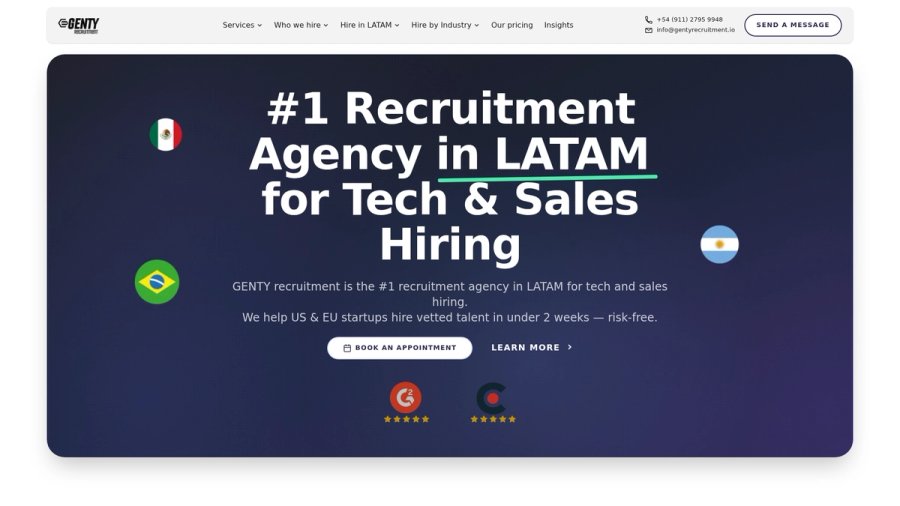
If the advantages of international recruitment described here align with where your company needs to go, Gentyrecruitment provides the execution infrastructure to get there. As a specialized recruitment agency focused on Latin America, Gentyrecruitment works with US and European tech companies to source pre-vetted engineers, sales professionals, and technical leaders from Argentina, Brazil, Mexico, Colombia, and beyond. Every candidate is technically qualified, English-speaking, and ready to integrate into distributed teams from day one.
Gentyrecruitment’s process combines structured technical assessment, salary benchmarking across LATAM markets, and hands-on recruiting to deliver candidates faster than most companies achieve through standard hiring pipelines. For companies building out engineering teams specifically, LATAM tech hiring through Gentyrecruitment delivers results up to five times faster than conventional timelines.
For HR leaders who want to explore staffing, executive search, or employer-of-record services in Latin America, LATAM staffing solutions from Gentyrecruitment cover the full compliance and operational infrastructure your team needs to hire confidently and correctly.
FAQ
What are the main benefits of global hiring?
The primary benefits include access to a wider talent pool, operational continuity across time zones, cost efficiencies through salary benchmarking, higher employee engagement, and innovation driven by diverse perspectives. Each advantage compounds when hiring is executed with proper compliance and onboarding processes.
How does global hiring improve employee engagement?
Distributed teams report engagement and satisfaction rates above 90%, largely due to autonomy, flexible work structures, and trust-based management. Retaining that engagement requires consistent communication and equitable treatment regardless of location.
What is the follow-the-sun model?
The follow-the-sun model distributes work across teams in different time zones so operations continue around the clock. It reduces resolution times, limits on-call burnout, and improves resilience by removing single-region dependencies.
Is global hiring cost-effective for mid-sized tech companies?
Yes, particularly in markets like Latin America where senior technical talent is available at 40 to 60 percent of equivalent US salaries. Cost-effectiveness depends on correctly structuring compensation to meet local statutory requirements rather than simply offering below-market rates.
Why hire internationally for innovation?
Research consistently shows that culturally diverse teams outperform homogeneous ones on innovation metrics. Different technical backgrounds, cultural frameworks, and problem-solving approaches produce better decisions and more original solutions.