

Companies that treat global hiring as a genuine strategic investment consistently outperform competitors who view it purely as a cost-cutting exercise. Strategic integration, not cost arbitrage, is what separates high-growth startups from those battling chronic turnover and skill gaps. This guide breaks down the real value of global talent, reveals the most common mistakes that derail even well-funded teams, and gives you a practical framework for hiring and retaining top performers from Latin America and beyond.
Table of Contents
- Why global talent is more than cost savings
- Top reasons to prioritize global talent now
- Comparison: Transactional vs. team-integrated global hiring
- Pitfalls to avoid when hiring global talent
- How to put global hiring into action for your company
- Why building for retention, not just hiring, is the true differentiator
- Ready to unlock your next global team advantage?
- Frequently asked questions
Key Takeaways
Why global talent is more than cost savings
The belief that companies hire globally to pay less is, at best, incomplete and, at worst, actively harmful to your hiring strategy. Yes, salary differentials exist between markets. But the organizations that build truly resilient engineering, product, and sales teams do so because they are accessing a broader range of problem-solving perspectives, cultural insights, and specialized skill sets that simply do not exist in their local labor market.
Understanding what is global recruitment matters here. It is not offshoring a task to the lowest bidder. It is building a team where every member, regardless of geography, contributes to the same mission with the same level of accountability and belonging. That distinction changes everything about how you recruit, onboard, and manage people.

Team-integrated global hiring consistently produces higher retention and performance compared to transactional outsourcing models. When companies hire strategically for cultural fit and long-term contribution rather than immediate cost reduction, they build organizations that can absorb market shocks, pivot faster, and sustain growth through periods of uncertainty.
What do you need?
Choose the hiring path that fits
After reading "Why global talent powers teams: unlock opportunity and resilience", most teams compare these options before deciding how to hire.
The strategic benefits extend well beyond retention numbers. Consider what a genuinely diverse global team brings to your product roadmap:
- Access to innovation: Engineers and designers from different markets challenge assumptions that local teams take for granted, often surfacing product improvements that would otherwise take years to discover.
- Market insights: Hiring talent in a region where you plan to expand gives you an embedded cultural intelligence advantage that no consultant report can replicate.
- Broader skill sets: Latin America in particular has produced a generation of engineers with deep expertise in FinTech, SaaS architecture, and AI, skills that are in short supply in the US and Europe.
- Time zone advantages: LATAM talent overlaps with US working hours almost entirely, meaning real-time collaboration rather than the asynchronous handoffs common with teams in Asia or Eastern Europe.
“Strategic integration, not cost cutting, is the true competitive advantage. Organizations that build for team unity and mission alignment, rather than headcount efficiency, are the ones scaling reliably through 2026 and beyond.”
Top reasons to prioritize global talent now
Once you recognize global hiring’s strategic value, the next step is understanding what specific benefits you can achieve by acting on it now rather than waiting for a talent crisis to force your hand.
The LATAM remote hiring advantages are increasingly well-documented, but the window for early-mover advantage is narrowing as more US and European companies compete for the same top candidates. Here are the five most impactful reasons to prioritize global talent in your 2026 hiring plan:
- Faster time-to-hire: Companies that actively recruit from LATAM fill technical roles up to 50% faster than those limited to domestic talent pools, primarily because competition for mid-senior engineers in the US market has reached historically high levels.
- Talent pool diversity: Latin America alone graduates hundreds of thousands of STEM professionals annually. Brazil, Mexico, Argentina, and Colombia have developed robust university systems producing engineers, data scientists, and product managers with strong English proficiency and global work experience.
- Enhanced resilience: Teams distributed across geographies are structurally less vulnerable to local labor disruptions, regulatory changes, or regional economic downturns. Your ability to deliver does not collapse when one location faces challenges.
- Overlapping time zones: Unlike nearshoring to Eastern Europe or Southeast Asia, LATAM talent shares working hours with your US-based leadership, making sprint planning, code reviews, and client calls far more practical and less dependent on asynchronous workflows.
- Innovation through inclusion: Research consistently shows that cognitively diverse teams produce more creative solutions and catch errors earlier in the development cycle. Hiring globally is one of the most direct ways to build that cognitive diversity into your team structure.
Pro Tip: Resist the instinct to cluster your international hires into a separate “offshore team.” The moment you create a geographic silo, you undermine the retention and performance advantages that make global hiring valuable in the first place. Integrate new hires into your core team channels, rituals, and planning processes from day one.
Comparison: Transactional vs. team-integrated global hiring
It’s clear global talent brings compelling benefits, but not all global hiring models deliver the same results. Two dominant approaches exist in the market, and they produce dramatically different outcomes for your team health, productivity, and bottom line.
Integrated global teams consistently report higher morale, stronger cross-functional collaboration, and better code quality compared to teams structured around transactional outsourcing. The difference comes down to whether the hire sees themselves as part of your mission or as an external vendor executing a task.
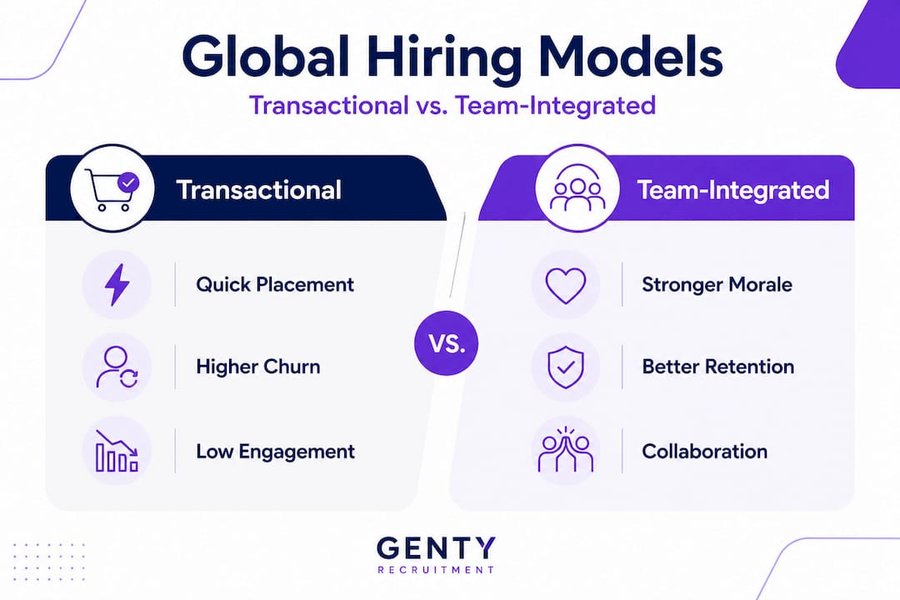
The risk of high churn with transactional models goes beyond the obvious cost of replacing a developer. Every departure takes institutional knowledge, context about your codebase, and client relationships with it. Integrated global teams can see up to 40% lower turnover, which compounds into significant productivity gains over a 12-to-24-month period.
For founders and hiring managers, the practical implication is this: the upfront investment in a structured, team-integrated hiring process almost always delivers a lower total cost of talent over time, even if the day rate looks slightly higher than a freelance platform quote.
Pitfalls to avoid when hiring global talent
Understanding what works is vital, but so is learning from common pitfalls that can halt your progress. The following mistakes are widespread across startups and scaleups that are new to global hiring, and most of them are entirely avoidable with the right process in place.
Avoiding over-reliance on juniors or unvetted platforms is one of the most critical principles for protecting your hiring ROI. Platforms that aggregate freelancers at volume cannot replicate the structured vetting, language assessment, and cultural fit evaluation that a specialized agency provides. The short-term savings evaporate quickly when you factor in churn, ramp time, and the management overhead of unvetted hires.
Top hiring mistakes to avoid:
- Chasing the lowest salary: Optimizing purely for cost signals to candidates that they are a commodity, which directly predicts early attrition and reduces the quality of applicants who engage with your roles.
- Skipping structured vetting: A resume from a LATAM university tells you very little without a technical assessment, English proficiency evaluation, and behavioral interview designed for remote collaboration.
- Neglecting onboarding: Dropping a new international hire into a Slack channel without a structured 30-60-90 day plan is one of the fastest ways to lose them. Onboarding is where retention is won or lost.
- Cultural misalignment: Ignoring cultural communication styles, feedback norms, and working expectations creates friction that compounds over time and is often misread as a performance issue.
- Ignoring collaboration tools: A team that does not agree on async communication standards, documentation practices, and meeting rhythms will struggle regardless of how talented the individuals are.
Pro Tip: When evaluating recruitment partners, ask specifically how they assess cultural fit and remote collaboration readiness. If their answer focuses entirely on technical skills, that is a signal their process is not designed for long-term team integration. Consider agencies that specialize in building engineering teams in Brazil or other specific LATAM markets, as regional expertise makes a measurable difference in candidate quality and fit.
How to put global hiring into action for your company
Now that you understand what to avoid, here is a concrete framework for moving from intention to effective global hiring. The following steps reflect the process that consistently produces high-retention, high-performance teams across FinTech, AI, and SaaS companies.
This remote staffing guide walks through the process in greater detail, but here is the core framework you need to get started:
- Conduct a needs analysis: Before opening a role, define not just the technical requirements but the collaboration style, communication expectations, and career trajectory you are offering. Candidates who self-select based on a complete picture stay longer.
- Choose the right market: Brazil leads in raw engineering talent and FinTech expertise. Argentina offers strong seniority and English proficiency at scale. Mexico provides proximity to US time zones and a growing AI engineering community. Colombia is emerging as a strong source of product and sales talent.
- Partner with a specialized agency: General job boards and freelance platforms do not screen for the variables that predict long-term retention. Strategic integration of global teams requires structured assessment, which is what specialist recruiters provide.
- Run structured assessments: Combine technical evaluations with English proficiency testing and a scenario-based interview that simulates real collaboration challenges your team faces.
- Build a structured onboarding program: Assign a peer buddy, create a 30-60-90 day milestone plan, and schedule regular check-ins during the first quarter. This investment pays back in retention and ramp-to-productivity time.
- Integrate immediately and fully: Add new hires to all team communication channels, sprint ceremonies, and planning sessions from week one. No “observer” period that signals second-class membership.
Why building for retention, not just hiring, is the true differentiator
These steps pave the way, but let’s be direct about what actually separates high-performing global teams from those that cycle through expensive turnover: it is not the hiring process. It is what happens after the offer is signed.
Too many startups hire for speed and cost, treating global recruitment as a procurement exercise rather than a people strategy. They fill the seat, celebrate the hire, and then provide the same minimal onboarding they would give a contractor expected to leave in six months. The result is exactly that: a contractor who leaves in six months. The risks of transactional hiring are not theoretical. High churn from non-integrated models, combined with over-reliance on junior or unvetted talent, is one of the primary reasons global hiring gets a bad reputation among founders who have tried and failed with low-quality platforms.
Our perspective at Genty Recruitment, built across hundreds of placements in FinTech, SaaS, and AI, is that retention is a design choice. You design for it by investing in mentorship programs, building clear promotion pathways, running regular one-on-ones with international team members, and being explicit about how their work connects to the company’s mission. Treating pre-vetted remote LATAM talent as mission-critical contributors rather than external resources is the single greatest ROI lever available to growing tech companies right now.
The most successful companies we work with share one trait: they do not distinguish between their San Francisco engineer and their Buenos Aires engineer in terms of expectations, recognition, or career opportunity. That cultural decision, made at the leadership level, is what converts a global headcount strategy into a genuine competitive advantage.
Ready to unlock your next global team advantage?
If the framework above resonates, the practical next step is finding a recruitment partner who specializes in team-integrated global hiring rather than volume placement. The difference in outcomes is significant, and the cost of getting it wrong compounds quickly.
Genty Recruitment works with US and European tech companies to source, vet, and place top talent across Latin America, delivering candidates who are technically qualified, English-speaking, and ready to integrate from day one. Whether you need specialized LATAM IT recruitment for your engineering team, LATAM sales recruitment for revenue-generating roles, or a broader remote LATAM talent solution across multiple functions, our process combines structured assessment with hands-on recruiting expertise to reduce time-to-hire without sacrificing quality. Reach out to our team to discuss your current hiring challenges and get a clear picture of what LATAM talent can do for your business.
Frequently asked questions
What is the biggest risk of global hiring?
The biggest risk is high employee churn resulting from transactional, non-integrated hiring models where candidates are treated as external vendors rather than core team members. Investing in team integration from day one is the most direct way to mitigate this risk.
What countries in LATAM are best for remote tech hiring?
Brazil, Mexico, Argentina, and Colombia consistently rank as top choices due to their large, skilled IT talent pools, strong English proficiency at the senior level, and significant time zone overlap with both the US and Western Europe.
How do we avoid poor retention with global hires?
Focus on structured team integration, invest in a formal onboarding program, and choose pre-vetted candidates through specialized agencies rather than filling seats quickly through freelance platforms. Retention is built in the first 90 days.
Is hiring from LATAM suitable for non-IT roles?
Yes. Latin America offers strong English communication skills, cultural alignment with US and European business norms, and growing specializations in sales, marketing, finance, and operations that make it an excellent source of non-IT talent as well as engineering talent.
What makes LATAM different from other global talent regions?
LATAM stands out primarily for its near-complete time zone overlap with US business hours and its rapidly expanding workforce of university-educated professionals with international experience, making real-time collaboration far more practical than with teams based in Europe or Asia.