

Curated shortlist hiring gives you a small set of pre-vetted Latin American candidates, typically three to six, matched to your exact role and ready for a final technical interview within about a week. For CTOs weighing speed against risk, it is the fastest low-risk route to a senior hire: less screening, built-in timezone overlap, and meaningful savings against US or European compensation.
TL;DR:
Require a scored skill test, recorded technical screen, verified reference, and documented salary expectation; missing evidence warrants another vendor review before interviews.
Candidates scoring 12 of 17 or higher are ready for final interviews; candidates below 8 should return to the vendor for another review.
Interviews follow in week two, while offers and notice periods put start dates four to ten weeks after the brief, depending on contract type.
Treat claimed savings of up to 40% as unverified until a salary benchmark for the specific role and country includes vendor, payroll, and onboarding costs.
Argentina and Chile align closely with Eastern hours, while Mexico and Colombia track Central and Pacific hours, shaping live collaboration across the team.
What a curated shortlist contains: candidate data, vetting artifacts, and logistics
A shortlist worth paying for is not a stack of resumes. Each candidate file should arrive as a complete package you can act on without a follow-up round of questions.
At minimum, every profile needs a snapshot: role title, seniority level, country (commonly Argentina, Brazil, Mexico, or Colombia), timezone, English proficiency level, and availability date. Behind that snapshot sits the actual proof: a coding test summary, a repository or code sample, architecture notes from a live screen, and a short writeup of how the candidate reasoned through a technical problem.
Behavioral evidence matters just as much for remote collaboration. Written communication samples, interview notes, and at least one verified reference tell you whether a strong technical performer will also communicate clearly across time zones and async channels.
Planning a hire?
Talk through the best hiring option
This article usually leads to one practical question: should you use staffing or country guide? We can help you choose quickly.
Simple next step
Start with staffing and we will help you pick the best hiring setup.
- Candidate snapshot: title, seniority, country, timezone, English level, start date.
- Technical evidence: test results, code sample, architecture notes, screen-share takeaways.
- Behavioral evidence: communication samples, interview notes, reference checks.
- Logistics: salary expectation, contract type preference, notice period, work authorization notes.
A good vendor also maps each candidate back to your job spec with a short justification, not a generic fit score. That justification is what separates a curated shortlist from a resume dump.
Checklist and evaluation table: a reproducible scoring grid for shortlists
Once a shortlist lands, you need a repeatable way to score it rather than relying on gut feel across five different resumes. Build the review around two layers: a vendor deliverables checklist and a candidate scoring matrix.
The vendor checklist confirms you received a complete package before you spend time on it:
- A skill or coding test with a scored summary, not just a pass/fail flag.
- A recorded pair-programming or technical screen session.
- At least one verified professional reference.
- A documented salary expectation in the candidate’s local currency.
The candidate scoring matrix turns subjective impressions into comparable numbers across five dimensions: technical match, communication, timezone overlap, salary fit, and risk.
A candidate scoring 12 or higher out of a possible 17 is typically ready for a final technical interview with your team, especially when supported by the right project management tools for recruitment agencies. Anyone below 8 usually needs another round with the vendor before you spend internal time on them.
Pro Tip: Run a short paid trial task or a one-week partnership sprint before a full offer. It validates context-specific skills, like how a candidate handles your actual codebase or sales motion, far better than a single interview can.
Cost, timeline, and salary guidance when hiring LATAM talent
A realistic hiring calendar runs in three phases. The shortlist itself lands within the first seven days of a scoped brief. Interviews with your top two or three candidates typically happen in week two. Offer, negotiation, and notice period stretch from week three through week six, with a start date landing anywhere from four to ten weeks out depending on the candidate’s notice period and whether you are contracting or employing directly.
Your total cost has four components worth separating out before you compare any vendor’s quote:
- Vendor fee: a fixed amount tied to seniority, paid once a hire is made.
- Candidate compensation: salary or contract rate, benchmarked to local market rates.
- Payroll or contracting overhead: compliance, invoicing, or an employer-of-record fee if you are not entity-registered locally.
- Onboarding cost: equipment, access provisioning, and ramp-up time against productivity.
When a vendor claims savings of up to 40% against US or European hiring, treat it as a starting point for your own math rather than a figure to accept outright, and ask for a salary benchmarking report scoped to the specific role and country before you sign anything.
Timezone alignment is the other variable that changes real collaboration cost. Argentina and Chile run close to Eastern time for most of the year, while Mexico and Colombia track closer to Central and Pacific time, which means engineering standups, code reviews, and sales handoffs happen in real time rather than across an overnight gap. Online job posting data across the region shows growing demand for specialized digital skills like backend development and data science, and that demand is uneven by platform and country, which is exactly why a vendor’s sourcing channel matters as much as its promised turnaround.
How GENTY recruitment delivers curated shortlists
We run a skill-first process built around triple-vetting: every candidate who reaches your shortlist has cleared a technical skill test, a live screen with a recruiter who understands the role, and a reference check, before you ever see a profile. This process supports delivering shortlists within a week on many roles.
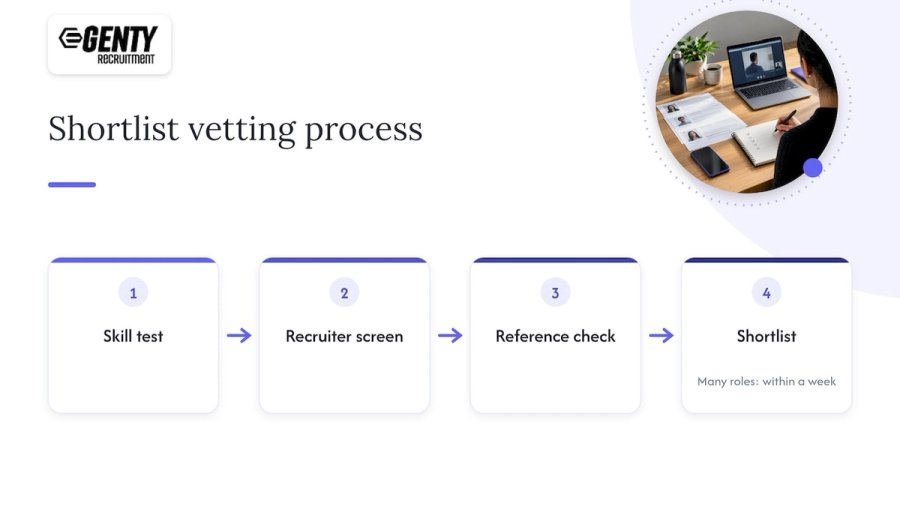
Commercial terms stay straightforward. We price on a fixed fee by seniority level with no upfront payment, so payment occurs once a hire is confirmed, and placements carry a replacement guarantee. We focus sourcing across Argentina, Brazil, Mexico, and Colombia, accessing nearshore talent pools with strong English proficiency and meaningful overlap with US working hours.
Every candidate we send comes with the technical evidence, communication samples, and reference notes outlined above, so your team can move straight to a final interview. When compensation benchmarks matter for your budget planning, we can scope a salary benchmarking report alongside the shortlist, and we are open to structuring a short trial arrangement for roles where context-specific skills carry extra weight.
When curated shortlists earn their keep
Curated shortlists pay off most on hires where getting it wrong is expensive: a senior infrastructure engineer, a founding data scientist, a sales lead who needs to close enterprise deals in month one. For a mid-level generalist role with a deep internal pipeline, your own sourcing may close faster.
The strongest setups blend both. Use an agency shortlist to compress your top-of-funnel work, then run your own panel: a technical deep-dive, a culture and communication round, and a short paid trial task scoped to a real problem you are solving. Set onboarding checkpoints at week one, week four, and week ninety to catch drift early rather than at the next performance cycle.
— Eugene
Get a curated shortlist in seven days
Hiring senior LATAM talent moves fastest when your brief is specific from the start. Give us the role spec, must-have technical skills, seniority level, salary band, timezone preferences, and your available interview windows, and we build the shortlist around exactly that.
Different needs call for different services on our end. IT recruitment covers engineers, DevOps, and data roles; sales teams fall under sales recruitment; leadership hires run through executive search; and ongoing hiring volume is better served by RPO.
- Role spec and must-have skills, written specifically, not generically.
- Seniority level and salary band for benchmarking.
- Timezone preference and interview availability windows.
Start a brief on our recruitment and staffing page or reach our team directly to scope your first shortlist.
FAQ
What is a curated shortlist in tech hiring?
A curated shortlist is a small set of three to six pre-vetted candidates matched to a specific role, each with technical test results, interview notes, and reference checks already completed. It is designed to let a hiring manager move straight to a final interview instead of screening a large resume pool.
How long does it take to get a shortlist from LATAM?
A well-scoped brief typically produces a shortlist within seven days, with interviews following in the second week. Total time to a confirmed start date runs four to ten weeks depending on the candidate’s notice period and contract type.
How much can companies save hiring in Latin America versus the US?
Argentina, Brazil, Mexico, and Colombia each have different compensation bands, so a country-specific benchmark matters more than a single regional figure.
Which LATAM countries have the best timezone overlap with the US?
Argentina and Chile track close to Eastern time for most of the year, while Mexico and Colombia align closer to Central and Pacific hours. That overlap reduces meeting friction and keeps code reviews, standups, and sales handoffs happening in real time rather than overnight.
What should a hiring manager check before trusting a shortlist?
Confirm every candidate file includes a scored skill test, a recorded technical or pair-programming screen, at least one verified reference, and a documented salary expectation. A shortlist missing any of those four elements needs another round with the vendor before it reaches your interview calendar.