
We recommend a 70/30 base-to-variable split as the default LatAm SDR compensation plan, built on three variable components: a per-meeting payout, a per-opportunity bonus triggered only when an AE accepts the lead, and a closed-won kicker. All-in costs across the region typically land between $16,000 and $55,000 a year depending on seniority, with sample templates by company stage detailed below.
TL;DR:
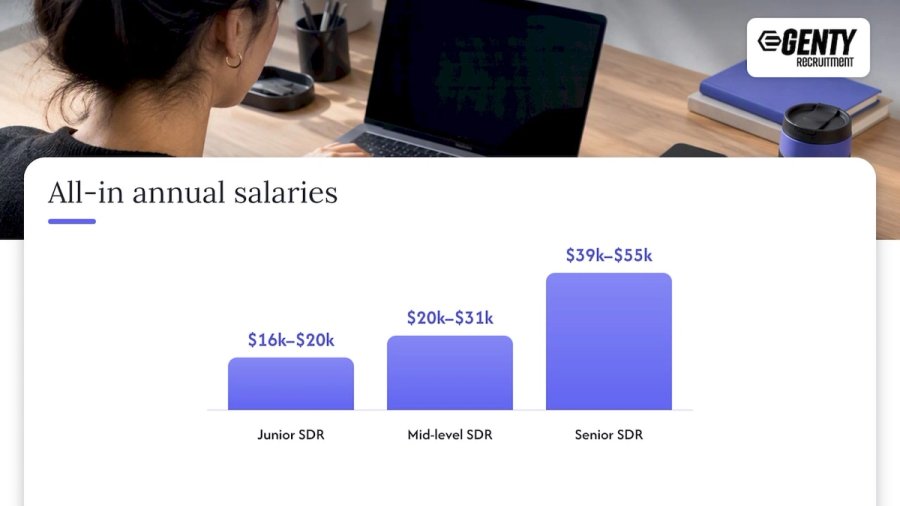
Total annual costs range from $16,000 to $20,000 for junior SDRs, $20,000 to $31,000 for midlevel hires, and $39,000 to $55,000 for senior reps.
Use an 80/20 split for enterprise sales cycles longer than six months, but shift to 60/40 for high velocity SMB motions that close within 30 days.
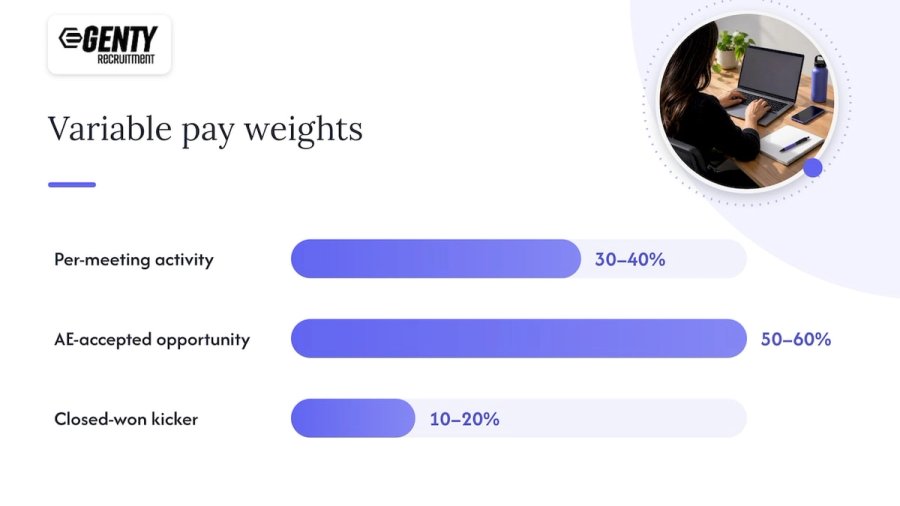
Weight variable pay 30% to 40% on held meetings, 50% to 60% on opportunities accepted by AEs, and 10% to 20% when sourced deals close.
Put ramp terms in the offer letter; midmarket reps typically reach 50% to 75% quota by month three and full quota by month four.
Check whether vendor quotes include payroll taxes, statutory benefits, provider fees, and sourcing charges before comparing annual costs across countries.
LatAm SDR Salary Ranges and What “All-In” Really Means
Hiring managers comparing LatAm to US SDR costs need a shared definition of “all-in,” because vendor quotes vary widely in what they bundle. All-in typically covers base salary, statutory benefits, employer-side payroll taxes, and either an Employer of Record (EOR) fee or a recruitment agency’s placement cost. Vendor figures sometimes fold a sourcing or management fee into the headline number, so we always ask what’s included before comparing two quotes.
Reported all-in annual bands for LatAm SDRs break down by seniority: junior reps run $16,000 to $20,000, mid-level reps run $20,000 to $31,000, and senior reps run $39,000 to $55,000, according to SDR commission structure benchmarks. Country-level pay varies within those bands, with Argentina and Colombia generally sitting toward the lower end and Brazil and Mexico trending higher for senior bilingual talent given stronger local tech demand.
A LatAm SDR working from Argentina, Brazil, Mexico, or Colombia overlaps with US EST and PST business hours for most or all of the workday, which means live call blocks, instant Slack follow-ups with AEs, and same-day calendar coordination, none of which survive a 10-to-12-hour time difference.
What do you need?
Choose the hiring path that fits
After reading "LatAm SDR Compensation Plans: $16K–$55K a Year, Templates by Stage", most teams compare these options before deciding how to hire.
Base, Variable, and OTE: Setting the Right Pay Mix
A 70/30 split, meaning 70% of OTE is fixed base and 30% is variable, remains the default structure because it keeps SDRs stable enough to prioritize quality over desperate quota-chasing while still rewarding performance.
- Use 70/30 as the default for most mid-market and SMB-focused LatAm SDR hires.
- Shift to 80/20 for enterprise motions where sales cycles stretch past six months and meeting volume alone says little about pipeline health.
- Shift to 60/40 for high-velocity SMB teams where meeting-to-close cycles run under 30 days and faster feedback loops reward aggressive variable pay.
A worked example: say a mid-level LatAm SDR has an all-in OTE of $26,000. Under a 70/30 split, that’s roughly $18,200 in guaranteed base and $7,800 in variable, which converts to a base of about $1,517 a month plus commission tracked against the three components below.
Structuring the Three Variable Components
The variable third of OTE should never pay purely on volume. Benchmarks on SDR commission structures show that plans paying only on booked meetings cause AE rejection rates to climb and pipeline quality to decline within two quarters, because reps optimize for calendar invites instead of qualified buyers. The fix is a three-part weighting that rewards activity, quality, and revenue alignment separately.
- Per-meeting (activity), weighted 30 to 40%: a flat payout of roughly $15 to $40 per booked, held meeting, gated behind a minimum show-rate requirement.
- Per-opportunity accepted by AE (quality), weighted 50 to 60%: a larger payout, often $50 to $150, triggered only once the receiving AE formally accepts the opportunity against written criteria.
- Closed-won kicker (alignment), weighted 10 to 20%: a smaller percentage of deal value or a flat bonus (commonly $100 to $500) paid when a sourced opportunity closes, with attribution capped to a defined window such as 90 or 120 days.
Best-in-class teams weight 50 to 60% of variable pay on AE-accepted opportunities specifically because it rewires the incentive from “book a meeting” to “find someone worth an AE’s time,” according to Gangly’s 2026 SDR compensation benchmarks.
Pro Tip: Review the accepted-opportunity definition with your AE team every 30 days during the first two quarters; vague criteria are the number one cause of comp disputes.
Setting Quotas, Ramp Policy, and Realistic Attainment
A written ramp protects both the hire and the business from mistaking a slow start for underperformance. Gangly’s benchmarks point to a standard 2-to-3-month ramp for mid-market roles and 3-to-4 months for enterprise, with a common cadence of 0% quota in month one, 50 to 75% in months two and three, and full quota by month four.
- Put the ramp schedule and quota percentages in the offer letter, not just a verbal agreement, so attainment reviews have a contractual anchor.
- Set monthly quotas as a range rather than a fixed number, commonly 15 to 25 AE-accepted opportunities a month for mid-market SDRs once fully ramped.
- Track AE acceptance rate, show rate, AE-to-SDR ratio, and time-to-first-accepted-opportunity monthly, since these four KPIs catch comp or process problems before quarterly attainment does.
Sample Comp-Plan Templates by Company Stage
The right structure shifts as a company moves from first SDR hire to a built-out team. A seed-stage plan should stay simple because there isn’t enough volume yet to support complex accelerators, while a Series A or B team benefits from the full three-component structure, and a scale-stage org layers in pod-level accelerators.
The seed-stage template trades precision for speed, since a founder-led sales motion often can’t yet define “accepted opportunity” cleanly, so a straightforward per-meeting plus kicker structure avoids disputes while the process matures.
Hidden Costs and the Mistakes That Undermine a Comp Plan
Budgeting for an SDR hire means more than the OTE number. EOR or payroll provider fees, onboarding and enablement spend, and the cost of a bad hire’s replacement all add to true cost per rep, and vendor “all-in” figures sometimes fold a 15% sourcing or management fee into the headline total, so verifying what’s included before comparing offers matters.
- Booking-only pay causes AE rejection rates above 40%, since reps optimize for calendar fills over fit.
- No written ramp turns a normal slow start into a false performance crisis.
- Fuzzy accepted-opportunity definitions generate comp disputes almost every quarter.
- Weak AE follow-up SLAs waste SDR-sourced pipeline before it ever gets worked.
Mitigation checklist: document every gate in writing, run quarterly comp calibration with both SDR and AE leadership present, and review attainment against the written ramp before any performance conversation.
Running a LatAm SDR Hire and Benchmark Step by Step
A disciplined process looks like this: benchmark pay against current country and seniority data, draft the comp plan with explicit weights, write the accepted-opportunity definition before the first candidate interview, put the ramp schedule in the offer letter, and build a 90-day enablement plan covering product, objection handling, and CRM hygiene from day one.
- Ask any EOR or payroll vendor exactly what their quoted “all-in” number includes before signing.
- Build a simple all-in cost calculator: base plus payroll tax plus benefits plus provider fee equals true monthly cost.
- Pair the comp plan with a dashboard that tracks AE acceptance and show rate weekly, not just at quarter-end; teams building this internally often reference CRM-to-dashboard guidance for structuring that reporting layer.
We offer recruitment services that deliver curated, pre-vetted shortlists quickly and back placements with a replacement guarantee, which helps reduce benchmarking guesswork in the hiring process.
What We’ve Learned Placing SDRs Across Argentina, Brazil, Mexico, and Colombia
Time-to-hire shortens noticeably when candidates already overlap US business hours, and bilingual proficiency in Mexico and Colombia tends to run strong for outbound-heavy motions. We’ve seen Series A teams fill a first LatAm SDR seat and reach full quota by month four using the ramp and gating structure outlined above.
— Eugene
Get a LatAm SDR Salary Benchmark and Hire-Ready Shortlist
Building the comp plan is half the work; finding reps who fit it on the first try is the other half. Our sales recruitment service pairs fixed-fee pricing with triple-vetted candidate shortlists, so you spend your time interviewing instead of sourcing.
- Pricing details are available on our website.
- Curated shortlists typically arrive quickly after kickoff.
- Placements are supported by a replacement guarantee.
A specialist recruiter earns its fee when a role needs regional salary context fast or when internal sourcing capacity is already stretched thin; an in-house hire still makes sense for a company with an established LatAm pipeline and recruiter headcount to spare. For a benchmarking report or a shortlist against the comp plan above, reach out through our main services page to get started.
FAQ
What is a 70/30 compensation plan?
For LatAm SDR hires, the most common default structure balances income stability with incentive to hit quota.
What is a good SDR pay structure?
A strong SDR pay structure splits variable pay across three components: a per-meeting payout, a larger bonus for opportunities an AE formally accepts, and a smaller closed-won kicker. Weighting the AE-accepted component at 50 to 60% of variable pay protects pipeline quality better than paying on meetings alone, per SDR commission structure research.
How much does an SDR make in the US?
US salary data shows wide variance by city and company size, with context available through Glassdoor’s SDR salary data. LatAm all-in costs for comparable seniority levels run meaningfully lower, which is why many growth-stage teams build their SDR function in the region.
Do SDRs get commission?
Yes, most SDR compensation plans include commission as the variable portion of pay, typically structured around booked meetings, AE-accepted opportunities, and closed-won deals. The specific mix and weighting should match company stage and sales cycle length, as outlined in SDR compensation benchmarking.