
The fastest, lowest-risk way to hire a data engineer from Latin America is a contract-to-hire engagement run through a LATAM-specialized recruiter, not a standalone full-time search. It works because nearshore candidates in Argentina, Brazil, Mexico, and Colombia already overlap with US EST and PST business hours and typically test strong on English proficiency, so speed becomes the deciding factor. Scope the pipeline type before you source. A vague job description is the single biggest cause of a failed search.
TL;DR:
Contract-to-hire arrangements with LATAM recruiters can fill data engineer positions in 2 to 4 weeks, ideal for urgent needs and validation before hiring.
Clear scope and a two-sentence problem statement before creating a job description prevent mismatched roles and improve hiring success.
Screening should focus on real pipeline walkthroughs, practical tests, and incident analysis, with interviews compressed into three stages for speed.
LATAM data engineer salaries are lower than US and EU rates but justify top-tier pay for candidates with strong English skills and EST/PST overlap.
The hiring process from sourcing to onboarding typically takes 6 to 8 weeks, with process speed as the key factor in securing top talent.
Data Engineer Hiring LATAM: Picking the Right Route
Every LATAM data engineer hiring decision comes down to a trade-off between speed, retention, and control. A full-time employee search gives you the most control over long-term direction but usually takes several months from posting to signed offer. Contract or contract-to-hire arrangements compress that to 2 to 4 weeks, because the candidate pool has already been screened for availability and skill match rather than long-term culture fit.
Contract-to-hire works best when you need to validate a candidate against your actual pipelines before committing to a permanent offer, which matters more in data engineering than in most technical roles since real production judgment is crucial. A specialized LATAM recruiter shortens time-to-fill further by maintaining curated, pre-vetted shortlists rather than starting sourcing from zero.
Choose based on urgency and risk tolerance:
Need help hiring?
See the next step after this guide
If this topic is relevant to your team, these are the most useful pages to check next.
- Need someone in 2 to 4 weeks: contract-to-hire through a recruitment partner
- Building a permanent core team: run a full FTE search, budget 60 to 90 days
- Testing a new data domain or stack: short-term contract with a defined scope
- Replacing a departed engineer under deadline pressure: curated shortlist from a LATAM-focused recruiter, typically delivered within days
Scope the Role Before You Write the JD
Data engineering fails as a hiring category more often from mismatched scope than from a thin candidate pool. Writing a two-sentence problem statement before you touch a job description forces clarity: what breaks today without this hire, and what does the team look like in 90 days once they’re productive.
Three practical profiles cover almost every real opening:
- Pipeline builder — owns ingestion and ETL/ELT logic, keeps data flowing from source systems to storage, and gets judged on freshness and reliability.
- Warehouse engineer — owns modeling, transformation layers, and query performance inside Snowflake, BigQuery, or Redshift, and gets judged on cost and query speed.
- ML data engineer — builds feature pipelines and serving infrastructure for machine learning teams, and gets judged on latency and reproducibility.
Seniority follows the stakes of the outcome, not years of experience alone. Budget for senior or principal pay when the role touches revenue-critical pipelines, multi-region compliance data, or systems with no existing documentation. Junior and mid-level engineers handle well-scoped, already-stable pipelines just fine.
Where to Find LATAM Data Engineers and How to Screen Them
Sourcing channels that actually produce qualified LATAM candidates look different from a generic US job board post. LATAM-focused boards, remote-first platforms, GitHub activity in relevant data tooling repositories, employee referrals from existing nearshore hires, and specialized LATAM recruiters each surface a different slice of the talent pool, and the strongest pipelines usually combine at least two.
- LATAM job boards and remote-first platforms: highest volume, requires internal screening capacity
- GitHub and open-source contribution history: strong signal for pipeline builders and warehouse engineers who work in public repos
- Employee referrals: fastest close rate, limited by your existing nearshore headcount
- Specialized recruitment partners: curated shortlists, fastest overall time-to-fill
Screening should mirror how the person will actually work. Ask for a real-pipeline walkthrough where the candidate explains a system they built end to end, not a whiteboard abstraction. Pair that with a practical SQL and Python test, direct questions about cloud and warehouse experience, and a production incident post-mortem: how they detected the failure, diagnosed it, and prevented it from recurring. Ownership of incidents like this outperforms tool-name trivia as a predictor of on-the-job performance, and SQL, cloud platforms, and Python remain the three most commonly tested skills in current data-engineering screens.
Pro Tip: Schedule the technical screen and the pipeline walkthrough back to back in the same call. Splitting them across separate weeks is how you lose candidates to faster-moving employers.
Data Engineer Salary in LATAM vs US and EU Hires
Compensation for LATAM data engineers scales with seniority the same way it does anywhere, but the base is meaningfully lower than US or Western European market rates while the work quality holds up. Posted salary bands for data engineers have climbed at every level, with principal-level individual contributors now approaching director-level pay in the US market. LATAM rates track a fraction of that.
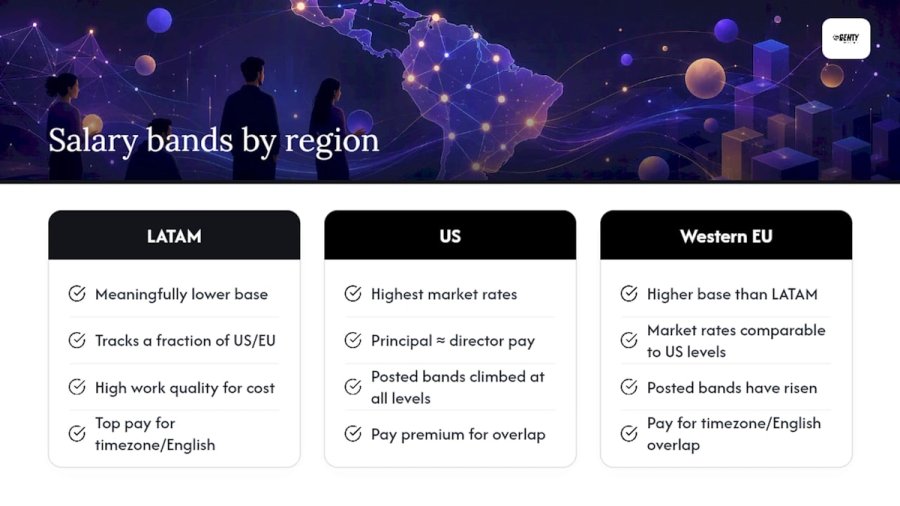
Strong English proficiency and EST or PST overlap justify paying toward the top of a given band. A candidate who can join your 10am standup without a translation lag or a six-hour delay is worth more than one who can’t, even at identical technical skill.
Building an Interview Loop That Closes Fast
A three-stage loop keeps the process short enough to beat competing offers while still testing what matters. Hiring processes that stretch past three weeks routinely lose top data-engineer candidates, which makes loop design a retention decision as much as an evaluation one.
- Screen (30 to 45 minutes): culture fit, timezone availability, English communication, and a light technical baseline.
- Deep technical (60 to 90 minutes): a real-pipeline walkthrough plus a design exercise, such as debugging a broken incremental load or sketching a schema for a stated business problem.
- Hiring manager final (45 minutes): trade-off discussion and ownership questions. What would they change about a system they inherited, and why.
Combine panels where possible instead of stacking sequential rounds, commit to a 48-hour feedback window after each stage, and state your compensation band up front rather than after three rounds of interviews.
Pro Tip: Being transparent about your current stack, including its legacy warts, closes candidates faster than hiding constraints. Companies that describe their modernization roadmap honestly close data-engineering hires faster than those that oversell a clean architecture.

The First 30 Days: A Ramp Plan That Proves the Hire
The first month sets the trajectory for the entire relationship, and a structured ramp beats an unstructured “figure it out” onboarding every time. A practical week-by-week plan looks like this. Week one is a pipeline audit, week two ships a small monitoring fix or alert, week three adds a new connector or schema change, and week four runs a data-quality review with freshness SLAs defined.
- Week 1: audit existing pipelines and document what’s fragile
- Week 2: ship a visible, low-risk fix or new monitoring alert
- Week 3: build a new connector or handle a schema change independently
- Week 4: deliver a data-quality review with agreed freshness targets
Avoid hiring into the middle of a major source-system refactor unless you explicitly scope the role for schema management. Doing otherwise sets the new engineer up to spend months redoing work as upstream schemas shift underneath them.
Common Pitfalls That Derail LATAM Data Engineer Hires
Most failed searches trace back to a small set of repeatable mistakes rather than a talent shortage.
- Vague job description: fix it with a two-sentence problem statement before posting, not after the first batch of unqualified applicants arrives
- Hiring into schema instability: delay the hire or scope it explicitly for schema management work
- Slow interview process: compress to three stages and commit to 48-hour feedback windows
- Over-indexing on tool names: replace tool checklists with a real-pipeline walkthrough and an incident post-mortem
- Hidden or shifting compensation bands: state the range in the first conversation, not the final offer
Run this list against your own draft JD before it goes live. Every item you can check off in advance is a week you don’t lose later.
Legal and Compliance Considerations for Hiring in LATAM
Hiring a data engineer in Argentina, Brazil, Mexico, or Colombia does not automatically require a local entity, but it does require choosing the right legal structure before an offer goes out. Most US and European companies hire LATAM data engineers through one of three structures: an Employer of Record (EOR) that legally employs the worker locally on your behalf, a contractor agreement for project-based or short-term work, or a locally incorporated entity for larger, permanent teams.
Each country carries its own labor code, and the differences matter more than most first-time hiring managers expect. Brazil’s CLT framework mandates a 13th salary payment and specific severance rules. Argentina’s labor law includes strong termination protections that make contractor misclassification a real legal exposure. Mexico and Colombia each have their own mandatory benefits structures tied to formal employment status. Misclassifying a full-time-equivalent worker as an independent contractor is one of the most common and costly mistakes companies make when hiring across LATAM, since local authorities can reclassify the relationship retroactively and assess penalties.
Contracts should specify governing law, intellectual property assignment, and confidentiality terms explicitly, because default protections vary sharply by country. An EOR partner or a recruitment firm that already operates compliant hiring infrastructure in these markets removes most of this risk without requiring you to stand up a local subsidiary just to make one hire.
Cultural Nuances and Integration for LATAM Remote Hires
LATAM professionals in tech generally bring a strong collaborative work style, but assuming zero cultural adaptation is needed is its own mistake. Communication norms differ subtly by country. Brazilian and Mexican engineers often favor building rapport before diving into pure task talk, while Argentine engineering culture tends to be more directly technical and debate-oriented in code reviews.
Meeting culture matters more than most US hiring managers plan for. LATAM team members frequently defer to hierarchy more visibly in group settings than a flat Silicon Valley team expects, which means a data engineer might not push back on a flawed pipeline design in a group standup even if they disagree, but will raise it directly one-on-one. Structuring regular 1:1 time, not just team syncs, surfaces real technical concerns faster.
Public holidays diverge substantially from the US calendar. Brazil observes Carnival week, Mexico observes Día de los Muertos and multiple civic holidays, and Argentina has its own set of national holidays that don’t map to the US calendar at all. Building these into your team calendar from day one, rather than discovering them reactively, prevents the kind of friction that quietly erodes trust in a new remote hire’s first months. Small gestures, like acknowledging local holidays in team channels, do more for integration than any onboarding document.
Retention and Career Growth for LATAM Data Engineers
LATAM data engineers leave roles for the same core reasons engineers anywhere do: stagnant compensation, unclear growth paths, and lack of technical challenge. What differs is the local market context. Nearshore engineers in Argentina, Brazil, Mexico, and Colombia field competing offers constantly, since demand for remote-capable technical talent in these countries has grown faster than the supply of comparable US-based candidates.
Career development needs to be explicit rather than assumed. Define a clear path from mid-level to senior to staff or principal, with the technical ownership expectations spelled out at each step, because ambiguous promotion criteria are a top driver of attrition among engineers who already have leverage in the market. Annual compensation reviews benchmarked against the current LATAM market, not a static number set at hire, keep offers competitive without requiring US-level pay.
Investing in a sense of team inclusion, not just individual growth, also drives retention. Bringing nearshore engineers into architecture decisions and roadmap discussions, rather than treating them as execution-only resources, signals that the role has real technical weight. Engineers who feel like peripheral contractors leave faster than engineers who feel like core team members, regardless of pay.
Timeline: From Sourcing to a Ramped-In LATAM Data Engineer
A realistic end-to-end timeline for a contract-to-hire or recruiter-sourced LATAM data engineer search runs about 6 to 8 weeks from kickoff to a fully ramped hire, compared to 4 to 5 months for a slower, self-run FTE search.
The biggest variable in this timeline isn’t candidate availability. Market volume for data-engineering roles runs roughly 1,280 new US postings per week, so competition for strong candidates is constant. The variable you control is how fast your own process moves once a good candidate enters the funnel.
GENTY Recruitment’s View on What Actually Works
GENTY recruitment has watched the same pattern repeat across FinTech, SaaS, and AI companies hiring data engineers from LATAM: the searches that stall almost always trace back to a JD written before the role was actually scoped. Curated shortlists delivered within 5 to 7 days work because the scoping conversation happens first, not after unqualified résumés start piling up. Fixed-fee pricing per seniority level, no upfront payment, and a 3-month replacement guarantee exist because a hiring decision made under time pressure still needs a safety net. The pattern holds across regional advantages like timezone overlap and English proficiency: the technical talent is there. The bottleneck is almost always process, not supply.
— Eugene
Start a LATAM Data-Engineer Search With GENTY Recruitment
GENTY recruitment gets you a curated shortlist of pre-vetted LATAM data engineers in 5 to 7 days, at fixed fees set per seniority level, with no upfront payment and a 3-month replacement guarantee if the hire doesn’t work out.
That timeline matters more than it looks on paper. Every extra week your search runs is a week a strong candidate takes a competing offer, and the sourcing, screening, and compliance work described throughout this piece is exactly what GENTY recruitment’s data-engineer hiring service runs on your behalf, whether you’re hiring a pipeline builder in Buenos Aires or a warehouse engineer in São Paulo. For senior and principal-level searches where the stakes and pay bands are higher, the senior data-engineer track applies the same scoping discipline with a deeper technical bar. If your data engineering need sits inside a regulated FinTech stack, the FinTech recruitment page covers the added compliance layer that comes with it.
Start by scoping your role with the two-sentence problem statement outlined earlier, then reach out to GENTY recruitment to get a shortlist moving this week instead of next quarter.