

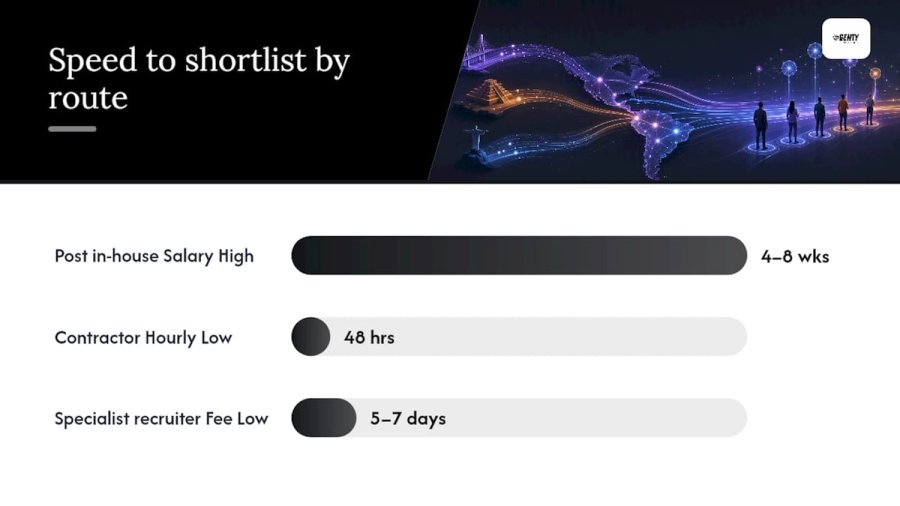
For most hiring managers who need a vetted data engineer quickly, a LATAM-focused specialist recruiter delivers a curated shortlist faster and at lower total cost than posting and waiting. GENTY recruitment’s skill-first process reaches a shortlist in 5–7 days, drawing from pre-vetted engineers across Argentina, Brazil, Mexico, and Colombia, all working within US EST/PST timezone overlap. LinkedIn lists 1,000+ active Data Engineer jobs in the United States right now, which means top candidates are fielding multiple offers simultaneously. Speed and precision are the only real advantages you have.
Three practical routes to hire data engineers, compared:
- Post in-house (LinkedIn, Indeed, Stack Overflow): Median time to shortlist is 4–8 weeks. Best when your employer brand is strong and you can run a tight screening loop yourself. Highest candidate volume, lowest signal-to-noise ratio.
- Hire a contractor (48-hour booking): Best for 2–12 week scopes or to validate a role before committing to a permanent hire. Rates run $75–$130/hr for US-based contractors; LATAM nearshore contractors typically run $40–$75/hr in USD.
- Specialist LATAM recruiter (5–7 day shortlist): Best for senior or rare skills, permanent hires, or when you need a replacement guarantee. GENTY recruitment delivers pre-vetted shortlists with fixed-fee pricing, no upfront payment, and a 3-month replacement guarantee. Engineers from Argentina, Brazil, Mexico, and Colombia typically cost 30–40% less than US equivalents at comparable seniority.
Key Takeaways
Hiring a qualified data engineer fast requires choosing the right route upfront: a specialist LATAM recruiter delivers the fastest, lowest-risk path to a vetted permanent hire, while contractors cover immediate gaps within 48 hours.
Which hiring route should you choose?
The right route depends on your time horizon, budget, and how well you can define the role. Here is a quick decision framework:
Planning a hire?
Talk through the best hiring option
This article usually leads to one practical question: should you use it recruitment or staffing? We can help you choose quickly.
Simple next step
Start with it recruitment and we will help you pick the best hiring setup.
- Post in-house when you have a strong employer brand, a dedicated recruiter, and at least six weeks before the role becomes critical. GitHub and Stack Overflow profiles can supplement LinkedIn sourcing, but expect to screen 40–80 applicants to find three worth interviewing.
- Hire a contractor when you have a defined 2–12 week deliverable, need to ship immediately, or want to trial a candidate before a permanent offer. Practical hiring guides for early-stage startups recommend evaluating managed tooling like Fivetran, dbt, and Snowflake before committing to a full-time hire at all.
- Use a specialist recruiter when the role is senior, the skill set is narrow (streaming + ML data pipelines, for example), or when a bad hire would cost more than the recruiter’s fee. Recruiter guides consistently recommend keeping full-time loops under three weeks; beyond that, top candidates accept competing offers.
Pro Tip: Run both tracks in parallel. Book a LATAM contractor to ship immediate pipeline work while running a permanent search through a specialist recruiter. You get coverage today and a long-term hire without a gap.
One underappreciated option: sell the role on problem ownership rather than salary alone. Recruiter guides note that strong engineers at mid-size companies often prefer ownership of a real data problem over a marginal salary bump at a larger firm.
What skills and job titles should your data engineer job description include?
The data engineering role has split into three distinct profiles, and conflating them in a single job description produces weak applicant pools. Employer guides emphasize that outcome-based JDs outperform tool laundry lists every time.
The three profiles:
- Analytics engineer: owns dbt models, data modeling, and the semantic layer between raw warehouse data and business dashboards. Hire this profile when your analysts are writing SQL against raw tables.
- Core data engineer: builds and maintains ingestion pipelines, orchestration (Airflow, Dagster, Prefect), and warehouse/lakehouse infrastructure (Snowflake, BigQuery, Databricks). Hire this profile when data reliability and pipeline uptime are the bottleneck.
- ML data engineer: designs feature stores, training data pipelines, and GenAI/RAG infrastructure. Hire this profile when your ML team is blocked on data quality or throughput.
Core skills checklist for any data engineer JD:
- SQL (advanced, including window functions and query optimization)
- Python and/or PySpark for pipeline development
- Cloud platform fluency: AWS (Glue, Redshift, S3), Azure (Data Factory, Synapse), or GCP (BigQuery, Dataflow)
- ETL/ELT tools and orchestration: Airflow, Dagster, or Prefect
- Data modeling and warehouse design (star schema, medallion architecture)
- Warehouse/lakehouse platforms: Snowflake, BigQuery, or Databricks
- dbt and data testing (Great Expectations, dbt tests)
- CI/CD for data pipelines (GitHub Actions, dbt Cloud)
- Streaming (Kafka, Kinesis) when real-time pipelines are in scope
- AI/ML data pipeline experience when the ML team is a stakeholder
Quick role-to-skill mapping:

Copyable JD template (LATAM-adapted):
Responsibilities: Design and maintain production data pipelines processing [X]+ daily records; own warehouse modeling and dbt layer; collaborate with analytics and ML teams on data contracts; monitor pipeline health and lead incident response.
Must-haves: 3+ years Python/SQL, cloud warehouse (Snowflake/BigQuery/Databricks), Airflow or equivalent orchestration, dbt, CI/CD for pipelines.
Nice-to-haves: Kafka/Kinesis, Spark/PySpark, feature store experience, GenAI data infrastructure.
Expected impact (3–6 months): Make measurable impact such as reducing pipeline failure rate, delivering new data products, and owning a data domain end-to-end within 3–6 months.
LATAM notes: Strong English required (written and spoken). Timezone: overlap with US EST or PST (Argentina UTC-3, Brazil UTC-3, Mexico UTC-6, Colombia UTC-5). Salary bands: Argentina $2,500–$5,000/mo USD; Brazil $3,000–$6,000/mo USD; Mexico $3,500–$6,500/mo USD; Colombia $2,800–$5,500/mo USD.
Pro Tip: A senior data engineer portfolio like Atul Kumar Pandey’s — documenting pipelines processing 500K+ daily records and lakehouse architectures — is the benchmark to test against. Use it to calibrate your take-home task difficulty.
Where do you find qualified data engineers?
Sourcing quality candidates fast requires combining passive channels with proactive outreach. Ranked by signal quality and speed:
- Specialist LATAM recruiter: Pre-vetted pools in Argentina, Brazil, Mexico, and Colombia. Fastest path to a qualified shortlist (5–7 days). Engineers are already screened for English proficiency and timezone fit.
- LinkedIn: 1,000+ active Data Engineer roles in the US alone. Boolean search on <code>"data engineer" AND ("dbt" OR "Airflow") AND ("Snowflake" OR "BigQuery")</code> narrows to practitioners fast. Outreach that names the specific data problem and mentions timezone overlap with US EST/PST gets meaningfully higher reply rates from LATAM candidates.
- GitHub: Search contributors to dbt, Apache Airflow, or Spark repos. A contributor with merged PRs to a production-scale open-source project is a stronger signal than a resume with the same tools listed.
- Stack Overflow: Filter by tags (<code>apache-spark</code>, <code>dbt</code>, <code>apache-airflow</code>) and look for users with consistent, detailed answers. These candidates are usually active and open to outreach.
- DataEngJobs: A niche board focused exclusively on data engineering roles. Candidates here are specifically looking for data engineering work, not just any tech role, which improves fit rates.
- LATAM communities: Argentina has active data engineering Slack and Telegram groups tied to Buenos Aires tech meetups. Brazil’s São Paulo tech community runs regular data engineering events. Colombia’s Bogotá and Medellín scenes have grown significantly, with university networks at Universidad de los Andes and EAFIT producing strong pipeline engineers. Mexico City’s tech community is large and well-connected to US remote work norms.
Robert Half’s active listings show hundreds of concurrent data engineer postings from employers, confirming that posting alone rarely outpaces a curated search when senior skills are required.
Pro Tip: Time-box your outreach sequences. Send a personalized first message mentioning the specific data problem (not just the role title), follow up once at day 5, and close the sequence at day 10. LATAM engineers respond well to outreach that explicitly names the timezone overlap and the technical challenge they would own.
How do you evaluate and shortlist data engineer candidates?
A reproducible four-step screening process separates genuine builders from candidates who list tools without production experience. Portfolio evidence — real pipeline scale, named architectures, production incident ownership — is a stronger early screen than any resume keyword.
Four-step screening rubric
- 30-minute mutual screen: Confirm timezone, English fluency, compensation alignment, and genuine interest in the problem space. Ask one open-ended question about a pipeline failure they owned and fixed.
- SQL and warehouse test (30–90 minutes, async): Real queries against a sample schema. Test window functions, CTEs, query optimization, and one data modeling question. Reject candidates who cannot read an unfamiliar schema without guidance.
- Paid build-a-pipeline take-home (4–6 hours): Provide a realistic dataset and ask the candidate to build an ingestion pipeline, apply dbt transformations, write tests, and document the result in a PR. Pay for this task.
- Architecture review and reference check (60 minutes live): Walk through a system design scenario (e.g., “design a streaming pipeline for 500K events/day with SLA guarantees”). Then check two references, specifically asking about production incident ownership.
Red flags to watch for:
- Cannot read real SQL written by someone else without asking for clarification
- No clear ownership of a production pipeline failure (vague answers like “the team handled it”)
- Avoids CI/CD or observability discussion entirely
- Lists Kafka or Spark on a resume but cannot explain a concrete trade-off in their usage
Take-home submission checklist:
- Correctness: does the pipeline produce the right output?
- Performance: are queries and transformations written efficiently?
- Testing: are dbt tests or equivalent assertions present?
- Documentation: is the README clear enough for a new team member?
- PR hygiene: are commits atomic and messages descriptive?
Sample interview questions:
- SQL: “Walk me through how you’d optimize a query that scans 200GB daily and runs in 45 minutes.”
- Data modeling: “How would you model a slowly changing dimension for a customer table with 10M rows?”
- Streaming: “What happens to your Kafka consumer group when a partition leader fails mid-batch?”
- Reliability: “Describe the worst pipeline incident you owned. What was the root cause and what did you change afterward?”
- AI/ML data: “How would you design a feature store for a recommendation model that needs sub-100ms feature retrieval?”
Pro Tip: Capture scores in a structured scorecard immediately after each step. Hiring loops that exceed three weeks lose top candidates to competing offers — compress steps 2 and 3 into the same week whenever possible.
What does it cost and how long does it take to hire a data engineer?
Timelines and costs vary significantly by route and geography. Here is what to expect:
Typical timelines:
- Contractor booking via LATAM network: 48 hours to trial start
- Specialist recruiter shortlist: 5–7 days
- Full-time hire via tight in-house loop: 4–8 weeks
- Full-time hire via slow posting process: 8–14+ weeks
Salary and rate benchmarks (USD, 2026):
LATAM salary ranges reflect USD-denominated remote compensation. Argentina and Colombia tend toward the lower end of the LATAM band; Brazil and Mexico toward the upper end, particularly for senior engineers with cloud and streaming experience.
Hiring route comparison:
Built In Chicago’s regional listings illustrate how city-level demand concentrates in tech hubs, which tightens the local candidate pool and pushes salaries upward. Hiring from LATAM nearshore markets sidesteps that geographic compression entirely.
One legal note: all data engineer contracts should include explicit work authorization confirmation, an NDA covering proprietary data schemas and pipeline logic, and an IP assignment clause that transfers pipeline code ownership to the company on day one.
Why GENTY recruitment is built for data engineering hires
GENTY recruitment specializes in placing data engineers from Argentina, Brazil, Mexico, and Colombia into US and European tech companies, with a process designed around speed and technical precision.
What the process looks like:
- Intake (day 1): Role scoping call to define the profile (analytics engineer, core data engineer, or ML data engineer), required stack, seniority level, and compensation band.
- Shortlist (days 2–7): Pre-vetted candidates delivered from GENTY recruitment’s LATAM network, each screened for English proficiency, timezone overlap, and technical fit against the JD.
- Technical vetting: Candidates complete role-specific assessments before the shortlist reaches you. SQL tests, pipeline take-homes, and architecture reviews are part of the standard screen.
- Trial and onboarding: GENTY recruitment supports the first two weeks of onboarding, including access setup, first PR guidance, and stakeholder 1:1 scheduling.
- Replacement guarantee: If the placed engineer does not work out within three months, GENTY recruitment replaces them at no additional fee.
Key value props at a glance:
- Fixed-fee pricing per seniority level, no upfront payment
- 5–7 day shortlists from LATAM talent pools
- Engineers working within US EST/PST timezone overlap
- Coverage across Argentina, Brazil, Mexico, and Colombia
- 3-month replacement guarantee on every placement
- Pre-vetted technical screening included in the fee
Onboarding checklist for a placed LATAM data engineer:
- Week 1: warehouse access provisioned, dbt repo cloned, one small PR shipped, 1:1s completed with three key stakeholders
- Week 2: ownership of one metric or data domain end-to-end, first pipeline health review with the team
Pro Tip: Assign the new engineer a real but low-stakes pipeline task in week one, not documentation or environment setup. A shipped PR in the first five days is the single strongest predictor of long-term retention.
When evaluating any recruitment partner, look for concrete trust signals: transparent fee structures, a published replacement guarantee, and verifiable vetting processes. BBB profiles for employment agencies are one public signal; direct reference calls with past clients are more reliable.
What most hiring managers get wrong when hiring data engineers
The six most common mistakes in data engineering recruitment, and the fast fix for each:
- Vague role definition: Posting “data engineer” without specifying the profile (analytics, core, or ML) produces a mismatched applicant pool. Fix: define the role by outcome, not tool list.
- Processes longer than three weeks: Top candidates accept other offers. Fix: compress the loop to screen, test, and architecture review within 10–14 days.
- Over-indexing on exact tool match: A strong engineer who knows Airflow but not Prefect will learn Prefect in a week. Fix: test problem-solving and production debugging, not tool familiarity.
- Skipping production debugging tests: Candidates who cannot diagnose a broken pipeline in a live session will not own incidents in production. Fix: include one live debugging exercise in the architecture review.
- Weak compensation benchmarking: Offering US market rates without accounting for LATAM cost structures, or offering LATAM rates without understanding local market competition, both produce offer rejections. Fix: use current salary bands by country (Argentina, Brazil, Mexico, Colombia) and benchmark against local market data, not US medians.
- Thin onboarding: Engineers who spend week one on access requests and documentation churn faster. Fix: ship a real PR in week one.
LATAM hiring note: When advertising roles to LATAM candidates, state the timezone overlap explicitly (“working hours overlap with US EST 9 AM–5 PM”) and name the specific countries you hire from. Candidates in Argentina and Colombia respond better to roles that acknowledge their geography as a feature, not a workaround. For salary bands, Argentina currently sits at $2,500–$5,000/mo USD for mid-level engineers; Brazil and Mexico run $3,000–$6,500/mo USD depending on seniority and stack depth.
Pro Tip: Combine a structured take-home (4 hours, paid) with a single 60-minute architecture review. You get the same signal as a four-round loop in two steps, and candidates respect the efficiency.
GENTY recruitment gets you a data engineer shortlist in 5 days
Posting on LinkedIn or Indeed and waiting four to eight weeks is a real cost: delayed pipelines, blocked ML teams, and engineers who accepted other offers while you were scheduling round three. GENTY recruitment’s data engineer hiring service delivers a pre-vetted shortlist of LATAM engineers in 5 days, with fixed-fee pricing starting from $2,900, no upfront payment, and a 3-month replacement guarantee built in. Every candidate is screened for English proficiency, US timezone overlap, and the specific technical skills your role requires — SQL, dbt, Airflow, Snowflake, Kafka, or whatever your stack demands.
For senior placements, the senior data engineer hiring page covers the full vetting process and seniority-specific pricing. Book a scoping call today and receive your shortlist within the week.