

Demand for remote tech talent from Latin America has surged dramatically, with US and European startups increasingly turning to the region to fill critical roles in FinTech, AI, and SaaS. Yet sourcing this talent effectively is far more complex than posting a job description and waiting for applications. The region offers genuine competitive advantages in terms of cost, skills, and time zone alignment, but capturing those advantages requires a deliberate, modern approach to talent sourcing. This article breaks down the strategies, tools, and frameworks that give forward-thinking hiring teams a real edge.
Table of Contents
- Why LATAM is the new hotspot for tech talent
- Core talent sourcing strategies explained: What works (and what doesn’t)
- The tech behind sourcing: AI, automation, and HR tech tools
- Evaluating and engaging remote candidates: Going beyond the resume
- A hard-won lesson: Your sourcing strategy is your competitive moat
- Accelerate your remote LATAM hiring with proven solutions
- Frequently asked questions
Key Takeaways
Why LATAM is the new hotspot for tech talent
The shift toward Latin America as a primary talent market for US and European startups is not accidental. The region has produced a rapidly expanding base of skilled software engineers, data scientists, and financial technology specialists, many of whom have trained at world-class universities in Brazil, Argentina, Mexico, and Colombia. For startups that need to move fast and hire smart, this creates a genuinely compelling opportunity.
LATAM tech startup hiring growth has accelerated precisely because the region delivers on three dimensions simultaneously: cost-effectiveness, technical depth, and time zone compatibility. A senior software engineer in Buenos Aires or Bogotá typically commands between 40% and 60% less than an equivalent candidate in San Francisco or London, without any sacrifice in output quality. Time zone overlap with North American cities averages six to nine hours of shared working time daily, which is far superior to alternatives in Eastern Europe or Southeast Asia for US-based teams.
The strongest concentrations of FinTech and AI talent cluster around São Paulo, Buenos Aires, Mexico City, and Bogotá, where a combination of fintech ecosystem growth, government investment in STEM education, and a thriving startup culture have produced a generation of engineers ready for global roles.
What do you need?
Choose the hiring path that fits
After reading "Effective talent sourcing strategies for remote LATAM tech teams", most teams compare these options before deciding how to hire.
That said, sourcing in LATAM comes with real complexity. Employment regulations vary significantly across countries, contractor versus employee classification requires careful navigation, and English proficiency, while generally strong in major tech hubs, must always be verified rather than assumed. As one industry perspective frames it, hiring LATAM tech talent at scale demands regional expertise, not just a LinkedIn search.
“LATAM is a fast-growing talent pool for tech startups hiring globally, but success depends on matching sourcing strategies to the region’s unique dynamics.”
The startups that thrive in this market are those that invest in understanding its nuances rather than treating LATAM as a generic offshore labor pool.
Core talent sourcing strategies explained: What works (and what doesn’t)
With the regional context clear, it’s time to explore the actual strategies that set winning teams apart. Modern sourcing is multi-channel by necessity, particularly for specialized roles in FinTech and AI where the qualified candidate pool is genuinely small. Top IT sourcing trends confirm that modern startups leverage multi-channel sourcing to access hard-to-find tech professionals, combining direct outreach, community engagement, and specialist partnerships.
Here is how the primary sourcing strategies break down:
Active sourcing involves identifying and reaching out to specific candidates directly, typically via LinkedIn, GitHub, or niche platforms like Stack Overflow. For a startup hiring a machine learning engineer with specific FinTech domain experience, active sourcing is often the only viable path because those candidates are rarely browsing job boards. The challenge is that it requires significant time investment and a high level of expertise in crafting outreach that resonates.

Passive sourcing through job boards such as Indeed, Glassdoor, or LATAM-specific platforms like Computrabajo or Getonboard works well for roles with a broader candidate pool. The weakness is that inbound applications for specialized roles in AI or FinTech tend to be dominated by underqualified candidates, creating screening noise that slows hiring velocity.
Tech communities represent a significantly underused channel. Communities organized around specific programming languages, blockchain development, or machine learning frameworks often contain exactly the kind of pre-vetted LATAM tech candidates a startup needs. Participating in these spaces authentically, whether through content contributions, sponsoring events, or engaging in technical discussions, builds a talent pipeline that job postings simply cannot replicate.
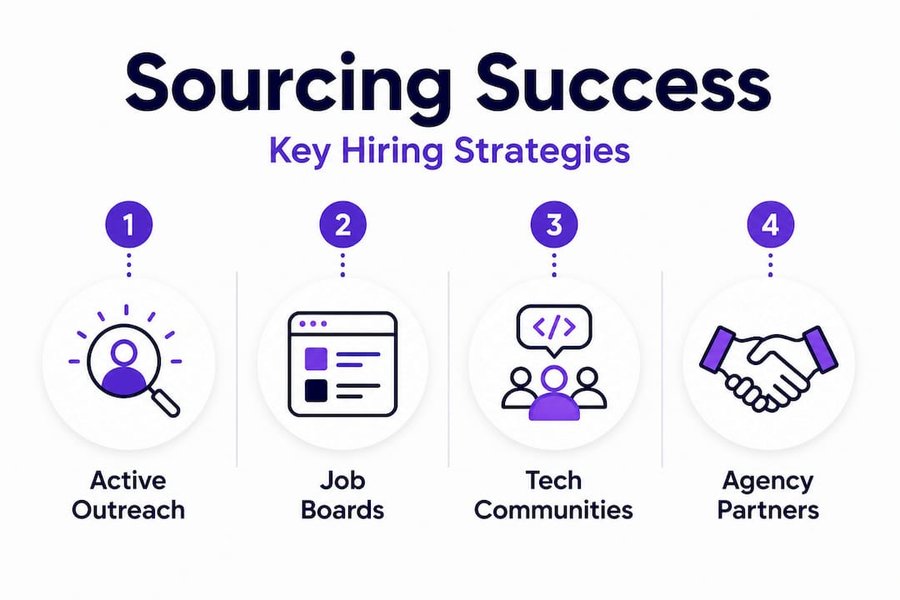
Recruitment partnerships with agencies that specialize in LATAM tech talent offer the fastest path to a qualified shortlist, particularly when time is the primary constraint. The best partnerships are built on transparency about role requirements, a clear understanding of technical standards, and access to pre-screened candidate pipelines.
Pro Tip: Before investing heavily in job postings for a specialized AI or FinTech role, spend two weeks doing targeted outreach in three to five relevant technical communities first. The quality of candidates you engage that way will almost always exceed what inbound applications deliver.
The numbered framework for effective multi-channel sourcing looks like this:
- Define the exact technical profile before sourcing begins, including must-have skills versus nice-to-have skills.
- Allocate sourcing budget and effort across at minimum two channels simultaneously.
- Build a candidate tracking system from day one to maintain relationship continuity.
- Set clear stage-gate criteria so every sourcing channel produces comparable data.
- Review channel performance weekly and reallocate effort based on pipeline quality, not volume.
The tech behind sourcing: AI, automation, and HR tech tools
While approaches differ, technology is the consistent game-changer in talent sourcing today. The right combination of HR technology and AI-powered tools can cut sourcing time by a substantial margin while simultaneously improving the quality of candidates who reach the interview stage.
AI recruitment benefits are well documented: HR tech and AI dramatically increase sourcing speed and fit quality for remote tech roles, giving startups the ability to compete with larger companies that have dedicated talent acquisition teams. For LATAM hiring specifically, AI-powered tools offer several concrete advantages:
- Automated candidate matching analyzes resumes, GitHub profiles, and portfolio data to rank candidates against a defined technical profile, dramatically reducing the time spent on initial screening.
- Natural language processing tools assess written communication samples to gauge English proficiency and communication clarity before any human time is invested.
- Sourcing platform algorithms on LinkedIn Recruiter and similar tools can surface passive candidates who match complex criteria, including domain-specific FinTech or AI experience, at a speed no manual search can replicate.
- Applicant tracking systems (ATS) with automation capabilities route candidates to the right interviewers, send timely status updates, and reduce drop-off caused by slow hiring processes.
- Bias-reduction tools structure early screening criteria around objective technical markers, which is particularly valuable when hiring across cultural and geographic boundaries.
The statistic that matters here is concrete: companies that implement HR tech for remote hiring report reducing time-to-shortlist by up to 50% compared to purely manual sourcing processes, a significant advantage when the best LATAM candidates typically hold multiple offers within two to three weeks of starting their search.
Pro Tip: Use AI screening tools not only for technical skill matching but to run early cultural alignment checks. Tools that analyze communication style, response patterns in asynchronous settings, and work sample quality can predict remote team integration far better than a resume review alone.
The most effective setups combine an ATS with a dedicated sourcing intelligence platform, layered with structured human review at each decision point. Technology handles volume and speed; experienced recruiters handle judgment and relationship-building. Neither works as well alone.
Evaluating and engaging remote candidates: Going beyond the resume
After sourcing, evaluation and candidate engagement are where startups can gain a decisive edge. The resume review, while necessary, tells you surprisingly little about a remote candidate’s ability to perform in a fast-moving, globally distributed team. A more rigorous framework is required.
Pre-vetted LATAM pipelines improve hiring efficiency precisely because they front-load the evaluation work, delivering candidates who have already cleared technical and communication bars before they reach the hiring team. This is the model that high-performing startups increasingly rely on for senior and specialized roles.
For teams doing their own evaluation, the following framework delivers consistent results:
- Technical skill assessment: Use a role-specific coding challenge, architecture review exercise, or case-based problem relevant to your actual product context. Generic coding tests filter for speed, not real-world competence.
- Structured competency interview: Standardize questions across all candidates to enable fair comparison. Ask for specific examples of past work in environments comparable to yours, including distributed teams and asynchronous workflows.
- Async communication test: Request a written summary of a complex technical concept or a short recorded video explanation. This reveals clarity, confidence, and English fluency in a naturalistic setting.
- Cultural alignment conversation: Discuss team norms, working hours, feedback styles, and conflict resolution approaches directly. Remote success depends heavily on alignment here, not just technical skill.
Common mistakes at this stage include:
- Over-relying on resumes for candidates from LATAM markets where resume formats and conventions differ significantly from US or European standards.
- Neglecting the candidate experience entirely. The best engineers receive multiple offers, and a slow or disorganized hiring process signals cultural problems before anyone even starts.
- Skipping the async communication test for roles that are entirely remote and text-based.
“Candidates who feel respected and informed throughout the hiring process are significantly more likely to accept offers and remain engaged post-hire, regardless of geography.”
Transparency matters enormously. Keeping remote candidates informed at every stage, sharing expected timelines, and providing honest feedback after each evaluation round builds the kind of trust that converts top talent. Remote candidate evaluation tips consistently point to candidate experience as a primary differentiator between startups that close offers and those that lose candidates at the final stage.
A hard-won lesson: Your sourcing strategy is your competitive moat
Most startup founders think of talent sourcing as an administrative task, something to delegate or automate entirely once a process is in place. This is a costly misunderstanding. Sourcing strategy, done deliberately, is one of the most durable competitive advantages a tech company can build.
The startups that consistently hire the strongest LATAM engineers are not those with the highest salaries or the most polished job descriptions. They are the ones that have built genuine relationships within technical communities, invested in a candidate-first process, and treat sourcing as an ongoing function rather than a reactive response to open headcount.
Growth through smarter sourcing is a compounding advantage. Each strong hire refers others, each positive candidate experience generates word-of-mouth within tight-knit technical communities, and each structured evaluation round produces data that makes the next hire faster and more accurate. The startups that understand this build talent pipelines months before they need them, not weeks after a resignation lands on their desk.
The branding effect of a transparent, candidate-first sourcing process is also frequently underestimated. In LATAM’s tech communities, which are genuinely interconnected and communicative, a startup’s reputation as a respectful employer travels fast. Conversely, a disorganized or disrespectful hiring process generates negative signals that can quietly close doors to future candidates.
Narrow, niche-focused sourcing always outperforms broad, high-volume approaches for specialized roles. The most impactful FinTech and AI hires come from precise targeting, not from casting the widest possible net. Founders who internalize this distinction, and who allocate real resources to building a sourcing function that reflects it, will consistently outcompete those still relying on job postings alone.
Accelerate your remote LATAM hiring with proven solutions
If the strategies in this article resonate with your hiring goals, the next step is finding the right execution partner to put them into practice at speed. Genty Recruitment specializes in exactly this work, connecting US and European tech startups with pre-vetted, English-speaking tech talent across Argentina, Brazil, Mexico, Colombia, and beyond.
Our LATAM IT recruitment process combines AI-powered sourcing, structured technical assessment, and hands-on recruiting expertise to deliver shortlists faster than traditional hiring cycles. Whether you need a single senior FinTech engineer or a full product team, we manage the sourcing complexity so your leadership team can focus on evaluating the best candidates. Explore our pre-vetted remote tech talent pipeline or learn more about our flexible LATAM staffing solutions to find the engagement model that fits your stage and growth goals.
Frequently asked questions
What’s the best way to source niche AI or FinTech talent in LATAM?
For highly specialized roles, combine targeted active sourcing with participation in industry-specific tech communities and leverage advanced sourcing tools for calibration. Multi-channel sourcing is essential because passive job board applicants rarely match the specificity these roles require.
How can startups vet remote LATAM tech candidates effectively?
Combine technical skill assessments, structured interviews, and pre-vetting services to ensure candidates meet both technical and cultural fit requirements. Pre-vetted LATAM pipelines reduce evaluation burden significantly by front-loading the screening process before candidates reach your team.
What role does AI play in sourcing remote LATAM talent?
AI speeds up candidate matching and shortlisting, especially for complex or high-volume searches, improving quality and reducing bias. AI-driven sourcing tools are particularly effective at identifying passive candidates who match precise technical criteria across large databases.
How do time zones and language impact remote hiring from Latin America?
LATAM offers strong time zone alignment with North America and Europe, reducing communication friction, though English proficiency should always be verified during screening. As confirmed by LATAM talent sourcing research, the region’s overlap advantages are real but must be paired with structured communication assessment for remote roles to succeed long term.