
If you need revenue now, hire a closing-focused rep or a vetted LATAM freelance closer through a specialist recruiter. If you need long-term pipeline, hire a W-2 account executive with a 90-day ramp plan.
Quick decision flow:
- Revenue now (0–30 days): Engage a freelance 1099 closer or contact a specialist recruiter for a curated shortlist. Write a one-page commission plan before you post anything.
- Build pipeline (30–90 days): Hire a full-time SDR or AE. Define your ICP, set a 30-60-90 plan, and budget for a 3–6 month ramp.
- Test a new market (LATAM entry or new vertical): Start with a bilingual freelance rep from Colombia or Mexico to validate the motion before committing to a W-2 hire.
Your single next action: Write a one-paragraph job description that names the role, the quota, and the territory, then choose your sourcing channel — job board, outbound LinkedIn, or a specialist recruiter like GENTY recruitment.
Key Takeaways
Hiring a sales rep delivers the fastest return when the role, employment model, and compensation structure are defined before sourcing begins.
Which kind of sales rep do you actually need?
Getting the role definition right before you post a job saves weeks of wasted interviews. The four core sales roles serve different stages of the revenue funnel, and confusing them is one of the most common early-stage hiring mistakes.
Before you start hiring
Check location, salary, and hiring fit
If you are moving from research to action, start with the market basics so your hiring plan is clearer.
Core role options
- SDR / BDR (Sales Development Representative / Business Development Representative): Focuses on outbound prospecting, cold outreach, and booking qualified meetings. The right hire when your pipeline is thin and you need volume at the top of the funnel.
- AE / Closer (Account Executive): Takes qualified leads, runs demos, handles objections, and closes deals. Suited for companies that already have inbound or SDR-generated pipeline and need conversion horsepower.
- Account Manager: Manages and expands existing customer relationships. Hire this role when retention and upsell are material revenue drivers, not before.
- Outside Sales Rep: Sources, qualifies, and closes customers through in-person or territory-based selling and can be engaged full-time or as a contractor depending on business need.
Hunter vs. pipeline builder
A hunter (closer/AE) fits when you have a short sales cycle under 30 days, a defined ICP, and existing inbound or a warm network to work. A pipeline builder (SDR/BDR) fits when your sales cycle runs 60–180 days, you need consistent meeting volume, and you are willing to invest 1–3 months in ramp. Mixing these expectations into one role is where early-stage companies burn cash.

For SaaS roles specifically, examples of SaaS job roles can sharpen your JD before you post.
Role decision matrix
When is it actually time to hire a sales rep?
Hiring too early burns runway on a rep who has nothing to work with. Hiring too late means the founder becomes the bottleneck and deals slip. The clearest trigger: hire your first salesperson after you have closed 10–20 customers yourself, can describe exactly why they bought, and when sales is consuming more than roughly 60% of your time as a founder.
Beyond that benchmark, watch for these signals:
Hard metrics that signal it’s time
- Founder or CEO is spending more than 60% of their week on sales calls, demos, and follow-up.
- You have closed at least 10 paying customers and can articulate the repeatable buying pattern.
- Pipeline coverage is below 3x your quarterly revenue target.
- Lead-to-close conversion has been stable for two consecutive quarters, meaning the process is teachable.
- Monthly churn is under control, so a new rep won’t inherit a leaky bucket.
Soft signals worth taking seriously
- You are consistently missing follow-up on inbound leads because there is no capacity.
- The same objections come up in every deal but no one is building responses or collateral.
- You are considering entering a new geographic market, such as Mexico or Colombia, where a bilingual local rep would close faster than a US-based founder flying in.
- Customers are asking for a dedicated point of contact post-sale, which signals an account management gap.
Quick self-assessment checklist:
- [ ] Closed 10+ customers with a repeatable pitch
- [ ] Sales consuming 60%+ of founder time
- [ ] Pipeline coverage below 3x quarterly target
- [ ] Stable conversion rate for 2+ quarters
- [ ] Inbound leads going unworked
- [ ] Geographic expansion planned (LATAM, new US region)
- [ ] Post-sale churn under control
- [ ] Budget for 3–6 month ramp period confirmed
If you check five or more of these, the hire is overdue.
Full-time W-2, freelance 1099, or specialist recruiter: which model fits you?
Each employment model carries a different risk profile, cost structure, and time-to-revenue. The right choice depends on your runway, how well-defined your sales process is, and how fast you need results.
Full-time W-2
A W-2 employee gives you maximum control over process, messaging, and culture. You can train them, embed them in your CRM, and build a repeatable playbook around their activity. The trade-off is cost and time: expect a 3–6 month ramp for a B2B SaaS AE, plus payroll taxes, benefits, and the compliance overhead of a formal employment relationship. This model suits companies with a defined sales process, a 90-day onboarding plan and enough runway to absorb the ramp period.
Freelance 1099 / contract
Freelance sales reps work well for short campaigns or cost-sensitive market tests, but they require explicit commission rules and careful attribution to avoid disputes. You pay only on results, which lowers fixed cost, but you get less control over their time, tools, and messaging. Misclassifying a W-2 employee as a 1099 contractor carries IRS penalties, so the distinction matters legally.
Specialist recruiter or agency placement
A specialist recruiter delivers a curated shortlist faster than an open job ad, particularly for niche roles or LATAM hires.
Worker classification matters. In the US, the IRS and Department of Labor use behavioral control, financial control, and the type of relationship to determine whether a worker is an employee or contractor. Getting this wrong exposes you to back taxes, penalties, and potential litigation. Before engaging a 1099 sales rep, have a contractor agreement, a commission plan with clear attribution rules, and an NDA reviewed by a US employment attorney. For W-2 hires, collect a completed I-9 and W-4 on day one.
Employment model decision matrix
How to set compensation plans and write contracts
Compensation is where most early-stage sales hires go wrong. A plan that is too complex creates confusion; one that is too simple fails to motivate the behaviors you actually need.
Common compensation structures
- Base + OTE (On-Target Earnings): The most common structure for full-time AEs. A base salary covers fixed costs; commission on top of it rewards performance. For example, a balanced base plus commission plan is often used for 100% quota attainment targets. Structured incentives that combine a clear base with measurable commission and periodic accelerators produce more consistent sales performance than vague bonus schemes.
- 100% commission: Works for freelance or part-time closers where you want zero fixed cost. Requires a higher commission rate (typically 15–25% of deal value) to compensate for income risk. Best for short-cycle, transactional products.
- Base + accelerator: Adds an accelerator above quota (e.g., 1.5x commission rate above 100% attainment). Motivates top performers to keep pushing after quota is hit.
- Draw against commission: A recoverable or non-recoverable advance on future commissions. Useful for new hires who need income stability during ramp but should be time-limited to 60–90 days.
Worked compensation example
Assume a SaaS AE with a $80,000 ACV product:
- Set OTE at 20–25% of the revenue the rep is expected to generate.
- If the rep is expected to close $400,000 ARR, OTE of $80,000–$100,000 is defensible.
- Split: 60% base ($48,000–$60,000), 40% variable ($32,000–$40,000).
- Break-even for the company: the rep must close enough ARR to cover their fully loaded cost (salary + benefits + tools + onboarding) within 6–9 months.
- Add an accelerator at 120% quota attainment: pay 1.5x the standard commission rate on every dollar above that threshold.
Pro Tip: Set commission payment timing to align with cash collection, not contract signature. A clawback clause for deals that churn within 90 days protects you from reps who close bad-fit customers.
Contract checklist
Every sales rep contract, whether W-2 or 1099, should include:
- Commission definition: what counts as a closed deal, what the rate is, and when it is paid
- Attribution rules: how split deals and house accounts are handled
- Territory or vertical scope
- Clawback clause and conditions
- NDA and IP assignment
- Non-solicitation clause (customers and employees)
- Termination terms and commission treatment on departure
Statistic callout: According to HBR’s research on sales motivation, transparent and measurable commission structures with clear thresholds consistently outperform discretionary bonus plans in driving repeatable sales behaviors.
For SaaS-specific compensation benchmarks, the tips for hiring SaaS professionals guide covers current OTE ranges by seniority.
Where do you find the best sales candidates?
Top-performing sales reps are rarely browsing job boards. The most effective sourcing strategies are proactive, targeted, and built around a candidate ICP — just like your sales process.
Ranked sourcing channels
- Targeted outbound via LinkedIn Sales Navigator: Build a search filter by title (SDR, AE, BDR), industry (SaaS, FinTech), company size, and location. Send a short, personalized connection request that leads with the role’s upside, not the job description. Response rates improve significantly when the message names a specific outcome (“We’re looking for someone who can own SMB outbound in LATAM”).
- Specialist LATAM recruiters: For bilingual remote hires from Argentina, Mexico, Colombia, or Brazil, a specialist recruiter with an existing talent network cuts sourcing time from weeks to days. GENTY recruitment’s skill-first process, for example, delivers curated shortlists within 7 days for sales roles across FinTech, SaaS, and AI.
- Internal referrals: Your existing sales team, advisors, and customers know who the strong performers are. A structured referral bonus ($1,000–$3,000 for a successful hire) generates warm candidates faster than any job board.
- Niche job boards: LinkedIn Jobs, AngelList (Wellfound), and Betts Recruiting reach active candidates. These work best for well-defined roles with clear comp ranges posted publicly.
- Curated marketplaces: Platforms that pre-screen candidates reduce screening time but add a platform fee. Useful for freelance or contract roles where speed matters more than deep vetting.
LATAM-specific sourcing notes
The talent mix varies meaningfully by country, and matching the right market to the role saves time:
- Argentina (Buenos Aires): Strong pool of enterprise SaaS sellers with experience in complex B2B cycles. English proficiency is high, and the timezone overlaps with US EST by 1–2 hours.
- Mexico (Mexico City, Monterrey): Natural fit for North American timezone alignment (CST, overlapping EST and PST). Strong bilingual talent for US-facing SDR and inside sales roles.
- Colombia (Bogotá, Medellín): Growing pool of bilingual SDRs and AEs with SaaS backgrounds. EST timezone overlap is near-perfect, making daily standups and US client calls straightforward.
- Brazil (São Paulo): Best for Portuguese-language market entry or roles requiring Brazilian market knowledge. English proficiency varies more than in Argentina or Colombia, so screen carefully.
For compliant outreach when using programmatic ad channels or targeting platforms, review vendor data-use policies to stay aligned with applicable consent frameworks.
Pro Tip: When writing a JD for a LATAM remote role, state the expected English proficiency level explicitly (“business-level English required for US client calls”) and include the timezone overlap window (“must be available 9 AM–1 PM EST”). This filters candidates accurately and sets expectations before the first screen.
How to run a structured hiring process that actually predicts performance
An unstructured interview where you “get a feel” for a candidate is the fastest path to a bad hire. Founders often confuse charisma with coachability, and theatrical interviewers pass screens that a structured simulation would have caught. A structured hiring process with a scored behavioral interview and a sales simulation exposes real selling skill far better than conversation alone.
Three-stage process
- Written screen (15 minutes, async): Send three short questions by email or form. Ask the candidate to describe their best deal, their prospecting method, and why they are leaving their current role. You are screening for clarity of thought, commercial specificity, and self-awareness. Disqualify vague answers.
- Structured behavioral interview (45–60 minutes, founder or hiring manager): Use the scorecard below. Ask STAR-format questions (Situation, Task, Action, Result) tied to each competency. Do not deviate from the question set across candidates — consistency is what makes scoring valid.
- Sales simulation (30 minutes, sales leader or senior AE): Give the candidate a one-page brief about your product 24 hours before. Ask them to run a discovery call or a closing call with you playing the prospect. Debrief immediately after: “What would you do differently?” is the single best coachability signal.
Candidate scorecard
Using scorecards and 30-60-90 milestones reduces hiring risk and makes early performance expectations explicit, which matters when you need to make a fast call on a new hire’s trajectory.
For the sales competencies most relevant to SaaS and tech roles, core sales skills for tech hiring provides a useful framework for what to screen for in 2025–2026.
Sample behavioral questions
- “Walk me through the largest deal you have closed. What was your role, and what almost killed it?”
- “Describe a quarter where you missed quota. What changed in the next quarter?”
- “How do you prioritize your pipeline when you have 40 open opportunities?”
- “Tell me about a time a manager gave you feedback you disagreed with. What did you do?”
Onboarding and ramp: the 30-60-90 plan that actually works
A new sales hire without a structured ramp plan is expensive guesswork. The 30-60-90 framework gives both the rep and the manager a shared contract for what success looks like at each milestone.
30-60-90 onboarding table
KPIs to track weekly
- Calls and emails sent (activity volume)
- Meetings booked and completed
- Proposals or demos delivered
- Pipeline value added
- Deals advanced by stage
- Win rate on proposals submitted
Pro Tip: The fastest way to shorten ramp time is a shadow-selling cadence in weeks 1–2: the new rep sits in on every live call the founder or a senior rep takes, then runs a role-play of that same call the same afternoon. Pair this with pre-built CRM templates and a call recording library (Gong, Chorus, or Loom) and most reps reach independent productivity 3–4 weeks earlier than without it. Sales training for SaaS roles can further compress ramp for AE and closer positions.
Expected ramp timelines by role:
- SDR: 4–6 weeks to full activity quota
- Inside AE (short-cycle SaaS): 6–10 weeks to first closed deal
- Enterprise AE (B2B, 90+ day cycle): 3–6 months to first closed deal
- Outside sales rep: 2–4 months depending on territory complexity
What does it actually cost to hire a sales rep in 2026?
Budget clarity before you post a job prevents the most common mistake: offering a comp package that attracts the wrong tier of candidate. US salary ranges and LATAM comparatives differ significantly, and the gap is where cost-conscious tech founders find real leverage.
US vs. LATAM salary benchmarks
LATAM ranges reflect talent from Argentina, Brazil, Mexico, and Colombia, with some variation by country and English proficiency level.
Hiring cost math: first 90 days
A worked example for a mid-level inside AE hired through a specialist recruiter in LATAM:
- Recruiter fixed fee: $4,000–$8,000 (fixed-fee model, no percentage of salary)
- Monthly salary: $3,000–$3,750 (mid-range LATAM AE)
- Tools and CRM seat: $200–$400/month
- Onboarding time cost (founder/manager hours): $1,500–$2,500 equivalent
- Total first 90 days: approximately $16,000–$24,000
Cost callout: GENTY recruitment clients save up to 40% compared to equivalent US or European hires, with nearshore timezone alignment (EST/PST overlap) included as a structural advantage, not an afterthought.
Time-to-hire benchmarks
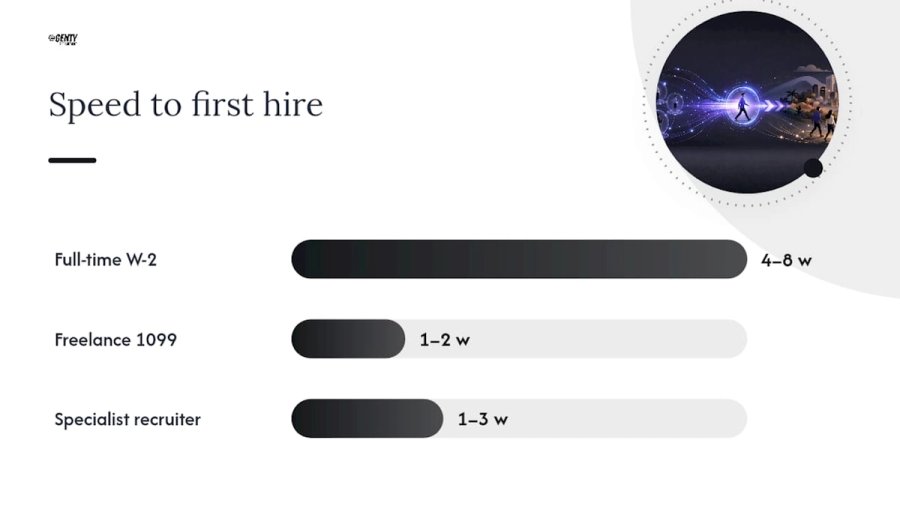
- Full-time W-2 (open job posting): 4–8 weeks from post to offer accepted
- Freelance 1099 (direct outreach): 1–2 weeks
- Specialist recruiter (LATAM, curated shortlist): 1–3 weeks from brief to shortlist
How GENTY recruitment speeds up sales hiring for US tech teams
For US and European tech companies that need a vetted LATAM sales rep without a 6-week sourcing cycle, GENTY recruitment’s process is built around speed and screening depth rather than volume.
The skill-first shortlist process
GENTY recruitment delivers curated shortlists within 7 days of receiving a role brief. The process screens for commercial skills, English proficiency, and timezone fit before a candidate reaches the hiring manager. For sales roles specifically, the screening includes a competency assessment aligned to the role type: SDR, AE, or account manager.
Key service features:
- 7-day shortlist: Curated, pre-vetted candidates delivered within one week of brief submission
- Fixed-fee pricing: Transparent per-seniority pricing with no upfront payment required
- 3-month replacement guarantee: If a placed candidate leaves or underperforms within 90 days, GENTY recruitment replaces them at no additional cost
- LATAM country coverage: Argentina, Brazil, Mexico, Colombia, Chile, and more
- Timezone alignment: All placements are screened for EST/PST overlap, so US team standups and client calls are never a scheduling problem
What to ask any recruiter before you engage
- What is your average time from brief to shortlist?
- How do you screen for sales competency specifically (not just resume review)?
- What does your replacement guarantee cover and for how long?
- Do you charge a percentage of salary or a fixed fee?
- Can you show me examples of sales roles you have placed in my industry?
A recruiter who cannot answer the first three questions with specifics is not worth the fee.
Offer letters, contracts, and the hire-day checklist
Getting the paperwork right on day one prevents disputes on day 90. The documentation differs meaningfully between a W-2 employee and a 1099 contractor, and missing a single element creates compliance exposure.
Offer letter components
Every offer, whether W-2 or contractor, should state:
- Job title and reporting structure
- Compensation summary: base salary or retainer, OTE, and commission rate
- Commission plan summary with quota, payment timing, and clawback terms
- 90-day performance milestones (the first three from the 30-60-90 plan)
- Equity or bonus if applicable, with vesting schedule
- Start date and work location (remote, office, or hybrid)
W-2 vs. 1099 paperwork
For a W-2 employee:
- Completed I-9 (employment eligibility verification) on or before day one
- Completed W-4 (federal withholding)
- Signed offer letter and employment agreement
- NDA and IP assignment agreement
- Non-solicitation clause (customers and employees)
- Benefits enrollment forms
For a 1099 contractor:
- Completed W-9 (taxpayer identification)
- Signed independent contractor agreement with scope of work, payment terms, and termination clause
- Commission plan agreement with attribution rules and clawback terms
- NDA
- IP assignment clause within the contractor agreement
Hire-day checklist
- [ ] CRM account created and role permissions set
- [ ] Email and Slack (or Teams) access provisioned
- [ ] Sales playbook, ICP document, and competitor battlecard shared
- [ ] First-week calendar blocked: product demo training, shadow calls, manager 1:1
- [ ] Intro email sent to relevant internal stakeholders
- [ ] Commission plan countersigned and filed
- [ ] 30-60-90 milestones reviewed and agreed in writing
When should a founder keep selling instead of hiring?
The conventional wisdom says hire a sales rep as soon as you can afford one. That advice is often wrong, and acting on it too early is one of the most expensive mistakes a founder can make.
Three heuristics that actually hold up:
First, repeatability. If you cannot write down your sales process in one page, a rep cannot follow it. A new hire will invent their own process, which may not work, and you will spend the next three months debugging their approach instead of closing deals. The hire is premature until the process is documented.
Second, runway. A full-time AE with a 3–6 month ramp requires 9–12 months of runway to show a return. If you have less than 12 months of cash, a freelance closer or a LATAM contractor on a commission-heavy plan is a lower-risk first move. The fixed cost of a W-2 hire during a ramp period can be the difference between a Series A and a bridge round.
Third, bandwidth. Hiring a closer when you are the only person who understands the product deeply enough to handle technical objections does not free up your time. It creates a dependency: the rep closes to the point of a technical question, then escalates to you for every deal. Hire a sales leader or a coach first if that is the actual bottleneck, not a closer.

The right hire for most early-stage founders is not a full-time AE. It is a part-time closer or a bilingual LATAM SDR who can run outbound while the founder handles the final close. That structure keeps fixed costs low, tests the process, and generates the data needed to justify a full-time hire.
GENTY recruitment places vetted LATAM sales reps in under 7 days
US tech founders who need a bilingual, timezone-aligned sales rep without a 6-week sourcing cycle have a faster path: GENTY recruitment’s LATAM sales recruitment service delivers curated shortlists within 7 days, with fixed-fee pricing per seniority level and a 3-month replacement guarantee.
Sales hires from Argentina, Colombia, Mexico, and Brazil come pre-screened for English proficiency, commercial competency, and EST/PST timezone overlap, so the first interview is a qualification conversation, not a cold introduction.
To get a shortlist for your open sales role, contact GENTY recruitment and submit a role brief today.
Sources
- Hbr
- How to Hire an Outside Sales Representative Updated 2026
- How to Hire Your First Salesperson: A Playbook
- Zendesk blog — Hiring a sales rep
- When to hire a freelance sales rep (and how to pay them)