

Most founders and engineering leaders assume that once they hand a job description to a recruiter, the hard part is done. The reality is quite different. In high-growth FinTech, AI, and SaaS companies, the most successful hires happen when technical leaders and hiring managers take direct ownership of key recruiting steps rather than delegating everything and waiting for a shortlist to appear. This shift toward hands-on recruiting in tech is not just a trend; it is a practical response to the complexity of evaluating technical talent across borders, time zones, and rapidly evolving skill sets.
Table of Contents
- What is hands-on recruiting and why does it matter?
- Execution ownership: The core of hands-on recruiting
- Efficient evaluation: Structured approaches and practical screens
- Reducing friction: Alignment between recruiters and hiring managers
- Hands-on recruiting in action: Case study for hiring remote LATAM tech talent
- Why hands-on recruiting outperforms traditional models for remote tech teams
- Need help implementing a hands-on recruiting strategy?
- Frequently asked questions
Key Takeaways
What is hands-on recruiting and why does it matter?
To truly understand this shift, let’s clarify what hands-on recruiting means and why it’s emerging as a best practice.
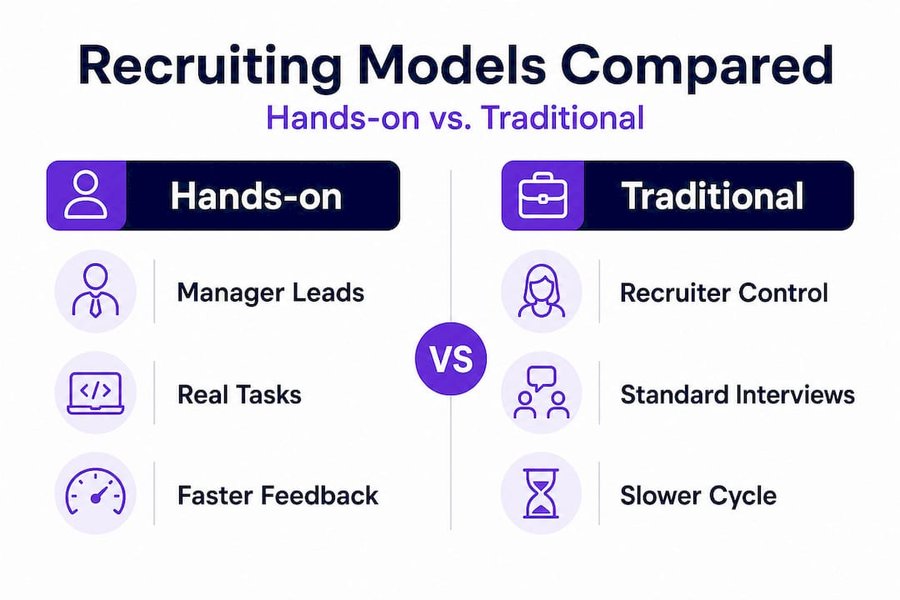
Hands-on recruiting is not about replacing professional recruiters. It is about redefining where hiring managers and technical leads invest their own time and judgment within the hiring process. Instead of simply approving a shortlist or conducting a final interview, technical stakeholders get involved at earlier, more consequential stages: sourcing decisions, application reviews, screening calls, and the design of technical evaluations.
This model contrasts sharply with traditional recruiter-led approaches, where recruiters carry the full process independently and only loop in technical leaders near the end. That older model made sense when companies hired locally and roles were more uniform. For globally distributed teams hiring pre-vetted LATAM tech talent, the stakes are higher and the nuance is greater, which means earlier technical input matters enormously.
What do you need?
Choose the hiring path that fits
After reading "How hands-on recruiting drives better tech hiring", most teams compare these options before deciding how to hire.
According to GitLab’s publicly documented approach, hiring managers actively run major steps such as reviewing applications, scheduling screens, and sourcing when recruiting team capacity is limited. GitLab is one of the most studied remote-first organizations in the world, and their operational discipline around hiring reflects hard-won experience running distributed teams at scale.
The benefits of this model include:
- Faster decision-making: Technical leaders who own their pipeline can move candidates forward or eliminate them without waiting for intermediary approvals.
- Better candidate quality: When engineers evaluate engineers, the signal is cleaner and more relevant to actual job requirements.
- Stronger team fit: Hiring managers who interact with candidates early develop a more nuanced sense of cultural and technical alignment before anyone gets to offer stage.
- Reduced time-to-fill: Fewer handoffs mean fewer delays, which is critical when competing for senior engineering talent in competitive markets.
“The best hires happen when the people who will work with a candidate are also the ones asking the right questions early in the process—not just at the final stage.”
Execution ownership: The core of hands-on recruiting
Now that we know what hands-on recruiting is, let’s dive into what makes it effective for tech teams: ownership at every step.
The concept of execution ownership is central here. As documented in GitLab’s Engineering Hiring guidance, hands-on recruiting in engineering organizations is treated as part of engineers’ and leaders’ core responsibilities to shape team standards and recruitment quality. It is not optional, and it is not secondary. It is how high-performing engineering cultures maintain bar-raising standards as they scale.
GitLab also clarifies that execution ownership means hiring managers and technical stakeholders actively manage pipelines, screening calls, evaluation design, and decision cadence rather than simply providing input to recruiters. This distinction matters. Providing input is passive. Owning execution is active, and the difference in outcomes is significant.
In practice, the responsibilities split between recruiters and hiring managers look something like this:
Pro Tip: Create internal SLAs (service-level agreements) for each hiring step so that both recruiters and hiring managers know exactly how long they have to complete their part. A 48-hour SLA for application reviews, for example, keeps the pipeline moving and prevents candidates from going cold while waiting for feedback.
HR tech tools like applicant tracking systems, collaborative scorecards, and asynchronous video screening platforms make execution ownership far more manageable, especially for remote teams operating across multiple time zones.
Efficient evaluation: Structured approaches and practical screens
With execution ownership in place, let’s see how to make evaluations more accurate and efficient.
One of the most common failure points in tech hiring is relying on traditional interviews as the primary evaluation tool. Unstructured interviews have well-documented reliability problems, partly because interviewers tend to assess confidence and presentation rather than actual technical competence. Modern hands-on recruiting addresses this through structured screening workflows that bring evaluation closer to real job performance.
A practical methodology endorsed by the 2026 startup hiring playbook is to move assessment closer to real work, evaluating behavior in context by using short structured screens combined with paid test days or bounded practical exercises. This sequence gives companies far more signal than a series of traditional interviews ever could.

The most robust evaluation pattern across leading sources, as highlighted by AIHR’s 2025 recruiting strategies, is to standardize evaluation using expectations, rubrics, and structured interview stages while increasing signal quality through bounded practical tasks or paid test days to reduce the gap between interview performance and on-the-job execution.
A structured evaluation workflow typically looks like this:
- Self-assessment or async screen: The candidate responds to a standardized set of written or recorded questions, allowing reviewers to assess communication quality and baseline technical understanding without scheduling pressure.
- Structured video call: A 45-minute call with a defined rubric covering technical skills, problem-solving approach, and role-specific scenarios. Both recruiter and hiring manager score independently to avoid bias anchoring.
- Practical task or bounded exercise: A short, relevant coding challenge, architecture review, or case study that mirrors actual work the candidate would do. Paid test days for senior roles signal respect for the candidate’s time and generate much higher completion rates.
- Calibration meeting: Evaluators compare scores against the rubric before making a decision, reducing the influence of personal preference and keeping the bar consistent across candidates.
Pro Tip: Use practical exercises earlier in the process, not just at the end. When a bounded technical task comes after the first structured screen rather than after three rounds of interviews, you eliminate false positives sooner and save significant time for both your team and the candidate.
Candidate vetting methods and automation in screening tools can help teams run these structured workflows at scale without adding proportional administrative load to hiring managers.
Reducing friction: Alignment between recruiters and hiring managers
A successful hands-on recruiting process also relies on team dynamics, especially alignment with recruiting partners.
Even the best-designed hands-on recruiting model breaks down without clear alignment between the people running it. When hiring managers and recruiters operate with different assumptions about what a role requires, what a strong candidate looks like, or how quickly decisions need to be made, the process slows and candidate quality suffers. Structured alignment and defined expectations between recruiters and hiring managers are central to efficient recruiting and directly reduce ambiguity-based delays.
The alignment process should cover several key areas:
- Role definition: Distinguish between must-have requirements and nice-to-haves before sourcing begins, not after the first batch of resumes arrives.
- Timeline agreement: Set clear expectations on how long each stage will take, including recruiter delivery timelines and hiring manager response windows.
- Evaluation criteria: Agree on the rubric and scoring system before any candidate enters the pipeline, so that feedback is consistent and actionable.
- Regular syncs: A brief weekly or bi-weekly check-in to review pipeline status, discuss emerging patterns, and adjust the search if needed keeps everyone oriented.
- Metrics tracking: Monitor time-to-fill, candidate conversion rates by stage, and team satisfaction with the process to identify friction points and improve over time.
“Effective recruiter and hiring manager alignment cuts the time wasted on rework and miscommunication in half, and it directly improves the candidate experience because decisions happen faster.”
This alignment discipline is especially important when headhunting in LATAM tech markets, where the best candidates often receive multiple offers and move quickly. A slow or disorganized internal process is one of the fastest ways to lose a high-quality candidate to a competitor who moves with more clarity.
Hands-on recruiting in action: Case study for hiring remote LATAM tech talent
To bring these lessons to life, let’s walk through a real-world scenario that many tech leaders face.
Consider a Series B FinTech company based in the United States that needs to hire two senior backend engineers and one AI/ML engineer to support rapid product expansion. The team decides to use a hands-on recruiting model to maintain quality and move fast. Here is how the process unfolds:
- Sourcing with technical input: The CTO and lead engineer define a clear technical profile, specifying key technologies, experience levels, and the types of problems the candidates must have solved before. The recruiting partner uses this to search across Argentina, Brazil, Colombia, and Mexico, tapping into a pool of English-speaking engineers with relevant FinTech or AI experience.
- Application review and initial screen: The recruiter pre-qualifies candidates against the agreed criteria. The hiring manager then reviews a shortlist of five to eight profiles per role and selects those worth advancing, contributing direct technical judgment rather than relying solely on the recruiter’s read.
- Structured video screen: Each advancing candidate participates in a 45-minute structured call with the hiring manager and a senior engineer, using a predefined rubric. Both interviewers score independently and compare notes immediately after.
- Paid practical exercise: Top candidates from the structured screen receive a bounded technical task, paid at a fair rate, that mirrors a real problem the team has faced. For backend engineers, this might be a focused API design challenge. For the AI/ML role, it could be a short model evaluation exercise with a provided dataset.
- Calibration and decision: The hiring team holds a calibration call to review all scores and evidence. A clear decision emerges from the data rather than from subjective impression, reducing back-and-forth and keeping momentum high.
As GitLab’s documented hiring model confirms, hiring managers who actively run major steps of the process generate better outcomes because they bring direct context to every evaluation decision. The result for this FinTech team is three strong hires made within six weeks, with all candidates already integrated into async workflows and contributing within their first two weeks.
Pro Tip: Use a shared collaborative tool such as a structured scorecard template in your applicant tracking system to let every evaluator log their assessment immediately after each interview. This eliminates the recall bias that comes from filling out feedback days after a conversation.
For teams hiring LATAM remote tech talent, this workflow works particularly well because it is built for asynchronous execution: async screens, written rubrics, and structured practical tasks do not require real-time coordination across multiple time zones.
Why hands-on recruiting outperforms traditional models for remote tech teams
Stepping back, here’s what most experts don’t tell you about hands-on recruiting for distributed tech teams.
Conventional wisdom frames hiring as a function that belongs to recruiters, with technical leaders stepping in only to approve a final shortlist. That model was designed for a world where talent was local, roles were standardized, and the cost of a slow hire was tolerable. None of those conditions apply to remote-first FinTech, AI, or SaaS companies competing for talent across global markets today.
The more important insight is that execution ownership is not just an efficiency play. It is a quality play. When engineering leaders own the evaluation design, they encode their actual standards into the process rather than hoping a recruiter can reverse-engineer those standards from a job description. The result is a fundamentally higher hiring bar, maintained consistently across every candidate who enters the pipeline.
Distributed teams face an additional challenge: they cannot rely on office culture, informal observation, or casual interaction to assess fit. Everything that matters must happen explicitly within the structured hiring process. That makes the design of those explicit steps more consequential, and it makes technical leader involvement in that design non-negotiable.
The final point is forward-looking. As AI tools increasingly assist with sourcing and initial screening, the human judgment that differentiates an excellent hire from a mediocre one will increasingly live with technical leaders who understand the real job. Companies that unlock growth with hands-on hiring now are building institutional muscle that scales with them as their teams grow and their markets evolve.
Need help implementing a hands-on recruiting strategy?
If you’re ready to take your hiring to the next level, here’s how to get practical help.
GENTY Recruitment partners with US and European tech companies to build and execute hands-on recruiting strategies for remote talent across Latin America. Whether you need IT recruitment in LATAM for FinTech, AI, or SaaS roles, or you’re looking to expand your team through proven remote staffing solutions, GENTY brings the technical expertise and regional knowledge to make every hire count. Our process combines structured assessment, execution ownership support, and deep market access across Argentina, Brazil, Mexico, Colombia, and beyond. If you’re serious about building a high-performing distributed team, hire remote LATAM talent through a partner who treats every search with the same rigor your best engineers would.
Frequently asked questions
What is hands-on recruiting and how does it differ from traditional recruitment?
Hands-on recruiting involves hiring managers and technical leaders directly running and owning key stages of hiring, rather than delegating all steps to recruiters. As GitLab’s process documents, execution ownership by hiring managers and technical stakeholders means actively managing pipelines, screens, and decisions rather than just providing input.
Why is hands-on recruiting especially valuable for remote tech teams?
It enables teams to quickly assess technical and culture fit, bridge time zones, and maintain high hiring standards across borders. Engineering organizations that treat hands-on recruiting as a core leadership responsibility consistently produce stronger, more aligned hires at scale.
What are best practices for structuring hands-on evaluations?
Combine short structured screenings, practical tasks or paid test days, and standardized rubrics to ensure quality and fairness. A practical methodology grounded in real work evaluation reduces the gap between how candidates perform in interviews and how they perform in the role.
How do recruiters and hiring managers collaborate effectively in a hands-on model?
They set clear expectations on roles and timelines, review key hiring metrics together, and maintain ongoing communication. Structured alignment with defined expectations is the most reliable way to keep the process efficient and reduce costly rework.