

Securing qualified tech talent fast is one of the most pressing growth bottlenecks facing US and European startups right now. Recruitment timelines stretch to months, local engineering salaries keep rising, and offshore alternatives in Eastern Europe or Southeast Asia often create timezone headaches and collaboration friction. Latin America has emerged as a structurally superior answer to this problem, offering pre-vetted, English-speaking engineers with overlapping working hours, strong technical fundamentals, and genuine enthusiasm for remote collaboration. This guide walks you through every step, from understanding the regional talent market to onboarding your first LATAM hire in under three weeks.
Table of Contents
- Why Latin America is the new hotspot for tech hiring
- Preparing to source: Prerequisites, pitfalls, and country nuances
- Step-by-step: How to source and vet LATAM tech talent
- Troubleshooting, risk mitigation, and how to measure success
- The overlooked factor: Collaboration and culture beat costs
- Ready to accelerate your tech hiring?
- Frequently asked questions
Key Takeaways
Why Latin America is the new hotspot for tech hiring
The argument for LATAM is not just about cost savings, though those are real and measurable. The more compelling case is operational fit. US and European startups consistently report smoother collaboration when their remote engineers share or closely overlap their working hours, and LATAM delivers exactly that. Countries like Colombia, Mexico, and Argentina operate in Central, Mountain, and Eastern-adjacent time zones, meaning your new developer joins standup calls, async reviews, and sprint planning in real time rather than at 10 PM.
The talent pool by country also breaks down in ways that matter for specific roles. Argentina produces some of the region’s strongest Python, AI, and data science engineers, with a culture of strong written English and academic rigor. Brazil offers sheer scale along with deep FinTech expertise, having built one of the world’s most advanced digital payments ecosystems through platforms like Pix. Mexico aligns closely with US business culture, benefits from a large STEM graduate pipeline, and is especially strong for full-stack and SaaS product roles. Colombia balances competitive pricing with genuinely skilled mid-level engineers who are increasingly specializing in cloud infrastructure and machine learning.
On cost, the numbers are concrete: LATAM mid-level engineers deliver 15 to 30% savings compared to equivalent Eastern European talent, while offering significantly better US timezone alignment. Against local US hires, the savings are even wider. This is not a race to the bottom. It reflects a regional cost of living differential, not a skills gap. You are accessing engineers who studied at strong universities, contribute to open-source projects, and hold certifications from Google, AWS, and Meta.
Before you start hiring
Check location, salary, and hiring fit
If you are moving from research to action, start with the market basics so your hiring plan is clearer.
The table below gives you a quick comparison across hiring regions to contextualize where LATAM fits in your recruiting strategy.
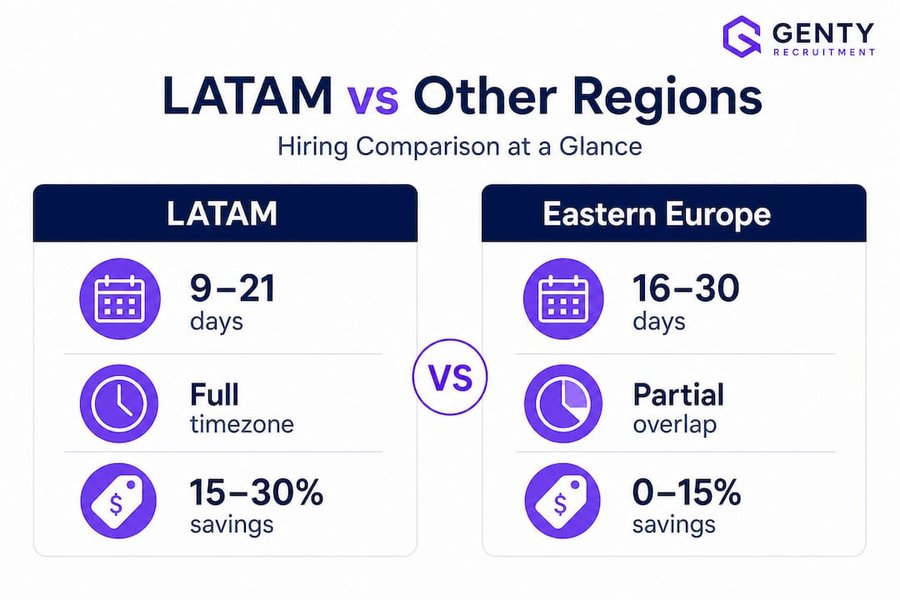
For startups prioritizing speed, collaboration, and sustained retention, the LATAM column consistently wins. Explore remote tech hiring in LATAM further to understand why the region is attracting serious attention from scaling startups and enterprise teams alike. Effective LATAM talent sourcing strategies also play a major role in separating fast, quality hires from drawn-out searches.
Preparing to source: Prerequisites, pitfalls, and country nuances
Knowing the ‘why’ makes preparation vital, and the biggest mistakes startups make happen before a single candidate is screened. The most important first step is defining your role with precision: the tech stack, the expected seniority level, whether the position is product-facing or infrastructure-focused, and what communication expectations look like day to day. Vague job descriptions produce vague candidate pools.
Beyond the role itself, you need to decide which hiring model fits your operational and legal situation. The four primary models are direct sourcing, staffing partner, staff augmentation, and independent contractor engagement. Each carries distinct compliance obligations. Direct sourcing gives you control but requires local entity setup or an Employer of Record (EOR) service. Staff augmentation through a partner is faster and offloads compliance entirely. Contractors offer flexibility but carry misclassification risk, especially in Brazil, where employment law is strict and courts historically favor worker protections.
Salary expectations also vary meaningfully by country. The table below shows benchmarks for senior-level developers based on current 2026 market data.
These salary benchmarks reflect current market rates as of 2026 and should anchor your compensation planning before you open a role. Offering below-market rates in Brazil or Mexico will cost you pipeline quality, while offering US rates in Colombia without understanding local norms creates internal equity issues if you scale later.
A few practical things to have ready before launch:
- Employment structure: Decide between EOR, contractor, or direct entity before outreach begins
- Compensation range: Set bands per country, not a single global figure
- Assessment format: Define what your technical screen looks like before candidates enter the funnel
- Communication requirements: Specify B2 or C1 English clearly in the job spec
- Legal review: Get at least a 30-minute review with a LATAM employment attorney before your first offer
Pro Tip: Argentina’s peso volatility means salaries quoted in ARS can shift dramatically. Always denominate contracts in USD for Argentine hires, and make sure your payment platform supports USD disbursement to avoid currency conversion losses on both sides.
“Hiring the wrong model for your situation is the most expensive mistake you can make. Defining structure first saves weeks of rework and real legal exposure.”
For a deeper breakdown on compensation benchmarking, the US vs LATAM salary guide and the full remote LATAM hiring guide both provide current figures organized by role and seniority level.
Step-by-step: How to source and vet LATAM tech talent
With preparation complete, here is a clear, step-by-step playbook to rapidly source and vet the best LATAM talent.
Step 1: Define your must-haves in writing. Before engaging any sourcing channel, write a one-page brief that captures the non-negotiables: stack, seniority, timezone requirement, English level, and domain knowledge. This document becomes your intake form for both internal hiring managers and any external partners.
Step 2: Choose your sourcing channel. For speed, a pre-vetted staffing partner significantly outperforms DIY sourcing. Time-to-hire with specialist partners typically runs 9 to 21 days, compared to 2 to 6 weeks when sourcing independently. For niche roles like AI engineers or FinTech architects, the gap is even wider because partners maintain active talent pools with pre-screened candidates.
Step 3: Screen for practical skills, not just credentials. Resumes in LATAM often undersell actual ability, and over-reliance on credentials misses strong engineers. Use a two-stage assessment: a 30-minute async coding task followed by a 45-minute live technical interview. For AI and machine learning roles specifically, AI/ML screening should test practical AI usage, debugging real model outputs, and API integration, not just theoretical knowledge of frameworks.

Step 4: Verify communication skills in context. Technical excellence does not guarantee effective remote collaboration. Include a short written task, such as a Slack-style async update summarizing a fictional bug fix, to assess written communication style and clarity alongside technical output.
Step 5: Check for pre-vetting credentials. If you use a staffing partner, confirm their vetting process includes English assessment scores, technical test results, and at least two reference checks. A reputable partner will share these transparently before your interview.
Step 6: Onboard with structure. Plan a 30-60-90 day onboarding track that includes system access, a technical buddy, and scheduled check-ins. Partners who offer a 60-day guarantee period give you a safety net if the fit does not hold. Clear onboarding documentation in English reduces ramp time dramatically, especially for engineers joining distributed agile teams.
Pro Tip: For AI and SaaS roles, ask candidates to walk you through a project they built using a recent LLM or cloud-native tool. Their ability to explain trade-offs and architectural decisions in plain English tells you more about collaboration readiness than any multiple-choice test.
Explore the full remote talent sourcing playbook and the latest breakdown of LATAM IT skills in demand to sharpen your screening criteria before you open the pipeline.
Troubleshooting, risk mitigation, and how to measure success
A strong process still needs checks, and several risks are specific enough to LATAM hiring that they deserve direct attention. The three most common problem areas are contractor misclassification, payment and currency disruption, and onboarding delays caused by incomplete compliance setup.
Contractor misclassification is the single biggest legal exposure for startups hiring in Brazil. Brazilian labor law grants extensive protections to workers and courts frequently reclassify long-term contractors as employees, triggering retroactive benefits, fines, and back taxes. Argentina’s currency instability adds a different layer of operational complexity: peso-denominated payroll erodes in value rapidly, and engineers expect USD-indexed compensation to protect their real income. Using an EOR eliminates most of these risks by handling local employment compliance on your behalf.
Practical risk mitigation actions include:
- Use an EOR or specialist staffing partner for Brazil and Argentina engagements to handle compliance automatically
- Denominate all contracts in USD for countries with active currency volatility
- Build a 10-15% payment buffer into project budgets to absorb platform fees and exchange timing differences
- Audit contractor relationships quarterly in high-risk jurisdictions to catch any misclassification exposure early
- Require written IP assignment clauses in all contracts regardless of hiring model
For measuring whether your LATAM strategy is working, set clear benchmarks from the start. ROI on LATAM hires averages 50 to 55% savings versus US or EU equivalents, with payback periods typically landing in 3 to 4 weeks. That is an unusually fast return compared to most hiring investments.
Retention is the other critical metric. Top LATAM staffing providers report annual retention rates of 94 to 98%, with average tenure running 24 to 38 months. These figures rival or exceed retention in US tech roles, where annual churn regularly exceeds 20%. Tracking your own retention against these benchmarks tells you quickly whether your compensation, onboarding, and culture integration are calibrated correctly.
Pro Tip: Set a 90-day retention review for every LATAM hire. If attrition happens, it almost always occurs in the first 90 days and is driven by onboarding gaps rather than capability mismatches. Catching early friction fast saves the cost of a replacement cycle.
Stay current with practical guidance through LATAM hiring insights as compliance requirements and market conditions evolve through 2026.
The overlooked factor: Collaboration and culture beat costs
Even with the checklist complete, one critical element determines lasting success: the degree to which your LATAM engineers feel like genuine team members rather than external contractors filling seats. This is the factor startups consistently underestimate.
When you ask most hiring managers why they pursued LATAM, the first answer is always cost. That is understandable. The savings are real and significant. But the startups that build durable, high-performing remote teams almost universally cite something else when you follow up six months later: communication rhythm, cultural alignment, and a shared commitment to iterative delivery. These qualities compound over time in ways that cost savings alone never can.
The data reinforces this. US companies are increasingly choosing nearshoring over pure offshoring specifically because proximity, whether geographic or cultural, accelerates collaboration. Engineers who share your business hours, understand your cultural references, and have worked within agile frameworks designed for US product teams integrate faster, stay longer, and contribute more meaningfully to product decisions.
LATAM engineers, particularly those working with pre-vetted staffing networks, have typically operated in distributed team environments before. They understand async documentation, pull request culture, and outcome-focused delivery. That baseline removes an entire layer of onboarding friction that companies hiring from regions with less remote-work maturity face regularly.
The practical implication is simple: when evaluating candidates, weight cultural fit and communication style alongside technical scores. A senior engineer who scores 90% on your technical assessment but struggles to articulate trade-offs in English during the interview will cost you more in collaboration overhead than an 80% technical scorer who communicates with clarity and confidence. Explore more on why this region for remote tech hiring has moved beyond cost arbitrage into a genuine strategic advantage for growth-stage startups.
Ready to accelerate your tech hiring?
Building a high-performing remote engineering team from LATAM is entirely achievable when you combine the right sourcing strategy with a partner who handles pre-vetting, compliance, and onboarding support from day one.
Our team at Genty Recruitment specializes in connecting US and European tech startups with pre-screened, English-speaking engineers from Argentina, Brazil, Mexico, Colombia, and beyond. Whether you need a LATAM IT recruitment partner to fill your pipeline fast, are looking for pre-vetted remote LATAM talent for SaaS or AI product teams, or are scaling a FinTech recruitment LATAM bench for payments or compliance-heavy roles, we can get the right candidates in front of you within days. Book a consultation and let us match you with talent that is technically qualified, culturally aligned, and ready to contribute from week one.
Frequently asked questions
How long does it take to hire a pre-vetted LATAM developer?
With a reputable staffing partner, top candidates can be placed in 9 to 21 days, significantly faster than the 4 to 12 weeks typical for local US hires.
What is the salary range for senior tech talent in LATAM?
Senior developer salaries range from $3,500 to $6,500 per month depending on country, with Mexico and Brazil at the higher end and Colombia offering strong value at the mid-range.
What are the key legal risks when hiring in LATAM?
Contractor misclassification is the primary risk, especially in Brazil where labor courts actively protect workers, while Argentina’s currency volatility requires USD-denominated contracts to protect both parties.
How does LATAM talent compare to Eastern Europe for US startups?
LATAM engineers offer 15 to 30% savings over Eastern European equivalents at junior and mid levels, plus significantly better US timezone alignment, making them a stronger operational fit for most US-based distributed teams.
What retention rates can I expect from LATAM hires?
Top staffing providers report annual retention of 94 to 98% with average tenure running 24 to 38 months, which compares favorably with US engineering teams where annual attrition often exceeds 20%.