

Vetting remote candidates is defined as the structured process of evaluating a candidate’s technical skills, communication abilities, identity, and behavioral consistency before making a hiring decision without in-person contact. For tech hiring managers, this process demands more rigor than traditional screening because the absence of physical cues creates real gaps in judgment. The most effective remote candidate assessment combines structured interviewing, asynchronous communication exercises, identity verification via tools like Checkr, and behavioral fraud detection guided by frameworks from Security Boulevard and Google re:Work. This guide covers each component with the specificity you need to build a repeatable, defensible hiring process.
What are the essential components of a structured remote vetting process?
Structured interviewing is the foundation of any credible remote hiring strategy. Google re:Work defines structured interviewing as a method built on standardized questions, scoring rubrics, and trained interviewers who apply criteria consistently across every candidate. Without that standardization, two interviewers evaluating the same person will reach different conclusions, and your hiring decisions become a product of individual bias rather than candidate quality.
The practical mechanics matter here. Each interview must map to a specific competency, and every interviewer must score independently before any group discussion. InCruiter recommends rubric validation with agreement thresholds, meaning interviewers score the same sample candidate data separately and compare results before the real loop begins. This calibration step catches scoring drift early and prevents one strong voice in a debrief from overriding the group’s independent assessments.

Question integrity is a frequently overlooked risk. When the same questions circulate in candidate communities, your rubric becomes useless because you are measuring preparation, not competency. Rotate question banks every quarter and track which questions have been in use longest. For LATAM tech hiring specifically, where candidate networks are tight in cities like Buenos Aires and São Paulo, question refresh cycles matter more than most hiring managers expect.
What do you need?
Choose the hiring path that fits
After reading "How to Vet Remote Candidates: A Tech Hiring Guide", most teams compare these options before deciding how to hire.
Key structural elements for a remote vetting rubric:
- Competency mapping: Each interview question ties to one defined skill or behavior, such as async communication, debugging under ambiguity, or cross-functional collaboration.
- Independent scoring: Every interviewer submits a numeric score before the debrief call. Scores are visible to all only after submission.
- Calibration sessions: Run a calibration exercise with new interviewers using archived candidate data before they join a live loop.
- Question rotation: Retire questions after 90 days or when they appear in public interview prep forums.
- Debrief structure: Debrief calls follow a fixed agenda. The hiring manager facilitates but does not anchor the discussion with their own score first.
Pro Tip: Build a shared scoring spreadsheet that locks individual scores until all interviewers have submitted. Google Sheets with protected ranges works for this without requiring dedicated software.
How can async communication assessments improve remote candidate evaluation?
Asynchronous communication assessment is the single most underused signal in remote hiring. HackerRank’s 2026 remote hiring guide identifies written communication review as a leading indicator of remote collaboration success, precisely because in-person cues like tone, body language, and real-time clarification are absent in distributed teams. A candidate who writes clearly, concisely, and with appropriate context is demonstrating the exact skill they will use every day on your team.
The format options for async assessment are broader than most hiring managers use. Consider these in order of implementation complexity:
- Short written exercise: Ask candidates to explain a technical decision they made recently, in 300 words or fewer. Evaluate structure, clarity, and whether they anticipate the reader’s questions.
- Take-home technical project: Scope this carefully. Klearskill advises scoping take-home projects under two hours to respect candidate time and attract a wider talent pool, including candidates currently employed full-time.
- Recorded video response: Tools like Spark Hire and HireVue let candidates record answers to set questions asynchronously. This adds a verbal communication layer without requiring live scheduling across time zones.
- Async code review: Send a pull request with intentional issues and ask the candidate to review it in writing. This tests both technical judgment and communication quality simultaneously.
- Loom-style walkthrough: Ask candidates to record a short screen-share explaining their approach to a sample problem. This reveals how they communicate technical reasoning to non-technical stakeholders.
Scope discipline is non-negotiable. Assignments that run four or more hours screen out strong candidates who are already employed and have limited discretionary time. They also introduce legal risk in jurisdictions where unpaid work tests face scrutiny. Keep tasks tight, define the evaluation criteria in the brief, and tell candidates exactly how long the task should take.
Pro Tip: Include a one-sentence evaluation rubric in the task brief itself. Telling candidates “we will assess clarity, structure, and technical accuracy” does not help them game the test. It does reduce anxiety and improve completion rates.
What are best practices to verify identity and prevent fraud in remote hiring?
Identity fraud in remote hiring is not a theoretical risk. Security Boulevard documents red flags including candidates who struggle to explain prior work in real time, show inconsistencies between their resume and verbal account, or whose communication style shifts noticeably between written and live formats. These behavioral signals are as important as document checks, and they require a deliberate multi-stage review process.
Document verification alone is insufficient. Checkr’s identity verification service validates government-issued ID against a live selfie, confirming that the person submitting documents is the same person appearing on camera. This liveness check prevents the most common fraud vector in remote hiring, which is a proxy candidate submitting credentials on behalf of someone else. Device fingerprinting adds another layer by flagging cases where multiple applications originate from the same device under different identities.
“Reviewing identity, behavior, and communication signals holistically throughout hiring is the only reliable defense against remote hiring fraud.” — Security Boulevard, 2026
Practical steps for a fraud-resistant remote screening process:
- Run IDV before technical screening: Confirm identity before investing in HackerRank assessments or multi-stage interviews. Discovering fraud after three interview rounds wastes significant time and budget.
- Cross-reference communication patterns: Compare writing style in the application, async exercise, and live interview. Significant shifts in vocabulary, sentence structure, or technical depth are a signal worth investigating.
- Use behavioral consistency checks: Ask candidates to explain the same project at two different stages. Genuine experience produces consistent, detailed accounts. Fabricated experience produces vague or contradictory ones.
- Verify right-to-work and consent: Veremark’s 2026 screening checklist emphasizes consent-based background checks linked to onboarding workflows, with right-to-work verification tied to the candidate’s actual work location.
- Document every check: Maintain an audit trail of verification steps taken, tools used, and results recorded. This protects your organization legally and creates a repeatable process for future hires.
How should hiring managers structure interview loops for remote vetting efficiency?
A well-designed interview loop is short, purposeful, and scored consistently. Klearskill’s research on candidate dropout shows that dropout rates rise when loops exceed five interviews, which means every stage you add costs you candidates, particularly strong ones who have competing offers. Four focused interviews with clear, distinct purposes outperform six loosely defined conversations every time.
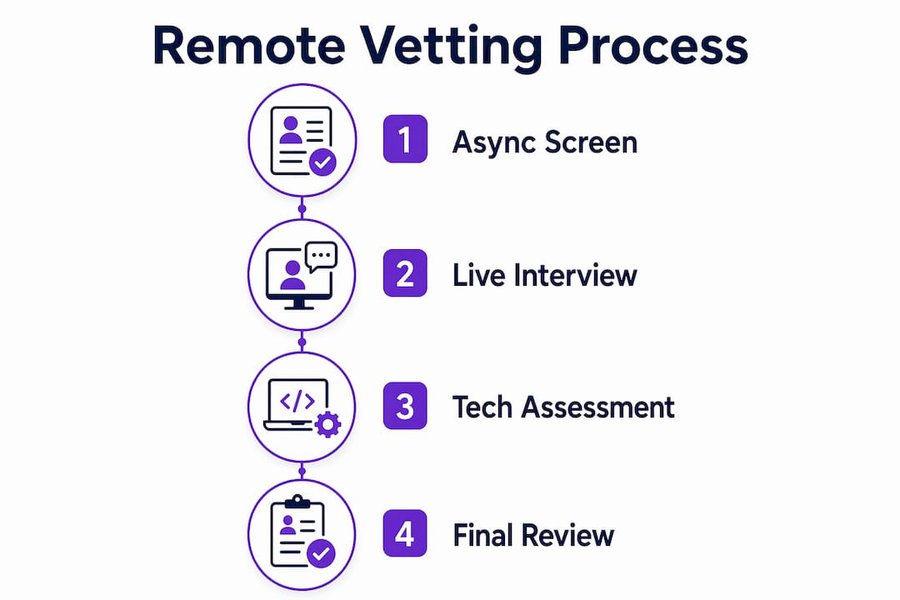
The table below shows a recommended four-stage loop structure for remote tech roles, with each stage mapped to its primary evaluation goal and the tool or method best suited to it.
Calibration meetings between stages prevent score drift. After Stage 2, interviewers compare scores independently before advancing candidates. This prevents a single strong advocate from carrying a candidate past a legitimate technical concern. ATS integration matters here too. Linking background check workflows and IDV steps directly into your ATS, whether that is Greenhouse, Lever, or Workable, reduces manual handoffs and keeps the process moving without losing compliance documentation.
Async exercises placed at Stage 1 serve a dual purpose. They generate a real work sample before any live interview investment, and they filter candidates who cannot complete a basic written task independently. For remote tech hiring workflows, this early signal saves significant interviewer time downstream.
Key takeaways
Effective remote candidate vetting requires structured interviews, async communication assessment, multi-layer identity verification, and a focused four-stage loop to produce consistent, defensible hiring decisions.
Why remote vetting demands more rigor than most teams apply
Most hiring managers I speak with treat remote vetting as a slightly modified version of their in-person process. They add a video call, maybe a take-home test, and call it done. That approach produces inconsistent results, and the failures are expensive. Bad hiring decisions in remote tech teams carry costs that go well beyond the obvious recruiting fees. They include onboarding time, team disruption, and the months it takes to recognize that a hire is not working out.
What I have found, working across dozens of LATAM tech placements, is that the teams with the best remote hiring outcomes share one habit: they treat every stage of the process as a data collection event, not a conversation. The structured rubric is not bureaucracy. It is the mechanism that lets you compare a developer in Bogotá against one in Buenos Aires using the same criteria, without letting timezone, accent, or interview nerves distort the outcome.
The fraud prevention piece is where I see the most complacency. Teams that have never encountered a proxy candidate assume it will not happen to them. The reality is that identity fraud in remote hiring is rising, and the most effective defense is behavioral consistency review across multiple touchpoints, not a single document check at the end of the process. Combining Checkr-style IDV with communication pattern analysis and live project walkthroughs gives you a multi-dimensional picture that is genuinely hard to fake.
My practical advice: do not build this process all at once. Start with the async written exercise and a structured rubric for your behavioral interview. Add IDV in the next hiring cycle. Calibration sessions come after that. Incremental implementation beats a perfect system that never gets deployed.
— Eugene
How Gentyrecruitment accelerates remote tech hiring with pre-vetted talent
Gentyrecruitment specializes in IT recruitment across LATAM, delivering pre-vetted candidates to US and European tech companies in FinTech, AI, and SaaS. The vetting process described in this guide is built into every search Gentyrecruitment runs, including structured competency assessments, async communication screening, and identity verification, so hiring managers receive candidates who have already cleared the most time-intensive stages.
For tech teams that need to move fast without sacrificing quality, Gentyrecruitment’s model combines technology, structured assessment, and hands-on recruiting to deliver shortlists in as few as five days. Whether you need a senior backend engineer in Mexico City or a product manager in Buenos Aires, the process is built to produce reliable, qualified hires who are ready to integrate into global teams from day one. Explore remote LATAM talent to see how the model works for your hiring cycle.
FAQ
What does vetting remote candidates actually involve?
Vetting remote candidates involves structured interviews with scoring rubrics, asynchronous communication assessments, identity verification, and behavioral consistency checks across multiple stages. The goal is to confirm technical ability, communication quality, and genuine identity before making an offer.
How do you assess communication skills in remote candidates?
Written communication is the most reliable signal. Assign a short take-home exercise scoped under two hours and evaluate structure, clarity, and technical accuracy. Tools like Spark Hire and HireVue also support recorded async video responses for verbal communication review.
What tools are used for identity verification in remote hiring?
Checkr’s identity verification service validates government-issued ID against a live selfie and uses device fingerprinting to prevent proxy candidates. For broader background screening, Veremark provides consent-based workflows linked to onboarding and right-to-work verification.
How many interview rounds should a remote hiring loop include?
Four focused rounds is the recommended maximum. Candidate dropout rises when loops exceed five interviews, so each stage must have a distinct purpose, whether that is async screening, technical assessment, behavioral evaluation, or final stakeholder alignment.
How do you detect fraud in remote hiring?
Compare communication style and project explanations across multiple stages. Significant inconsistencies between written and verbal accounts, or between resume claims and live explanations, are documented red flags. Combining IDV tools with behavioral consistency review across the full loop provides the most reliable fraud detection.