

Hiring managers at tech startups know this pain well: a promising candidate applies on Monday, and by the time internal feedback arrives on Friday, they have already accepted another offer. A broken staffing strategy workflow is rarely the result of bad intentions. It is the result of an undocumented process, unclear ownership, and tools that do not talk to each other. This guide walks you through how to build, optimize, and measure a recruitment workflow specifically designed for hiring remote tech talent, whether you are sourcing engineers from Argentina, product managers from Colombia, or FinTech specialists from Brazil.
Key Takeaways
Your staffing strategy workflow starts with preparation
Before you write a single job description or open a requisition, you need a clear picture of where your organization is today and where it needs to go. Most hiring delays are not rooted in a shortage of candidates. They are rooted in a mismatch between staffing goals and business reality.
Start by aligning your hiring plan to your growth roadmap. If your product team is releasing a new feature set in Q3, the engineers supporting that release need to be onboarded at least six to eight weeks earlier. That kind of backward planning requires HR and department heads to work from the same timeline, not separate spreadsheets.
Once alignment is established, conduct a skills gap analysis across your current workforce. This does not need to be an elaborate process. A straightforward audit comparing current team competencies against your 12-month technical roadmap will surface the roles you genuinely need to fill, versus roles that feel urgent but could be addressed through upskilling or internal mobility. Remote hiring compounds this step because the talent you are evaluating spans different time zones, legal frameworks, and salary expectations across Latin America.
Need help hiring?
See the next step after this guide
If this topic is relevant to your team, these are the most useful pages to check next.
Set measurable KPIs for your hiring process before it begins, not after it has already gone sideways. The metrics worth tracking from day one include:
- Time-to-fill: days from requisition approval to accepted offer
- Time-to-productivity: days from start date to full contribution
- Offer acceptance rate: a signal of both candidate experience and compensation competitiveness
- Sourcing channel efficiency: which channels deliver qualified candidates at the best ratio
Pro Tip: If you are hiring across multiple LATAM countries, build a salary benchmarking reference for each market into your preparation phase. Compensation expectations vary meaningfully between, for example, Mexico City and Buenos Aires, and entering negotiations without that context costs you both time and offers.
Designing a workflow that actually gets candidates hired
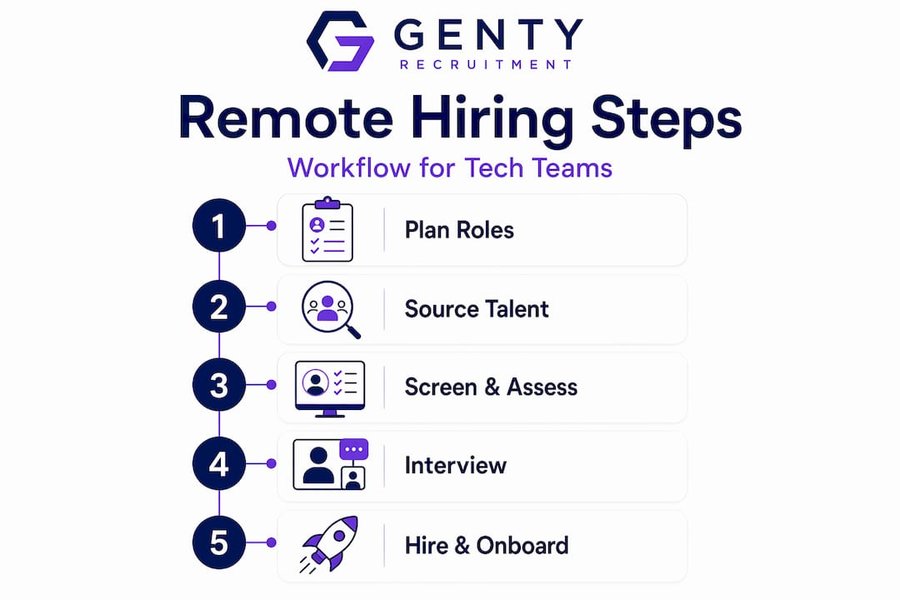
This is where most organizations stumble. They have a general sense of how hiring works but have never mapped their actual, end-to-end process from requisition to signed contract. Mapping the full requisition-to-offer workflow and identifying specific stages where candidates stagnate is the single most useful exercise you can do before touching any tool or template.
Here is a step-by-step framework for building your optimized staffing strategy workflow:
<p>Document the current process visually. Use a simple flowchart to capture every step from job approval through offer signing. Include every handoff point: who passes what to whom, and by when.</p>
<p>Identify bottlenecks by stage. Look for stages where candidates sit for more than three days without action. Treating staffing as open role lists rather than mapped workflows is where most staffing failures begin.</p>
<p>Implement automation for coordination tasks. Self-scheduling calendar tools remove the back-and-forth that kills candidate momentum. Self-scheduling tools reduce interview delays by as many as four to six days per candidate. Pair these with an ATS that integrates with your communication tools so no feedback gets lost in an email thread.</p>
<p>Cap interview rounds and use structured scorecards. Capping rounds at three, with each round evaluating distinct competency dimensions, keeps the process moving without sacrificing evaluation quality. If two rounds are serving overlapping purposes, consolidate them.</p>
<p>Set feedback SLAs for every internal stakeholder. The average hiring process takes 44 days, and most of that time is lost in process friction, not candidate quality. A 24-hour internal feedback SLA after each interview round can cut that number substantially.</p>
<p>Assign named ownership and deadlines to every step. A staffing plan with clear owners, deadlines, and intervention strategies transforms intent into execution. Without named accountability, every stage becomes a shared responsibility that no one owns.</p>
<p>Apply AI-driven sourcing at the task level, not the role level. AI applied at the task level across workflows increases efficiency without creating bloated hiring processes. Use it to surface matched candidates, flag stale requisitions, or auto-screen for technical qualifications. You can explore concrete examples of this approach in recruitment automation for fast growth.</p>
For remote-specific workflows, build time zone alignment directly into your scheduling logic. If your hiring team is in New York and your candidate is in Bogotá, the overlap window is generous. If your team is in Berlin and the candidate is in São Paulo, you have a narrower window that needs intentional scheduling, not a last-minute scramble.

Pro Tip: Run parallel reference checks while your candidate is completing a technical assessment, not after you have decided to make an offer. This saves three to five days at the end of the process without cutting any corners on diligence.
Common pitfalls in staffing workflow optimization
Even a well-designed staffing strategy workflow will falter if it is not implemented with careful attention to people and process dynamics. The technical fixes are usually the easier part. The organizational ones take more deliberate effort.
The most common pitfalls hiring managers encounter are:
- Stakeholder resistance to process changes. Hiring managers who have always done things a certain way will push back on new feedback SLAs or consolidated interview stages. Address this early by showing them the data: slower processes cost the company candidates and money.
- Over-engineering the workflow. Adding too many approval layers or interview rounds in the name of thoroughness creates the very delays you set out to eliminate. Every step in your process should have a clear, defensible purpose.
- Fragmented tool stacks. 62% of buyers have experienced financial damage from workforce management software that did not integrate properly with their existing systems. Before purchasing any new platform, audit your current integrations and confirm compatibility.
- Ignoring remote candidate experience. Candidates applying from Latin America are often evaluating multiple opportunities simultaneously, including roles at US-based companies offering competitive salaries. A slow, unresponsive process signals organizational dysfunction before they have even started.
- Skipping phased implementation. Trying to overhaul your entire staffing workflow in one sprint almost always produces confusion and partial adoption. Roll out changes by stage, measure impact, and adjust before moving to the next phase.
“The workflow itself is only as strong as the team’s commitment to following it. Accountability without buy-in is just a checklist that no one checks.”
If you are integrating AI tools into your IT recruitment workflow, build a brief training session into your rollout. Adoption rates for new tools drop sharply when users feel they are being handed something without context or support.
Measuring and improving your workflow over time
Building the workflow is the beginning, not the end. Sustaining its effectiveness requires a structured approach to measurement and iteration. Monthly and quarterly KPI reviews focused on time-to-hire and conversion rates are what keep a staffing process from drifting back toward its old inefficiencies.
The table below compares a reactive staffing approach with a measurement-driven one:
Beyond the numbers, build a feedback culture between your recruiters and hiring managers. A 15-minute debrief after each hire, asking what slowed you down and what went well, generates the qualitative data that dashboards cannot capture. This is especially valuable when hiring for specialized tech roles across different LATAM markets, where candidate behavior and expectations shift by geography and seniority level.
Adapt your workflow as your company grows. A five-person startup hiring its first remote engineer needs a different process than a 200-person SaaS company scaling a distributed engineering team. Schedule a formal workflow audit every six months, aligned to your headcount and product roadmap milestones. For guidance on accelerating this process at scale, reviewing how to speed up tech hiring for startups offers a useful practical framework.
My take on shifting from reactive hiring to proactive workflows
I have seen too many startups treat hiring as something that happens to them rather than something they design. A role opens up, the pressure is on, and suddenly everyone is moving fast with no clear process. The result is a chaotic sprint that burns recruiter time, frustrates candidates, and often ends in a hire that does not quite fit.
What changes outcomes is the decision to treat staffing as a workflow, not a to-do list. When you map every step, assign ownership, and hold the process to time standards, hiring becomes repeatable. And repeatable processes scale. The startups I have seen thrive at remote hiring are not the ones with the biggest budgets. They are the ones where a recruiter can tell you exactly where every candidate is in the funnel at any given moment.
The other thing I would emphasize is stakeholder alignment. Hiring managers who are not accountable to feedback SLAs will always be the bottleneck, regardless of how good your ATS is. Getting that buy-in early, with data behind it, is not a soft skill. It is the hard infrastructure of an effective staffing strategy workflow.
AI in recruitment has genuinely changed what is possible at the task level. Not to replace recruiters, but to remove the administrative drag that slows every process down. The teams using it well are the ones who applied it surgically, not wholesale.
— Eugene
How Gentyrecruitment accelerates your remote hiring
If your staffing strategy workflow is built for speed and quality but you still need access to pre-vetted, English-speaking tech talent in Latin America, Gentyrecruitment fills that gap directly. The team specializes in remote staffing and EOR services across Argentina, Brazil, Mexico, Colombia, and beyond, covering FinTech, AI, and SaaS roles with a process that combines structured technical assessment, AI-driven sourcing, and hands-on recruiting. For companies that need to hire faster without sacrificing fit, Gentyrecruitment delivers IT recruitment built for speed, reducing time-to-hire while maintaining the candidate quality your team depends on.
FAQ
What is a staffing strategy workflow?
A staffing strategy workflow is a structured, step-by-step process that maps every stage of hiring from requisition approval to onboarding, with defined ownership, timelines, and decision criteria at each phase.
How long does the average hiring process take?
The average hiring process takes 44 days, with most delays caused by process friction and coordination gaps rather than a shortage of qualified candidates.
How many interview rounds should a remote tech hiring process include?
Research supports capping interview rounds at three, using structured scorecards at each stage to consolidate evaluation dimensions and reduce scheduling delays.
What KPIs should I track in my staffing workflow?
The most useful metrics are time-to-fill, offer acceptance rate, sourcing channel efficiency, and time-to-productivity. Reviewing these on a monthly or quarterly cadence drives consistent improvement.
How does AI fit into a staffing strategy workflow?
AI applied at the task level across your workflow, such as candidate matching, screening, and scheduling, increases process efficiency without replacing recruiter judgment on hiring decisions.