

LATAM recruitment strategies are defined as the specialized hiring approaches US and European companies use to source, assess, and onboard remote talent from Latin America. The region offers a compelling combination of time-zone alignment, English-speaking technical talent, and competitive compensation expectations. Countries like Argentina, Brazil, Mexico, and Colombia have produced deep talent pools in software engineering, FinTech, AI, and SaaS. The most effective LATAM talent acquisition programs combine local market knowledge, flexible hiring models, and structured candidate assessment to build teams that integrate quickly into global operations.
1. What are the top hiring models for LATAM recruitment strategies?
The two dominant hiring models for LATAM talent acquisition are the contractor model and the Employer of Record model, known as EOR. Each serves a different business need, and choosing the wrong one creates compliance risk and retention problems.
The contractor model suits short-term projects and companies testing a new market. It offers flexibility and lower administrative overhead. The drawback is that contractors receive no benefits, which limits long-term loyalty and increases turnover risk on critical roles.
The EOR model provides official employment status, local benefits, and full labor law compliance. It costs more per hire, but it pays off for senior technical roles where retention matters. Companies hiring across Argentina, Brazil, and Colombia often use EOR for permanent hires and contractor agreements for project-based work.
Planning a hire?
Talk through the best hiring option
This article usually leads to one practical question: should you use rpo or staffing? We can help you choose quickly.
- Contractor model: Fast to set up, low overhead, suited for short-term or project-based work
- EOR model: Full compliance, benefits included, best for long-term and senior hires
- Hybrid approach: Contractors for project roles, EOR for core team members
Pro Tip: If your company has fewer than 10 LATAM hires, start with contractors to test the market. Once you identify roles that need long-term stability, transition those positions to EOR.
2. How do payment platforms affect trust and compliance in LATAM hiring?
Payment infrastructure is one of the most overlooked factors in Latin America hiring tactics. Reliable payment systems that support local currencies and automate tax handling directly improve employer reputation in LATAM markets. Late or incomplete payments are the fastest way to lose a strong candidate to a competitor.

Platforms that support Brazilian reais, Argentine pesos, Mexican pesos, and Colombian pesos reduce friction for local talent. They also handle withholding requirements that vary significantly by country. For US and European companies, this removes a compliance burden that would otherwise require a local legal entity.
Deel, Remote, and Papaya Global are widely used platforms that handle multi-country payroll across Latin America. Each supports contractor and EOR payment structures. Choosing a platform before your first hire, rather than after, prevents costly payment delays that damage your employer brand early in the relationship.
3. How to use local market expertise to source LATAM talent faster
Specialized recruitment partners with deep regional expertise provide access to passive candidates and leadership talent that job boards cannot reach. This is the single biggest gap most US and European companies face when hiring in Latin America independently.
Local recruiters understand compensation norms, labor law differences, and cultural expectations across Argentina, Brazil, Mexico, and Colombia. That knowledge prevents misaligned offers that waste time for both sides. A recruiter who knows that senior engineers in Buenos Aires expect equity conversations early will structure your process accordingly.
Pro Tip: When selecting a recruitment partner for LATAM hiring, ask specifically about their cross-border compliance experience. A firm that has placed candidates in both Brazil and Argentina understands the legal differences that trip up most international companies.
4. What role does compensation benchmarking play in LATAM talent acquisition?
Compensation expectations vary widely across LATAM countries and must be benchmarked carefully to attract senior and specialized talent. A software engineer in São Paulo has different salary expectations than one in Bogotá or Mexico City. Applying a single compensation band across the region costs you candidates in higher-cost markets and overpays in lower-cost ones.
Salary benchmarking services that cover Argentina, Brazil, Mexico, and Colombia give hiring managers a defensible offer range before the first interview. This speeds up the offer stage and reduces the back-and-forth that delays closing strong candidates. Gentyrecruitment provides salary benchmarking across Latin America as part of its recruitment process, which removes this research burden from internal teams.
Competitive packages for senior technical roles in LATAM typically include base salary, performance bonuses, and clear career progression. Relocation support matters less for remote roles, but professional development budgets and access to global projects carry significant weight. Candidates in FinTech and AI sectors specifically evaluate whether the role exposes them to international work.
5. How to attract and retain senior technical talent in LATAM
Market demand for senior LATAM specialists continues to grow in FinTech, renewable energy, and infrastructure sectors. That demand means top candidates receive multiple offers. Your recruitment process must move fast and communicate career value clearly.
The most effective retention tactics for LATAM technical talent combine financial competitiveness with professional growth signals. Candidates who see a defined path to senior or lead roles stay longer than those hired into undefined positions. Communicating that path during the interview process, not after the offer, separates companies that retain talent from those that lose it within 18 months.
Key retention tactics that work in the LATAM market:
- Competitive base salary benchmarked to local market rates
- Performance bonuses tied to clear, measurable goals
- Access to international projects and cross-functional teams
- Paid professional development and certification support
- Transparent promotion criteria communicated at hire
- Regular one-on-one check-ins with direct managers
- Flexible working hours that respect local time zones
For pre-vetted remote talent in technical roles, the vetting process itself signals quality to candidates. Engineers who pass structured assessments know they are joining a team that values technical rigor. That signal improves offer acceptance rates.
6. What communication practices make LATAM remote teams work?
Setting clear expectations about working hours, invoicing schedules, contract terms, and check-in routines is the foundation of successful remote LATAM team management. Most collaboration failures in remote LATAM teams trace back to ambiguous expectations set at the start of the engagement, not to skill gaps.
Most of LATAM falls within a 1–3 hour time-zone difference from the US East Coast. That overlap makes daily standups, sprint reviews, and real-time problem-solving practical in ways that offshore teams in Asia or Eastern Europe cannot match. European companies working with LATAM talent typically schedule core collaboration hours in the morning to bridge the gap.
Tools like Slack, Notion, Linear, and Zoom are standard across LATAM tech teams. Most senior candidates already use these platforms in their current roles. The more important factor is how your team uses them. Async documentation, clear ticket descriptions, and recorded decision logs reduce the communication overhead that slows remote teams down.
Pro Tip: Include contract renewal timelines and invoicing schedules in the onboarding document, not just the contract itself. Candidates who see this level of operational clarity during onboarding trust the engagement more and disengage less.
7. How does candidate sourcing differ across LATAM countries?
Candidate sourcing in LATAM is not uniform. Argentina produces a high concentration of software engineers and data scientists with strong English proficiency. Brazil has the largest talent pool by volume, particularly in FinTech and mobile development, but Portuguese language requirements can limit cross-border collaboration. Mexico offers strong proximity to US time zones and a growing SaaS engineering community. Colombia has become a top destination for companies hiring customer success, sales development, and backend engineering roles.
International recruitment strategies that treat LATAM as a single market miss these distinctions. A sourcing strategy that works in Buenos Aires will not produce the same results in Bogotá. Country-specific job boards, local LinkedIn networks, and referral programs within existing LATAM teams all outperform generic global job postings for specialized roles.
Gentyrecruitment sources candidates across 14 LATAM countries, which gives hiring managers access to the right talent pool for each role rather than defaulting to the most visible market. That geographic breadth matters most when hiring for niche technical skills or senior leadership positions where the candidate pool is small.
8. How to evaluate LATAM candidates effectively before making an offer
Structured candidate evaluation is the difference between a fast hire and a costly mis-hire. Best practices in candidate assessment include technical skills tests, behavioral interviews, and English proficiency checks conducted before the hiring manager ever sees a profile. This front-loads the quality filter and protects your team’s time.
For technical roles, a skills assessment calibrated to the actual job requirements outperforms resume screening alone. A candidate with a strong GitHub profile and a clean take-home assessment tells you more than five years of experience at an unfamiliar company. Gentyrecruitment uses structured assessments as part of its pre-vetting process, which is why clients receive shortlists of candidates who are ready to interview rather than candidates who need further screening.
Reference checks in LATAM carry real weight. Former managers in the region are generally willing to speak candidly about a candidate’s performance, communication style, and reliability. Building reference checks into your standard process, rather than treating them as optional, catches issues that technical assessments miss.
Key takeaways
Effective LATAM recruitment strategies combine local market expertise, the right hiring model, and structured candidate assessment to build remote teams that perform from day one.
What I have learned building LATAM remote teams
The biggest mistake I see US and European companies make is treating LATAM recruitment like a cost-reduction exercise. They enter the market looking for cheap engineers and end up with high turnover, misaligned expectations, and a damaged employer brand in a region where word travels fast among technical communities.
The companies that build strong LATAM teams approach the region as a talent opportunity, not a cost arbitrage. They invest in compensation benchmarking, work with partners who understand local labor law, and communicate career growth clearly from the first interview. Those companies retain their LATAM hires at rates that rival their domestic teams.
The LATAM talent landscape is evolving fast. The FinTech and AI sectors in particular are producing senior engineers and product leaders who have worked on global products and expect global-quality hiring processes. A slow, disorganized recruitment process signals to these candidates that the company is not worth their time. Speed and clarity in your hiring process are now competitive advantages in this market.
My honest advice: invest in one strong recruitment partner who knows the specific countries you are hiring in, rather than spreading across three generalist platforms. The market intelligence, passive candidate access, and compliance support that a specialized partner provides will save you more time and money than any job board subscription.
— Eugene
Gentyrecruitment’s approach to faster LATAM hiring
Hiring managers who need qualified LATAM talent quickly face a real tradeoff: speed versus quality. Gentyrecruitment resolves that tradeoff by delivering pre-vetted, English-speaking candidates across 14 Latin American countries, with shortlists ready in as few as five business days.
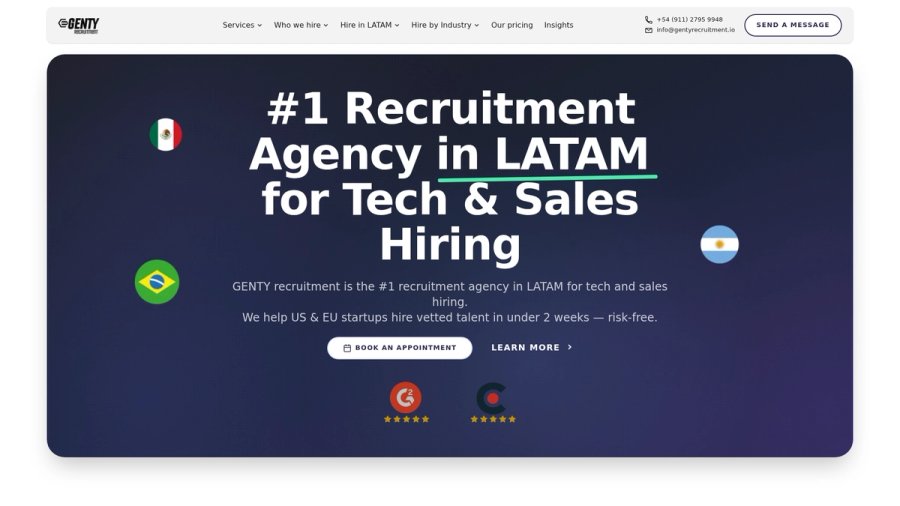
Gentyrecruitment specializes in IT and tech recruitment across FinTech, AI, and SaaS, with additional coverage for sales and non-technical roles. Every candidate passes structured technical assessments and English proficiency checks before reaching your team. For companies that need to hire across LATAM at scale, Gentyrecruitment also provides salary benchmarking and executive search services to support the full hiring cycle.
FAQ
What are LATAM recruitment strategies?
LATAM recruitment strategies are structured approaches US and European companies use to source, assess, and hire remote talent from Latin America. They typically combine local market expertise, flexible hiring models, and compensation benchmarking to attract qualified candidates.
Why do US companies prefer LATAM talent over other offshore regions?
Most of Latin America falls within a 1–3 hour time-zone difference from the US, which makes real-time collaboration practical. That overlap reduces the communication delays common with offshore teams in Asia or Eastern Europe.
What is the difference between a contractor and an EOR model in LATAM?
The contractor model offers flexibility and lower cost for short-term projects, while the Employer of Record model provides official employment status and benefits. EOR is the better choice for long-term senior hires where retention matters.
Which LATAM countries produce the most technical talent?
Argentina, Brazil, Mexico, and Colombia are the top sources of technical talent in Latin America. Each country has distinct strengths: Argentina in software engineering, Brazil in FinTech and mobile, Mexico in SaaS, and Colombia in customer success and backend development.
How fast can a specialized recruitment firm fill a LATAM role?
Specialized recruitment partners with established LATAM networks can deliver a shortlist in 5–10 business days. That speed comes from pre-built candidate pipelines and local market knowledge that in-house teams typically take months to develop.