

Finding English-speaking talent requires more than posting a job ad and waiting. For tech startups and growing companies hiring from Latin America, the standard term for this practice is international language-targeted recruitment, and the ways to find English-speaking talent that actually work combine targeted sourcing, structured language assessment, and regional platform knowledge. Countries like Argentina, Colombia, Mexico, and Brazil produce thousands of bilingual tech professionals each year, and the hiring managers who reach them first use specific, repeatable methods.
1. Ways to find English-speaking talent: write job ads in English only
Publishing your job ad exclusively in English is the single fastest filter for language proficiency. English-only ads produce fewer applications but a significantly higher-quality candidate pool, which saves your HR team hours of screening time. A candidate who reads, understands, and applies to an English-language posting has already demonstrated baseline comprehension.
Specify the exact proficiency level you need. “Business English” means something different than “native-level fluency,” and candidates need that clarity to self-select accurately. Include role-specific language expectations directly in the ad. A customer-facing SaaS role requires different English skills than a back-end engineering position.
- State the required proficiency level (B2, C1, or native equivalent)
- List the English-language tools the candidate will use daily (Slack, Jira, Confluence)
- Describe the communication context: async writing, live video calls, client presentations
- Avoid translating the ad into Spanish or Portuguese for English-fluency roles
Pro Tip: Add one or two sentences in the job ad written at a C1 complexity level. Candidates who find those sentences easy to read are the ones you want to interview first.
Planning a hire?
Talk through the best hiring option
This article usually leads to one practical question: should you use staffing or salary guide? We can help you choose quickly.
Simple next step
Start with staffing and we will help you pick the best hiring setup.
2. Source candidates on the right platforms
LinkedIn and local Latin American job boards are the two most effective channels for reaching English-speaking tech professionals in the region. Using both together gives you global reach with regional precision.

GitHub and Stack Overflow are particularly strong for passive candidates. A developer who maintains an active GitHub profile and writes commit messages in English is signaling both technical engagement and language comfort. Stack Overflow’s job board attracts professionals who are already embedded in English-language technical communities.
For LinkedIn campaigns, filter by location (Argentina, Colombia, Mexico, Brazil), job title, and skill keywords. Add “English” or “bilingual” as a keyword in your Boolean search string. Bilingual job ads on regional boards like GetOnBrd can expand your reach while still filtering for language ability through the application process itself.
3. Use language assessments that go beyond certificates
TOEFL and IELTS scores tell you a candidate passed a standardized test. They do not tell you whether that candidate can write a clear bug report, run a client call, or document an API in English. Certificates alone are insufficient without practical, role-specific assessment built into your process.
The most reliable assessments combine multiple formats:
- Async video introduction: Ask candidates to record a 2-minute video answering a role-specific question in English. This tests spoken fluency, structure, and confidence under low-pressure conditions.
- Written task: Send a short scenario relevant to the role. Ask for a written response in English. Evaluate grammar, clarity, and professional tone.
- Live interview in English: Conduct at least one interview stage entirely in English. Consistency across interview stages produces comparable data and reduces evaluator bias.
- Typing speed test: Require a minimum of 35 words per minute. This filters for digital literacy alongside language ability.
The “85% Filter” combines typing speed and English assessment to eliminate roughly 85% of unqualified remote applicants before a human reviewer ever sees a resume. That number matters because it means your team spends time only on candidates who have already cleared a meaningful bar.
Pro Tip: Build your English onboarding materials before you hire. Candidates who see English-language documentation during the offer stage understand immediately that English is the working language, not just a checkbox on the job description.
4. Build an ATS workflow that routes by language proficiency
An applicant tracking system configured for language proficiency saves significant time at scale. Language-specific ATS workflows auto-route candidates to the correct pipeline based on their proficiency claims and assessment results. This prevents bilingual candidates from getting lost in a general pool and keeps your English-fluency pipeline clean.
Set up a dedicated pipeline stage for English assessment. Any candidate who does not complete the language task within 48 hours moves to a lower-priority queue automatically. Candidates who score above your threshold move forward without manual intervention. Tools like Greenhouse, Lever, and Workable all support custom pipeline stages and automated triggers that make this configuration straightforward.
Pair your ATS with an automated English typing test tool such as TypingTest.com or Ratatype. Both integrate via link and return results you can attach directly to a candidate profile. This keeps your candidate vetting process structured and auditable.
5. Engage passive candidates through targeted outreach
The strongest English-speaking tech professionals in Latin America are rarely browsing job boards. They are working, contributing to open-source projects, and attending virtual conferences. Reaching them requires outreach, not just postings.
- LinkedIn cold outreach in English: Write your connection request and first message entirely in English. A candidate who responds in English has already passed your first filter.
- GitHub profile targeting: Search for developers in LATAM cities whose repositories include English-language README files and commit messages. These are strong signals of working English proficiency.
- Employee referral programs: Offer a bonus specifically for referrals who pass the English assessment stage. Your existing English-speaking employees know other English-speaking professionals.
- Virtual info sessions: Host a 30-minute webinar in English about your company, team culture, and open roles. Promote it on LinkedIn targeting professionals in Argentina, Colombia, and Mexico. Attendance itself filters for language comfort.
- Employer brand content in English: Publish blog posts, LinkedIn articles, and team spotlights in English. Professionals who follow and engage with English-language content are self-selecting into your awareness pool.
Clear communication about English requirements in all recruiting materials reduces candidate drop-off at later stages. When a candidate knows from the first touchpoint that English is the working language, there are no surprises at the offer stage.
6. Decide between in-house recruiting and a specialized agency
The choice between building an in-house LATAM sourcing function and partnering with a specialized agency depends on your hiring volume, timeline, and internal capacity.
Agencies specializing in LATAM tech recruitment deliver pre-vetted, English-speaking candidates and reduce screening time significantly. That efficiency matters most for startups that need to hire fast without building a dedicated sourcing team from scratch. In-house recruiting makes more sense when you have a dedicated recruiter, an established LATAM presence, and a long-term pipeline to maintain.
The right answer for most early-stage tech companies is to use an agency for the first two or three LATAM hires, then build internal capacity once you understand the market. Trying to learn LATAM sourcing, English assessment, and time-zone coordination simultaneously while also running a product sprint is a reliable way to make a slow, expensive hire.
7. Extend English language use into onboarding
Hiring an English-speaking professional and then onboarding them in Spanish or Portuguese sends a contradictory signal. Onboarding documentation in the employee’s working language prevents early frustration and confirms the English-first culture you described during recruiting.
Every document your new hire receives in their first 30 days should be in English: the employee handbook, the technical setup guide, the team communication norms, and the 30/60/90-day plan. This is not about excluding non-English speakers. It is about confirming to your new hire that the environment they accepted the offer for is the environment they are actually joining. Consistency here also reduces early attrition, which is one of the most expensive outcomes in international hiring.
For multilingual recruiting contexts where some team members are not English-dominant, bilingual onboarding materials work well. The key is that English is always present and always the primary language of record.
Key takeaways
The most effective strategies for finding English-speaking talent from Latin America combine English-only job ads, multi-platform sourcing, structured language assessments, and consistent English use from first contact through onboarding.
What I have learned from years of LATAM hiring
The biggest mistake I see tech startups make is treating English proficiency as a binary. Either a candidate “speaks English” or they do not. The reality is far more nuanced, and that nuance is where most hiring errors happen.
I have seen candidates with C1 IELTS scores struggle to write a coherent Slack message under time pressure. I have also seen candidates with no formal certification who write flawless technical documentation and run client calls without a single miscommunication. The certificate is a starting point, not a conclusion. The practical assessment is where you find out what you actually need to know.
The other thing I would push back on is the assumption that LATAM English proficiency is uniformly lower than North American or European standards. Argentina and Colombia in particular have produced a generation of tech professionals who grew up consuming English-language content, studying at bilingual institutions, and working on distributed teams. The talent is there. The sourcing strategy is what separates companies that find it from companies that conclude it does not exist.
My honest recommendation: run pre-vetted LATAM talent through at least two English-language touchpoints before making an offer. One written, one spoken. That combination gives you enough signal to hire with confidence.
— Eugene
How Gentyrecruitment helps you hire English-speaking LATAM talent faster
Gentyrecruitment is a specialized IT recruitment agency that sources, vets, and delivers English-speaking tech professionals from Argentina, Colombia, Mexico, Brazil, and beyond. Every candidate in the Gentyrecruitment pipeline has passed structured English assessments before you see their profile, which means your team skips the screening stage and goes straight to evaluation.
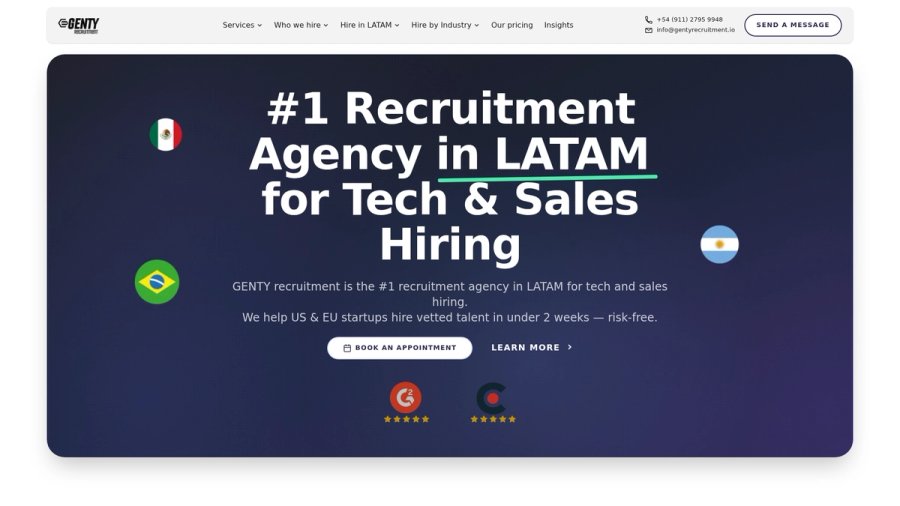
For tech startups that need to move fast, Gentyrecruitment’s LATAM IT recruitment process cuts typical time-to-hire from 6–12 weeks to 2–4 weeks. The agency also provides salary benchmarking, executive search, and staffing services across Latin America, giving you a single partner for every stage of LATAM team growth. If you are ready to build a high-performing, English-speaking remote team, Gentyrecruitment is the place to start.
FAQ
What is the fastest way to find English-speaking tech talent in Latin America?
Partnering with a specialized LATAM recruitment agency is the fastest method. Agencies like Gentyrecruitment deliver pre-vetted, English-speaking candidates in 2–4 weeks by maintaining active talent pools and running language assessments before client review.
Are TOEFL and IELTS scores enough to verify English proficiency for tech roles?
No. Certificates do not replace practical, role-specific English assessment. Combine certificate review with async video interviews and written tasks to get an accurate picture of working proficiency.
Which platforms work best for sourcing English-speaking candidates in LATAM?
LinkedIn, GitHub, and Stack Overflow are the strongest global platforms. Regional boards like GetOnBrd (Argentina) add local depth. Using both global and regional channels together gives you the best reach and quality mix.
What is the 85% Filter in remote hiring?
The 85% Filter is a screening method that combines a typing speed test (35+ words per minute) with an English assessment. Together, these two automated tests eliminate roughly 85% of unqualified applicants before a recruiter reviews a single resume.
Should job ads for English-speaking roles be written in English or Spanish?
Write them in English only. English-only ads attract fewer applicants but a significantly more qualified pool, saving your team screening time and improving the overall quality of candidates who advance.