
A replacement guarantee is a recruiter’s contractual promise to provide a new candidate, a refund, or a fee credit if a placed hire leaves or is terminated within a defined window after starting. The industry modal term is 90 days, used by roughly 45% of agencies, with 30, 60, and 90-day terms together cover more than 85% of guarantees written. Permanent-placement fees typically run 15% to 25% of the hire’s first-year salary, and when a replacement search fails, most contracts convert to a prorated refund rather than a full return of fees.
Three things matter before you sign anything:
- Confirm the clock start. The guarantee period should begin on the candidate’s first active workday, not the offer date or contract signature.
- Pin down the remedy. Know whether you get a replacement search, a refund, a credit, or your choice among them, because agencies default to whichever remedy costs them least.
- Get the deadline in writing. A guarantee without a firm replacement timeline is a promise with no teeth.
Quick fact: under a typical 90-day model, a candidate who leaves after 60 days generally triggers a refund of about one-third of the placement fee. The remaining terms of the clause and what most agencies leave vague determine whether that math ever works in your favor.
Key Takeaways
A replacement guarantee protects hiring managers only when the contract specifies the clock start, the remedy type, and a firm replacement deadline in writing.
Need help hiring?
See the next step after this guide
If this topic is relevant to your team, these are the most useful pages to check next.
What Does a Replacement Guarantee Recruitment Clause Cover?
A replacement guarantee binds two parties: the recruitment agency, which agrees to remedy a failed placement, and the client company, which agrees to notify the agency and cooperate with the process. It does not bind the candidate, who owes the agency nothing once hired, and it does not extend to third parties like subcontractors or referral partners the client brings in separately.
The clause activates on a defined start date, almost always the candidate’s first day of active work. Defining that date matters more than it sounds. Visa processing, relocation logistics, or delayed onboarding can push a start date by weeks, and if the contract doesn’t specify “active work” as the trigger, you can end up arguing about when the 90 days actually began.
Coverage exists to protect the employer’s hiring investment and the agency’s reputation for delivering durable placements. It is not designed to protect the candidate’s job security or to compensate for unrelated business changes on your end.
Guarantees typically activate under these conditions:
- The candidate resigns voluntarily within the guarantee window.
- The employer documents termination for cause (performance failure, policy violation).
- The candidate fails to show up for the agreed start date.
- For LATAM placements specifically, unresolved work-authorization or relocation issues that prevent the candidate from starting as scheduled.
That last trigger deserves attention if you’re hiring remote talent from Argentina, Brazil, Mexico, or Colombia. A strong contract will distinguish between a candidate backing out and a delay caused by paperwork outside anyone’s control, because those two scenarios should not be treated identically under the clause.
How Does the Replacement Guarantee Process Actually Work?
The mechanics follow a predictable sequence once something goes wrong, and knowing the sequence in advance is what separates hiring managers who get fast resolutions from those who get stuck in email threads.
- Incident occurs. The candidate resigns, is terminated for cause, or fails to start.
- Client notifies the agency. Most contracts require written notice within a defined window, commonly five business days from the incident.
- Agency verifies the claim. Expect a 48 to 72-hour turnaround for the agency to confirm the guarantee applies and check payment status.
- Agency reopens the search. Using existing candidate pools where possible, which is faster than starting cold.
- Agency presents a replacement slate. Deadlines here vary, but 10 to 30 business days is standard, with some firms committing to candidate presentations within 5 to 10 days when they maintain an active regional bench.
Pro Tip: Keep a dated file the moment anything goes sideways with a placed hire. Save the resignation email, log performance write-ups as they happen, and confirm your invoice is paid in full before you file a claim. Agencies audit payment status first, and a $200 unpaid line item can sink an otherwise valid claim.
Notice deadlines are the single most common reason claims get denied. If your internal process for flagging a departure to HR or the hiring manager takes two weeks, you may already be outside the window by the time anyone contacts the agency.
What Types of Recruiting Guarantees Exist?
Not every guarantee works the same way, and the model an agency defaults to tells you a lot about how much risk they’re actually willing to carry.
- Replacement search only. The agency finds a new candidate at no additional fee, but you get no refund if the search fails. This is the most common baseline model and the cheapest for agencies to offer.
- Full refund. Rare beyond the first 30 days. Agencies resist this because it puts 100% of the placement risk on them.
- Prorated refund. The most balanced model. You get a percentage of the fee back based on how much of the guarantee period the candidate actually worked.
- Prorated replacement credit. Instead of cash back, you get a credit toward a future placement, scaled to the unused guarantee period.
- Client-choice hybrid. You pick between a replacement search or a prorated refund depending on what your team needs at that moment. This is the strongest structure for the client and worth pushing for in negotiation.
Here’s how proration typically plays out on a standard 90-day guarantee, assuming a $20,000 placement fee:
The math follows a simple rule: roughly one-third of the fee per 30-day period the candidate did not complete. If the candidate leaves on day 61, you’ve used two-thirds of the guarantee window, so you’d expect to recover close to a third of the fee, not two-thirds.
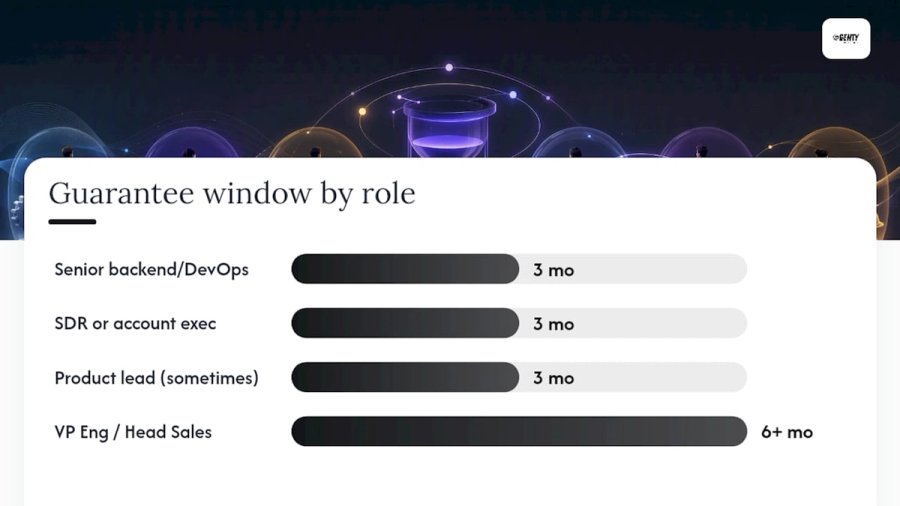
Executive and senior sales searches often break this pattern entirely. Because ramp time for a VP of Engineering or an enterprise account executive can run three to six months before performance is even measurable, some specialist recruiters extend guarantees to 6 or even 12 months for those roles. Expect to pay a premium fee or accept an exclusivity clause in exchange for that extended window.
What Should You Look for in a Replacement Guarantee Policy?
Run every contract through this checklist before signing. Missing even one of these items usually means the clause was written to protect the agency, not you.
- Time period. Is it 30, 60, or 90 days, and is that competitive with the industry standard?
- Remedy type. Replacement, refund, credit, or your choice among them?
- Number of replacements allowed. Some contracts cap it at one; others allow unlimited replacements within the window.
- Notice requirements. How many days do you have to report an incident, and through what channel (email, portal, account manager)?
- Payment timing. Does the guarantee require full payment upfront, or does it survive a delayed final invoice?
- Cooperation obligations. What documentation or access must you provide the agency during a replacement search?
- Seniority carve-outs. Do executive or specialized technical roles get different terms than standard placements?
Ask the agency these questions directly during procurement, before you’re negotiating from a position of already having a problem:
- How soon after notice will you present replacement candidates, in business days?
- Does a replacement hire trigger a brand new guarantee period, or does it inherit the time remaining on the original one?
- What happens if your first replacement also leaves within the window?
- Is the remedy my choice, or does your team decide unilaterally?
Red flags that should stop you from signing as-is:
- Vague activation language like “at the agency’s discretion.”
- A clause that offers refund-only with no replacement option, which usually signals a thin candidate pipeline.
- Any exclusion tied to unpaid invoices without a grace period or dispute process.
- A guarantee window under 30 days, which the industry treats as a minimal, defensive offer rather than a genuine commitment.
Pro Tip: If an agency won’t put a specific number of business days on their replacement deadline, that’s a negotiating opening, not a dead end. Ask them to commit to a number in writing before you sign, even if it’s longer than you’d like. A vague promise is worth nothing in a dispute.
What Isn’t Covered by a Recruitment Refund Option?
Every guarantee has carve-outs, and knowing them ahead of time prevents an unpleasant surprise when you actually need to file a claim.
Common exclusions include:
- Genuine redundancy or layoffs. If you eliminate the role for business reasons unrelated to the candidate’s performance, most agencies won’t honor the guarantee.
- Employer-initiated role changes. If you significantly change the job description, reporting structure, or compensation after hire, that can void coverage.
- Force majeure events. Natural disasters, political instability, or other events outside either party’s control.
- Unpaid invoices. As noted above, outstanding payment is the most frequent reason claims get denied.
- Missed notice deadlines. File a day late on a strict five-day window, and some agencies will reject the claim outright.
When a dispute arises, agencies generally expect specific documentation: performance review records, the resignation email or termination letter, and confirmation of payment status. Route all communication through the notice channel specified in the contract, whether that’s a named account manager or a dedicated claims email.
To avoid losing a valid claim over a technicality:
- Pay invoices on the agreed schedule, every time, without exception.
- Document performance concerns in writing as they happen, not retroactively.
- Assign one internal person to own guarantee notifications so nothing falls through the cracks between HR and the hiring manager.
How Long Do Replacements Take, and What Do They Cost?
The 90-day guarantee dominates the market for a reason: it balances enough time to see whether a hire sticks against a window short enough that agencies can underwrite the risk. Roughly 45% of agencies use it as their standard, while only about 5% offer six months or longer, usually reserved for senior or hard-to-fill roles.
Timeline expectations differ sharply depending on where the recruiter sources talent. A fresh external search for a specialized engineering role commonly takes 8 to 12 weeks or more when starting from zero. Recruiters with an active regional bench, particularly for LATAM roles, can often present viable replacement candidates within 7 to 30 days, because they’re pulling from a pre-vetted pool instead of building a pipeline from scratch. That gap alone can be the difference between a role sitting empty for a quarter or getting back to full productivity within a month.

Here’s how the proration math and cost comparison typically look side by side for a senior backend engineer role:
The timezone factor compounds the savings. Argentina and Brazil sit close to or within EST, and Mexico and Colombia align closely with CST and EST, which means daily standups, code reviews, and sales calls happen in real time with US teams instead of across a nine or twelve-hour gap common with offshore alternatives in other regions.
Sample Replacement Guarantee Clause and Contract Checklist
A vague guarantee clause is worse than no guarantee at all, because it creates the appearance of protection without the substance. Here’s language you can adapt for a statement of work or master services agreement:
Run this checklist with procurement and legal before signing anything:
- Payment terms match your internal AP schedule, with no penalty for standard net-30 or net-45 cycles.
- Notice channel and format are named explicitly (email address, portal, or account manager).
- Evidence requirements are listed, not left to agency discretion.
- Cooperation obligations (interview availability, feedback turnaround) are reasonable for your team’s bandwidth.
Pro Tip: Send your legal team the sample clause above before your first call with a recruiter, not after. Agencies negotiate more flexibly when you arrive with specific language instead of asking them to explain their standard terms.
How GENTY recruitment Structures Its 3-Month Guarantee
GENTY recruitment builds its guarantee around a straightforward principle: clients shouldn’t carry hiring risk alone, and they shouldn’t pay upfront to find out whether a placement works. The agency operates on transparent fixed fees by seniority level, charges no upfront payments, and covers a full 90-day replacement guarantee at no additional commission if a placed candidate departs within that window.
That structure matters most for companies hiring technical and sales talent across Latin America, where GENTY recruitment maintains active candidate pools rather than starting searches cold:
- Argentina and Brazil: Senior software engineers typically range from $2,500 to $5,000 per month depending on stack and seniority, compared to $9,000 to $14,000 monthly for equivalent US talent.
- Mexico and Colombia: Sales development reps and account executives often run $1,800 to $3,500 monthly, with strong English proficiency and EST/CST overlap that supports live pipeline reviews and forecast calls.
- Timezone alignment: All four countries fall within one to three hours of US EST or PST, which eliminates the asynchronous handoff delays common with offshore teams in other regions.
Clients working with GENTY recruitment generally save up to 40% versus equivalent US or European hires, according to the agency’s own salary benchmarking, while curated shortlists arrive within seven days of kickoff rather than the multi-week wait typical of a cold search. For roles with long ramp curves, like engineering leadership placements, negotiating an extended guarantee window beyond 90 days is worth raising directly, especially when the hire sits on a critical path like a fintech product launch.
A Recruiter’s Take on Getting the Best Terms
Most hiring managers negotiate salary and start date hard, then skim the guarantee clause because it feels like boilerplate. That’s backward. The guarantee clause is the only part of the contract that protects you after the placement fee has already left your bank account, and it’s usually the most negotiable term in the entire agreement because agencies rarely get pushed on it.
The highest-leverage move is asking for a client-choice remedy instead of accepting whatever the agency defaults to. Agencies will often grant this if you ask directly, because it costs them nothing extra to write into the contract, it just requires them to give up the option of deciding unilaterally which remedy is cheapest for them. For senior roles, push for a longer window before you push for a lower fee. A three-month guarantee on a role that takes four months to prove out is functionally no guarantee at all.
Three things to lock down before you sign anything:
- Pay the final invoice on schedule, every time, so no future claim gets denied on a technicality.
- Name one internal owner responsible for guarantee notifications, so a departure doesn’t sit unreported past the notice window.
- Get a specific business-day number for replacement delivery in writing, not a vague “as soon as possible.”
None of this requires legal expertise to execute. It requires reading the clause as carefully as you’d read the compensation package, because in practice, that’s exactly what it is.
Get a Faster, Lower-Risk Path to Your Next LATAM Hire
GENTY recruitment removes the two biggest risks in the traditional agency model: upfront fees you pay before seeing a single candidate, and a guarantee window too short to matter. Every engagement runs on fixed fees by seniority level, zero upfront payment, and a full 90-day replacement guarantee that activates automatically if a placed hire doesn’t work out.
If you’re evaluating recruiters for a technical or sales role in Argentina, Brazil, Mexico, or Colombia, GENTY recruitment delivers curated shortlists within seven days of kickoff, backed by regional candidate pools that also make replacement searches faster than a cold external hire. Companies hiring engineers, DevOps specialists, or SDR teams through the agency typically save up to 40% compared to equivalent US or European talent, without sacrificing EST/PST timezone overlap for daily collaboration. Start by requesting a salary benchmark for your open role and see what a fixed-fee, guarantee-backed search looks like for your specific hiring need.
Frequently Asked Questions
What is a typical replacement guarantee period in recruitment?
Does a replacement guarantee cover a layoff or role elimination?
No. Guarantees typically exclude genuine redundancy, employer-initiated role changes, and other business decisions unrelated to the candidate’s performance or fit.
What happens if the agency can’t find a suitable replacement?
Most contracts convert to a prorated refund or credit, calculated as a percentage of the fee based on how much of the guarantee window the original hire completed.
Can I negotiate a longer guarantee for an executive hire?
Yes. Extended windows of six to twelve months are common for senior or hard-to-fill roles, though agencies often require a premium fee or exclusivity in exchange.
Why do LATAM placements sometimes have faster replacement timelines?
Recruiters with active regional candidate pools in countries like Argentina, Brazil, Mexico, and Colombia can often present replacement candidates within one to four weeks, compared to eight to twelve weeks or more for a search started from zero.
Sources
- Recruiter guarantees: Once I am paid I do not refund any money
- Recruitment Guarantee Periods: Replacements, Refunds & Claims - LegalClarity
- Understanding recruitment guarantee contracts - Strategic Workforce Planning
- 8 Guarantee and Refund Policies - NPA Worldwide