

The recruitment process for US startups is one of the most consequential yet underbuilt systems in early-stage companies. While founders obsess over product and funding, hiring often runs on gut instinct, informal conversations, and whoever applied last week. That approach costs real money: a bad hire at the manager level can set a team back months, and a slow process loses top candidates to better-organized competitors. This guide walks you through every stage of startup hiring, from defining roles to verifying new hires, with the structure and specificity that actually produces results.
Key takeaways
The recruitment process for US startups: building the foundation
Before you post a single job description, you need to do the work that most startups skip. That work is job analysis, and it is the difference between hiring someone who looks right on paper and hiring someone who actually performs.
Documented job analysis defines the knowledge, skills, abilities, and other characteristics (KSAOs) required for a role. It drives everything downstream: your job description, your interview questions, your scoring rubrics, and your legal defensibility if a hiring decision is ever challenged. A 10-person SaaS startup hiring its first DevOps engineer needs to know whether it needs someone who can architect infrastructure from scratch or someone who can maintain and monitor existing pipelines. Those are different roles, and conflating them wastes months.
Defining the candidate profile
Beyond technical skills, your candidate profile should reflect your company’s operating culture and growth trajectory. A startup scaling from 15 to 50 people in 18 months needs people who can build processes, not just follow them. Document this explicitly. Write down the behaviors and attributes that predict success in your specific environment, not just the credentials that look impressive.
What do you need?
Choose the hiring path that fits
After reading "Recruitment Process for US Startups: 2026 Guide", most teams compare these options before deciding how to hire.
Legal groundwork every US startup needs
The EEOC’s Uniform Guidelines, codified at 29 C.F.R. Part 1607, require that all selection procedures, including interviews, be job-related and demonstrably valid. This applies to startups just as much as to Fortune 500 companies. Many founders assume EEOC compliance is a large-company concern. It is not. Any hiring decision that produces adverse impact against a protected class can trigger scrutiny, and “we just went with our gut” is not a defensible answer.
Pro Tip: Build a simple compliance checklist before your first hire: confirm job descriptions reference KSAOs, document your screening criteria, and set a retention schedule for interview records. Under EEOC record-keeping rules, you must retain interview documentation for at least one year, and two years if you hold federal contracts.
The tools you use also matter at this stage. An applicant tracking system (ATS) with resume parsing capability, like ParseWorks, can reduce manual screening time and create consistent records from day one. Pair that with a lightweight CRM to manage candidate relationships and you have a functional recruiting stack without enterprise-level cost.
Sourcing, screening, and structured interviewing
With your foundation in place, execution is where most startups either gain ground or lose candidates to faster, better-organized competitors. The steps in startup hiring that matter most are sourcing strategy, resume screening, and how you conduct interviews.

Sourcing: prioritize referrals first
Referred candidates pass initial screens at a rate of 52% compared to 35% for all other sources, and they accept offers at higher rates too. For a startup with limited recruiting bandwidth, that math is significant. Build a formal employee referral program before you spend money on job boards. Even a small cash incentive per successful hire generates a pipeline that outperforms most paid channels.
Targeted outreach through LinkedIn and GitHub works well for technical roles, particularly when your message is specific about the problem the candidate would solve. Generic “exciting opportunity” messages get ignored. A message that references a specific project someone contributed to, and explains exactly what your team is building, gets responses.
Screening resumes with consistent criteria
Define your screening criteria before you open the first resume. Decide in advance which qualifications are required versus preferred, and apply those criteria consistently across every applicant. This is not just good practice. It is a legal requirement under the UGESP framework that selection methods be applied uniformly.
Phone screens should follow a brief structured format: three to five questions tied directly to the KSAOs you documented, with a simple scoring rubric. This takes 20 minutes and produces a defensible record of why candidates advanced or did not.
Structured interviews: the single biggest upgrade you can make
Structured interviews produce a validity coefficient of 0.51 compared to 0.38 for unstructured interviews. That gap translates directly into better hires and fewer costly mis-selections. Structured means every candidate answers the same questions, in the same order, scored against the same rubric before any group discussion happens.
The reason scoring before deliberation matters is that group discussions tend to be dominated by the most senior or most vocal person in the room. Locking scores prior to deliberation preserves independent judgment and produces a hiring record that can withstand scrutiny.
Panel interviews add another layer of reliability. Multi-interviewer panels scoring independently reduce individual bias and create stronger documentation. For a startup, a three-person panel covering technical competency, cultural fit, and cross-functional collaboration covers the major dimensions without turning the process into a marathon.
- Define the competencies being evaluated before writing interview questions.
- Write two to three behavioral or situational questions per competency.
- Build a scoring rubric with anchored descriptions for each score level (1 to 5).
- Brief all interviewers on the rubric and their assigned competencies before the interview.
- Collect individual scores before any debrief conversation begins.
- Conduct a calibration session where scores are compared and outliers are discussed with evidence.
Pro Tip: Automated scheduling tools average 3.7 hours to coordinate an interview compared to 5 hours for manual scheduling. At scale, that difference compounds quickly. Use calendar automation from your first hire, not after your tenth.
Assessment, decisions, and offer management
Getting to a great shortlist means nothing if your decision-making process is slow, inconsistent, or opaque to candidates. This is where many startups lose people they worked hard to find.
Behaviorally anchored rating scales (BARS) are the most practical tool for objective scoring. Instead of a generic “communication skills: 1 to 5” rubric, a BARS rubric describes what a 3 looks like versus a 5 with specific behavioral examples. A score of 5 for communication might read: “Candidate explained a complex technical concept clearly to a non-technical audience, anticipated follow-up questions, and adjusted their explanation based on interviewer responses.” That specificity removes ambiguity and makes calibration sessions much faster.
Calibration sessions should happen within 24 hours of the final interview. Waiting longer allows impressions to fade and recency bias to distort scores. Keep the session structured: review scores, surface disagreements, require evidence-based reasoning for any score changes. Document the outcome.
Speeding up offers without cutting corners
Offer delays are a top reason candidates withdraw. A skills-first hiring approach that pre-defines salary bands and approval authority means your team can move from decision to offer letter in under 24 hours. Get compensation ranges approved before the process starts, not after you fall in love with a candidate.
Transparent communication throughout the process also reduces dropoffs. Candidates who know what to expect at each stage, and who receive timely updates, are significantly less likely to accept competing offers while waiting to hear from you. A simple automated status email after each stage costs nothing and signals professionalism.
- Pre-approve salary bands and equity ranges before opening a role.
- Assign a single point of contact for each candidate to avoid communication gaps.
- Set internal SLAs: 48 hours maximum from final interview to verbal offer.
- Send offer letters digitally with a clear expiration date to create appropriate urgency.
- Follow up by phone, not just email, for senior or hard-to-fill roles.
Post-hire verification and process improvement
Hiring does not end when the offer is accepted. Verification, onboarding coordination, and process analysis are where effective hiring in tech startups separates itself from average hiring.
Background checks, reference calls, and work authorization verification should follow a consistent protocol applied to every hire in the same role. Inconsistency here creates legal exposure. Reference calls are most valuable when structured around the same competencies you evaluated in interviews, asking former managers to describe specific situations rather than general impressions.
Recruitment KPIs tell you where your process is working and where it is not. Track these metrics after every hire and review them quarterly.
Feedback from new hires at the 30 and 90-day marks is underused data. Ask them directly: what was unclear about the role during the process? What surprised them in the first month? Their answers reveal gaps in your job analysis and candidate communication that you can fix before the next hire. This feedback loop, combined with quarterly compliance audits of your documentation and record retention, is what separates startups that build great teams consistently from those that treat every hire as a one-off scramble.
My take: why most startup hiring fails before the first interview
I’ve seen the same pattern repeat across dozens of growing US startups. The founder or hiring manager knows exactly what they need, but they have never written it down in a way that can be evaluated consistently. So they interview five people, feel differently about each one, argue about it in a Slack thread for three days, and either make a compromise hire or lose the best candidate to a faster competitor.
The uncomfortable truth is that unstructured hiring is not just inefficient. It is legally risky and statistically worse at predicting performance. I’ve watched teams spend months recovering from a bad hire that a 20-minute structured screen would have caught. The rater training piece gets ignored almost universally. Interviewers are briefed on logistics but not on how to score, what anchored behaviors look like, or why their scores need to be independent before the debrief. That one change, training your interviewers and locking scores before calibration, produces a measurable improvement in hiring quality without adding significant time.
Technology helps, but it is not a substitute for process clarity. I’ve seen startups adopt expensive HR tech for recruitment and still hire poorly because the underlying process had no structure. Get the process right first, then use tools to scale it. The startups that build this infrastructure early, even when it feels like overkill at 15 people, are the ones that can hire reliably at 50 and 150.
— Eugene
How Gentyrecruitment accelerates startup hiring
Building a structured recruitment process takes time that most founders and hiring managers do not have. Gentyrecruitment works with US startups to fill technical and sales roles faster by connecting them with pre-vetted, English-speaking talent from Latin America, covering markets in Argentina, Brazil, Mexico, Colombia, and beyond.
The Gentyrecruitment process combines structured assessment, technology-assisted screening, and hands-on recruiting expertise to deliver candidates who are technically qualified and ready to integrate into global teams. For startups in FinTech, AI, and SaaS, this means accessing a deep talent pool without the overhead of building a full internal recruiting function. Whether you need to hire tech talent faster or scale your sales team with SDRs and account executives through LATAM sales recruitment, Gentyrecruitment has the infrastructure and regional expertise to move quickly. Explore how remote staffing solutions can extend your hiring reach without adding headcount to your HR team.
FAQ
What are the key steps in the recruitment process for US startups?
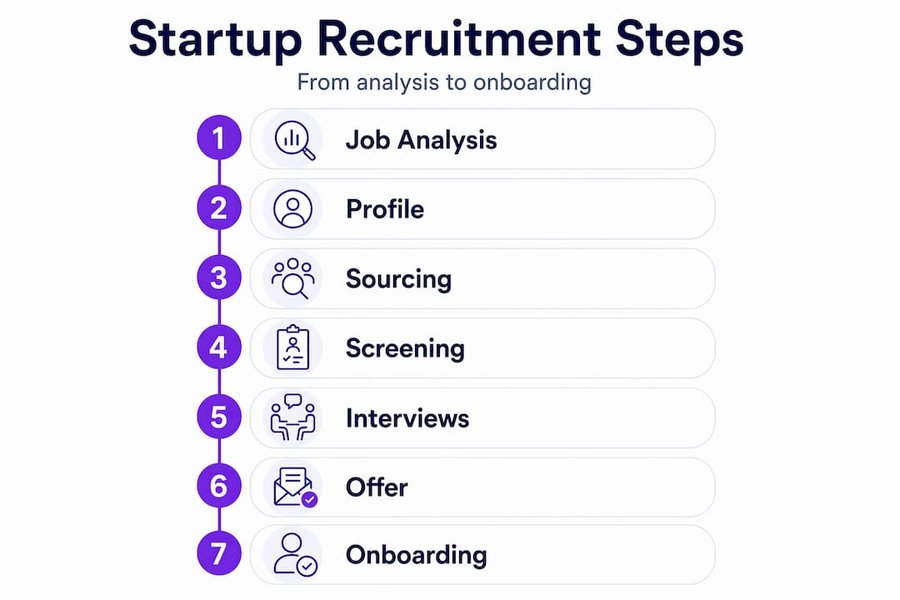
The core steps are job analysis, candidate profile definition, sourcing, structured screening, panel interviews with scored rubrics, calibration-based decision-making, offer management, and post-hire verification. Each step builds on the previous one to produce consistent, defensible hiring decisions.
How do structured interviews improve startup hiring outcomes?
Structured interviews have a validity of 0.51 compared to 0.38 for unstructured ones, meaning they predict job performance more accurately. They also reduce legal risk by creating documented, job-related evaluation records.
What sourcing channels work best for startup recruitment?
Employee referrals consistently outperform other channels. Referred candidates pass screens at 52% versus 35% overall, making a formal referral program the highest-return sourcing investment for most startups.
What recruitment KPIs should startups track?
The most useful KPIs are Time to Hire, passthrough rate by stage, offer acceptance rate, source of hire, and 90-day new hire retention. Together, these metrics identify where your process is losing good candidates and where hiring decisions are not translating into successful placements.
How long must startups retain interview records under EEOC rules?
EEOC regulations require that interview records be retained for at least one year. Federal contractors must retain documentation for two years. Consistent record retention protects startups during audits and legal challenges.