

Every week a critical engineering role sits open, your product roadmap slips, your existing team absorbs extra pressure, and your competitors move faster. Research consistently shows that the average tech hiring cycle stretches between 30 and 45 days, and for startups sourcing remote talent from Latin America without a structured approach, that timeline can push well past 60 days. This guide gives you a concrete, step-by-step framework to cut that timeline dramatically, covering process audits, preparation checklists, automation tools, interview design, and offer execution, so you can bring qualified LATAM engineers and tech professionals onto your team faster without sacrificing quality.
Table of Contents
- Assess your current tech hiring process
- Prepare the essentials before sourcing
- Use technology and automation for rapid sourcing
- Execute an efficient and structured interview process
- Verify and finalize efficiently: offers, onboarding, and feedback
- Why speed matters more than ever in tech hiring — Our take
- Unlock faster hiring with GENTY recruitment
- Frequently asked questions
Key Takeaways
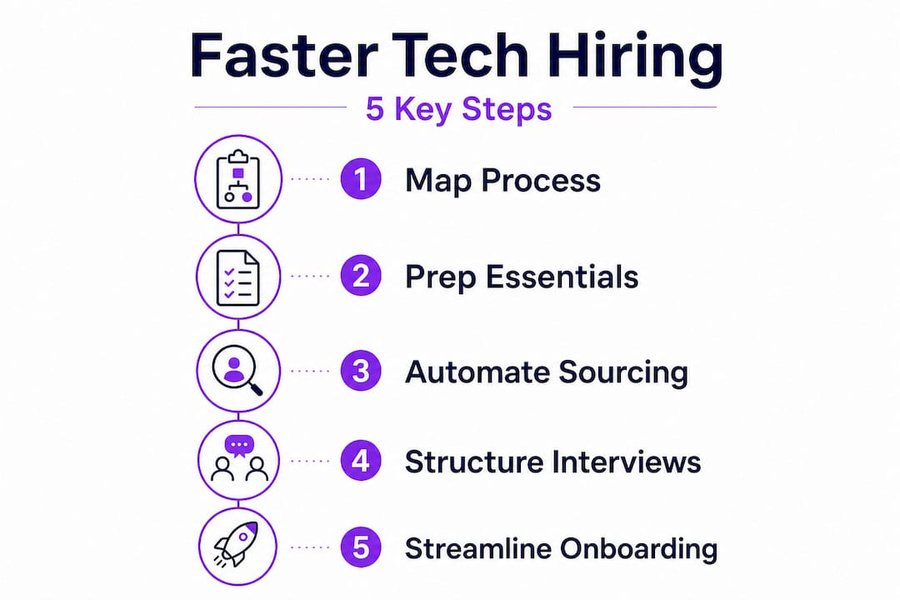
Assess your current tech hiring process
With the problem defined, let’s start by mapping your current process to pinpoint what’s slowing things down.
Before you can fix a slow hiring process, you need to see exactly where time disappears. Most hiring managers feel the pain but can’t identify the precise stage causing the delay. Start by documenting every step from the moment a role opens to the moment a candidate signs, then assign an average number of days to each stage. Compare your numbers to industry benchmarks.
Looking at those numbers side by side often reveals that scheduling and internal feedback loops account for the largest share of wasted time. The instinct among many hiring teams is to add more interview rounds in pursuit of certainty. However, adding more rounds can worsen speed without improving hire quality. Focus instead on structured evaluation and faster decisions at each existing stage.
What do you need?
Choose the hiring path that fits
After reading "How to speed up tech hiring: a practical guide for startups", most teams compare these options before deciding how to hire.
Common bottlenecks to troubleshoot first:
- Undefined decision criteria that cause interviewers to loop back for more input
- Calendar coordination without a designated scheduling tool or owner
- Feedback submission delays when interviewers don’t have a structured scorecard or deadline
- Too many approvers in the offer stage, each adding 24 to 48 hours
- Inconsistent job descriptions that attract mismatched candidates and force extended sourcing
Building a scalable hiring pipeline for remote teams solves many of these structural problems before they compound. When every stage has a defined owner, a time limit, and a clear output, the entire process accelerates.
Prepare the essentials before sourcing
Once you know where your process bottlenecks are, it’s vital to get your hiring prerequisites handled upfront.
One of the most underestimated causes of slow hiring is starting sourcing before the team is fully aligned on what they’re looking for. When a strong candidate appears, the absence of a pre-approved salary range, an unclear skills priority list, or missing information about timezone expectations can add days or even weeks to the process while stakeholders scramble to align internally. Structured preparation enables faster offers when sourcing remote talent, and the investment of one planning session upfront pays back immediately.
Documents and information to prepare before outreach for LATAM candidates:
- Finalized job description with must-have versus nice-to-have skills clearly separated
- Approved compensation range that reflects local market rates in Argentina, Brazil, Mexico, or Colombia
- Timezone requirements and the expected overlap with your core team hours
- Language proficiency standard and whether written or spoken English fluency is prioritized
- Payment and contractor structure including whether you’re hiring as a contractor or full employee
- Technical assessment ready to send within hours of a candidate expressing interest
- Interview panel identified with availability blocked in advance
Pro Tip: Draft templated communications for each hiring stage, including outreach, confirmation, assessment delivery, and rejection, before you post the role. Removing the need to write each email from scratch can shave two to three days off your total cycle time while keeping the candidate experience consistent and professional.
The automation examples for fast hiring on this topic illustrate how preparation and technology work together to compress timelines without cutting corners.
Use technology and automation for rapid sourcing
With everything prepared, leverage automation and technology to jumpstart the sourcing phase and reduce delays.
Recruitment automation expedites large-scale tech hiring by streamlining tasks like resume screening and interview scheduling, and the LATAM market specifically benefits from platforms that support region-specific outreach. A recruiter manually searching LinkedIn and emailing candidates one at a time cannot compete with an automated sequence that identifies, contacts, and tracks 200 candidates simultaneously while logging every touchpoint.
Key platforms and tools to integrate into your sourcing workflow:
- ATS with automation triggers that send assessments automatically after a candidate submits an application
- AI-powered matching tools that rank candidates by fit score against your job description without human review of every profile
- Scheduling automation that eliminates back-and-forth email by allowing candidates to self-book interview slots
- Region-specific job boards and networks with strong coverage in Brazil, Mexico, Argentina, and Colombia
- Pre-built candidate pools from agencies that specialize in LATAM talent and maintain active pipelines
For teams that need to assess technical skills at scale, AI-enabled recruitment tools can run coding evaluations, analyze outputs, and rank candidates by performance within hours of the assessment being sent. This is especially valuable when you’re evaluating 50 or more applicants for a single backend or data engineering role.
Pro Tip: Automated coding tests sent within 24 hours of application receipt can filter a large applicant pool down to a qualified shortlist in under 48 hours. Pair this with a defined pass threshold agreed upon by your technical team before sourcing begins, and you eliminate subjective debate at the screening stage entirely.
Combining automation with regional expertise is the fastest path to a qualified shortlist. The LATAM remote staffing guide covers the sourcing channels and platforms most effective across key Latin American markets, and the automation for fast growth hiring resource shows how to connect these tools into a seamless workflow.
Execute an efficient and structured interview process
Automation speeds up sourcing, but a structured, concise interview process is the next critical leverage point.

Many startups treat the interview stage as a catch-all for any lingering uncertainty about a candidate. This results in a fifth interview being added when the fourth didn’t yield a clear answer, which almost never produces the clarity the team is looking for. Too many interview rounds reduce speed and deliver diminishing returns on candidate signal. Structure and decisiveness are the solution, not more rounds.
Steps for a high-velocity interview loop:
- Define the evaluation criteria in advance with each interviewer assigned specific competencies to assess, such as technical depth, communication clarity, or system design thinking.
- Limit the process to two live rounds plus one async technical assessment, keeping the entire interview phase within five to seven business days.
- Use async video tools for first-round screening so candidates in different time zones can respond on their own schedule, saving 48 hours of scheduling friction.
- Set a feedback submission deadline of 24 hours after each interview with a structured scorecard rather than free-form notes.
- Schedule a debrief call within 48 hours of the final interview so the decision is made while observations are still fresh.
- Designate a single decision-maker who can make the hire or no-hire call without waiting for full consensus from a large panel.
“More interview rounds rarely produce more certainty. What they reliably produce is more elapsed time, more candidate drop-off, and more organizational friction. Design your process around quality signals, not quantity of touchpoints.”
For cross-border interviews with LATAM candidates, a few practical adjustments make a meaningful difference. Acknowledge timezone differences openly and offer interview slots that don’t require the candidate to join before 7 AM or after 9 PM their local time. Confirm English proficiency expectations early so neither party wastes time on a mismatch. Use async assessments as a default for the technical stage since they remove scheduling barriers and give candidates time to produce their best work.
Understanding the value of hands-on recruiting benefits becomes especially clear at this stage. When a recruiter with regional expertise manages candidate communication, scheduling, and prep logistics, your internal team can stay focused on evaluation rather than coordination.
Verify and finalize efficiently: offers, onboarding, and feedback
Once you’ve identified the right candidate, the last step is turning the decision into an accepted offer and starting work without costly delays.
The post-interview phase is where many startups lose candidates they fought hard to find. A strong engineer in Brazil or Colombia who interviews well on a Thursday and doesn’t hear back by Monday is likely speaking to two or three other companies over that same weekend. Speed at this stage is not courtesy; it is a competitive necessity.
Candidates who receive an offer within 24 hours of a final decision are significantly more likely to accept it, with industry data pointing to acceptance rates as much as 70% higher compared to offers that take five or more days to issue. That number is not surprising when you consider that top candidates don’t wait and aren’t passive.
Steps to close the loop efficiently:
- Make the hire or no-hire decision within 24 hours of the final interview debrief, with the decision-maker empowered to act without additional approvals.
- Run reference checks in parallel with offer preparation rather than sequentially. Send reference requests the same day the final interview ends so results arrive as the offer is being finalized.
- Issue the offer letter within 24 hours of the internal decision, using a pre-approved template that requires only role-specific details to be filled in.
- Begin onboarding preparation immediately after the verbal acceptance, including equipment shipping, access provisioning, and team introductions, so day one is productive.
Remote onboarding for LATAM hires has specific requirements that differ from domestic hiring. Confirm payment structure and currency, clarify intellectual property agreements under local law, establish communication expectations across time zones, and assign a dedicated onboarding buddy from your team to accelerate cultural integration.
Common pitfalls at this stage include stalling on references because no one owns the task, requiring multiple approvals for an offer amount already within the pre-approved budget, and sending contract drafts in formats that require the candidate to print, sign, and scan. Use e-signature tools and pre-approved templates to eliminate every preventable day from this phase.
Working with pre-vetted LATAM tech talent through a specialized partner means reference and background verification is often completed before you even interview the candidate, removing this step from your critical path entirely.
Why speed matters more than ever in tech hiring — Our take
Understanding the tactics is just the beginning. Here is our perspective, shaped by observing hundreds of remote hiring processes across Latin America, on why speed has become the decisive factor, not just a nice-to-have.
The conventional wisdom in hiring has long been that thoroughness protects quality. More rounds, more voices, more deliberation. In practice, what we see repeatedly is that the startups adding the most rounds are rarely the ones making the best hires. They are the ones losing their top shortlisted candidates to faster-moving competitors while their process is still in round three.
Latin America’s senior engineering talent pool is genuinely competitive. The strongest candidates in Brazil, Argentina, Mexico, and Colombia typically have multiple active conversations at any given time. A two-week delay in your process doesn’t create patience; it creates a window for someone else to close. We have watched companies invest weeks of effort into identifying an exceptional candidate only to lose them to a company that moved from first interview to offer in five days.
The counterintuitive lesson is that less process often produces better outcomes. When you define your evaluation criteria clearly, assign each criterion to a specific interviewer, and commit to a 48-hour feedback window, you gather more useful signal per interview, not less. The discipline of constraint forces clarity.
Building engineering teams fast in the current environment means treating every day of an open role as a measurable cost, because it is. Every week without a senior backend engineer is a week of delayed features, stretched existing team capacity, and compounding technical debt. Speed in hiring is not about cutting corners. It is about removing the unnecessary steps, delays, and indecision that add time without adding information.
Unlock faster hiring with GENTY recruitment
The framework in this guide works. But implementing it while managing an active product roadmap, an existing engineering team, and multiple open roles simultaneously is a significant operational load.
GENTY Recruitment specializes in helping US and European tech startups hire pre-vetted, English-speaking tech talent from Latin America with shortlists delivered in as few as five business days. Our process combines structured assessment, regional expertise, and purpose-built automation to eliminate sourcing delays from your pipeline. Whether you need IT hiring in LATAM for a single critical role or want to build a repeatable system for LATAM hiring shortlists across multiple positions, we operate as an extension of your team. Reach out today to explore how we can help you hire pre-vetted remote talent faster and with greater confidence.
Frequently asked questions
What is the fastest way to hire tech talent from Latin America?
The fastest way is to use automated sourcing tools combined with a specialized LATAM recruiter who maintains a pool of pre-vetted candidates, since recruitment automation expedites hiring by streamlining both sourcing and screening so qualified candidates reach your interview stage in days rather than weeks.
How many interview rounds is optimal for hiring remote tech talent?
For most startups, two well-structured live rounds combined with one technical assessment are sufficient to evaluate fit accurately and efficiently, given that more rounds yield diminishing returns on candidate signal while adding meaningful time to the process.
How can I ensure quality when speeding up hiring?
Use structured interviews with pre-defined evaluation criteria, assign specific competencies to each interviewer, and include a technical assessment for objective scoring. Structured evaluation and faster decisions actually improve hiring outcomes compared to longer, unstructured processes.
What mistakes delay remote hiring the most?
The most common delays come from too many interview rounds, slow internal feedback, and insufficient preparation before sourcing begins. Scheduling delays and redundant steps are consistently the top drivers of extended time-to-hire across remote hiring processes.