

Hiring the right SaaS professionals remotely is one of the highest-stakes decisions a tech startup can make, and the most common mistake founders make is applying traditional hiring methods to a fundamentally different kind of role. SaaS positions demand subscription-aware thinking, async collaboration instincts, and metric-driven accountability that generic job descriptions and casual interviews simply cannot detect. These tips for hiring SaaS professionals address exactly that gap, giving you a structured, data-backed framework to identify, assess, and close the right candidates regardless of where they work.
Key takeaways
1. Define role criteria around deliverables, not duties
The single most common failure in SaaS hiring starts with the job description. Most postings list responsibilities like “manage customer relationships” or “write clean code,” which say almost nothing about what success actually looks like in the first 90 days.
Deliverables-based role requirements define expected outcomes such as quota attainment, pipeline generation rates, or churn reduction targets rather than a list of tasks. For a Customer Success Manager, that might mean owning 90-day renewal cycles for accounts above a defined ARR threshold. For an SDR, it could mean generating 15 qualified opportunities per month within the first quarter.
This shift matters enormously in SaaS because subscription revenue compounds. A mis-hire in a renewal or expansion role does not just cost salary. It costs you logo retention, net revenue retention, and the downstream compounding of lost accounts.
What do you need?
Choose the hiring path that fits
After reading "Tips for Hiring SaaS Professionals: 2026 Guide", most teams compare these options before deciding how to hire.
- Write each role requirement as a measurable outcome
- Define the business metric each role directly influences (NRR, MRR, churn rate)
- Specify the 30, 60, and 90-day deliverables in the job post itself
- Build a scoring rubric before you open the role, not after candidates apply
Pro Tip: A scorecard tied to SaaS metrics gives every interviewer the same evaluation lens and prevents post-interview consensus bias from distorting what you actually heard.
2. Use structured interviews with anchored rubrics
Once you have clear role criteria, the interview process needs to match. Unstructured conversations feel natural but produce unreliable data. Structured interviews outperform unstructured ones by a statistically meaningful margin, and that gap widens further when general mental ability tests are added alongside them.

Anchored rubrics work by assigning specific example answers to each score level before the interview starts. A score of 1 on “churn risk handling” gets defined differently from a score of 4, and every interviewer uses the same frame. This eliminates the noise that comes from different interviewers weighting personality, communication confidence, or cultural familiarity differently.
Questions should connect directly to the SaaS subscription lifecycle. Generic questions like “tell me about a time you handled a difficult customer” will not surface the specificity you need. Instead, ask candidates how they identified a renewal at risk three months before the contract date, what signals they tracked, and what actions they took to close the gap. Subscription lifecycle-specific questions elicit responses that reveal actual operational thinking, not practiced interview language.
Pro Tip: Build your questions around three to five SaaS-specific competencies per role. Renewal risk handling, sprint prioritization conflict, and pipeline generation are far more predictive than generic leadership or teamwork questions.
3. Add role-specific work samples to your process
Work samples are the most underused tool in SaaS hiring. They do two things at once: they give you objective performance data, and they signal to serious candidates that your company operates with rigor.
Real-task simulations like engineering code reviews on actual pull requests or sales discovery calls built around your ideal customer profile (ICP) reveal how a candidate thinks under real conditions. An AE who runs a sharp discovery call with your actual product and ICP is demonstrably more prepared than one who speaks generally about their “consultative sales approach.”
For engineering roles, ask candidates to review a recent pull request and explain what they would approve, flag, or change. For Customer Success hires, run a simulated QBR (Quarterly Business Review) using anonymized account data from a real at-risk customer. These exercises take preparation but they replace hours of inconclusive live interviews with concrete, comparable data.
4. Leverage async assessments and written communication reviews
Remote SaaS hiring introduces a specific challenge: you lose the in-person signals that interviews traditionally rely on. The answer is not to force everything into live video calls. It is to shift evaluation weight toward methods designed for async environments.
Async coding assessments reduce both geographic scheduling friction and the unconscious bias that live technical interviews can introduce. When a candidate completes a timed coding challenge on their own schedule, their output reflects actual skill rather than their comfort on camera at 9am in their time zone.
Written communication deserves equal attention. Before any live call, review the candidate’s emails, application materials, and any written responses you have collected. Written communication predicts async collaboration quality more accurately than a 30-minute Zoom call. Candidates who write clearly, acknowledge context, and structure their thinking without prompting will perform better in distributed teams where decisions live in documents and Slack threads rather than meeting rooms.
- Send async video prompts asking candidates to walk through a past project or product challenge
- Review response quality: structure, clarity, length appropriateness, and tone
- Build in a written case study response as a pre-screen before the first live interview
- Allow connectivity fallbacks (audio-only options, written response alternatives) to avoid penalizing candidates for infrastructure issues outside their control
Pro Tip: Remote candidates who thrive in async-first cultures document decisions before meetings and send written updates proactively. Ask them directly how they have handled disagreements or blockers in writing. Their answer will tell you more than their resume.
5. Balance live interviews with async data to reduce polish bias
This is one of the most important best practices for hiring SaaS professionals remotely and it is consistently overlooked. Live interviews, even structured ones, have a tendency to overweight communication polish. A confident, articulate candidate who performs well on camera can outscore a technically stronger candidate who comes across as quieter or more reserved.
The fix is sequencing. Use async assessments first to establish an objective technical or competency baseline. Then use live interviews to validate thinking clarity, ask follow-up questions about the async work, and assess accountability. Live interviews work best when they focus on dimensions that actually require real-time interaction, such as how a candidate handles pushback, responds to ambiguity, or explains complex trade-offs under pressure.
This sequencing approach also respects the candidate’s time and sets a positive tone for your employer brand, which matters when you are competing for SaaS talent across multiple geographies.
6. Ask interview questions tied to SaaS subscription events
The specific questions you ask matter as much as the structure you use. One of the most practical interview tips for SaaS professionals is to build your question bank around the events that define the SaaS subscription lifecycle rather than around generic competency categories.
For sales roles: “Walk me through how you managed a renewal conversation where the customer was actively evaluating a competitor.” For Customer Success: “Describe a time you identified expansion revenue in an account that had not been flagged for growth.” For engineering: “How did you handle a production incident that was affecting paying customers and how did you communicate it to non-technical stakeholders?”
These questions surface real operational experience and reveal whether candidates understand that in SaaS, every action connects back to subscription health. They also differentiate candidates who have worked in true SaaS environments from those who have adapted their answers from different industries.
7. Evaluate recruitment platforms for workflow fit, not feature lists
Selecting the right recruitment software is part of any solid SaaS hiring checklist, and the mistake most startups make is choosing a platform based on feature volume rather than workflow compatibility.
SaaS recruitment platforms should be evaluated based on how well they fit your team’s specific needs. A 15-person startup hiring three engineers does not need the same governance infrastructure as a Series B company hiring across five countries. The right questions to ask include: How fast do we need to scale? What analytics do our hiring managers actually review? How does this platform integrate with our existing HR stack?
Centralized recruitment data and automated coordination features reduce the manual follow-up that slows most hiring processes. Look for platforms that integrate ATS functionality, hiring team collaboration, and compliance reporting into one view. This matters especially for remote SaaS hiring across multiple geographies, where legal and time-zone complexity can stall an otherwise strong process.
8. Partner with specialist recruiters who understand SaaS and remote markets
Speed matters in SaaS hiring. The best candidates are typically off the market within two to three weeks, and a slow process will cost you more than a bad job description will.
Specialist recruitment partners with deep SaaS knowledge and regional market access can present pre-vetted candidates within days rather than weeks. They understand the nuances of SaaS roles, know which competencies actually predict performance, and have warm talent networks that cold job postings cannot reach. For startups hiring remotely across Latin America, this access is especially valuable given the depth and breadth of technical talent available in markets like Argentina, Brazil, Mexico, and Colombia, where product-focused engineering teams are well-established.
The right partner also reduces compliance risk in cross-border hiring, helping you structure engagements correctly from day one.
My take on what actually moves the needle in SaaS hiring
I have watched a lot of SaaS hiring processes up close, and the pattern that separates the teams that hire well from the ones that churn through people is almost always the same. The teams that struggle are making decisions based on gut feel and interview confidence. The teams that hire reliably have removed as much judgment-based noise from the process as possible before anyone picks up the phone.
Async assessments before live interviews is not just a remote-friendly idea. It is a fairer and more accurate one. I have seen candidates with average communication polish perform in the top 10% of their cohort because their async work was precise, well-reasoned, and production-ready. Those are the hires that compound.
What I have also learned is that onboarding quality changes the math on every hiring decision. A strong hire in a weak onboarding environment will underperform. If your remote staffing workflow does not include structured 30, 60, and 90-day check-ins tied back to the role scorecard you built during hiring, you are leaving retention to chance. Hiring and onboarding are the same system, not two separate ones.
— Eugene
How Gentyrecruitment helps you hire SaaS talent faster
Gentyrecruitment specializes in connecting US and European tech startups with pre-vetted SaaS professionals across Latin America, including Argentina, Brazil, Mexico, and Colombia. Every candidate goes through structured technical and communication assessment before they reach your desk, which means you spend your interview time validating fit, not filtering out unqualified applicants.
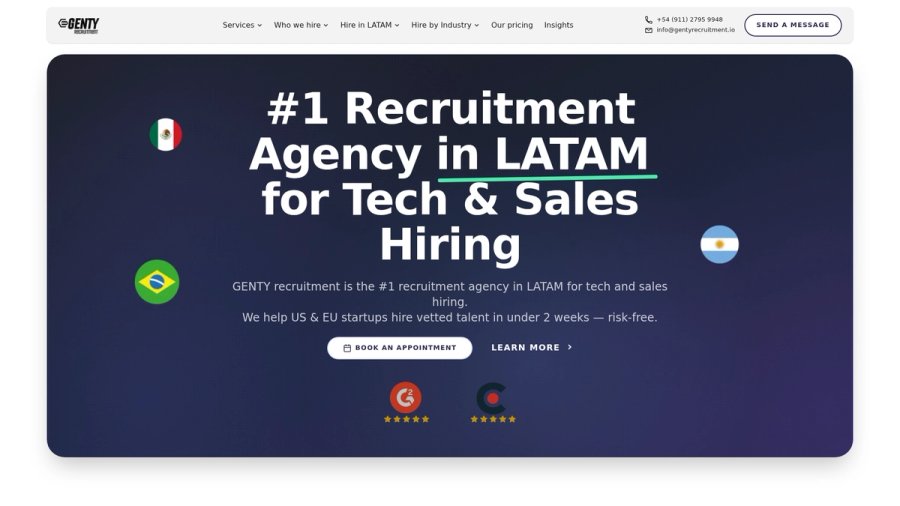
Whether you need IT recruitment for engineers, SaaS sales professionals like SDRs and Account Executives, or senior leaders through executive search, Gentyrecruitment covers the full hiring spectrum with regional compliance support built in. Gentyrecruitment also provides salary benchmarking across LATAM to help you build competitive offers that close faster. If you are ready to put these hiring strategies to work with a partner who already knows the market, reach out to Gentyrecruitment directly.
FAQ
What makes SaaS hiring different from general tech hiring?
SaaS roles require subscription-aware thinking, metric-driven accountability, and alignment with recurring revenue cycles. Candidates need experience with churn, NRR, and expansion revenue, not just general technical or sales competencies.
How do structured interviews improve SaaS hiring outcomes?
Structured interviews with rubrics deliver significantly higher predictive accuracy than unstructured conversations, reducing hiring noise and improving consistency across all interviewers.
What questions should I ask SaaS candidates in interviews?
Focus questions on subscription lifecycle events such as renewal risk handling, expansion opportunity identification, and production incident communication. These reveal real SaaS operational experience more accurately than generic behavioral questions.
How do I evaluate remote SaaS candidates fairly?
Use async coding assessments and written communication reviews before live interviews to establish an objective baseline and reduce the polish bias that video calls can introduce.
When does it make sense to use a SaaS recruitment partner?
When your time-to-fill exceeds three weeks or you lack access to pre-vetted regional talent pools, a specialist SaaS recruiter can significantly reduce both hiring time and the risk of a costly mis-hire.