

Multilingual recruiting is defined as the strategic process of sourcing, assessing, and onboarding professionals fluent in two or more languages to support global operations, cross-border teams, and diverse customer bases. For tech companies scaling across the US, Europe, and Latin America, this practice has moved from a niche capability to a core hiring function. As distributed engineering teams become the default model in FinTech, SaaS, and AI sectors, the ability to hire candidates who communicate across languages and cultures directly determines how fast a company can grow and how well it retains talent. This guide covers the definition, strategic value, best practices, and common pitfalls of multilingual talent acquisition so your HR team can build a program that actually works.
What are the key benefits of multilingual recruiting for tech companies?
Multilingual recruiting gives tech companies access to talent pools that monolingual hiring processes simply cannot reach. Diverse teams outperform peers according to McKinsey research, and the same study found that 75% of people prefer to receive information in their native language. That preference directly affects candidate engagement, offer acceptance rates, and long-term retention.
The strategic advantages extend well beyond headcount:
- Broader candidate reach. Posting roles in Spanish, Portuguese, or French opens pipelines in Argentina, Brazil, and Colombia where strong engineering talent is abundant and compensation expectations are competitive.
- Stronger customer support. A multilingual support engineer in Mexico City who speaks English and Spanish can resolve tickets for both US enterprise clients and Latin American end users without escalation delays.
- Faster team integration. When distributed teams share at least one common language with local fluency as a secondary asset, onboarding timelines shrink and miscommunication incidents drop.
- Employer brand differentiation. Tech companies that localize job postings for cultural relevance rather than literal translation see up to 40% higher candidate engagement. That number reflects a real competitive edge in markets where top engineers receive multiple offers per month.
- Reduced mismatch and turnover. A well-defined multilingual strategy reduces role mismatches by aligning language requirements to actual job functions rather than vague “fluency preferred” language that attracts the wrong candidates.
The compounding effect matters most in tech. A SaaS company expanding from the US into Brazil needs product managers who can run sprint reviews in English and stakeholder meetings in Portuguese. Hiring for one language and hoping for the other is a common and expensive mistake.
Need help hiring?
See the next step after this guide
If this topic is relevant to your team, these are the most useful pages to check next.
How does multilingual recruiting differ from bilingual recruitment and international recruitment?

These three terms are often used interchangeably, but they describe meaningfully different hiring strategies. Understanding the distinction helps HR teams allocate resources correctly and set precise job requirements.
Bilingual recruitment focuses on hiring candidates who speak exactly two languages, typically the corporate language plus one regional language. It is common in customer-facing roles where a company serves a specific second-language market. A US fintech hiring Spanish-speaking support agents is practicing bilingual recruitment.
International recruitment describes the process of hiring candidates across national borders, regardless of language. It focuses on legal compliance, visa sponsorship, relocation logistics, and cross-border compensation structures. Language proficiency may or may not be a primary requirement.
Multilingual recruiting combines elements of both but operates at greater scale and strategic depth. It targets candidates fluent in two or more languages across multiple markets simultaneously, and it integrates language assessment into every stage of the hiring funnel.
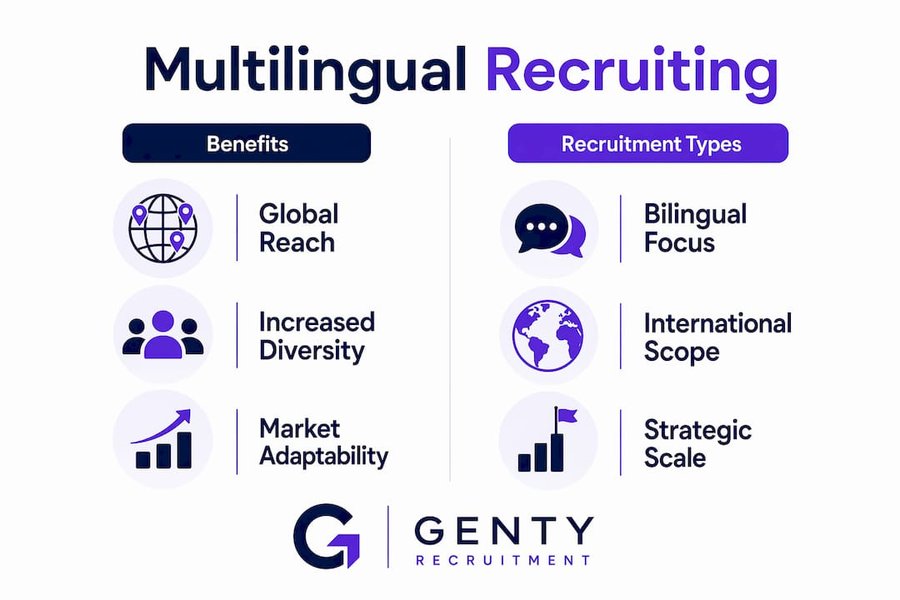
The overlap is real. A tech company hiring a remote senior engineer in Colombia who speaks English, Spanish, and Portuguese is doing all three simultaneously. The key distinction is intent: multilingual recruiting treats language as a strategic hiring asset rather than a secondary filter applied after technical screening.
What are best practices for implementing multilingual recruiting programs?
Building a multilingual recruiting program requires more than adding a language field to your ATS. The following steps reflect what actually works for tech companies hiring across multiple markets.
<p>Define language requirements by job function, not assumption. Document exactly which languages are needed, at what proficiency level, and for which tasks. A backend engineer who attends English-only standups needs B2 conversational English, not C2 academic fluency. Language requirements must be documented and defensible to meet anti-discrimination regulations in the US and EU.</p>
<p>Localize job ads, not just translate them. A Portuguese job posting for Brazil should reflect Brazilian professional norms, not a word-for-word translation of an English template. Localized postings that account for cultural communication styles generate significantly higher engagement from passive candidates.</p>
<p>Configure your ATS with language tagging. Platforms like Greenhouse, Lever, and Workable support custom fields for language proficiency. Tag candidates by language, level, and market so your pipeline stays searchable and reportable across regions.</p>
<p>Use validated language assessments. Tools like Versant, Duolingo for Business, and Pipplet provide standardized proficiency scores that reduce subjective bias in screening. Pair these with role-specific tasks, such as a written technical summary in the target language, to assess real-world communication ability.</p>
<p>Train hiring managers on structured multilingual interviews. Structured interviews with shared competency frameworks and language proficiency dimensions reduce bias and improve consistency. Sharing questions in advance and providing interpreters only when necessary levels the playing field for non-native speakers.</p>
<p>Source passive candidates in their native language. Searching LinkedIn or GitHub using keywords in Spanish or Portuguese surfaces candidates who never respond to English-only outreach. Cross-reference their profiles with culturally appropriate communication styles to avoid misreading tone or formality.</p>
<p>Pilot in one market before scaling. Launch your multilingual program in a single region, such as Mexico or Colombia, measure quality-of-hire and time-to-fill, then iterate before expanding to Brazil or Argentina.</p>
Pro Tip: When interviewing candidates in a second language, separate language proficiency from technical competency in your scoring rubric. A brilliant engineer with B2 English should not lose points on a technical assessment because an interviewer conflated communication style with problem-solving ability.
What challenges and common pitfalls exist in multilingual recruiting?
The most common mistake tech companies make is treating language proficiency as a binary pass-or-fail filter rather than a spectrum of capability. This creates unnecessary barriers that exclude qualified candidates and reduce the diversity of your pipeline.
Key challenges to anticipate and address:
- Native-speaker bias. Requiring “native-level” fluency for roles that only need professional working proficiency eliminates large segments of qualified talent. Most tech roles require B2 to C1 English, not C2 academic mastery.
- Language hierarchies within teams. Multilingualism can constrain employees within corporate hierarchies. Multilingual employees often access entry and mid-level roles more easily but face structural barriers to leadership positions, particularly when English fluency is treated as a proxy for intelligence or leadership potential.
- Assessment bias. Unvalidated language tests administered by non-specialist interviewers introduce significant subjectivity. Accent, dialect, and communication style are frequently penalized even when they have no bearing on job performance.
- Legal exposure. Employers can legally require language fluency when it is genuinely essential to the role, but questions about national origin, native language, or country of birth during interviews create legal risk. Requirements must be role-specific and documented.
- Over-reliance on AI translation tools. Automated CV parsing and translation tools miss cultural context, idiomatic expressions, and tone shifts that a human recruiter would catch immediately.
“Multilingual recruiting can create dependencies; HR should implement inclusive policy design to avoid language-based corporate gatekeeping.” — IBIMA Publishing, 2026
The most effective mitigation strategy is the “English-plus” approach: establish English as the corporate lingua franca for documentation and cross-team communication, then actively support local language use within regional teams. This hybrid language policy reduces stress for non-native English speakers and improves knowledge flow across distributed organizations.
How can HR teams use AI and technology to enhance multilingual recruiting?
AI tools have changed the economics of multilingual recruiting at scale, but they require careful deployment. AI-driven translation tools help with CV screening and parsing across languages, but human intervention remains essential for interviews and cultural nuance detection. AI is effective for volume tasks and poor at detecting tone shifts or cultural subtleties.
The practical technology stack for multilingual recruiting in 2026 looks like this. ATS platforms with language filters handle pipeline organization. AI-powered CV parsers like those built into Greenhouse or Workable extract language proficiency data from resumes in multiple languages. Automated scheduling tools reduce coordination friction across time zones. Interview transcription platforms like Otter.ai or Fireflies.ai generate searchable records of multilingual interviews for structured review.
For the interview stage itself, AI-powered interview tools can assist with real-time transcription and structured scoring, but they should never replace a trained human interviewer when assessing cultural fit or communication nuance. The combination of AI efficiency and human judgment produces the most accurate candidate evaluations. You can also explore how AI affects tech startup hiring to understand where automation adds the most value in your specific context.
Pro Tip: Audit your AI screening tools quarterly for language bias. Models trained predominantly on English-language resumes frequently underrank candidates whose CVs are written in Spanish or Portuguese, even when those candidates are technically stronger than English-language applicants.
Key takeaways
Multilingual recruiting succeeds when language proficiency is treated as a measurable, role-specific competency rather than a vague preference, and when AI tools are paired with human judgment at every critical decision point.
Why language strategy is the hiring decision most tech leaders underestimate
Most HR teams I work with treat language requirements as an afterthought. They finalize the technical spec, agree on compensation, and then add “English proficiency required” at the bottom of the job description as if it costs nothing to enforce. It costs a great deal.
The research is clear: language functions as linguistic capital within organizations, and how you define and assess it shapes who gets hired, who gets promoted, and who leaves. A tech company that sets C2 English requirements for a backend role that involves writing code and attending two standups per week is not protecting quality. It is restricting its own talent pipeline and paying a premium for it.
What I find more interesting is the leadership gap. Multilingual employees in tech consistently reach mid-level roles faster than their monolingual peers, but they stall at the director and VP level in companies that conflate English fluency with executive presence. That is a structural problem, not a language problem. The companies that recognize this and build multilingual leadership pipelines are the ones winning the global talent competition right now.
The practical advice I give every HR team is this: treat language proficiency the same way you treat technical skills. Define the level you actually need, test for it with validated tools, and score it separately from everything else. When you do that, you stop filtering out the best candidates and start building teams that can actually operate across markets.
— Eugene
How Gentyrecruitment supports multilingual tech hiring
Gentyrecruitment specializes in connecting US and European tech companies with pre-vetted, English-speaking talent from Latin America, including Argentina, Brazil, Mexico, and Colombia. Every candidate in the Gentyrecruitment pipeline has been assessed for both technical competency and language proficiency before you see their profile, which removes the most time-consuming part of multilingual recruiting from your team’s workload. For FinTech, SaaS, and AI companies that need to hire fast without sacrificing quality, Gentyrecruitment’s LATAM IT recruitment service delivers qualified candidates up to five times faster than traditional search. You can also review current tech hiring trends to align your multilingual strategy with where the market is heading.
FAQ
What is multilingual recruiting in simple terms?
Multilingual recruiting is the process of hiring professionals who speak two or more languages to support global teams, international customers, and cross-border operations. It integrates language assessment into every stage of the hiring funnel, from job posting to onboarding.
How does bilingual recruitment differ from multilingual recruiting?
Bilingual recruitment targets candidates who speak exactly two languages, typically for a specific regional market. Multilingual recruiting operates at broader scale, targeting candidates fluent in multiple languages across several markets simultaneously.
What legal rules apply to language requirements in hiring?
Employers can require language fluency when it is genuinely essential to the job, but must avoid questions about national origin or native language during interviews. Requirements must be documented and tied directly to specific job functions to comply with anti-discrimination regulations.
Which AI tools are most useful for multilingual recruiting?
AI-powered CV parsers, ATS language filters, and interview transcription platforms like Otter.ai handle volume tasks effectively. Human reviewers remain necessary for cultural nuance and interview assessment, as AI tools alone cannot reliably detect tone shifts or cultural subtleties.
How do you assess language proficiency fairly in tech hiring?
Use validated tools such as Versant, Duolingo for Business, or Pipplet to generate standardized proficiency scores. Score language proficiency separately from technical competency in your evaluation rubric to prevent communication style from influencing technical assessments.