

Most hiring managers in tech have experienced the same frustration: a critical role opens, the search starts from scratch, and weeks pass before a qualified shortlist appears. Understanding what is a talent pool, and more importantly how to build one that actually works, is what separates reactive hiring teams from organizations that can fill senior engineering or product roles in days rather than months.
Key takeaways
What is a talent pool: core definition and key distinctions
The definition of a talent pool is straightforward on the surface: it is a curated group of candidates who have expressed interest in your organization or whom your recruiting team has identified as potentially strong fits for future roles. That group can include former applicants, passive candidates, internal employees eligible for lateral moves, freelancers, and referrals from your existing team. But the definition only tells part of the story.
What separates a genuine talent pool from a pile of old resumes sitting in a folder is active management. Talent pools are distinct from talent pipelines in a precise way: a pool is broad and largely passive, housing candidates across a range of roles and stages, while a pipeline is narrow and actively nurtured, focused on candidates being moved toward a specific open position. Both are valuable, but they serve different functions and require different management approaches.
Your applicant tracking system (ATS) is a tool, not a talent pool. An ATS stores data. A talent pool is a living resource that requires deliberate cultivation to produce results. Understanding this distinction helps you stop treating your ATS archive as a recruiting asset and start building something genuinely useful.
What do you need?
Choose the hiring path that fits
After reading "What Is a Talent Pool? Guide for Tech HR Teams", most teams compare these options before deciding how to hire.
Here is a breakdown of how these three concepts differ:
- Talent pool: Broad, multi-role, long-term relationships with candidates who may not be actively looking
- Talent pipeline: Narrow, role-specific, candidates in active consideration for an imminent hire
- ATS database: A record-keeping system that can support a talent pool but is not one by itself
- Internal talent pool: Current employees segmented by skills, performance, and growth potential for future internal mobility
Recruiters are evolving into Talent Architects, working with hiring managers to define skills-based success factors and build broader, more resilient candidate pools. This shift reflects a fundamental change in how forward-looking tech organizations think about talent acquisition strategy.
Why talent pools matter for tech companies
The business case for building a talent pool is clearer now than it has ever been. 63% of organizations identify developing a critical talent sourcing strategy as their top priority for 2026, and the shift toward skills-based recruitment is central to that. For tech companies specifically, where the competition for senior engineers, ML specialists, and DevOps professionals is relentless, a well-maintained pool is a direct competitive advantage.

The benefits of a talent pool play out across several dimensions that matter to hiring managers and HR leaders.
Reduced time-to-hire. When a role opens and your team can immediately query a segmented pool of pre-qualified candidates rather than starting a cold search, the timeline compresses significantly. You are not reposting to job boards and waiting. You are reaching out to people who already know your brand and have signaled interest.
Lower cost-per-hire. Sourcing costs drop when your team spends less time on top-of-funnel discovery. A maintained pool shifts effort toward relationship management rather than repeated cold outreach, which is both cheaper and more effective.
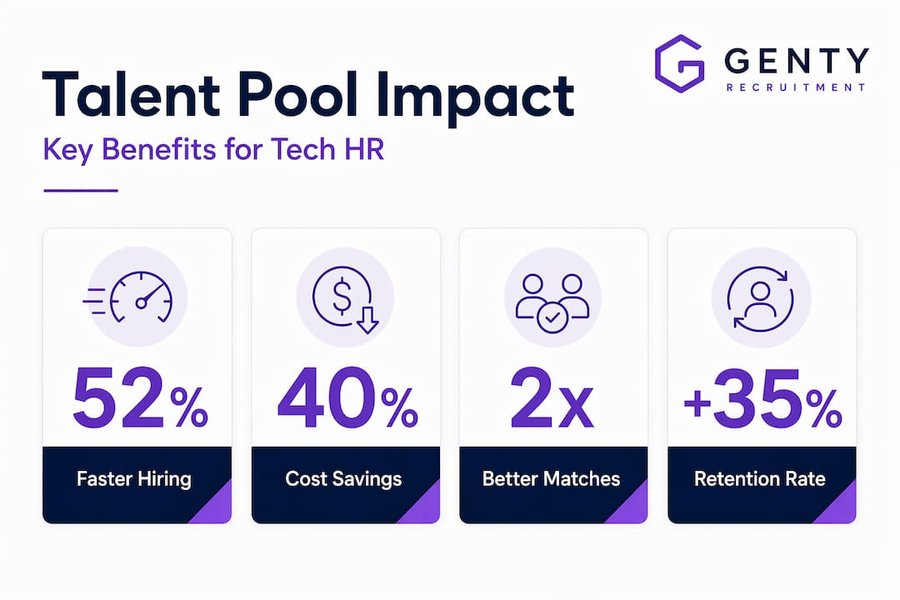
Higher quality of hire. Skills-based criteria applied at the pool-building stage mean candidates are already pre-screened against the competencies your roles require. You are not starting quality assessment from zero with each search.
Workforce resilience under disruption. 50% of Chief People Officers are prioritizing local talent pools through internal mobility and redeployment in direct response to geopolitical and market disruptions. Having a pool ready means your hiring strategy does not collapse when external conditions shift.
Support for diversity and inclusion goals. Proactively building a global talent pool, specifically what is often called a global talent pool, allows your team to source from underrepresented regions and demographics intentionally rather than defaulting to familiar networks. Investing in untapped talent pools in emerging economies could unlock hundreds of thousands of jobs and substantial economic growth by 2030, which signals the scale of available talent that most companies currently overlook.
How to build and manage a talent pool for tech hiring
Building a talent pool that produces real hiring results requires a repeatable process, not a one-time sprint. The following steps reflect best practices for talent pooling specifically in tech environments where role complexity and candidate scarcity demand more rigor than most industries.
<p>Define your pool segments before you source. Start by mapping the roles and skills your organization will need over the next 12 to 24 months. Group these into segments: backend engineers, security specialists, product managers, data scientists, and so on. Segmenting by competency rather than job title gives you more flexibility when a new role does not map neatly to a standard description.</p>
<p>Source from multiple channels simultaneously. Previous applicants who were strong but not the right fit at the time are your most underused asset. Beyond that, draw from LinkedIn outreach, technical communities like GitHub and Stack Overflow, employee referrals, and specialized platforms. For companies open to global hiring, Latin America has become a high-value source of English-speaking engineers with strong technical credentials in FinTech, AI, and SaaS.</p>
<p>Evaluate candidates against skills-based criteria. At the pool stage, you are not conducting full hiring processes. You are qualifying candidates against core technical and behavioral competencies, recording assessments, and tagging profiles accordingly. This is the groundwork that makes future searches fast. Current IT recruitment trends consistently show that skills-first evaluation expands access to quality candidates who would be filtered out by credential-based screening.</p>
<p>Build an engagement cadence and stick to it. A talent pool only retains value if candidates remain warm. Talent pool engagement timeframes run from six months to over two years, particularly for senior or niche roles. That means you need a communication schedule: quarterly updates, relevant content, event invitations, and occasional personal check-ins. The goal is to stay present without being intrusive.</p>
<p>Maintain data hygiene consistently. Talent pool management requires regular engagement and data hygiene. Outdated contact information, stale skill assessments, and candidates who have already moved to competitors destroy pool quality over time. Schedule quarterly reviews to update profiles, remove unresponsive contacts, and add new candidates.</p>
<p>Integrate the pool with your hiring workflow. An effective workflow involves querying your segmented pool when a role opens, moving top matches into an active pipeline, running your full assessment process, and then returning candidates who were not selected to the pool with updated notes. This cycle keeps the pool continuously enriched rather than depleted.</p>
Pro Tip: Tag every candidate in your pool with both their current skills and their stated growth areas. When a new role requires a skill a candidate is actively developing, you have a placement opportunity that a skills-only snapshot would miss entirely.
For teams building remote hiring capabilities, the process of building a scalable hiring pipeline complements talent pool management by giving you the infrastructure to move candidates efficiently from pool to offer.
Challenges and misconceptions that limit talent pool success
The biggest misconception about talent pools in tech recruitment is that having a large database equates to having a strong pool. Volume is not the metric. Engagement quality and data accuracy are. A pool of 500 well-documented, actively engaged candidates outperforms a pool of 5,000 contacts who last heard from your company two years ago.
Several specific pitfalls consistently limit talent pool effectiveness:
- Treating the pool as a one-time project. Building a pool and then ignoring it is worse than not building one at all, because it creates false confidence that you have a resource when you actually have stale data.
- Failing to segment by skills. Generic pools organized by job title become useless when roles evolve or new specializations emerge. Skills-based tagging gives your pool longevity.
- Poor integration with the ATS. When your talent pool lives in a spreadsheet disconnected from your ATS, candidates fall through the cracks and your team wastes time reconciling information from two systems.
- Ignoring engagement timing for senior roles. Many teams apply the same communication cadence to junior and senior candidates. A principal engineer or VP of Engineering considering a move needs a more deliberate, less frequent, and more personalized approach.
Pro Tip: For senior technical roles, assign a specific recruiter as the relationship owner for each high-value candidate in your pool. Personal relationships convert at dramatically higher rates than broadcast email sequences for this segment.
Active management is what separates a valuable pool from an inert database. The organizations that get this right treat their talent pool as a living asset that demands the same attention as any other strategic resource.
My take on talent pool strategy in tech hiring
I have watched too many tech companies invest significant effort into building a talent pool and then wonder six months later why it has not changed their hiring velocity. What I have seen consistently is that the failure point is almost never the sourcing. It is the follow-through.
In my experience, the teams that extract real value from their pools are the ones that have shifted their mental model entirely. They no longer think of candidates as applicants to be evaluated. They think of them as relationships to be developed. That distinction sounds small, but it changes everything about how you communicate, how often, and what you say.
What I have also learned is that the concept of what is a global talent pool deserves far more attention than most US and European tech companies give it. Latin America, in particular, is not a backup option or a cost-cutting measure. It is a genuinely competitive talent market with engineers who have contributed to global FinTech and AI products and who bring time zone alignment that Asia-based talent often cannot provide. The companies I have seen build the most resilient pools are the ones that deliberately sourced across multiple geographies from the start.
My practical advice for HR leaders: stop measuring your pool by size and start measuring it by response rate and conversion rate into active pipeline. Those two numbers will tell you more about pool health than any headcount metric.
— Eugene
How Gentyrecruitment accelerates your talent pool strategy
Building a high-quality talent pool takes time and the right sourcing infrastructure, particularly when your roles require specialized tech skills that are scarce in traditional markets. Gentyrecruitment helps US and European tech companies accelerate this process by providing access to pre-vetted, English-speaking engineers and tech professionals from across Latin America, including Argentina, Brazil, Mexico, and Colombia.
For FinTech, AI, and SaaS teams that need to fill roles faster without sacrificing candidate quality, Gentyrecruitment’s approach combines structured technical assessment with hands-on recruiting to deliver shortlists that are ready to integrate into your hiring workflow. Whether you are building your initial talent pool or looking to add high-quality candidates to an existing one, their LATAM tech hiring service can reduce your time-to-shortlist to as little as five days. Teams looking for pre-screened remote talent can also explore their pre-vetted remote candidates service, which is designed specifically for tech companies that want quality without the delay.
FAQ
What is a talent pool in recruitment?
A talent pool is a curated group of pre-qualified candidates maintained by an organization for current and future hiring needs. Unlike an ATS database, a talent pool is actively managed through ongoing engagement and regular data updates.
How is a talent pool different from a talent pipeline?
Talent pools are broad and passive, covering many roles and long time horizons, while talent pipelines are narrow and active, focused on candidates being moved toward a specific open position. Both work best when used together as part of a connected recruiting strategy.
How long does it take to build an effective talent pool?
Building a functional talent pool typically takes three to six months of consistent sourcing and engagement. However, the pool only delivers full recruiting value after multiple hiring cycles have cycled candidates through and enriched their profiles.
What is a global talent pool and why does it matter for tech?
A global talent pool extends your candidate sourcing across international markets, giving tech companies access to specialized skills that may be scarce domestically. Regions like Latin America offer strong technical talent with English proficiency and favorable time zone overlap for US and European teams.
What are the best practices for talent pooling in tech hiring?
The most effective practices include segmenting candidates by skills rather than job titles, maintaining a consistent engagement cadence, integrating pool management with your ATS workflow, and reviewing data hygiene on a quarterly schedule to keep profiles accurate and contacts active.