

Most hiring managers assume that global recruitment is simply a wider net cast over a larger pond of candidates. More applicants, more options, problem solved. That assumption leaves serious value on the table. True global recruitment is a structured, technology-supported discipline that spans sourcing strategy, compliance frameworks, employer branding, and cross-cultural team integration. For fast-growing tech startups in the US and Europe, getting this right is not a nice-to-have. It is a competitive requirement in a market where the best engineers, product managers, and data scientists are distributed across multiple continents.
Table of Contents
- Defining global recruitment: What it is and why it matters
- The essential tools and strategies for global recruitment
- Global recruitment in action: Best practices for hiring Latin American tech talent
- Challenges and solutions in global recruitment
- Why most startups misunderstand global recruitment
- Get expert help for your global tech recruitment
- Frequently asked questions
Key Takeaways
Defining global recruitment: What it is and why it matters
Global recruitment is not simply hiring someone from another country. It is a deliberate, end-to-end strategy for attracting, evaluating, and onboarding qualified candidates across borders, while managing the legal, cultural, and logistical complexity that comes with doing so at scale. The distinction between global recruitment and basic international hiring matters. International hiring might mean posting a job on LinkedIn and accepting applications from abroad. Global recruitment, by contrast, involves structured pipelines, multi-channel sourcing, AI-assisted screening, employer branding that resonates internationally, and compliance systems that protect both the company and the candidate.
For tech companies, this is especially relevant because the talent they need, such as backend engineers, machine learning specialists, and DevOps architects, is not concentrated in one geography. Global tech recruitment trends show that companies competing for top-tier engineers can no longer rely on local pipelines alone. The demand simply outpaces supply in most major tech hubs.
Key characteristics that define mature global recruitment include:
Planning a hire?
Talk through the best hiring option
This article usually leads to one practical question: should you use rpo or it recruitment? We can help you choose quickly.
- Strategic sourcing: Using multiple channels including GitHub, niche developer forums, and regional job boards in addition to mainstream platforms
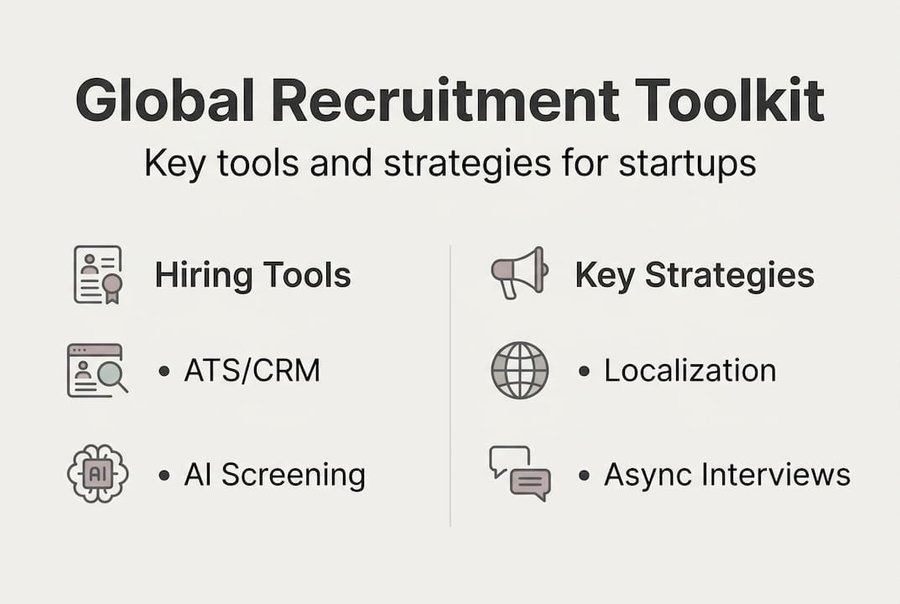
- Technology infrastructure: Applicant tracking systems (ATS) and candidate relationship management (CRM) tools that organize pipelines across different markets
- AI-assisted screening: Automated tools that pre-qualify candidates based on technical skill signals before human reviewers engage
- Compliance and legal frameworks: Especially Employer of Record (EOR) services that handle cross-border payroll, tax obligations, and labor law
- Employer branding: A clear, globally consistent message about your company culture, compensation philosophy, and remote work expectations
“Global recruitment for tech startups relies on ATS/CRM for pipelines, AI screening, multi-channel sourcing, EOR for compliance, and employer branding.” — BatchTransfer Global Recruitment Strategy
The strategic payoff extends beyond headcount. Companies that embrace workforce transformation through global hiring gain access to diverse cognitive approaches, cost-effective talent tiers, and greater organizational resilience when any one regional labor market tightens.
The essential tools and strategies for global recruitment
Understanding what global recruitment is, let’s explore the specific strategies and tools that help startups stay competitive and compliant. The good news is that the technology to execute this well is more accessible than ever, even for small teams operating without a dedicated HR department.
Here is a breakdown of the core technology stack for effective global recruitment:
Automating global recruitment processes with these tools reduces time-to-hire significantly and frees recruiters to focus on high-judgment tasks like final interviews and offer negotiations. The HR tech impact on recruitment is substantial, with companies reporting faster pipelines and more consistent candidate experiences when these systems work in concert.
Here is a numbered process for how a startup can set up global recruitment from scratch:
- Define your target talent markets. Identify which regions have the skills you need, at compensation levels that work for your stage. Latin America, Eastern Europe, and Southeast Asia are common starting points for US and European startups.
- Choose your ATS and integrate your sourcing channels. Your ATS should aggregate candidates from LinkedIn, GitHub, Wellfound, and any regional job boards relevant to your target markets.
- Build a global employer brand. Create content, clear job descriptions with salary ranges, and a careers page that speaks to remote-first candidates internationally.
- Set up AI screening criteria. Define the technical must-haves for each role and configure your screening tools to surface relevant profiles before human review.
- Deploy async video interviews. This equalizes the process across time zones and gives candidates in different regions a fair opportunity to present their skills without scheduling friction.
- Engage an EOR for legal coverage. Rather than establishing legal entities in every country you hire from, an EOR lets you bring someone onto payroll compliantly from day one.
Pro Tip: Recruitment marketing strategies work best when you localize your messaging for each target region rather than using a one-size-fits-all approach. Engineers in Brazil respond to different signals than those in Colombia or Argentina, even within the same technical discipline.
The combination of ATS/CRM, AI-powered screening, async interviews, multi-channel sourcing, and EOR gives startups the infrastructure needed to hire internationally without the overhead of a large, siloed HR function. This is the operational foundation that separates companies that scale their teams efficiently from those that spend months on a single cross-border hire.
Global recruitment in action: Best practices for hiring Latin American tech talent
With the frameworks in mind, see how global recruitment plays out specifically for Latin American tech talent acquisition. Consider a US-based fintech startup that needs to scale its backend engineering team quickly. The internal US pipeline is too slow and too expensive for its runway. The team decides to open hiring to Latin America, targeting senior engineers in Argentina, Brazil, and Colombia.
The comparison between traditional and modern approaches is striking:
Effective global hiring strategies include employer branding, clear job descriptions, and explicit remote work norms tailored to the candidate’s regional context. When a startup communicates compensation in USD, specifies working hours with time zone flexibility, and describes its collaboration tools and team culture clearly, candidates self-select more accurately and dropout rates after offers drop significantly.
Best practices for hiring LATAM tech talent specifically include:
- Write bilingual or fully English job descriptions. Most senior LATAM engineers are proficient in English, but clear role specifications reduce ambiguity and signal professionalism.
- Specify async and sync expectations upfront. Engineers in Buenos Aires or São Paulo need to know when live overlap is required versus when they can work autonomously.
- Use structured technical assessments. Standardized coding challenges or system design exercises let you evaluate candidates consistently, regardless of their geographic background.
- Integrate hiring pre-vetted LATAM talent through a specialized agency when speed and precision matter, because an agency with regional expertise can pre-qualify candidates faster than most internal teams can.
- Plan onboarding for remote-first workflows. A solid digital onboarding workflow ensures new hires from Latin America integrate into the team quickly and feel connected to the company’s mission from week one.
Pro Tip: The most common mistake US startups make when hiring LATAM talent is treating the region as a monolith. Compensation benchmarks, talent density, and cultural communication norms differ meaningfully between, say, Mexico City and Medellín. Localized research before you open a role saves negotiation time later.
Async hiring methods do more than just accommodate different time zones. They also reduce scheduling bottlenecks that add days or weeks to a pipeline. When a candidate in Buenos Aires can complete a 15-minute async video response at their convenience, the startup receives comparable information to a live screening call and can evaluate it on their own timeline.

Challenges and solutions in global recruitment
Seeing the best practices, it’s critical to also address the hurdles and how forward-thinking startups overcome them. Global recruitment introduces complexities that domestic hiring simply does not surface, and underestimating them leads to expensive mistakes.
The most common challenges include:
- Legal and regulatory compliance. Every country has distinct labor laws governing contracts, notice periods, termination rights, benefits, and tax obligations. Failing to comply can expose the company to fines or litigation, even when the relationship is fully remote.
- Candidate experience across cultures. Communication styles differ across regions. A recruitment process that feels efficient and professional to a US hiring manager might feel impersonal or rushed to a candidate in a relationship-oriented culture.
- Time zone coordination. Managing interview panels, technical rounds, and onboarding across three or four time zones simultaneously strains small recruiting teams without proper tooling and coordination protocols.
- Compensation benchmarking. Pricing roles incorrectly, either too high or too low for the local market, undermines both budget efficiency and offer acceptance rates.
- Employer brand credibility. Candidates in high-competition markets like Buenos Aires and São Paulo have access to many remote opportunities. If your careers page is generic or your process is disorganized, they will choose another offer.
“EOR is a key solution for regulatory compliance and smooth international hiring.” — BatchTransfer Global Recruitment Strategy
The EOR model solves the compliance problem cleanly. Instead of establishing a legal entity in Colombia or Brazil, a startup contracts an EOR provider who becomes the legal employer of record in that country. The startup retains full management authority while the EOR handles local payroll, statutory benefits, and tax reporting. EOR solutions for startups are specifically designed to keep overhead low while maintaining full legal coverage across multiple jurisdictions.
Outsourcing for tech hiring to a specialized partner can also address the candidate experience and benchmarking challenges simultaneously. A recruitment agency with deep LATAM expertise already knows the compensation landscape, the top technical communities in each market, and the cultural nuances that affect how candidates respond to outreach. That knowledge is difficult and time-consuming to build internally.
Remote collaboration tools such as Slack, Notion, Linear, and Loom also reduce the operational friction of cross-border teams. But tooling alone is not sufficient. Teams need explicit norms around response times, documentation standards, and how decisions are communicated across asynchronous channels. The companies that crack this establish these norms during onboarding rather than trying to retrofit them after conflict arises.
Why most startups misunderstand global recruitment
After weighing the challenges and solutions, it’s worth re-examining the bigger picture, because even experienced leaders often get this wrong. The most persistent misunderstanding is treating global recruitment as a sourcing problem rather than a systems problem.
When engineering or product leadership says “we need more candidates,” the reflex is to open up job boards to more countries, post in a few Slack communities, and call it global recruiting. That approach produces volume, not quality. It generates pipelines full of candidates who may not be technically pre-qualified, who have not been assessed for English fluency, and who have no guarantee of a compliant hiring process at the end of the funnel.
The companies that build truly high-performing distributed teams understand that global recruitment is an evolving competitive strategy. It requires investment in employer branding that resonates with specific regional talent pools. It requires compliance infrastructure that moves with the company as it expands to new countries. It requires cultural intelligence in how recruiters communicate with candidates and how managers onboard new hires from different backgrounds.
Consider the difference between a startup that treats LATAM hiring as a cost-reduction tactic versus one that treats it as a way to access world-class engineering talent that happens to be more accessible. The first company lowballs offers, cuts corners on onboarding, and churns through contractors. The second company invests in pre-vetting, competitive regional compensation, and thoughtful integration practices, and it retains engineers who become some of its strongest contributors. The teams behind how recruiters unlock growth for tech startups understand that recruitment is not a support function. It is a growth function.
Global recruitment done right is not a checklist item you complete once and file away. It requires periodic review of your target markets, compensation benchmarks, sourcing channels, and process performance metrics. The startups that treat it with that level of strategic seriousness are the ones that build the teams capable of shipping products that compete globally.
Get expert help for your global tech recruitment
For leaders who want to accelerate global hiring and avoid common pitfalls, professional support can be genuinely game-changing.
Genty Recruitment specializes in connecting US and European tech companies with pre-vetted, English-speaking talent from Latin America, including Argentina, Brazil, Mexico, and Colombia. Whether you need a senior backend engineer, a product manager, or an entire distributed team, we handle sourcing, structured assessment, and compliance support so your hiring process moves faster and delivers stronger results. Our LATAM IT recruitment experts combine regional expertise with technology-driven processes to surface candidates who are technically qualified and ready to integrate into global workflows from day one. Explore how you can hire pre-vetted LATAM talent and build the team your product roadmap demands.
Frequently asked questions
What is the difference between global recruitment and regular recruitment?
Global recruitment uses strategic, tech-driven processes to source, screen, and employ talent from multiple countries, while traditional recruitment is locally focused and typically lacks the compliance infrastructure and multi-channel sourcing that global hiring requires.
Why do tech startups choose Latin America for global recruitment?
Latin America offers a strong pool of pre-vetted tech talent with overlapping time zones, solid English proficiency among senior engineers, and compensation levels that make scaling distributed teams cost-effective for US and European companies.
How does an Employer of Record (EOR) help in global recruitment?
An EOR manages cross-border hiring compliance and local payroll on the startup’s behalf, reducing legal risk significantly and enabling compliant global hiring without requiring the company to establish a legal entity in each country.
What technology tools are most important for global recruitment?
ATS/CRM for pipelines, AI screening, async video interviews, and multi-channel sourcing platforms are the highest-impact tools for building efficient and consistent global recruitment workflows.