

Many HR professionals assume that hiring internationally is primarily a legal obstacle course. The reality is that multi-country hiring, when executed with the right structure, is one of the most powerful levers for building competitive, resilient teams. 52% of companies plan to expand their international presence within 18 months, which means the organizations that master cross-border employment now will have a measurable head start on talent access, speed, and scalability. This guide breaks down what it actually means to hire across borders, what the frameworks look like in practice, and how to avoid the compliance traps that derail even well-resourced HR teams.
Key Takeaways
What multi-country hiring actually means
Multi-country hiring is the practice of recruiting, employing, and managing workers across two or more national jurisdictions within a single organizational strategy. It goes well beyond posting a job opening on an international board. Operationally, it requires aligning payroll, benefits, tax obligations, employment contracts, and local labor law compliance for every country where you employ staff. Strategically, it gives your organization access to talent that simply does not exist at the same depth or cost in your home market.
The business drivers are real. Companies hire internationally to fill specific technical skills gaps, to establish time-zone coverage for engineering or support teams, and to build market presence in new regions. The approach is no longer reserved for multinational corporations with legal teams in every capital. Mid-market SaaS companies, FinTech startups, and growing AI firms now routinely run multi-country recruitment operations with lean HR teams, enabled by modern infrastructure.
Three terms come up constantly in this space and are worth clarifying upfront:
Before you start hiring
Check location, salary, and hiring fit
If you are moving from research to action, start with the market basics so your hiring plan is clearer.
- Employer of Record (EOR): A third-party company that legally employs workers on your behalf in a foreign country, handling local payroll, taxes, and compliance while you retain day-to-day management of the employee.
- Professional Employer Organization (PEO): Similar to an EOR but typically requires you to have a legal entity in the country. PEOs co-employ your workforce and manage HR administration.
- Local entity: A subsidiary or branch you establish directly in a foreign country, giving you full control but also full legal and administrative responsibility.
Understanding these structures before you hire is not optional. The model you choose determines your exposure, your speed to market, and your long-term operational costs.
Legal and compliance essentials for hiring abroad
The single most common misconception in the international hiring process is that your domestic employment policies travel with you. They do not. Local labor laws override global corporate policies in virtually every jurisdiction, and failure to recognize this creates long-term legal disputes that are expensive and slow to resolve.
Here is where most compliance failures originate:
- Misclassification of workers: Treating a full-time employee as an independent contractor to avoid local payroll obligations is the fastest path to years of back taxes plus interest and fines. Classification rules vary significantly by country.
- Termination regulations: Many countries require statutory notice periods, severance pay, and formal termination procedures that bear no resemblance to US at-will employment. Skipping these steps creates immediate legal exposure.
- Work location verification: Skipping local work location checks can inadvertently create an illegal branch of your company in a foreign jurisdiction, triggering tax obligations you never anticipated.
- Statutory benefits compliance: Health insurance mandates, pension contributions, paid leave minimums, and parental leave rights differ by country and must be built into every employment contract from day one.
Critically, 46% of companies fail to successfully onboard international talent due to compliance gaps, and 37% identify compliance as their single biggest friction point in global hiring. These are not edge cases. They are predictable failures that happen when organizations apply domestic hiring logic to foreign employment situations.
Pro Tip: Before hiring in any new country, conduct a formal legal review of that country’s employment law, specifically regarding probation periods, termination rights, and mandatory benefits. Build that review into your standard pre-hire checklist for every new market.

Compliance is not a one-time task either. Labor laws change. Tax treaties get renegotiated. Social security contribution rates shift. Building a continuous compliance monitoring process, whether internal or through a trusted partner, is what separates organizations that scale globally without incident from those that face regulatory action after the fact.
Comparing hiring models and their trade-offs
Choosing the right employment structure is where multi-country workforce management becomes highly operational. Each model serves a different scenario, and the wrong choice costs you either money, time, or control.
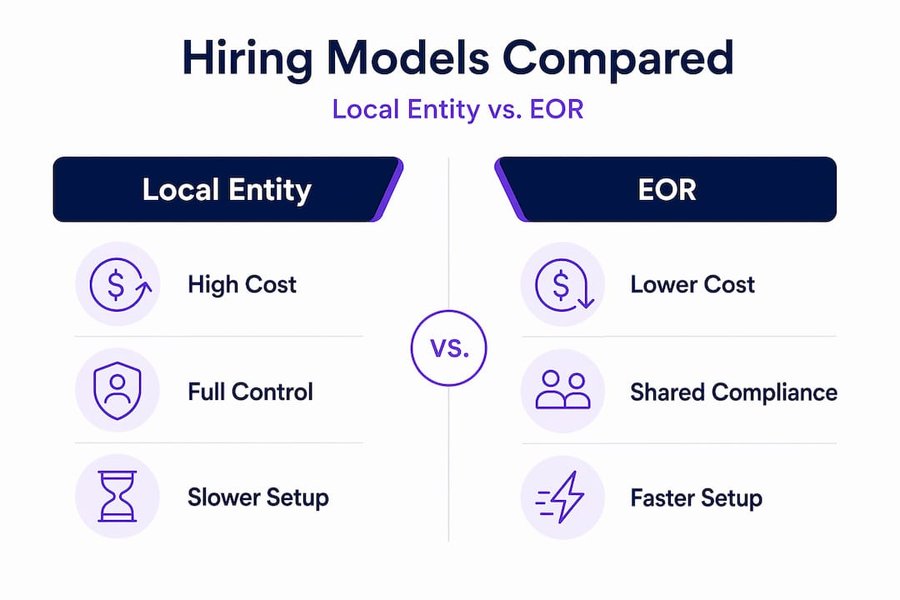
Using an EOR is the most practical entry point for most companies entering a new market. EOR services enable onboarding in as little as 24 hours without requiring a local entity, which means your engineering hire in Brazil or your sales rep in Mexico can be legally employed and generating output within days rather than months.
The local entity model makes sense when you have a high-volume, long-term hiring commitment in a specific country and need full operational control. The setup cost and timeline, which can range from three to six months depending on the jurisdiction, are only justified when the headcount and strategic intent support it. For global hiring models across Latin America specifically, the EOR path consistently outperforms entity setup for companies in their first 18 months of regional expansion.
Independent contractors carry the lowest entry cost but the highest legal risk. The moment a contractor works exclusively for you, follows your internal processes, and uses your equipment, many jurisdictions will reclassify them as employees regardless of what your contract says.
Pro Tip: Do not select your EOR based on pricing alone. Evaluate their in-country legal expertise, their payroll processing track record, and their ability to handle terminations compliantly. A cheap EOR that mismanages a termination in Germany or Colombia will cost you far more than the savings.
How to implement a multi-country hiring strategy
Getting the framework right requires discipline up front. Companies that try to hire in five countries simultaneously without proven processes almost always hit compliance failures, payroll errors, or broken candidate experiences. The better path is methodical.
- Start with a pilot in one or two countries. Pilot programs in 1 to 2 countries with 1 to 3 hires each build the operational muscle for global hiring without exposing the organization to unmanageable risk. Use the pilot to test your onboarding workflows, payroll integrations, and compliance processes before scaling.
- Select HR and payroll platforms with genuine multi-country support. Not every HR platform handles international payroll well. Evaluate tools based on their ability to process multi-currency payments and manage statutory filings across jurisdictions. Look for platforms that support localized payslips, tax reporting, and benefits administration in your target countries. Guidance on evaluating HR tech for global startups can help you narrow your options faster.
- Build compliant, localized onboarding processes. Each country requires its own employment contract template, benefits enrollment flow, and statutory documentation. A single global onboarding template is not adequate and often not legal.
- Manage remote employee experience intentionally. International employees who never meet their colleagues and receive no cultural integration support disengage quickly. 49% of organizations report that retaining international talent is very or extremely challenging, and poor remote experience is a leading driver of that attrition.
- Establish quarterly compliance audit cycles. Assign ownership for monitoring regulatory changes in each country where you employ staff. Set a review cadence tied to key legislative events such as annual budget cycles and fiscal year transitions.
- Partner with specialized recruiters and EOR services. Speed and quality in best practices for international hiring come from working with firms that already have candidate pipelines, in-country legal knowledge, and proven assessment processes in your target markets.
Pro Tip: Document every decision you make during your pilot hiring round, including which EOR you chose and why, how you structured the employment contract, and what compliance checks you ran. That documentation becomes the foundation of your global hiring playbook.
Real challenges in multi-country hiring and how teams address them
Even well-prepared HR teams hit friction in cross-border employment. The challenges are predictable, but they catch organizations off guard when they scale faster than their operational infrastructure.
- Immigration and visa complexity: Remote hiring in different countries does not always mean employees work from their home country. When employees relocate or work nomadically, visa status and work authorization become active compliance issues that require ongoing monitoring rather than one-time verification.
- Currency and payroll complexity: Running payroll across multiple currencies means managing exchange rate fluctuations, local pay cycle requirements (weekly in some countries, monthly in others), and varying social security contribution structures. Errors here create both legal exposure and significant employee dissatisfaction.
- Cultural and engagement gaps: Distributed international teams require deliberate investment in communication infrastructure, cross-cultural management training for team leads, and recognition practices that translate across time zones and cultural contexts. Without this investment, attrition rises and performance suffers.
- Evolving labor law: A country that had flexible contractor norms two years ago may have introduced strict employment classification rules since then. Spain, the UK, and several Latin American countries have all updated their gig economy and contractor regulations recently. Staying current requires either in-house expertise or reliable local partners.
- Multinational recruitment strategies that ignore local nuance: Standardized job descriptions, compensation benchmarks from domestic markets, and interview processes designed for one culture often fail to attract or assess candidates accurately in foreign markets. Localization of the hiring process itself is a requirement, not a preference.
My honest take on getting global hiring right
I have watched companies approach multi-country hiring as a compliance exercise and others approach it as a talent strategy. The ones that treat it primarily as a legal checklist tend to hire slowly, struggle with retention, and often cycle through EOR providers looking for a solution to a problem that was never really about the EOR.
What I have come to believe is that the real competitive advantage in international hiring is treating compliance as the floor, not the ceiling. Yes, you need airtight contracts and locally compliant payroll. But the organizations that genuinely win in global talent markets invest equally in employee experience, in cultural integration, and in choosing recruitment partners who understand the specific talent pools they are targeting. Global hiring now drives talent access far more than cost savings, and that shift matters for how you prioritize.
The other thing I would tell HR leaders directly: partner selection is not a procurement decision. The firm or platform you choose to support your cross-border employment will either accelerate your ability to scale or create friction at every stage. Evaluate them the way you would evaluate a leadership hire. Ask hard questions about their in-country legal track record, their candidate quality, and how they handle the situations that go wrong, because some will.
— Eugene
How Gentyrecruitment supports your global hiring strategy
Building a multi-country team is a real operational challenge, and the quality of your hiring partners determines how fast and reliably you can do it. Gentyrecruitment specializes in connecting US and European tech companies with pre-vetted, English-speaking talent across Latin America, covering Argentina, Brazil, Mexico, Colombia, and beyond.
Whether you need to scale an engineering team quickly, find a senior sales leader in a new market, or establish a remote staffing and EOR structure that keeps you compliant across the region, Gentyrecruitment brings the candidate pipelines, legal knowledge, and structured assessment process to do it efficiently. The team also provides salary benchmarking across LATAM markets, executive search services, and IT recruitment that consistently cuts time-to-hire without cutting candidate quality. If you are building a global team and want a partner with genuine regional expertise, reach out to Gentyrecruitment to discuss your hiring goals.
FAQ
What is multi-country hiring?
Multi-country hiring is the process of recruiting and employing workers across two or more national jurisdictions within a single organizational framework, requiring compliance with each country’s labor laws, payroll systems, and statutory benefits.
What is an Employer of Record in multi-country hiring?
An Employer of Record (EOR) is a third-party entity that legally employs workers on your behalf in a foreign country, managing local payroll, taxes, and compliance while you retain operational control of the employee’s day-to-day work.
What are the biggest risks in international hiring?
The primary risks are worker misclassification, non-compliant termination procedures, and failure to meet local statutory benefit requirements. 46% of companies cite compliance failures as the top reason international onboarding breaks down.
When should a company set up a local entity vs. use an EOR?
A local entity makes sense for high-volume, long-term hiring commitments in a specific country. An EOR is the faster and lower-risk option for companies entering a new market with fewer than ten hires or testing international expansion for the first time.
How do you manage payroll across multiple countries?
Managing international payroll requires platforms that support multi-currency payments, localized tax filings, and country-specific pay cycles. Each country has distinct social security, pension, and income tax rules that must be handled separately to avoid compliance exposure.