

Most hiring managers have experienced the same frustration: a candidate looks perfect on paper, clears every generalist screen, then fails within 90 days because they simply did not understand the industry. That gap is exactly what sector-specific recruitment is designed to close. This approach aligns every stage of hiring, from sourcing to offer, with the precise technical, regulatory, and cultural demands of a single industry. The result is faster hiring, stronger retention, and far fewer costly mismatches. For HR professionals managing high-volume or specialized roles, understanding this model is no longer optional.
Key takeaways
What sector-specific recruitment actually means
Sector-specific recruitment is the practice of designing and executing your entire hiring process around the distinct demands of one industry vertical. It is not simply posting a job on a niche board. It means your sourcing channels, screening criteria, compensation benchmarks, compliance checks, and onboarding materials all reflect the realities of that specific sector, whether that is FinTech, construction, manufacturing, SaaS, or healthcare.
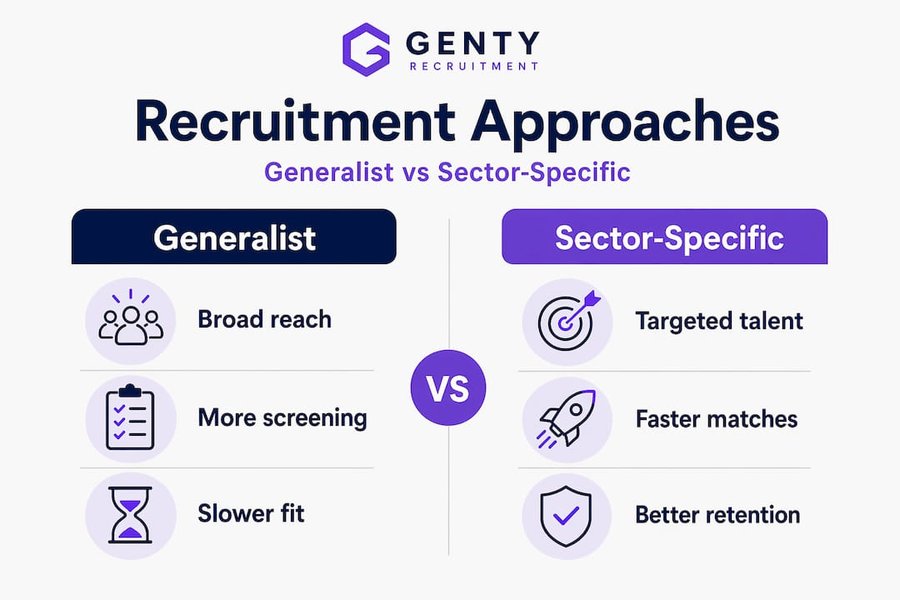
The clearest way to understand what sector-specific means in practice is to compare it with generalist recruitment. A generalist recruiter fills roles across multiple industries by applying the same intake process, the same screening questions, and the same offer framework to every search. That approach works reasonably well for administrative or entry-level positions where transferable skills dominate. It breaks down fast when you are hiring a senior DevOps engineer, a licensed structural engineer, or a compliance officer for a regulated financial institution.
Sector-specific screening requires technical fluency with tools, terminology, and regulatory concepts unique to the sector. A recruiter who cannot distinguish between Kubernetes orchestration and basic containerization will pass unqualified engineers, just as a recruiter unfamiliar with OSHA standards will miss red flags in a construction hire. The mismatch is not malicious. It is structural.
Before you start hiring
Check location, salary, and hiring fit
If you are moving from research to action, start with the market basics so your hiring plan is clearer.
The key components of sector-specific recruitment include:
- Targeted sourcing: Using channels where your specific talent pool actively searches, such as niche job boards, professional associations, trade schools, or sector-specific LinkedIn communities.
- Technical screening: Applying criteria and interview scripts developed with subject-matter experts from within the industry.
- Regulatory compliance: Building background checks and credentialing steps that reflect sector licensing requirements.
- Compensation benchmarking: Structuring offers around what that market actually pays, not generic salary surveys.
- Talent and market mapping: Continuously analyzing where talent is concentrated, what competitors pay, and which candidates are passively open to moves.
Pro Tip: Market mapping works best when treated as ongoing intelligence rather than a one-time research project. Agencies that specialize in two or three thoroughly mapped markets consistently outperform those spreading effort across many sectors.
The real benefits of sector-specific hiring
The business case for focusing on one sector is quantifiable. Specialized recruitment agencies achieve profit margins of 25 to 40 percent compared to under 20 percent for generalist firms, and that same efficiency logic applies internally when HR teams build sector-specific hiring practices.
The table below summarizes the key advantages by dimension:
Consider the passive candidate point specifically. Talent mapping enables proactive engagement of passive candidates, who represent roughly 80 percent of successful hires. Without sector knowledge, you cannot identify these individuals or make a credible approach. With it, your team can track career trajectories, monitor company restructures in your sector, and reach out to qualified candidates before they ever consider a job search.
Job offer packages must reflect sector values to reduce offer declines. A construction candidate evaluates project stability and site safety. A SaaS engineer weighs equity structure and remote flexibility. A manufacturing supervisor looks at shift premiums and union considerations. Offering the wrong package, even with a competitive base salary, is one of the most common and most preventable causes of offer rejection in specialized roles.
How sector-specific hiring differs across industries
Understanding the theory matters less than seeing how the approach adapts in practice. Recruitment methods that work in one sector fail in another because the talent pool, the candidate mindset, and the hiring timeline are fundamentally different.

Construction and manufacturing
In construction, visibility into active projects drives candidate interest. Strong performers want to know they will be working on meaningful work with consistent volume. Sourcing through trade schools, apprenticeship programs, and union job boards produces better results than general-purpose platforms. For manufacturing, skill-first hiring protocols that test for machine operation, safety certification, or quality control proficiency replace the resume-review approach almost entirely. Shift premium structures and benefits tied to tenure are non-negotiable elements of any competitive offer.
Technology and SaaS
Tech hiring moves faster than any other sector. IT recruitment trends show that speed of process is itself a signal to candidates about how a company operates. Engineers reject slow hiring pipelines. Your sourcing must operate through GitHub, developer communities, sector-specific job boards, and structured referral programs simultaneously. Technical screening must go beyond LeetCode exercises and assess real-world fluency with the tools your team uses daily.
Leisure, hospitality, and retail
Culture and seasonality dominate these sectors. Hiring for a hotel group means understanding that peak-season spikes require a standing pipeline rather than reactive postings. Candidates in these sectors respond strongly to employer brand signals around team culture, flexibility, and progression. Generic job postings that describe responsibilities without reflecting the environment will consistently underperform.
Pro Tip: Before selecting your sourcing channels for any sector, audit where your last ten successful hires actually came from. In most specialized sectors, two or three channels account for over 70 percent of quality placements, and those channels vary significantly by industry.
The channel strategy differences across sectors look like this:
- Construction and trades: Trade school partnerships, union boards, word-of-mouth referral programs.
- Technology: Developer communities, GitHub, specialized tech job boards, structured referrals, direct LinkedIn outreach.
- Healthcare and regulated industries: Professional licensing bodies, association boards, compliance-aware job platforms.
- Leisure and hospitality: Social media, local community outreach, employer brand content, internal promotion pipelines.
Building a sector-specific recruitment playbook
The organizations that consistently win on hiring do not reinvent the process for every role. They build a repeatable system and refine it continuously. A sector hiring playbook standardizes interview scripts, onboarding, wage bands, and recruitment channels to protect margins and maintain compliance across all hires within that vertical.
Here is how to build one that actually holds up:
- Define your target role profiles. For each role category within your sector, document the non-negotiable technical skills, certifications, experience levels, and behavioral indicators. Involve current high performers and their managers in building these profiles rather than relying on generic job description templates.
- Map your wage bands. Compensation must be benchmarked against your specific sector and geography, not industry-wide averages. Salary expectations in FinTech differ sharply from those in traditional banking even for equivalent titles. Update these benchmarks at minimum annually or whenever your offer acceptance rate drops below target.
- Select and document your channels. Based on your own hire-source data and sector research, identify the two or three channels that consistently produce quality candidates. Allocate the majority of your sourcing budget there, and establish metrics to evaluate performance quarterly.
- Standardize your screening process. Write technical screening questions with verified correct answers developed by subject-matter experts. Create structured interview scorecards that assess both technical competency and sector-specific behavioral traits.
- Track, measure, and adjust. Log offer acceptance rates, time-to-hire, 90-day retention, and source-of-hire data by sector and role type. These metrics will reveal where your playbook is working and where it needs adjustment before a pattern of bad hires develops.
AI-powered market mapping tools can identify hiring signals 48 to 72 hours before competitors, which means your team can move from reactive sourcing to strategic pipeline building. Integrating these tools into your playbook gives you a structural advantage, particularly in high-competition sectors like AI, FinTech, and SaaS where the best candidates receive multiple approaches simultaneously. The HR tech tools available for market mapping and candidate intelligence have matured significantly and are accessible even for mid-sized recruiting teams.
Using sector-specific job boards effectively
Not all job boards are created equal, and in sector-specific recruitment the right platform does more than distribute your posting. Niche job boards attract pre-qualified candidates, reducing screening burden and cutting time-to-hire by filtering out candidates who lack basic sector familiarity before your team reviews a single application.
The practical value here is significant. When you post a senior cloud architect role on a general-purpose job board, you will review hundreds of applications from candidates who searched “cloud” and clicked apply. When you post on a platform specifically serving infrastructure engineers, the baseline technical literacy of applicants rises immediately. Your screening team spends time evaluating fit and depth, not verifying that candidates understand what AWS is.
To use sector-specific boards effectively, follow these practices:
- Match your job description language to sector conventions. Use the terminology, tools, and certifications that practitioners in your sector actually use. Generic descriptions attract generic applicants even on specialized platforms.
- Optimize your employer brand presence. Sector communities are tight. Candidates on niche boards will research your company reputation before applying. Invest in showcasing your technical environment, team culture, and career progression paths.
- Integrate boards into your tracking system. Source-of-hire data by board will tell you which platforms produce candidates who get to offer stage versus those who produce volume without quality.
- Use sector-specific assessment tools to screen applicants from these boards consistently. Even pre-qualified candidates need structured evaluation to distinguish between competent and genuinely exceptional.
- Re-engage your talent pool. Many niche boards allow saved candidate searches and direct outreach. Use that capability to maintain a warm pipeline rather than starting from zero on every requisition.
My take on why generic recruitment is failing in 2026
I have watched hiring teams invest significant budgets in generalist processes and wonder why their quality-of-hire metrics refuse to improve. After working in and around specialized recruitment for years, my honest assessment is this: generic recruitment is not just inefficient, it is becoming structurally incompatible with how modern labor markets work.
The sectors that grew fastest over the past several years, FinTech, AI infrastructure, SaaS platforms, and regulated healthcare technology, all require candidates who bring both technical depth and sector literacy. A strong backend developer who has never worked in a regulated FinTech environment will spend months learning compliance requirements that a sector-experienced hire walks in knowing on day one. That learning curve has a real cost.
What I have found genuinely moves the needle is committing to market mapping as a continuous function rather than a pre-requisition activity. Teams that know their talent pool before a role opens win on speed. Teams that have to research the market after a vacancy appears are always playing catch-up.
The mistake I see most often is confusing sector specialization with rigidity. A well-built playbook should adapt to changing market conditions. Wage bands need quarterly reviews. Channel performance shifts. Candidate expectations in tech, for instance, changed substantially between 2022 and 2026 as remote-first norms became baseline expectations rather than perks. Your playbook should reflect those changes, not lock you into a 2019 hiring model.
My advice: pick the one or two sectors where your organization hires most often, build a proper playbook for each, and treat that playbook as a living system. The teams that do this consistently outperform those still relying on generalist processes, and the gap is widening.
— Eugene
How Gentyrecruitment supports your sector-specific hiring
If your organization needs to scale hiring in tech-adjacent sectors and wants a recruitment partner that already has the market intelligence, candidate pipelines, and sector expertise built in, Gentyrecruitment is worth a direct conversation.
Gentyrecruitment specializes in pre-vetted talent from Latin America across FinTech, AI, SaaS, and broader tech and non-tech industries, delivering English-speaking candidates who are technically qualified and ready to integrate into US and European teams. The process combines structured assessment, sector-specific screening, and hands-on recruiting to reduce time-to-hire without sacrificing quality. For companies needing faster tech hiring or looking to build out sales functions with vetted account executives, Gentyrecruitment offers dedicated category services with salary benchmarking built in. Organizations that need flexible arrangements can also explore remote staffing solutions that scale with headcount demands across LATAM. Reach out to discuss your sector requirements and get a clearer picture of what a specialized hiring partner can deliver.
FAQ
What does sector-specific recruitment mean?
Sector-specific recruitment is the practice of tailoring every stage of the hiring process, from sourcing and screening to compensation and onboarding, to the specific technical, cultural, and regulatory demands of one industry. It contrasts with generalist recruitment by requiring deep sector knowledge rather than transferable process skills.
What are the main benefits of sector-specific hiring?
The primary benefits include higher candidate quality, shorter time-to-hire, lower offer decline rates, and reduced compliance risk. Specialized recruitment agencies consistently achieve 25 to 40 percent profit margins compared to under 20 percent for generalist firms, reflecting the efficiency gains of sector focus.
How do sector-specific job boards improve hiring outcomes?
Niche job boards attract pre-qualified candidates who already possess baseline sector knowledge, which reduces screening volume and allows recruiters to focus evaluation time on cultural alignment and depth of expertise rather than basic eligibility.
What should a sector-specific recruitment playbook include?
A complete playbook covers defined role profiles, benchmarked wage bands, documented sourcing channels, standardized interview scripts, compliance requirements, and measurable KPIs tracking time-to-hire and offer acceptance by role type. Top organizations treat this as a living system updated continuously with market data.
How does talent mapping support sector-specific hiring?
Talent mapping gives recruiting teams visibility into where qualified candidates are concentrated, what they earn, and which ones may be open to a move. Since passive candidates represent roughly 80 percent of successful hires, this intelligence transforms hiring from reactive posting into proactive pipeline management.