

Staff augmentation is defined as a flexible hiring model where companies add external professionals to their internal teams temporarily while retaining full control over management, workflows, and delivery outcomes. Unlike outsourcing, where a vendor owns the project scope and results independently, staff augmentation keeps decision-making authority with your team. For US and European tech companies, this model has become a primary path to accessing specialized talent in Latin America, including Argentina, Brazil, Mexico, and Colombia, where timezone alignment with North American markets and competitive salary ranges make the model especially attractive. Top providers can place vetted senior engineers in 7–21 days, compared to the 60–90 day cycle typical of full-time hiring.
What is staff augmentation and how does it differ from outsourcing?
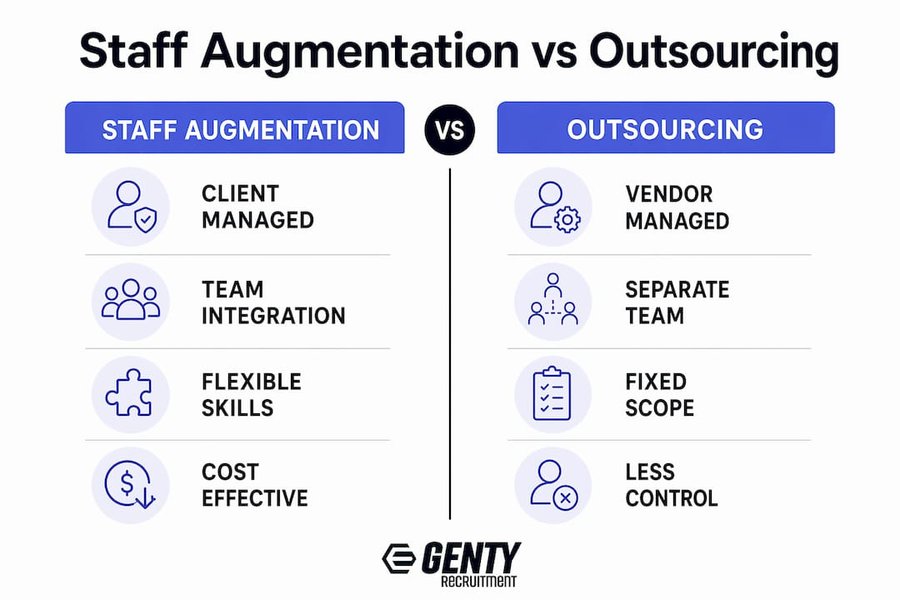
The critical distinction in any staffing model is delivery ownership. Staff augmentation is client-managed delivery: the vendor places vetted contractors under your direct supervision, and your team sets priorities, reviews output, and controls the roadmap. Outsourcing transfers that authority to the vendor, who manages scope, timelines, and results independently.
This difference matters more than most hiring managers realize. When you outsource a feature build, you receive a deliverable. When you augment your team, you gain a contributor who attends your standups, commits to your repo, and reports to your engineering lead. The work product belongs to your process from day one.

Consulting and managed services sit in a different category entirely. Consultants advise and recommend. Managed service providers operate systems on your behalf. Neither model integrates external professionals into your internal team the way talent augmentation does.
Planning a hire?
Talk through the best hiring option
This article usually leads to one practical question: should you use it recruitment or staffing? We can help you choose quickly.
Simple next step
Start with it recruitment and we will help you pick the best hiring setup.
The table below summarizes the key structural differences:
Pro Tip: Choose staff augmentation when you need a specific skill set for a defined period and want the engineer to work inside your existing agile process, not alongside it.
The model works best for niche skills, seasonal surges, and capacity ramp-ups where flexible team scaling without long-term commitments is the priority.
What are the benefits of staff augmentation for tech companies?
The financial case for staff augmentation is direct. Hiring costs run 30–40% lower than traditional full-time hiring in US and European markets. That gap widens further when you factor in LATAM salary ranges, which are competitive by global standards while reflecting local market rates in countries like Colombia, Mexico, and Brazil.
Speed is the second major advantage. Top staff augmentation providers deploy vetted senior engineers in 7–21 days. That is 3–4 times faster than the standard full-time hiring cycle. For a SaaS company mid-sprint or a FinTech team facing a compliance deadline, that difference is material.
Key operational benefits include:
- Faster time to productivity: Augmented engineers join your existing workflows rather than waiting for onboarding programs designed for permanent staff.
- Cost efficiency: No benefits packages, no severance obligations, and no recruitment overhead beyond the agency fee.
- Flexible contract terms: Scale headcount up or down based on project phases without restructuring your permanent team.
- Retention stability: Top agencies report retention rates of 85–91% for long-term project engagements, which means less disruption than many hiring managers expect.
- Timezone alignment: LATAM professionals in Argentina, Colombia, and Mexico overlap with US EST and PST business hours, enabling real-time collaboration without the async delays common in offshore models.
The LATAM angle deserves specific attention. LATAM hiring offers timezone alignment with North American markets, competitive salary advantages, and access to a deep pool of tech talent. A senior software engineer in Buenos Aires or Bogotá typically costs significantly less than an equivalent hire in San Francisco or New York, while delivering the same technical depth and strong English proficiency.
Pro Tip: When comparing LATAM candidates to US-based contractors, factor in the full cost: agency fee, hourly rate, and zero employer tax burden. The total is often 35–50% below a comparable W-2 hire.
How to implement staff augmentation with LATAM talent
Successful implementation starts with a precise skills definition. Vague job descriptions produce mismatched candidates. Before engaging any agency, document the specific technologies, seniority level, and expected weekly hours. A DevOps engineer who knows Kubernetes and Terraform is a different hire than one who specializes in AWS infrastructure automation.
The vetting process is where agencies earn their value. A credible provider conducts technical assessments, reference checks, and English proficiency evaluations before presenting candidates. GENTY recruitment, for example, delivers curated shortlists within 7 days using a skill-first process that filters for both technical fit and communication quality. That shortlist model saves your engineering leads from screening 40 resumes to find two viable candidates.
Integration into your existing team requires deliberate structure. Follow these steps:
- Assign a dedicated internal point of contact. The augmented engineer needs one person who owns their onboarding, answers questions, and connects them to the right internal resources.
- Add them to your project management tools immediately. Access to Jira, GitHub, Slack, and Confluence on day one signals that they are a real team member, not a contractor kept at arm’s length.
- Schedule a structured first-week knowledge transfer. Walk them through the codebase, architecture decisions, and team conventions before assigning production tickets.
- Set 30-day and 90-day milestones. Clear expectations prevent the ambiguity that leads to underperformance and early contract termination.
- Establish a knowledge documentation habit. Require augmented engineers to document their work in your internal wiki. This protects you when contracts end.
Compliance and payroll in LATAM markets require attention. Labor laws in Brazil, Argentina, and Mexico differ significantly from US employment law. Working with an agency that handles local compliance, contractor classification, and payment in local currency removes that liability from your team. Building a talent pool of pre-vetted LATAM professionals through a specialized agency also reduces future time-to-hire for repeat engagements.
Effective staff augmentation requires structured onboarding, regular knowledge transfer, and alignment with internal agile workflows. Teams that skip this step report friction within the first 30 days and reduced output through the first quarter.
Pro Tip: Ask your agency whether their candidates have prior experience working with US or European teams. Engineers who have already navigated cross-cultural collaboration ramp up 40–60% faster than those doing it for the first time.
What challenges should tech leaders anticipate?
Communication is the most common friction point in augmented team setups. Remote engineers in a different country face the same coordination challenges as any distributed team, compounded by the fact that they are not permanent employees with deep organizational context. Proactive quality control, frequent check-ins, and transparent contracts help maintain productivity across distributed setups.
The practical mitigation strategies are:
- Daily async standups: A written update at the start of each workday keeps the augmented engineer visible and accountable without requiring synchronous meetings.
- Weekly video check-ins: A 30-minute call with the internal lead catches misalignments before they become missed deadlines.
- Clear definition of done: Every ticket should specify acceptance criteria. Ambiguous requirements produce rework, which erodes the cost savings that made augmentation attractive in the first place.
- Retention planning: Augmented engineers who perform well often receive competing offers. Build a renewal conversation into the contract at the 90-day mark, not at expiration.
Cultural integration is underestimated. LATAM professionals bring strong technical skills and high English proficiency, but team culture is built through deliberate inclusion. Invite augmented engineers to team retrospectives, celebrate their wins in team channels, and treat them as contributors rather than vendors. Teams that do this report higher retention and better output quality through the full engagement period.
Long-term workforce planning is the final consideration. Staff augmentation is not a permanent substitute for building internal capability. The best tech leaders use it to cover specific gaps while their permanent hiring pipeline catches up, or to test a new technical direction before committing to a full-time role. AI tools for agencies and augmented teams are also showing measurable productivity gains, which means the model continues to improve as tooling matures.
Key Takeaways
Staff augmentation is the fastest, most cost-effective way for tech companies to add specialized talent without sacrificing management control or committing to permanent headcount.
Why I think most companies underuse LATAM staff augmentation
After working with dozens of US and European tech teams on LATAM hiring, the pattern I see most often is this: companies try staff augmentation once, run a poor process, and conclude the model does not work. The real problem is almost never the talent. It is the absence of structure on the client side.
LATAM engineers from Argentina, Colombia, and Brazil are technically strong, English-proficient, and accustomed to working with distributed teams. What they cannot compensate for is a client who has not defined the role clearly, assigned a real point of contact, or built any knowledge transfer process. That failure gets attributed to the model rather than the execution.
The timezone advantage is also more significant than most hiring managers price in. A senior engineer in Bogotá or Buenos Aires who overlaps with your EST team for six to eight hours per day is functionally equivalent to a domestic remote hire. The async friction that plagues offshore models simply does not exist at that overlap level.
My honest recommendation: treat your first augmented hire the same way you would treat a new permanent employee for the first 30 days. The investment in onboarding pays back in productivity within the first quarter, and the cost savings compound from there. The 2025 IT recruitment trends confirm that the companies scaling fastest are the ones treating augmented talent as a core workforce strategy, not a stopgap.
— Eugene
How GENTY recruitment places LATAM tech talent in days, not months
GENTY recruitment specializes in placing pre-vetted software engineers, DevOps professionals, data specialists, and sales teams from Argentina, Brazil, Mexico, Colombia, and Chile into US and European tech companies. The process is built for speed: curated shortlists arrive within 7 days, pricing is fixed per seniority level with no upfront payments, and every placement includes a 3-month replacement guarantee.
Clients working with GENTY recruitment typically save up to 40% compared to equivalent US or European hires, while gaining engineers who overlap with North American business hours and communicate in strong English. Compliance, contractor classification, and local payroll are handled by the agency, so your team focuses on building product rather than managing legal exposure. If you are ready to add specialized LATAM tech talent to your engineering team, GENTY recruitment delivers the shortlist in a week.
FAQ
What is staff augmentation in simple terms?
Staff augmentation is a hiring model where you add external professionals to your team temporarily while keeping full control over their work and direction. The augmented engineer works inside your processes, not independently.
How does staff augmentation differ from outsourcing?
In staff augmentation, your team manages the work and owns the outcome. In outsourcing, the vendor manages delivery and is accountable for the result. The day-to-day control stays with you in augmentation and transfers to the vendor in outsourcing.
What is talent augmentation and is it the same thing?
Talent augmentation is another term for staff augmentation. Both describe the practice of supplementing an internal team with external specialists under client-managed direction.
How fast can staff augmentation companies in the USA place engineers?
Top staff augmentation providers deploy vetted senior engineers in 7–21 days, which is 3–4 times faster than the standard full-time hiring cycle of 60–90 days.
Is staff augmentation effective for long-term projects?
Staff augmentation is effective for long-term projects when structured correctly. Top agencies report retention rates of 85–91% for extended engagements, and proactive contract renewal planning at the 90-day mark reduces turnover risk significantly.