
Interview process best practices are defined as the structured, legally compliant, and candidate-centered methods that produce consistent, defensible hiring decisions. For tech startups hiring remote talent from Latin America, getting this right is not optional. Structured interviews produce a validity coefficient of 0.51 compared to 0.38 for unstructured interviews, a gap that translates directly into fewer bad hires. GENTY recruitment works with US and European tech teams daily on exactly this challenge, placing pre-vetted engineers, DevOps specialists, and sales talent from Argentina, Brazil, Mexico, and Colombia within days.
What are interview process best practices for structured, compliant hiring?
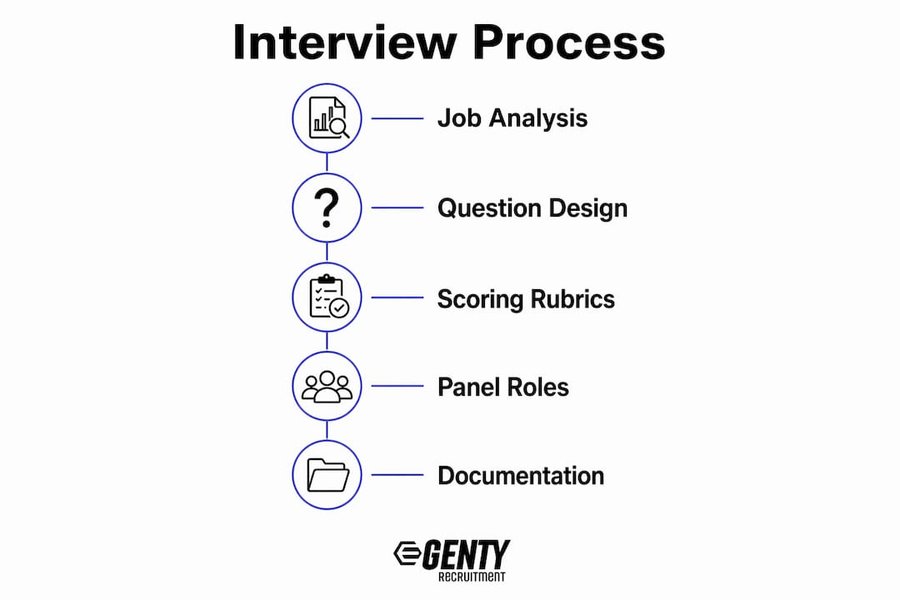
A structured interview process starts with a detailed job analysis that ties every question directly to a specific job function. Without that foundation, your questions drift toward gut-feel territory, and your hiring decisions become legally indefensible. The Equal Employment Opportunity Commission (EEOC) and the Americans with Disabilities Act (ADA) set clear boundaries on what hiring teams can ask, and a job-anchored question set keeps you inside those boundaries automatically.
The most reliable question formats are behavioral and situational, both built around the STAR method (Situation, Task, Action, Result). STAR-format questions gather specific, behaviorally grounded evidence rather than hypothetical guesses. A candidate who says “I led the migration of our monolith to microservices over six months” gives you verifiable data. A candidate who says “I would probably start by assessing the architecture” gives you nothing useful.

Scoring rubrics are the second pillar. The Behaviorally Anchored Rating Scale (BARS) defines what a weak, solid, or strong answer looks like for each question before the interview begins. Sharing rubric definitions with the panel before interviews start is one of the most overlooked steps in structured hiring. When every interviewer knows what a “4 out of 5” answer looks like, scoring becomes consistent across candidates and interviewers.
Planning a hire?
Talk through the best hiring option
This article usually leads to one practical question: should you use staffing or rpo? We can help you choose quickly.
Simple next step
Start with staffing and we will help you pick the best hiring setup.
Panel role assignment prevents overlap and reduces redundancy. Assign one interviewer to technical depth, one to behavioral history, and one to team fit. Each person scores independently before any group debrief. Independent scoring before debrief prevents anchoring bias and groupthink, two of the most common ways structured processes break down in practice.
Documentation is not optional for US-based employers. Per 29 CFR § 1602.14, employers with 15 or more employees must retain all interviewer notes and debrief records for a minimum of one year. That means your scoring sheets, your written notes, and your debrief summaries all need to be stored and retrievable.
Pro Tip: Build a panel that includes at least one interviewer from a different demographic background than the hiring manager. Multi-demographic panels reduce in-group bias without adding rounds or cost.
Key elements of a compliant interview design
- Conduct a job analysis before writing any questions
- Use STAR-format behavioral and situational questions tied to job functions
- Define BARS rubric anchors (weak, solid, strong) before the first interview
- Assign distinct panel roles: technical, behavioral, and culture
- Require independent scoring before group debrief
- Retain all notes and scoring records for at least one year per EEOC rules
- Include DEI considerations in panel composition from the start
For practical examples of how tech teams structure these panels, the structured hiring examples from GENTY recruitment show how startups at different growth stages have applied these frameworks.
What are the best strategies for administering skills assessments?
Skills assessments are the most misused tool in tech hiring. The most common mistake is sending candidates a multi-day project with no compensation and no feedback. That approach filters out employed candidates who cannot afford to spend a weekend on a speculative task, and it signals disrespect before the hire even happens.
The correct approach is to limit assessments to under 90 minutes or compensate candidates financially for longer tasks. Work-sample tasks should mirror actual daily job requirements, not abstract puzzles. A backend engineer applying for a role at a FinTech startup should see a task that resembles real API work, not a whiteboard algorithm problem disconnected from the job. Platforms like ApplyGenius have raised awareness of candidate experience standards in tech hiring, and candidates increasingly compare notes on which companies treat their time with respect.
Transparency about the assessment is equally important. Tell candidates exactly what you are evaluating, how long it should take, and who will review it. Candidates who understand the criteria perform more authentically, and you get cleaner signal. After the assessment, provide feedback regardless of outcome. Even a brief summary of what scored well and what did not costs you ten minutes and builds your employer brand significantly.
- Define the specific competency the assessment measures before building it
- Cap the task at 90 minutes for unpaid assessments; compensate for anything longer
- Use realistic work-sample tasks that reflect actual daily responsibilities
- Share evaluation criteria with candidates before they begin
- Score assessment results on the same rubric used in interviews
- Provide written feedback to every candidate who completes the task
- Integrate assessment scores with interview scores before making any offer
Pro Tip: For remote LATAM candidates, schedule a 15-minute async video introduction before the assessment. It reduces dropout rates and gives candidates context that written instructions alone cannot provide.
Understanding why pre-assessed talent reduces time-to-hire is directly relevant here. GENTY recruitment delivers candidates who have already cleared technical screening, which means your assessment round focuses on fit rather than baseline competency.
How can interview teams minimize bias in remote LATAM hiring?
Unconscious bias is the most consistent threat to a structured interview process. It does not require bad intent. It operates through familiarity, shared backgrounds, and the natural human tendency to favor people who remind us of ourselves. For US tech teams interviewing candidates from Colombia, Mexico, or Brazil, affinity bias can work in reverse, causing interviewers to undervalue strong candidates simply because their communication style or accent differs from what the team is used to.
Neutral, prepared small talk questions reduce unconscious bias more effectively than casual affinity-driven conversation. Replace “Where did you grow up?” with “What’s one thing you’re working on outside of work that you’re excited about?” The first question opens the door to protected characteristic information. The second builds rapport without legal risk.
Viewing interviews as structured data-gathering instruments, not social conversations, prevents inconsistent hiring and reduces legal exposure. Every question should serve the evaluation, and every answer should be scored against a rubric before the debrief begins.
After each interview, audit your notes for biased language. Phrases like “not a culture fit,” “seemed reserved,” or “hard to read” often reflect cultural unfamiliarity rather than actual performance gaps. Remove any reference to protected characteristics before notes enter the official record. LATAM candidates, particularly those from Argentina and Brazil, often bring direct, technically precise communication styles that score well on structured rubrics but can be misread in unstructured conversations.
Pro Tip: Train every interviewer on implicit bias before they conduct their first remote interview. A 60-minute online course on implicit bias, such as those offered through Harvard’s Project Implicit, costs nothing and measurably improves scoring consistency.
LATAM timezone alignment is an underrated advantage here. Candidates in Colombia (EST) and Argentina (EST+1 in summer) overlap cleanly with US East Coast working hours. That overlap means your interview scheduling does not require anyone to join calls at 6:00 AM or 11:00 PM, which reduces fatigue-driven bias on both sides of the call.
What is the recommended interview sequence for hiring remote LATAM tech talent?
The total number of interview rounds should not exceed four for most roles. Exceeding four rounds causes candidate drop-off, particularly among employed senior engineers who have multiple offers in play. Every unnecessary round costs you candidates and signals organizational indecision.
The recommended sequence for a tech startup hiring a remote LATAM engineer follows a clear logic:
Panel interviews in Round 3 consolidate evaluation and reduce the need for additional rounds. Three interviewers in one 60-minute session gather more consistent data than three separate 30-minute calls spread over two weeks. Set clear expectations with candidates at the start of Round 1. Tell them exactly how many rounds exist, what each round evaluates, and when they can expect feedback after each stage.
Scheduling across US and LATAM timezones is straightforward when you plan for it. Mexico City (CST) overlaps with US Central and Mountain time. Bogotá and Lima sit on EST year-round. Buenos Aires runs one to two hours ahead of EST depending on the season. Build your scheduling templates around these overlaps and you eliminate the most common logistical friction in remote LATAM hiring.
- Send a candidate brief before Round 1 covering process, timeline, and evaluation criteria
- Use async video tools for initial screening to respect candidate time across timezones
- Include a five-minute break in any panel interview running longer than 45 minutes
- Send a written summary of next steps within 24 hours of each completed round
- Use a 2026 hiring checklist to verify each stage meets compliance and candidate experience standards
Key Takeaways
A structured, legally compliant interview process is the single most reliable way to improve hire quality, reduce bias, and protect your company from legal exposure when hiring remote tech talent from Latin America.
Why I think most startups are getting the interview process wrong
The most common mistake I see tech startups make is treating the interview process as a formality rather than a measurement instrument. They write job descriptions carefully, they source candidates thoughtfully, and then they run interviews on instinct. One interviewer asks about system design. Another spends 20 minutes on culture fit without a single rubric. A third forgets to take notes. The result is a hiring decision made on whoever made the best impression in the room, not whoever had the strongest evidence of competency.
The data on this is not subtle. The gap between structured and unstructured interview validity is real and measurable. Yet most startups I work with have never defined what a “strong” answer looks like before the interview begins. They calibrate after the fact, which means they are rationalizing a gut decision rather than evaluating evidence.
The LATAM angle makes this even more consequential. When you are hiring a senior DevOps engineer from Buenos Aires or a FinTech backend developer from São Paulo, you are often interviewing someone whose communication style, educational background, and professional culture differ from your US-based team. Without a structured rubric, those differences get misread as weaknesses. With a rubric, they become irrelevant to the scoring. The candidate either demonstrated the competency or they did not.
The teams that get this right share one habit: they debrief with evidence, not impressions. Every interviewer arrives at the debrief with a completed scorecard and specific behavioral examples. The conversation is about data, not vibes. That discipline is what separates companies that hire well at scale from those that stay stuck in a cycle of bad hires and re-opens.
GENTY recruitment builds this discipline into its sourcing process by delivering pre-vetted shortlists that have already cleared technical screening. That means your interview rounds focus on the questions that actually matter for your team.
— Eugene
How GENTY recruitment helps tech startups run better interviews
Tech startups that hire remote LATAM talent through GENTY recruitment arrive at the interview stage with a significant advantage. The candidates on every shortlist have already cleared technical screening, English proficiency checks, and availability verification. That means your four-round process starts at Round 2, not Round 1.
GENTY recruitment’s IT recruitment in LATAM service covers software engineers, DevOps, data specialists, and AI talent across Argentina, Brazil, Mexico, Colombia, Chile, and beyond. Shortlists arrive within 7 days. Pricing is fixed per seniority level with no upfront payment and a 3-month replacement guarantee. If you want to hire remote LATAM talent without rebuilding your interview process from scratch, GENTY recruitment provides the framework and the candidates to make it work.
FAQ
What is a structured interview process?
A structured interview process uses predetermined questions, standardized scoring rubrics, and documented evaluation criteria applied consistently to every candidate. It produces more reliable and legally defensible hiring decisions than unstructured interviews.
How many interview rounds should a tech startup use?
Most roles should not exceed four interview rounds. More than four rounds increases candidate drop-off, particularly among senior engineers who are actively fielding multiple offers.
What is the STAR method in interviews?
STAR stands for Situation, Task, Action, and Result. It is a behavioral questioning format that asks candidates to describe specific past experiences rather than hypothetical responses, producing higher predictive validity.
How long should a skills assessment be for remote candidates?
Skills assessments should be capped at 90 minutes for unpaid tasks. If the assessment requires more time, candidates should receive financial compensation to respect their time and avoid unpaid labor concerns.
What records must US employers keep after interviews?
Under 29 CFR § 1602.14, US employers with 15 or more employees must retain all interviewer notes, scoring records, and debrief documentation for a minimum of one year after the hiring decision.