
A Head of Product at a Series B SaaS company is nine weeks into a PM search. The team has run dozens of screens, completed multiple interview loops, and extended offers that candidates declined. The requisition still says “strong PM,” so nobody agrees on what the hire must deliver.
The fix isn't more outreach. Product manager recruitment works when you segment the role by seniority, product type, and location, then align the scorecard, compensation, interview loop, and sourcing channel to that segment. Define the seat precisely, test the judgment it requires, and price it against the right market. That approach turns a vague funnel into an operating plan.
Why Product Manager Hiring Is Harder Than It Looks
Most PM searches fail before the first candidate enters the funnel. “Strong product sense” can describe a growth PM who owns activation, a technical PM who coordinates platform work, or a senior operator who has taken a product from discovery to commercial scale. Those profiles aren't interchangeable, even when their titles are identical.
Product management itself has evolved from the brand-management model formalized at Procter & Gamble in 1931 into a cross-functional digital leadership role spanning engineering, marketing, sales, analytics, and customer outcomes, as outlined in the history of product management. That history explains why companies expect PMs to combine market understanding with execution and commercial judgment.
Need help hiring?
See the next step after this guide
If this topic is relevant to your team, these are the most useful pages to check next.
For a Series A–C company, start with four questions:
What business problem does this person own? Retention, onboarding, platform reliability, a new product line, or portfolio strategy require different profiles.
What decisions will they make without permission? A PM who prioritizes one squad needs a different bar from one who sets investment choices across several teams.
What product environment will they enter? AI, SaaS, and marketplace products create different customer, data, and operational constraints.
Where must the person work? Time-zone overlap, language, relocation, and compensation expectations reshape the available pool.</li>
Practical rule: If two interviewers describe the role differently after reading the job description, the search isn't ready to launch.
The same discipline applies to geography. A US company can recruit locally, internationally, or through a nearshore model, but each option changes the sourcing map and offer design. The broader technology talent gap is less useful than a concrete answer to which segment contains the evidence you need.
Mapping the Product Manager Role by Seniority
Titles create false confidence. A senior PM at a small startup may own the whole product, while a senior PM at a large company may own a narrow area. Use the level to describe decision scope, not prestige.
Product Manager Levels at Series A–C Companies
An Associate PM should run a defined workstream inside an established area. Don't ask this candidate to invent the company's product strategy. Test whether they can learn a customer problem, write a clear requirement, work with design and engineering, and close loops reliably.
A Mid-Level PM should own an area end to end. In a Series A company, that might mean onboarding or billing. In a Series C company, it could mean a mature workflow with several squads. The interview should focus on how the candidate made trade-offs, used evidence, and handled a launch that didn't go exactly as planned.
A Senior PM sets direction for a product line. They need to connect customer pain to adoption, retention, activation, or revenue without waiting for an executive to translate the business problem. A Staff or Principal PM is a force multiplier across teams, especially when no single squad can solve the problem alone.
Directors manage the portfolio and the people system around it. They should explain why one investment deserves resources over another, how they develop PMs, and how they create consistency without flattening team autonomy. VPs and CPOs own the product bet, the executive narrative, and the relationship between product strategy and company strategy.
For a practical senior-level search, define the expected decisions before writing the requisition. A Senior Product Manager hiring profile should describe the product surface, customer, metrics, team interfaces, and authority level, not just list years of experience.
Skills and Signals That Actually Matter in 2026
A useful scorecard separates baseline capabilities from differentiators. A 2026 job-posting analysis found Product Strategy in 65.8% of active PM listings and Roadmapping in 60.0%, with both appearing together in 45.9% of postings, according to the product manager skills analysis. Agile appeared in 23.8%, Prioritization in 21.2%, A/B Testing in 18.7%, and SQL in 9.7% of listings from the same analysis.
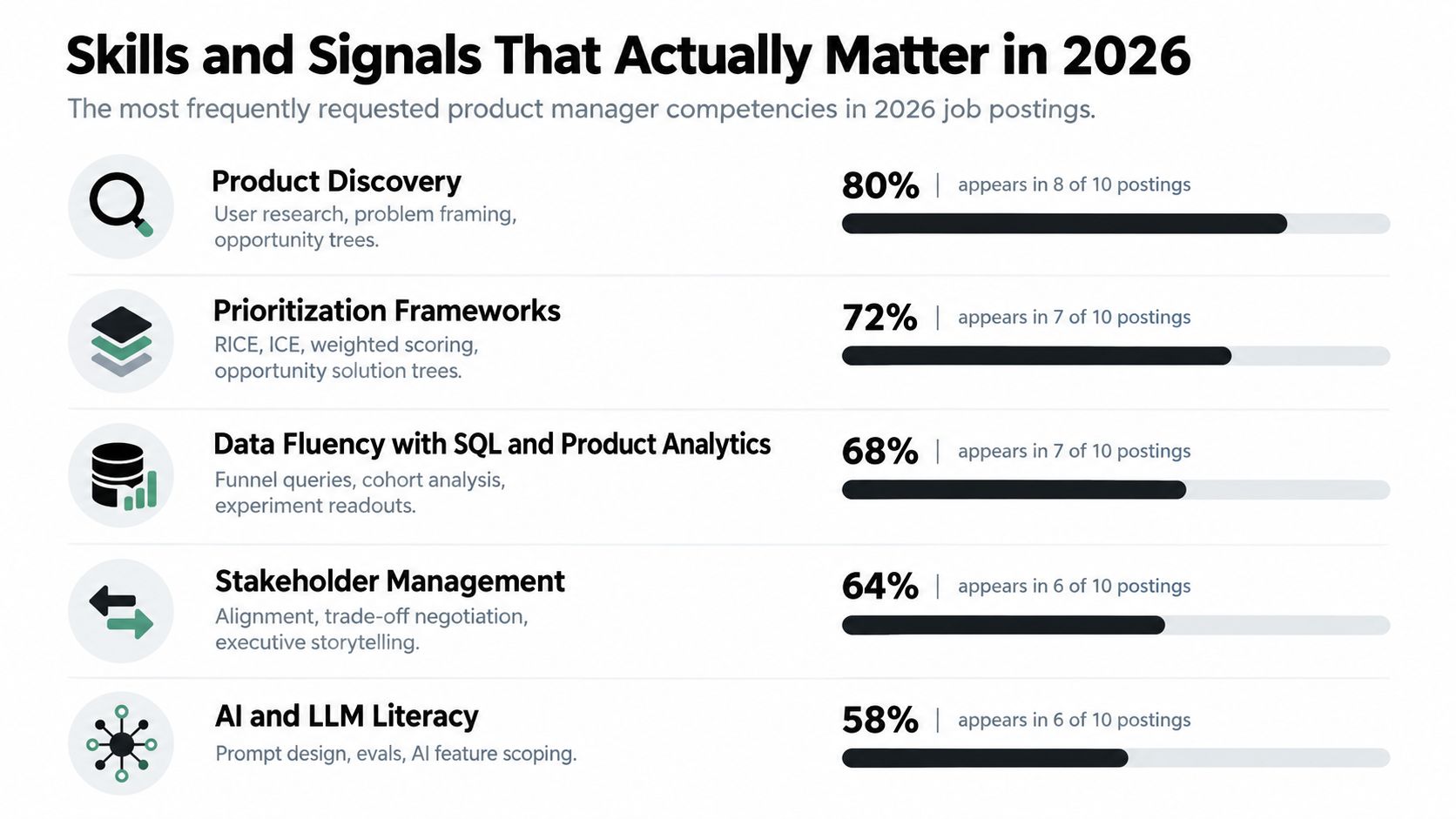
Those figures point to a practical distinction. Product strategy and roadmapping are common expectations, while SQL and experimentation are differentiators in a smaller but important group of roles. Don't turn every item into a mandatory requirement.
Convert each skill into observable evidence
Product discovery: Ask the candidate to move from an ambiguous customer complaint to a defined problem, target user, and research plan.
Prioritization: Give them competing opportunities and limited capacity. Evaluate the trade-offs, not whether they name RICE or another framework.
Data fluency: Include a metrics interpretation exercise for analytics-heavy roles. Candidates should explain what changed, what they need to know, and what action they would take.
Stakeholder management: Use a scenario where engineering, sales, and customer success want different outcomes. Listen for alignment mechanics and decision ownership.
AI and LLM literacy: Specify the actual use case, such as evaluation design, human review, retrieval quality, or workflow automation. “AI experience” alone means very little.</li>
Skills-first hiring also matters for adjacent candidates. A practical skills-first hiring approach can identify engineers, designers, analysts, or operators who have already made product decisions, even if their title hasn't included “Product Manager.”
Communication is part of the signal, especially for PMs presenting to distributed teams or US and European stakeholders. Candidates who need to present complex decisions in English may benefit from targeted product manager accent training, but training should supplement demonstrated judgment, not replace it.
Designing an Interview Loop That Filters for Product Judgment
The interview loop should mirror the work. A polished roadmap presentation can hide weak prioritization, and an impressive whiteboard idea can conceal poor execution discipline. Use structured exercises that force the candidate to make decisions with incomplete information.
A four-stage loop
Recruiter screen, 30 minutes. Confirm motivation, communication, location, compensation alignment, and the type of product environment the candidate has operated in.
Product sense exercise, 60 minutes. Give the candidate a vague product problem. Assess how they clarify the user, frame the opportunity, generate options, and choose a direction.
Execution interview, 60 minutes. Use a written prioritization document or a metrics-root-cause scenario. Ask the candidate to identify the decision, evidence, risks, and next action.
Stakeholder simulation, 45 minutes. Have an engineering, design, sales, or customer success partner challenge scope and trade-offs. Evaluate whether the candidate can disagree without losing the decision process.</li>
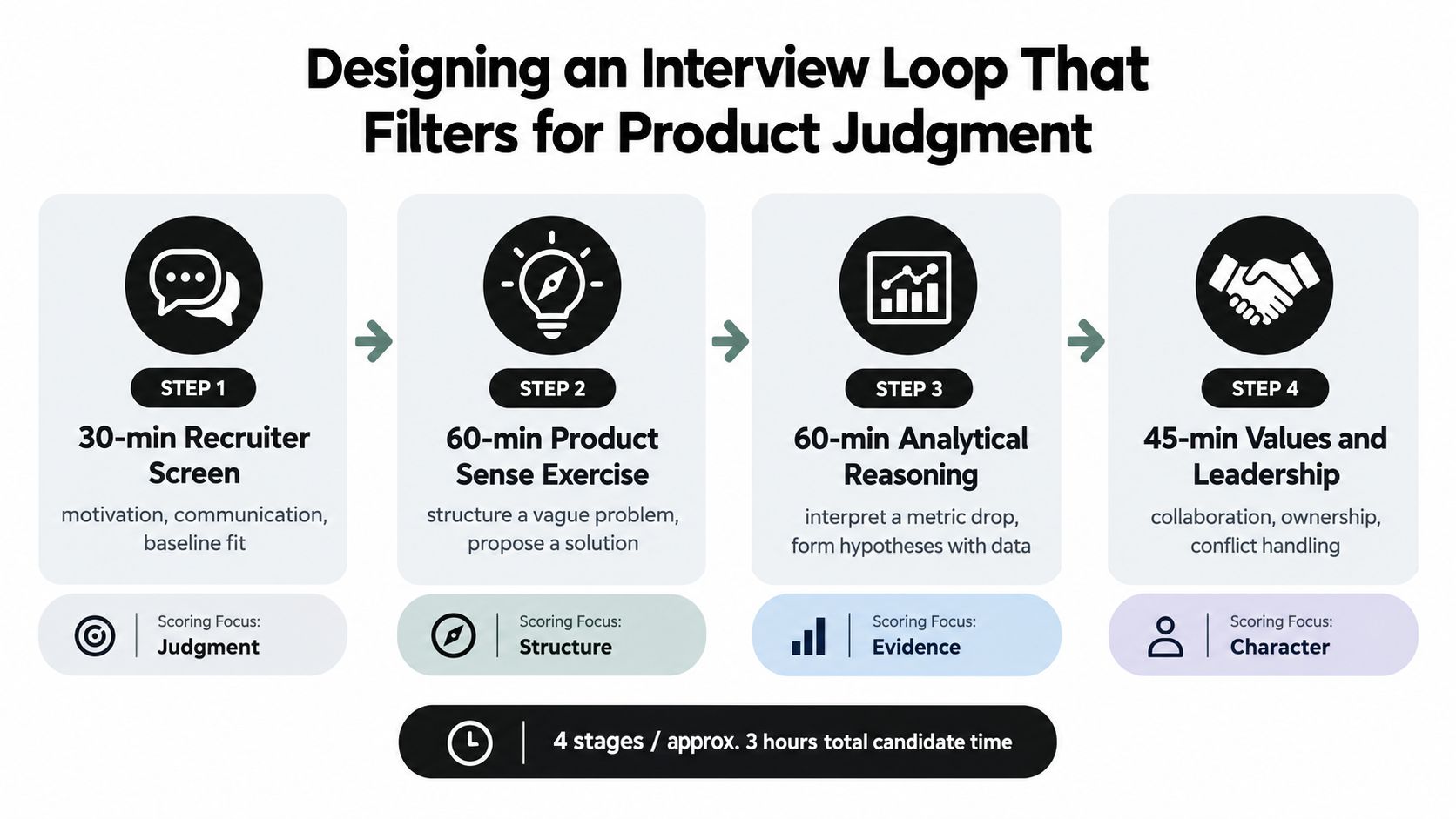
Weight the scorecard toward execution at 60%, product sense at 30%, and stakeholder judgment at 10% when the role's primary risk is delivery and operating consistency. Adjust the weighting when the seat is explicitly strategic, but make the change before interviews begin. Culture fit should be a calibrated bar for collaboration, ownership, and integrity, not a reason to hire someone who feels familiar.
The most common mistakes are predictable:
Testing ideas instead of judgment: A candidate can invent an attractive feature without understanding the user or business constraint.
Hiring for presentation polish: Clear communication matters, but slides aren't evidence of prioritization.
Skipping execution for senior candidates: Seniority increases the need for evidence. It doesn't remove it.
Changing the bar mid-search: If one candidate is judged on strategy and another on delivery, the debrief has no meaning.</li>
Use one scorecard with anchored evidence. After each loop, interviewers should record observations independently before discussing the candidate. If two candidates diverge sharply on the same signal, revisit the rubric instead of changing the standard.
Use this guide to interview questions for candidates to expand the question bank, then tailor every prompt to the product and level. For broader coordination between product, sales, and marketing hiring, a GTM hiring stack guide can help clarify how recruiting systems connect across functions.
Salary Benchmarks and How to Set Your Band
A senior PM in an AI company and a mid-level PM in a SaaS business should not enter the same salary band. Product type, seniority, location, company stage, and equity expectations change both the market reference and the offer required to close the hire.
One 2026 compensation guide reports US median total compensation of $185K for Product Managers, with a $155K to $230K 25th to 75th percentile range. It places senior PMs at a $250K median and Staff or Principal PMs at $315K, as shown in the PM compensation report. Those figures describe total compensation, not a standalone base salary. A separate source reports a US average Product Manager salary of $136,560, ranging from $82,807 to $225,206, based on 8.7k salaries collected over the prior 36 months. The different results reflect different methodologies, company mixes, and compensation definitions.
A defensible band-setting process
Pull three relevant data points for each level, and label each as base salary or total compensation.
Segment the comparison by product type, market, company stage, hiring location, and equity assumptions.
Publish the internal band before sourcing begins.
Define equity refreshes, promotion adjustments, and review timing before making offers.
Check whether the upper end can compete for the exact segment you need.</li>
Do not publish a benchmark table that disguises missing evidence as precision. The available figures support these reference points:
For location, use a separate benchmark rather than blending markets into one number. A September 2026 benchmark reports a US Product Manager average of $159,405, with most salaries between $141,000 and $197,000, and top earners at $197,000, according to ZipRecruiter's Product Manager salary data. Treat it as one market reference, not a universal offer rule.
For Series A to C companies, compare the band with the segment you actually need. If the top of band cannot compete for that level, raise the band, narrow the scope, or shorten the process. A marketplace PM, an AI product leader, and a SaaS growth PM may require different ranges even at the same seniority. Hiring location can change the range again.
Use salary benchmarking services to separate role level, geography, and total-reward assumptions before approving the requisition. Compensation clarity will not repair a weak role, but ambiguity will lose strong candidates before the final round.
Sourcing Channels by Level and Product Type
One funnel won't produce every PM profile. Associate and mid-level searches can support volume, while senior and executive searches require targeted outreach built around evidence of ownership.
Sourcing Channels by Seniority and Product Type
For SaaS, target PMs from PLG or self-serve companies when the role owns activation, onboarding, or monetization. For marketplaces, look for operators who understand supply, demand, liquidity, trust, and operational constraints. Marketplace experience may come from a product title, but it can also come from operations-heavy roles with direct ownership of those dynamics.
For AI, search beyond the exact PM title. Strong candidates may have worked in ML-heavy teams as technical product leaders, product analysts, growth operators, or platform owners. Test their understanding of model behavior, evaluation, data quality, and user trust rather than filtering on a narrow title history.
Senior, Staff, Director, and VP searches should prioritize passive candidates already succeeding in similar environments. Retained search makes sense when the pool is small, the role is confidential, or the company needs a market map before outreach. For Associate and Mid-Level roles, structured referrals and targeted inbound can produce broader coverage without treating every applicant as equivalent.
Nearshore LATAM can fit Mid-Level and Senior PM roles at US-headquartered companies that need timezone overlap and English fluency, with the possibility of a 30% to 50% base-compensation arbitrage compared with US hiring, as discussed in the 2026 product management hiring report. Keep Director and executive searches onshore when board exposure, local customer networks, or executive presence in the primary market are central to the job.
A Realistic 30 to 45 Day Hiring Timeline
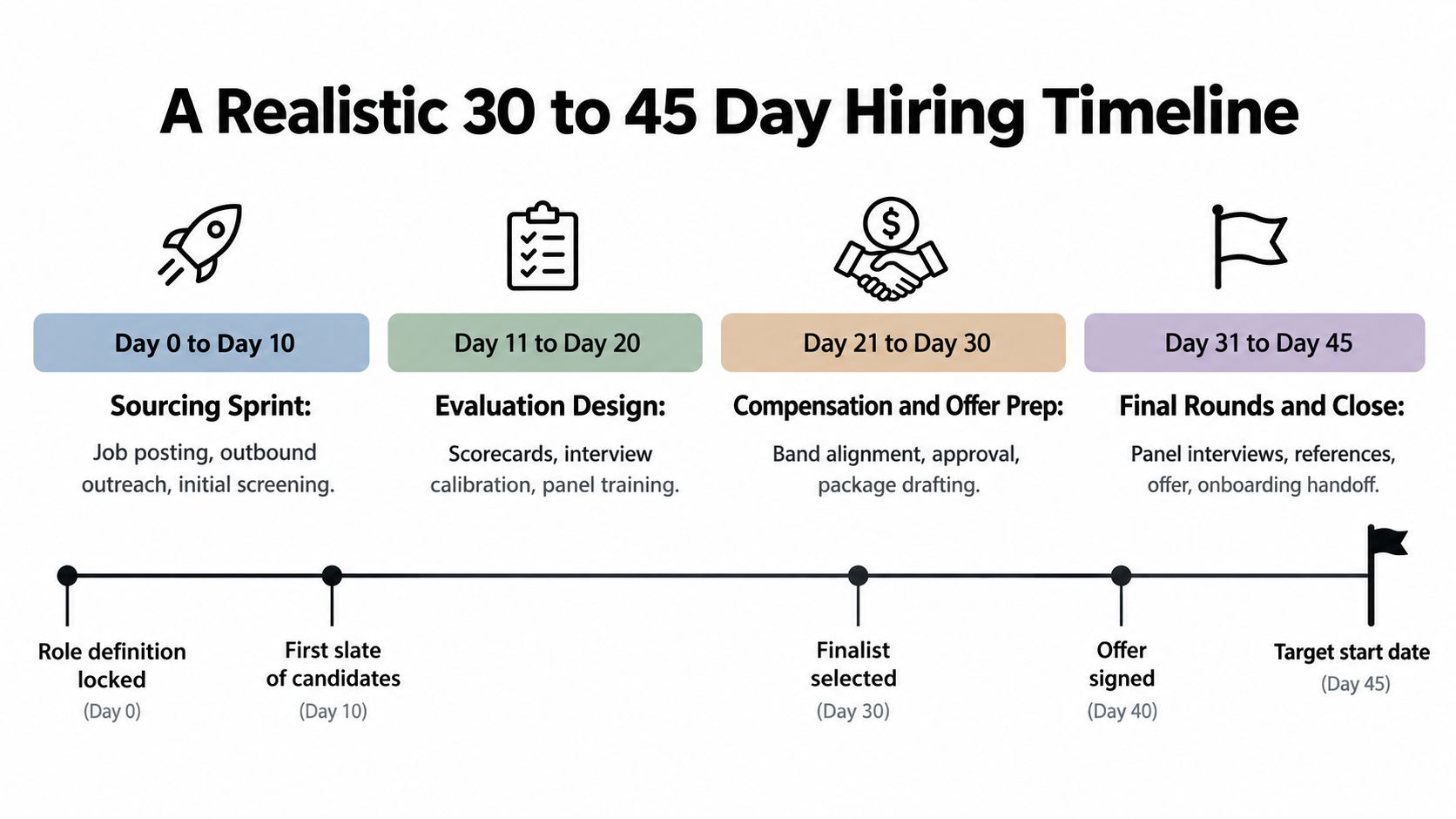
A well-designed PM search can move from approved role to signed offer in 30 to 45 days when the job description, salary range, and work sample are defined early, according to the Product Manager hiring guide. The calendar only works if decision rights are assigned before sourcing begins.
Days 0 to 10
Lock the role definition, scorecard, salary band, location policy, and interview panel. Launch the job posting, targeted outbound, referral push, and any specialist search partner at the same time. The hiring manager owns the business problem, People or HR owns process compliance, and recruiting owns pipeline movement.
Days 10 to 20
Run recruiter screens and calibrate the product case with the interview panel. Don't wait until the first finalist to discover that one interviewer expects a growth PM while another expects a technical platform PM. Assemble the loop, give interviewers the scoring anchors, and reject any exercise that tests irrelevant trivia.
Days 20 to 35
Run the structured interviews in a compressed window. Product sense, execution, stakeholder judgment, and references should have clear owners. Debrief on evidence, not enthusiasm, and record the decision before discussing compensation.
Days 35 to 45
Complete references, confirm the offer package, deliver the verbal offer quickly, and prepare the onboarding handoff. Lost references, interviewer scheduling, and competing offers create the most avoidable delays. Keep the candidate informed even when an internal approval is pending.
If the search passes Day 45, don't add more candidates. Diagnose the failure:
Weak slate: Revisit the product segment, level, and sourcing channel.
Conflicting feedback: Recalibrate the scorecard with concrete evidence.
Offer risk: Recheck the band and decision-maker availability.
Slow scheduling: Replace optional interviewers with accountable owners.</li>
Assign ownership in writing: the hiring manager owns the job description and final decision, the recruiting lead owns the process and candidate communication, the interview chair owns the debrief, Finance or HR owns compensation approval, and the executive sponsor owns the verbal offer.
GENTY recruitment helps Series A–C companies define and fill product roles through skill-first recruiting, targeted shortlists, RPO, and salary benchmarking across US, European, and LATAM hiring markets. If your PM search needs sharper segmentation, faster calibration, or nearshore product talent, visit GENTY recruitment and start with the role, scope, and market you need to hire for.