

Your Series A product team needs more engineers, but local hiring is slow and expensive. An offshore team could reduce the rate, yet overnight handoffs may leave developers blocked until the next day. A nearshore outsourcing company provides engineers, DevOps specialists, QA professionals, or support staff in a nearby time zone, working as an extension of your internal team. The key decision isn't whether the hourly rate looks attractive. It's whether the partner can deliver reliable skills, daily collaboration, compliant employment, and retention at a predictable total cost.
What a Nearshore Outsourcing Company Actually Does
A nearshore outsourcing company acts like a second office for your startup. You define the product goal, architecture boundaries, security requirements, and delivery standards. The partner helps source, employ or contract, manage, and coordinate the people who execute the work.
For example, a CTO might add two backend engineers and a DevOps specialist to support a platform migration. The nearshore team joins the same sprint planning, uses the same GitHub workflow, attends incident reviews, and works inside the agreed cloud and security controls. The arrangement differs from handing a project to an unknown supplier because the team is designed to operate alongside your employees.
The global market reflects sustained demand for this model. Nearshore business-process outsourcing reached an estimated US$61.57 billion in 2025 and is projected to reach US$120.11 billion by 2033, with an estimated 8.8% compound annual growth rate from 2025 through 2033, according to Grand View Research's nearshore market data. The figures cover business-process outsourcing broadly, not technology recruitment alone.
Planning a hire?
Talk through the best hiring option
This article usually leads to one practical question: should you use rpo or staffing? We can help you choose quickly.
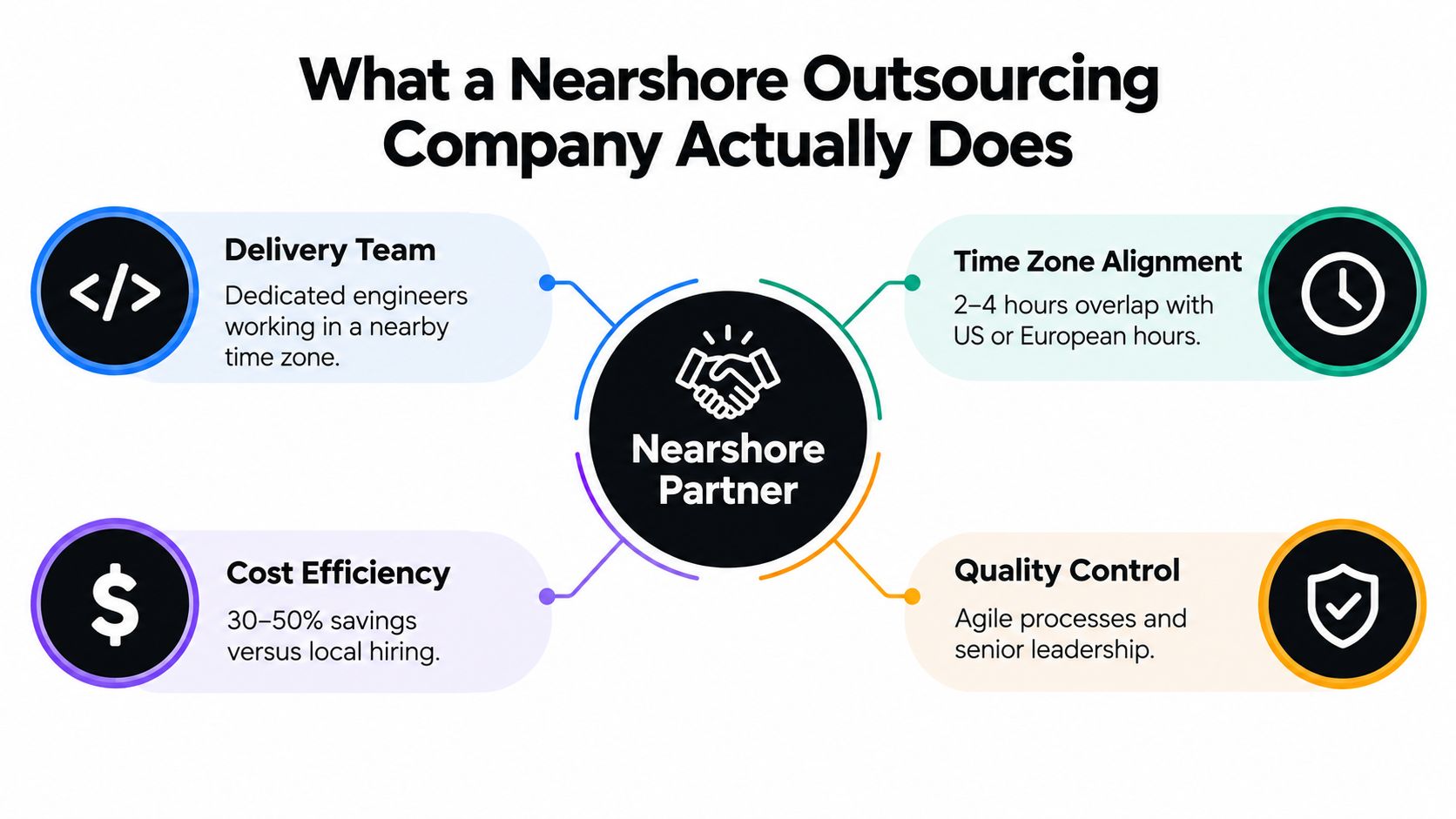
Three ways to engage a partner
Staff augmentation adds individual specialists to your existing structure. Your engineering manager assigns work, reviews pull requests, and owns performance management. This setup suits a startup that has strong technical leadership but needs to fill specific gaps quickly.
A dedicated team gives you a stable pod, often including engineers, QA, and a technical lead. You still own product priorities, while the partner handles recruiting and some people operations. This works when you need capacity that will remain together across multiple initiatives.
Managed delivery transfers responsibility for a defined outcome, such as a mobile application, test automation program, or cloud migration. The provider manages more of the planning and execution. You need clear acceptance criteria, decision rights, security obligations, and reporting because control moves further from your internal team.
What proximity changes each day
Time-zone alignment affects simple operating moments. A product manager can clarify an acceptance criterion while the engineer is still working on it. A security lead can join a design review before implementation begins. A production issue can reach the right specialist during the same working window.
A useful overview of nearshore outsourcing should therefore describe more than geography or rates. Ask how the partner staffs ceremonies, escalates incidents, documents decisions, and replaces people when a critical contributor leaves.
Practical rule: Treat the partner as an operating extension of your company, not as a queue where tasks disappear.
Nearshore Versus Offshore and Onshore Models
The difference between these models is mainly operational distance. Onshore teams work in the same country or local market. Nearshore teams work in a nearby country or region with meaningful working-hour overlap. Offshore teams operate farther away, often with a larger time difference and more reliance on asynchronous communication.
Latin America's nearshore role grew after the 2008 global financial crisis, when companies increasingly considered it alongside established offshore locations such as India, China, and Malaysia. Mexico benefited from proximity to the United States, overlapping time zones, and the North American trade framework that preceded USMCA, as described in Brookings' analysis of Mexico and nearshoring.
A US Eastern Time product team working with a nearby country may review a pull request while the author is online. The same team working with an office many time zones away may leave comments at the end of its day and wait for the next response window. Neither model is automatically superior. The right choice depends on how often the work needs conversation rather than written instructions.
Nearshore generally fits product work with changing requirements, live incident response, and frequent stakeholder input. Offshore can fit well when the work is modular, documented, and measured through clear outputs. Onshore remains sensible for roles constrained by regulation, customer access, or executive trust.
A comparison of offshore and nearshore staffing models can help your team frame the decision, but don't stop at the label. Write down the actual overlap required for planning, pair programming, deployment approvals, and support coverage.
How Time Zone Overlap Improves Delivery
Shared hours are a delivery control, not a lifestyle perk. They let people resolve ambiguity while context is still fresh. A developer can ask whether a product rule applies to one workflow or several. A QA engineer can reproduce a defect with the person who wrote the code. A DevOps specialist can escalate a failed deployment before the release window closes.
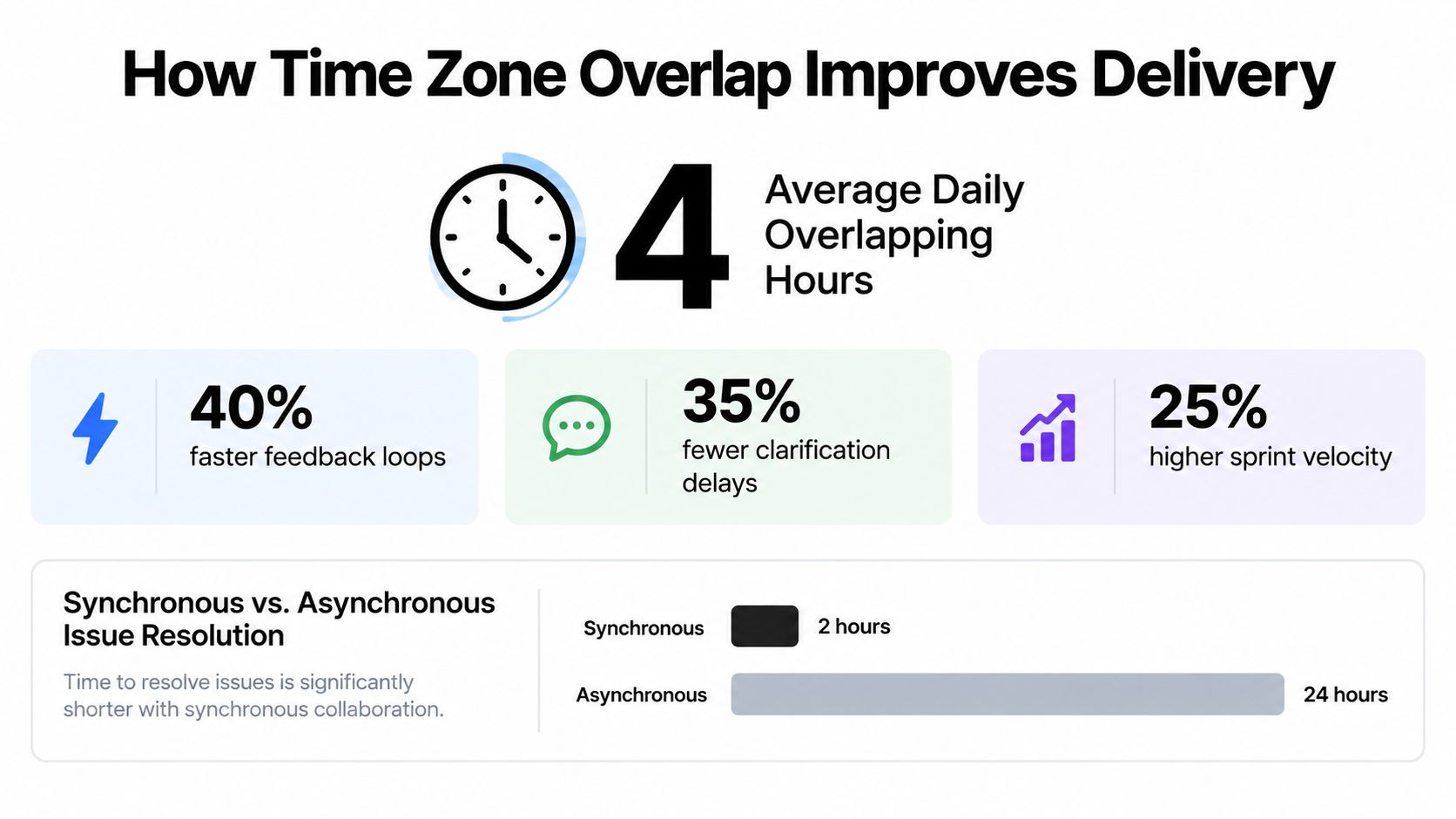
An academic analysis of global software-development outsourcing associated nearshore location with statistically significant improvements in overall project success, cost, schedule adherence, software quality, communication problems, and project-management effort, according to the published analysis of nearshore software delivery. The useful lesson isn't that proximity removes every delivery problem. It gives managers more opportunities to detect and correct problems before they become rework.
What overlap looks like in practice
For a platform team, overlap might support a morning stand-up, a live review of an infrastructure change, and a same-day incident handoff. For QA automation, it can turn a failing test from a ticket into a shared debugging session. For product engineering, it reduces the time between a design decision and a working implementation.
The contract should define this operationally. “Nearshore” isn't enough. Specify the working window, the minimum overlap with your core team, the people required during that window, and the escalation route for production issues.
Track delivery signals that expose coordination friction:
Cycle time: Measure how long work takes from ready to production.
Escaped defects: Count defects discovered after release and classify their source.
Blocked-work duration: Record how long tickets wait for clarification, access, or another team.
Review latency: Measure the time between a pull request and a useful review.
Synchronous ceremony coverage: Track whether planning, retrospectives, incident reviews, and architecture discussions include the required participants.</li>
Don't interpret these metrics in isolation. A shorter cycle time with rising escaped defects indicates speed without sufficient quality control. A high review latency may reflect reviewer capacity rather than geography. Use the measures together to identify the constraint.
Contract language should answer one question: When a developer is blocked at midday, who is available to remove the block?
Overlap also needs asynchronous support. Teams still need written architecture decisions, runbooks, ticket context, and recorded incident outcomes. The best arrangement combines live collaboration for ambiguity with durable documentation for continuity.
Why Latin America Works for US and European Teams
The attraction is not just lower labor cost. The region offers multiple talent markets, overlapping work schedules, and established cross-border commercial relationships. Those advantages matter only when a partner can convert them into people who communicate clearly and operate at production standards.
Brazil and Mexico together represent more than 2.2 million software-engineering professionals and produce over 350,000 new engineering graduates annually, according to Deloitte's analysis of nearshoring as an offshore alternative. That depth can help a startup expand beyond one hard-to-replace engineer or one city. It doesn't mean every candidate is ready for your stack.

Choose for deployable capability
A country-level talent claim says little about whether a candidate can operate your production environment. Screen for the specific work your team needs:
Cloud operations: Ask for examples involving AWS, Azure, or Google Cloud in production.
Infrastructure as code: Review Terraform, Pulumi, or equivalent practices, including state management and change review.
Container operations: Test Kubernetes or container troubleshooting rather than accepting a tool list on a résumé.
Delivery discipline: Inspect how the candidate uses CI/CD, feature flags, testing, and rollback procedures.
Communication: Run a technical discussion in English and require the candidate to explain tradeoffs to a non-specialist stakeholder.
Ownership: Ask how the person handled an incident, an unclear requirement, or a failed release.</li>
A US Eastern Time team may prioritize locations with substantial same-day overlap. A European team should compare the working hours available during its morning and afternoon, rather than assuming that every regional location offers the same schedule. Remote-work experience also deserves explicit screening because remote roles represent a limited share of job postings across the region, according to the Inter-American Development Bank's analysis of remote work in Latin America and the Caribbean.
A strong shortlist includes evidence of home-office reliability, written communication, schedule compatibility, and collaboration in distributed teams. The World Bank also reports uneven digital-skill availability across the region, so a candidate's practical assessment matters more than a national average.
Use IT recruitment support for technical hiring as a reference point when designing a sourcing process, but keep your evaluation tied to the role. A senior DevOps engineer, a frontend specialist, and a QA automation engineer need different proof of competence.
How to Vet a Partner and Reduce Risk
A partner can present an attractive bench and still fail your company through weak screening, poor documentation, or unstable staffing. Use a numbered process that forces evidence into the decision instead of relying on sales confidence.
1. Confirm production capability
Ask the provider to explain how it validates cloud experience, infrastructure as code, container operations, observability, CI/CD, and security behavior. You don't need access to a client's confidential environment. You do need concrete examples, technical interviews, anonymized work samples, and a clear description of who performs the evaluation.
If the provider can't distinguish a developer who has read about Kubernetes from one who has operated workloads under pressure, the shortlist is not ready.
2. Test communication in the real workflow
Don't limit assessment to conversational fluency. Give candidates a short architecture prompt, a sample incident, or a pull request discussion. Ask them to explain the issue, state assumptions, propose a fix, and document the decision.
A useful developer technical and soft-skills vetting guide should result in repeatable scorecards. Score clarity, listening, tradeoff reasoning, written follow-through, and willingness to surface risk.
3. Run a controlled trial
A trial sprint can reveal more than a polished presentation. Give the team a bounded task with a known outcome, access only to non-sensitive systems, and your normal review process. Observe how they clarify requirements, split work, write tests, respond to feedback, and report blockers.
Keep the trial small enough that failure is affordable. The objective isn't to simulate a quarter of delivery. It is to inspect working behavior before granting broad access or committing to a long engagement.
4. Put controls in the agreement
The contract should cover intellectual property ownership, confidentiality, data access, security responsibilities, approved tools, incident notification, working-hour overlap, service levels, and replacement expectations. Define what happens when a named engineer becomes unavailable.
Ask for backup coverage without accepting a revolving door. A backup person should understand the architecture and documentation, not merely appear on an account list.
5. Validate references and retention evidence
Speak with customers who used the partner for technical work similar to yours. Ask how quickly the provider responded to a failed hire, whether the original team remained stable, and who owned delivery when requirements changed.
The World Bank reports that only 28% of the region's population had basic digital skills, compared with 64% across OECD countries. The same document identifies Chile as a regional front-runner in intermediate and advanced skills, with Colombia and Mexico behind Chile but above the regional average, as shown in the World Bank digital-skills analysis. This is another reason to assess individuals and role-specific evidence rather than making assumptions from geography.
Sales organizations need the same discipline. If you're evaluating a partner for outbound roles, this explanation of how SDR outsourcing works can help you separate lead generation responsibilities, quality controls, and reporting ownership before signing.
True Cost and Retention Realities to Plan For
The cheapest quoted rate often excludes the costs that make a team expensive to operate. Build a fully loaded comparison that includes gross compensation, employer contributions, statutory benefits, paid leave, 13th-month payments where applicable, severance exposure, payroll administration, equipment, recruiting fees, foreign-exchange movement, security controls, management time, and replacement costs.
Worker classification can change the calculation. A contractor who works under your schedule, direction, tools, and supervision may be treated as an employee under local rules. A partner should explain its employment model, compliance responsibilities, and documentation process instead of presenting contractor pricing as a universal solution.
Hiring-cost guidance for Latin America is most useful when it helps you compare net operating cost, not just salary. Put each offer into the same model and test the cost of a delayed start, weak English communication, additional management, and an unplanned replacement.
Retention belongs in the price
Talent risk increases when your roles require scarce skills such as AI, cloud, data, DevOps, or cybersecurity. A provider should explain how it handles career progression, compensation reviews, technical communities, manager quality, and succession coverage. Ask for time-to-productivity, six-month retention, replacement time, and delivery-quality measures by role.
Flexibility has an economic value in these markets. An Inter-American Development Bank study summarized in a 2026 academic publication found that participants were willing to give up 10% of wages, about USD 109 per month, for hybrid work, and 6%, about USD 60 per month, for fully remote work, as reported in the academic publication on work-location preferences. These are study-specific average preferences, not a discount every candidate will accept.
Use flexibility deliberately. A predictable remote schedule, clear overlap window, and limited office requirement may improve an offer without raising base pay. Document the arrangement consistently, then compare its retention effect with cash compensation and the cost of replacing a specialist.
Choosing the Right Setup for Your Startup Stage
A Series A company with a small internal engineering group often needs staff augmentation. Add a focused group of engineers or one specialist who can work inside your existing process, and keep architecture and product ownership close to the founders or technical lead.
A Series B company may benefit from a dedicated pod that combines engineering with QA and DevOps. The pod should have a stable lead, documented interfaces with the internal team, and a defined area of ownership. That structure reduces the chance that every decision returns to one overloaded CTO.
A Series C company usually needs repeatable hiring operations rather than one successful search. An RPO model, salary benchmarking, structured scorecards, and workforce planning can support several roles without forcing the internal team to coordinate every candidate and interview.
Use a thirty-day launch plan:
Days one through five: Define roles, required overlap, production responsibilities, security constraints, and the fully loaded cost model.
Days six through fifteen: Compare partners through technical evidence, references, contracts, and a trial process.
Days sixteen through twenty-five: Interview a skill-first shortlist and score technical communication, delivery judgment, and role fit.
Days twenty-six through thirty: Start with a bounded scope, establish delivery metrics, and schedule a retention review.</li>
If you also need to improve external discovery for a new hiring or services initiative, evaluate backlinks from directory submissions as one channel, while keeping technical hiring decisions separate from marketing distribution.
GENTY recruitment helps US and European startups source vetted software engineers, DevOps specialists, QA professionals, and sales talent across nearshore markets through skill-first shortlists, salary benchmarking, RPO, and fixed-fee recruiting. Visit GENTY recruitment to discuss your required overlap, total-cost model, and the team structure you need next.