
A new remote hire joins the first video call with no laptop access, no clear owner for questions, and a calendar full of compliance documents. By the end of the week, they've attended meetings but still can't explain what success looks like or ship a small piece of work. Successful onboarding remote employees requires operational design before day one, staged learning through the first 90 days, and a manager who creates predictable access to context. Welcome kits are secondary.
The Real Cost of Remote Onboarding Failures
A remote hire rarely fails because they lack technical ability. More often, the company gives them fragmented access to tools, undocumented decisions, unclear ownership, and too much information before they understand the role. In an office, a new engineer might resolve those gaps through a quick conversation. A distributed employee sees an empty Slack thread, waits for a reply across time zones, and loses a day.
The labor market makes this an operating issue, not an administrative detail. Gallup data cited in recent onboarding summaries shows that 26% of U.S. employees worked remotely, 52% worked on-site, and 22% worked in hybrid arrangements. The same dataset reports that strong onboarding can increase three-year retention by 69%, while structured onboarding raises it by 58%. These figures are reported in the onboarding statistics summary from FirstHR.
Practical rule: Treat the first quarter as a delivery system. Every meeting, document, introduction, and access request should help the employee become effective.
What do you need?
Choose the hiring path that fits
After reading "Onboarding Remote Employees for Nearshore Teams", most teams compare these options before deciding how to hire.
The failure is measurable. Paychex survey results reported in a 2026 summary found that 74% of employees considered their remote onboarding a failure, while 63% of remote workers felt undertrained and 60% felt disoriented afterward. The same source reports that organizations with strong onboarding improve new-hire retention by 82% and productivity by over 70%, while 20% of turnover occurs within the first 45 days in poor onboarding environments. See the remote onboarding research summary from Speakwise.
The practical fix is to remove ambiguity in sequence. Prepare the environment before the start date, limit early information to what the role requires, assign a manager and buddy with explicit responsibilities, and define observable outcomes for the first 30, 60, and 90 days. A useful review of the hidden costs of bad hiring decisions in remote tech teams reinforces why selection and onboarding should be treated as one operating process.
Pre-Hire Preparation and Environment Setup
Day one should be about context, relationships, and the first work objective. It shouldn't be spent waiting for an Okta invitation, discovering that the laptop is still in transit, or asking who approves access to the production repository.
Use the week before the start date to assign an owner to every dependency. The hiring manager owns role expectations and the first-week schedule. IT owns hardware, identity, security, and software access. Finance or operations owns payroll and employment documentation. A recruiting or employment partner can coordinate cross-border paperwork, but the internal manager still needs to confirm that the employee can work productively.
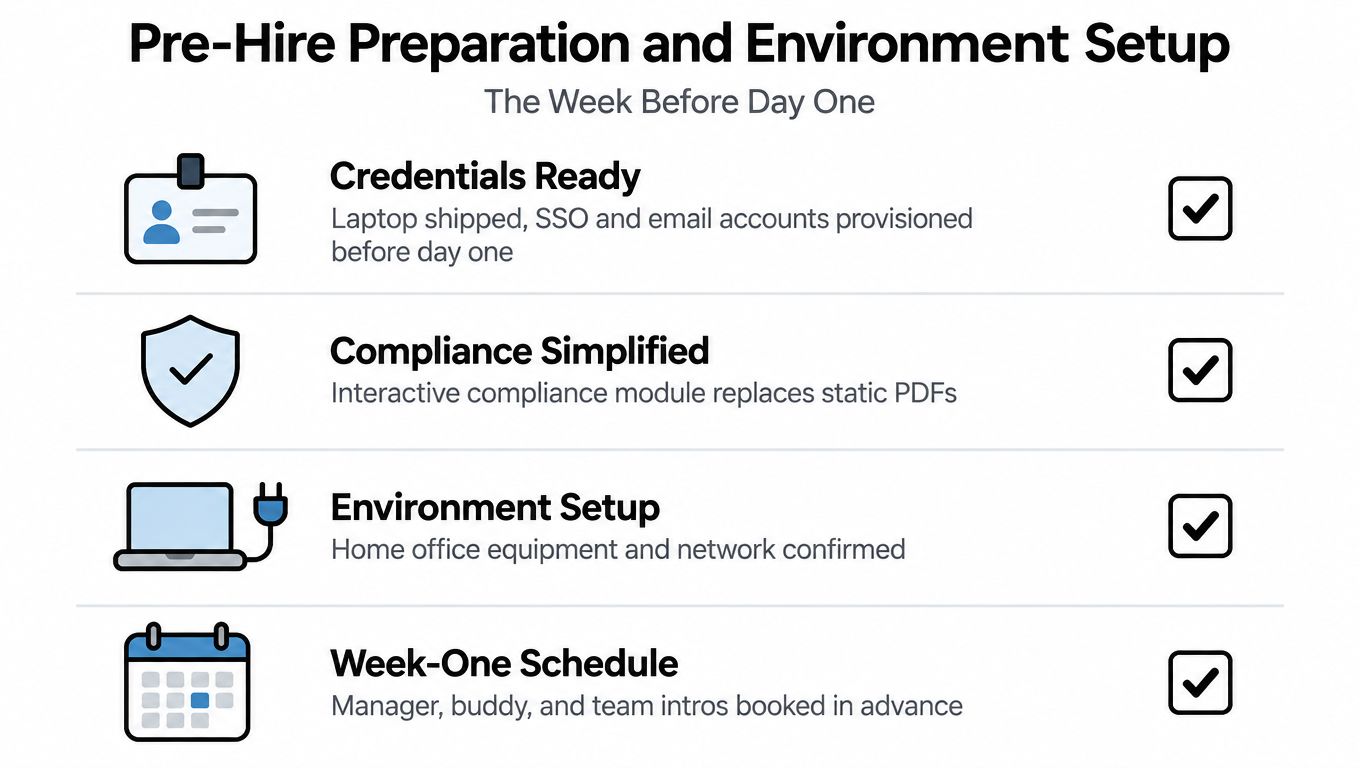
The week before day one
Run this checklist in a shared workspace such as Notion, Confluence, or Linear:
Credentials ready: Provision company email, SSO, password-manager access, communication tools, repositories, project systems, and role-specific applications. Test access with a non-admin account.
Environment confirmed: Ship the laptop and required peripherals, verify the home-office setup, and document the support path for connectivity or hardware issues.
Compliance completed: Collect required employment and payroll documentation, then replace long static PDF bundles with a short, trackable learning path where possible.
People scheduled: Book the manager welcome, buddy meeting, team introduction, cross-functional meetings, and first one-to-one before the calendar reaches the new hire.
Role brief published: Provide a concise page covering the team mission, current priorities, decision-makers, communication norms, and the first small deliverable.</li>
Cross-border hiring adds administrative details that shouldn't be improvised after the offer is signed. For teams hiring in Colombia, Filta employment solutions Colombia provides useful context on employment support and local execution.
A clear equipment policy also prevents avoidable friction over reimbursements, security, and home-office needs. Document who supplies devices, what employees can expense, and how replacements are handled in a remote-team equipment stipend policy.
Structuring the First 90 Days for Distributed Teams
The most common onboarding mistake is not insufficient documentation. It's delivering the right information at the wrong time. A new engineer doesn't need every architecture decision on the first morning, and a new account executive doesn't need the entire historical sales archive before hearing the current positioning.
Recent benchmarking identified information overload as a leading onboarding challenge for remote employees. The study surveyed 1,156 U.S. employees hired within the prior 12 months, according to BambooHR's onboarding benchmarking guide. The operational response is to create a smaller curriculum, repeat essential concepts, and release information when the employee has enough context to use it.
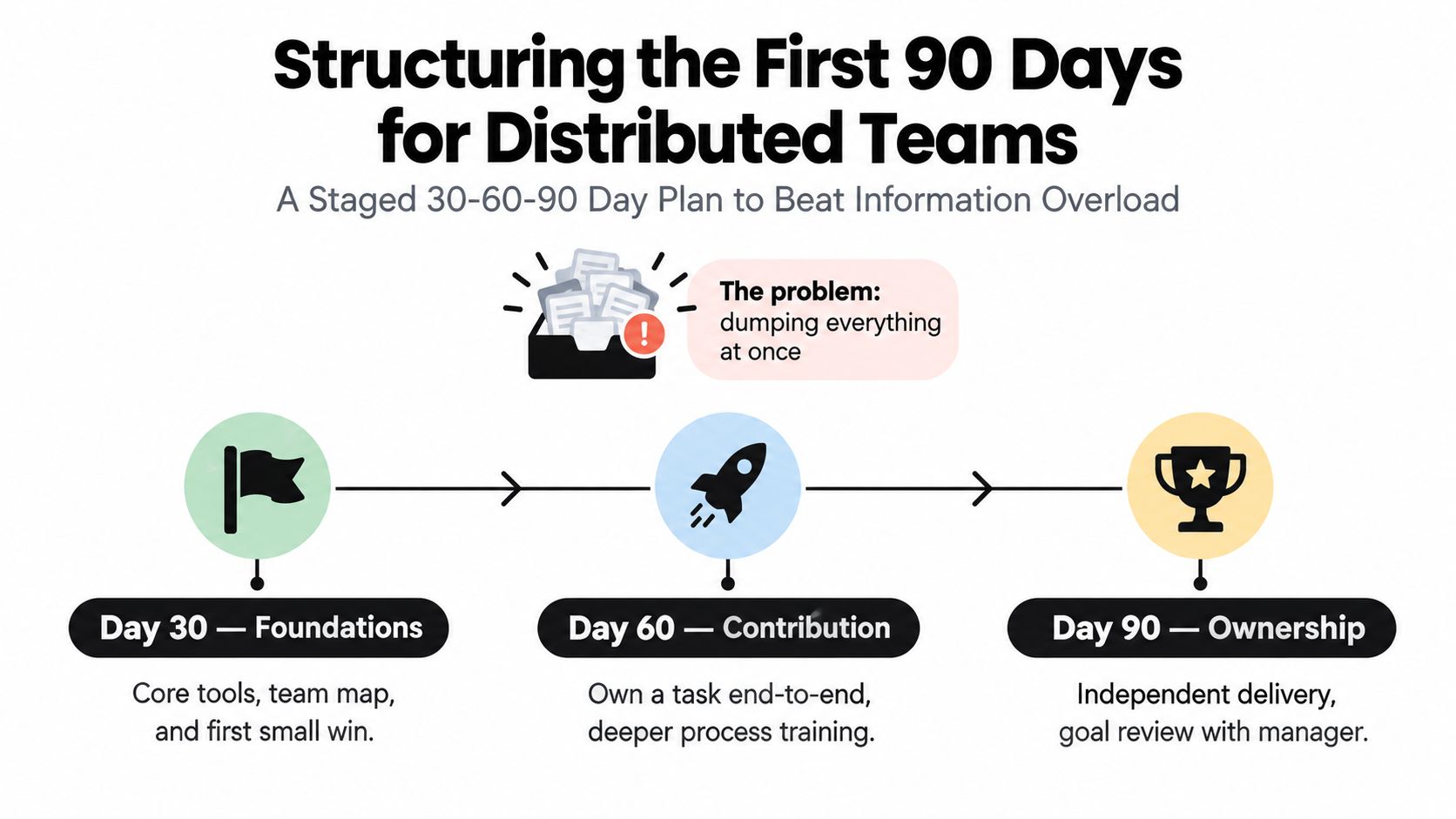
Day 30 foundations
The first milestone should establish role clarity, psychological safety, and one small shipped win. Give the employee a map of the team, the systems they touch, the people who make decisions, and the communication channels that matter. Withhold peripheral material until it becomes relevant.
For an engineer, the early win might be a small bug fix, test improvement, or documented deployment change. For a sales hire, it might be a qualified discovery handoff or a clean update to an existing account record. The task should be real, bounded, reviewable, and useful.
Use the first milestone review to ask:
Can the employee explain the team's current priorities?
Do they know where to find authoritative information?
Have they completed a small piece of work?
Which unanswered questions are blocking progress?
Does the role match what the hiring process described?</li>
Day 60 contribution
The second milestone shifts from orientation to ownership. Assign one workstream or recurring responsibility that the employee can manage end to end with appropriate review. Training should now become deeper and more specific, based on the decisions the employee is making.
Ask the new hire to identify one onboarding improvement. Their feedback often exposes broken documentation, unclear approval paths, or a meeting that exists only because nobody has defined a better workflow. That feedback is valuable because the employee is still close enough to notice friction that established team members have normalized.
Day 90 ownership
By the final milestone, the employee should operate with increasing independence, deliver against agreed goals, and discuss development with the manager. A structured program should run for at least 90 days, with the first week focused on logistics and introductions, weeks two through four on role clarity and early delivery, and months two and three on independence and integration. The progression is supported by SHRM-based onboarding guidance from HR University.
Teams using a written plan, regular manager one-to-ones, cross-functional introductions, a designated buddy, and other structured elements report remote time to productivity of about 55 to 60 days, compared with about 90 to 120 days for unstructured remote hires. Those figures are summarized in the 2026 remote onboarding research from Stealth Agents.
Use a practical guide to building a stronger first 90 days when turning these milestones into manager templates. For additional context on the hiring-to-onboarding handoff, see remote hiring guidance for distributed teams.
A short visual explanation can help managers communicate the sequence without turning the plan into another document dump.
Role-Specific Tracks for Engineering and Sales
A shared onboarding framework should define cadence and milestones. It shouldn't define identical work. An engineer needs controlled exposure to the codebase and deployment process. An SDR or account executive needs product fluency, message discipline, and observed customer conversations.
The manager should publish different early deliverables for each track. That makes performance expectations concrete without forcing a new hire to absorb the entire organization at once.
Early Deliverables by Role Track
For engineering, pairing is more useful than assigning hours of architecture reading. A senior architect or experienced maintainer should explain why a boundary exists, which trade-offs are accepted, and where the system is fragile. The new hire then records only the decisions needed for future work.
For sales, passive product training creates false confidence. Have the employee listen to real calls, annotate what they heard, and explain how the conversation maps to qualification and positioning. Review the work synchronously at first, then reduce support as judgment improves.
Nearshore teams also need explicit overlap rules. Document which questions belong in the shared channel, which issues justify a live call, and what information must be included when handing work across time zones. Companies evaluating distributed hiring models can use guidance on hiring remote talent to align the recruitment process with the operating model that follows.
Manager Cadence and Cultural Integration
Remote employees can't infer priorities from hallway conversations, overheard planning, or who happens to be in the office. The manager must create those signals deliberately. Gallup reports that managers account for 70% of the variance in team-level engagement and recommends at least one meaningful conversation per week with each employee, lasting 15 to 30 minutes. The figures and recommendation appear in Gallup's guidance on managing remote workers.
A useful weekly one-to-one isn't a status meeting. Use a consistent structure:
Opening: Ask what feels clear and what feels uncertain.
Delivery: Review the current work, decisions needed, and dependencies.
Friction: Remove access, process, technical, or interpersonal blockers.
Development: Discuss one skill, behavior, or area of judgment to strengthen.
Feedback: Give specific feedback and ask what the manager should change.
Close: Confirm the next meaningful outcome and who owns each follow-up.</li>
Keep the format stable, but don't make every conversation formal. A new hire should be able to raise a concern before it becomes a performance issue. If the manager repeatedly cancels these meetings, the employee receives a clear message about how much support they can expect.
The buddy as an access layer
Assign a buddy outside the reporting line for the first 30 to 90 days, as recommended in the structured remote onboarding framework from Stealth Agents. The buddy isn't a second manager and shouldn't be responsible for evaluating performance. Their role is to answer questions that feel too small, too political, or too embarrassing to raise in a formal meeting.
Give the buddy a short brief:
Explain unwritten communication norms.
Point out the right owner for common requests.
Invite the new hire to one informal conversation each week.
Review the team map and help decode acronyms.
Escalate recurring confusion to the manager.</li>
Cultural integration also requires cross-functional contact. Introduce a developer to product, support, security, and customer-facing colleagues. Introduce a sales hire to implementation, product marketing, customer success, and finance. The purpose isn't to fill calendars. It's to show how work moves through the company and where a decision affects someone outside the immediate team.
For managers building a stronger async environment, this guide to async team management offers useful operating principles. Internal guidance on managing remote teams as a tech leader can help turn those principles into team norms.
Measuring Success and Avoiding Common Pitfalls
An onboarding program is working when the employee can make progress without repeatedly asking where to begin. Measure that directly instead of relying only on a welcome survey.
Track time to first commit for engineering, with the quality and scope of the change considered alongside speed. For DevOps hires, track the first reviewed operational contribution and whether the employee can explain the relevant runbook. For sales, track the first qualified activity, pipeline generation, follow-up quality, and CRM completeness. Across both groups, review milestone completion, unresolved blockers, manager-meeting consistency, buddy participation, and 90-day retention.
Use a simple monthly audit:
Access: Did the employee have the required systems and equipment before starting?
Clarity: Could they state their responsibilities and first-quarter outcomes?
Contribution: Did they complete work appropriate to their role and stage?
Connection: Did they meet the people needed to operate across team boundaries?
Correction: Did the manager adjust the plan when the original assumptions were wrong?</li>
Digital-only onboarding can also create fatigue when the experience is long, static, and dominated by passive training. Recent summaries report that remote hires are more likely to feel undertrained, confused, or disconnected, while a 2025 BambooHR and TalentLMS study found higher satisfaction among hybrid-onboarded employees, 75%, than among in-person employees, 73%, or fully remote-only employees, 71%. These figures are reported in the remote and hybrid onboarding analysis from Custom Ink.
The answer isn't to force every team into an office. Decide which moments benefit from synchronous or in-person interaction, then keep the rest asynchronous and role-specific. Replace content volume with sequencing, measure behavior rather than attendance, and have managers correct the program whenever new hires repeatedly encounter the same confusion.
GENTY recruitment provides curated tech and sales hiring across Latin America, along with RPO, staffing, onboarding coordination, payroll, compliance, and employment support for distributed teams. If you're building a nearshore cohort and want the hiring and first-90-day handoff designed together, visit GENTY recruitment to discuss your roles and operating model.