
Adopt a two-part model: a one-time setup cap for hardware plus a modest recurring connectivity allowance, with an IRS-accountable plan covering any large, itemized purchase. This structure keeps most reimbursements out of taxable wages, satisfies the state laws that actually require reimbursement, and gives IT a clean line for asset control.
Three things determine whether this works: legal compliance by employee location, tax treatment of the payment itself, and who owns the equipment once it ships. Get those three wrong and a well-intentioned stipend turns into a payroll liability or a security gap.
- Compliance: Eleven states plus D.C. can legally require reimbursement for remote work expenses.
- Tax treatment: An accountable plan keeps reimbursements off the W-2; a flat stipend does not.
- Control: Company-owned hardware is easier to secure and recover than employee-purchased gear.
Mid-market benchmarks run $1,000 to $1,500 for one-time setup and roughly $150 a month recurring.
Key Takeaways
A two-part equipment stipend, a capped one-time setup plus a modest recurring allowance, satisfies more state laws and preserves better tax treatment than a single flat payment.
What do you need?
Choose the hiring path that fits
After reading "Equipment Stipend for Remote Teams: A Policy Guide for HR", most teams compare these options before deciding how to hire.
Where to Verify the Details
Confirm the specifics before finalizing your policy rather than relying on secondhand summaries.
- IRS guidance on accountable-plan requirements for the exact federal substantiation rules.
- State-by-state reimbursement rules to check obligations tied to each employee’s location.
- SHRM’s benefits research for current adoption rates and category benchmarks.
- A sample policy template from VITL’s published home-office stipend policy for proration and offset language.
Route final policy wording through employment counsel and a payroll vendor before launch, since state thresholds and IRS guidance both shift periodically.
Define Purpose and Scope for Your Equipment Stipend Remote Teams Policy
Every equipment stipend remote teams program needs a purpose statement before it needs a dollar figure. Decide upfront whether the stipend exists as an operational perk (helping people work comfortably) or as a legal reimbursement obligation (satisfying state law). The two purposes call for different documentation, and blending them without saying so is how policies fall apart during an audit.
Eligibility should follow role reality, not job title. A fully remote data engineer and a hybrid account executive who comes in twice a week don’t need the same setup budget.
- Fully remote employees get the full one-time and recurring allowance.
- Hybrid employees get a tiered amount, often 50 to 60% of the full stipend, since the company already provides office equipment.
- Part-time staff get a prorated amount based on scheduled hours.
- Contractors typically fall outside stipend programs entirely, since accountable-plan rules apply to employees, not 1099 workers.
Build eligibility rules around actual duties, too. Someone with on-call responsibilities or a requirement for a private, HIPAA-compliant workspace justifies a higher cap than a role with no such constraint. Draft the policy with these components ready before you circulate it:
- Purpose statement (operational vs. legal reimbursement)
- Eligibility matrix by employment type and work arrangement
- Approved expense categories with dollar caps
- Tax treatment for each category
- Documentation and receipt requirements
- Proration formula and payroll timing
What Expenses Does an Equipment Stipend Cover?
Ambiguity is where equipment stipend remote teams policies get expensive. Managers approve inconsistent requests, employees push boundaries, and Finance ends up reclassifying charges after the fact. Five categories cover nearly everything a remote employee legitimately needs.
- Core equipment: laptops, external monitors, keyboards, mice, webcams, headsets.
- Connectivity: home internet service, mobile data plans when the role requires phone-based work.
- Furniture and ergonomics: desks, ergonomic chairs, monitor arms, and, in accessibility cases, specialized equipment recommended by an occupational health provider.
- Software and licenses: tools not already covered by a company-wide subscription.
- Coworking access: monthly memberships for employees without a workable home setup.
Boundary cases need explicit language, not manager discretion. A standing desk is work-related; a mini fridge for the home office is not. A second monitor is standard; a gaming chair marketed for comfort but priced at $900 needs a cap, not a blank check. Write the exclusion list into the policy itself rather than leaving it to case-by-case judgment calls that create resentment when two employees get different answers.
SHRM’s benchmarking research found that employer stipend programs skew heavily toward hardware and lag on internet and furniture coverage, which leaves a real gap for employees paying for connectivity out of pocket while their laptop got fully reimbursed.
Documentation requirements should scale with the tax treatment chosen. If you’re running an accountable plan, every category needs a dated receipt and a brief note on business purpose, submitted within a reasonable window, typically 60 days. If you’re running a flat taxable stipend instead, you can skip receipt collection entirely since the payment is wages regardless of how it’s spent.
Payment Models: Reimbursement, Stipend, or Company-Owned?
Three models dominate equipment stipend remote teams programs, and each trades tax efficiency against administrative load differently.
Reimbursement under an accountable plan keeps payments out of taxable wages, but only when the IRS’s three tests are met: the expense has a clear business connection, the employee substantiates it within a reasonable time, and any excess advance gets returned. This model demands the most paperwork but saves both the employer and employee payroll tax.
A flat taxable stipend is the simplest to run. HR pays a fixed monthly or annual amount, no receipts required, and payroll treats it as ordinary wages subject to withholding. Employees like the flexibility; Finance likes the predictability. The tradeoff is that both employer and employee absorb payroll tax on the full amount.
Company-owned procurement removes ambiguity entirely. IT buys the laptop, ships it, and owns it. Security teams prefer this model because it eliminates the patchwork of personal devices connecting to company systems, though it front-loads capital expense and slows down provisioning for new hires.
- Assign an owner for each workflow step: HR handles eligibility, Finance approves budget, IT vets security specs.
- Set a service-level target for provisioning, most remote-first companies aim for a working setup within 5 to 7 business days of start date.
- Choose a reconciliation cadence, monthly for reimbursements, quarterly for asset audits on company-owned gear.
Platforms like Deel, Compt, and PeopleKeep handle the administrative layer for accountable-plan tracking and global payroll integration, though their strength varies. Deel leans toward global payroll and contractor payments, Compt focuses on lifestyle and stipend administration with automated substantiation, and PeopleKeep built its platform originally around health reimbursement arrangements before expanding into broader stipend management.
Pro Tip: Run reimbursement and company-owned procurement side by side for the first two hires in a new country. The workflow that clears customs and payroll fastest tells you which model to standardize on.
How Much Should an Equipment Stipend Be?
Benchmark data gives HR a defensible starting point, not a rulebook. Industry research shows about 56% of employers now offer some equipment reimbursement, with one-time setups clustering between $1,000 and $1,500 and recurring monthly allowances averaging close to $150. Fully remote, tech-sector employers tend to sit at the higher end of that range, while hybrid and non-tech companies often land lower.
SHRM’s own survey work found employer-reported annual averages closer to $891, a reminder that “average” varies a lot depending on whether internet and furniture get bundled in or reported separately.
Tiering by role protects the budget from scope creep while still meeting real needs:
- Junior/individual contributor: $800–$1,200 one-time, $50–$75/month recurring.
- Standard mid-level engineering or sales: $1,000–$1,500 one-time, $75–$100/month.
- Senior engineering, design, or DevOps: $1,500–$2,500 one-time, given dual-monitor and higher-spec hardware needs, $100–$150/month.
- Specialized roles (video, 3D, data science with local compute needs): up to $3,000 one-time, reviewed case by case.
Refresh cycles matter for the 24-month math above. Most policies assume one full hardware refresh every 3 years, so year one absorbs the setup cost and years two and three carry only the recurring allowance plus occasional peripheral replacement.
When you’re comparing this budget against a US-based hire, the LATAM cost advantage compounds rather than competes with it. A senior engineer hired through GENTY recruitment in Argentina, Brazil, Mexico, or Colombia can come in at 30 to 40% lower total compensation than an equivalent US hire, which means the same $5,000 lifecycle equipment cost represents a smaller share of total headcount spend.
What Tax Rules Apply to Equipment Stipends?
The single biggest compliance risk in an equipment stipend remote teams policy is treating a taxable stipend as if it were tax-free. The IRS draws a hard line, and getting it wrong means back taxes, penalties, and W-2 corrections.
An accountable plan requires three things to hold at once, per IRS guidance:
- Business connection: the expense must relate directly to the employee’s job duties.
- Timely substantiation: the employee submits receipts and a brief description within a reasonable period, generally within 60 days of the purchase.
- Return of excess: any advance that exceeds the actual expense gets returned to the company within 120 days.
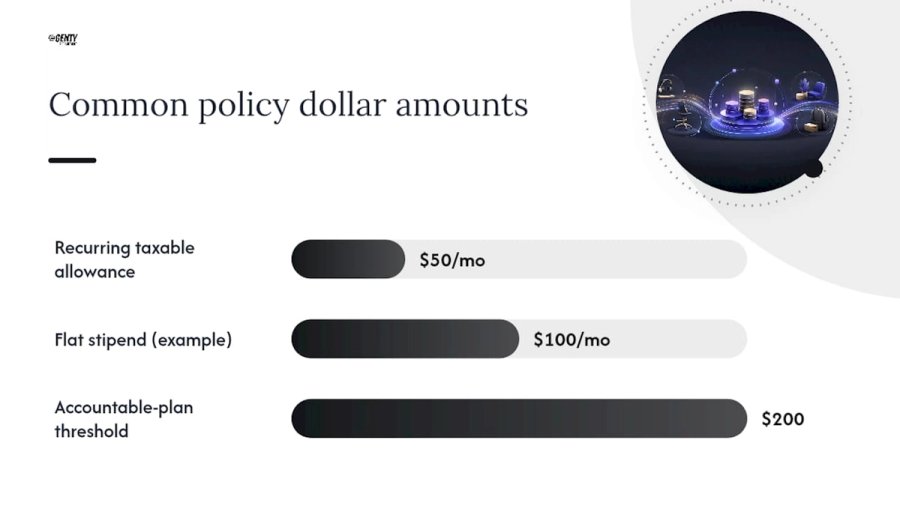
Fail any one of these tests and the payment becomes taxable wages, subject to income tax withholding and FICA on both sides. A flat $100/month stipend with no receipts required is not an accountable plan by definition, it’s compensation, and payroll should code it that way from day one.
State law adds a second layer. Eleven states plus D.C. have statutes that can require employers to reimburse necessary business expenses for remote employees, including California, Illinois, Massachusetts, New York, and Pennsylvania. These laws typically trigger when remote work is a job requirement rather than an employee preference, and the reimbursement duty can cover internet, phone, and equipment costs regardless of whether the company has a formal stipend program at all.
Run a state-by-state check before finalizing any policy:
- Does the employee’s state require reimbursement for remote work expenses?
- Does the law specify minimum coverage categories (internet, phone, equipment)?
- Does your stipend amount meet or exceed what the state considers “necessary”?
- Is the payment structured to qualify as non-wage reimbursement where the law expects that treatment?
Pro Tip: Structure a hybrid design: a small taxable recurring allowance (say $50/month, treated as wages, no receipts) plus accountable-plan reimbursement for anything over $200. This keeps day-to-day admin light while still capturing the tax advantage on larger purchases. Route the final policy language through legal counsel or a payroll vendor before launch, since state reimbursement thresholds shift and a template that worked last year may already be outdated.
Who Owns the Equipment and What Happens at Termination?
Ownership structure decides how much friction you’ll deal with when someone leaves the company. Three models cover almost every equipment stipend remote teams setup.
Fully company-owned equipment gets shipped, tracked in an asset registry, and recovered at termination through a prepaid return label. This model wins on security and recovery but slows down provisioning in countries where shipping and customs add delays.
Employee-owned with company reimbursement puts purchasing power in the employee’s hands. It’s fast and flexible, but recovery at termination is impossible, since the employee bought the hardware with their own name on the receipt, even if the company reimbursed the cost.
Hybrid ownership assigns the core device (laptop) to the company while letting employees purchase and keep peripherals (mouse, keyboard, monitor stand) with stipend funds. This is the most common structure among remote-first tech companies, since it protects the highest-value, highest-risk asset while giving flexibility on the rest.
Whichever model you choose, lock in the operational rules before launch:
- Standard refresh cycle: laptop every 3 years, peripherals as needed.
- Repair requests go through IT, not reimbursed independently by the employee.
- Termination triggers a return request within 10 business days, with a prepaid shipping label for company-owned gear.
- Security requirements apply regardless of ownership: multi-factor authentication, full-disk encryption, VPN for system access, and a signed acceptable-use agreement.
Build an asset registry with fields for serial number, purchase date, assigned employee, refresh due date, and return status. Pair it with an employee acknowledgment form at onboarding that spells out security obligations and the return timeline, so nobody can claim they weren’t told at the time of setup.
How to Roll Out and Govern an Equipment Stipend Policy
Launching an equipment stipend remote teams program works best as a pilot, not a company-wide rollout on day one. Test the workflow with a team of 10 to 15 people over 6 to 8 weeks before scaling.
- Weeks 1 to 2: Draft policy, get legal and Finance sign-off, select an admin platform.
- Weeks 3 to 4: Pilot with one team, track provisioning time and receipt compliance.
- Weeks 5 to 6: Collect feedback, adjust caps or categories based on real requests.
- Weeks 7 to 8: Roll out company-wide with finalized documentation.
The approval workflow itself should run request, IT security vet, purchase or reimbursement, asset tagging, payroll coding, in that fixed order every time.
Track these KPIs quarterly:
- Adoption rate (percentage of eligible employees who’ve used the stipend)
- Time-to-provision (request to working setup)
- Attrition delta between stipend recipients and non-recipients
- Reconciliation accuracy on accountable-plan submissions
Escalate to legal when a new state hire triggers an unfamiliar reimbursement statute, and loop in Finance whenever adoption rates suggest the budget needs a mid-year revision.
Adjusting Stipends for LATAM Hires
Hiring engineers in Argentina, Brazil, Mexico, or Colombia changes the equipment stipend math in ways a US-only policy doesn’t anticipate. GENTY recruitment clients typically see total hiring costs drop by up to 40% compared to US or Western European hires, which means the same $1,500 setup budget represents a smaller fraction of overall compensation while still needing to buy equivalent hardware.

Procurement logistics differ by country. Brazil’s import taxes on electronics can add 60% or more to the cost of foreign-purchased laptops, making local procurement or a cash reimbursement paid in local currency far more practical than shipping US-bought hardware across the border. Argentina’s currency volatility argues for reimbursing in US dollars or adjusting stipend amounts quarterly rather than annually. Mexico and Colombia generally have more predictable import channels, making direct shipment from US vendors a viable option for standardized hardware.
Timezone overlap is where LATAM hiring pays off operationally, not just financially. Argentina and Brazil run on GMT-3, overlapping most of the US Eastern workday, while Mexico and Colombia align closely with Central and Eastern time. That overlap means IT support tickets on equipment issues get same-day responses instead of the 12 to 16 hour lag common with hiring in Eastern Europe or Asia.
Pro Tip: Default to local currency reimbursement for LATAM hires rather than a fixed USD stipend. It protects the employee from exchange-rate swings and keeps your budget forecast stable in USD terms.
Common Pitfalls in Equipment Stipend Policies
Most equipment stipend remote teams programs fail in one of five predictable ways: treating a voluntary stipend as if it satisfies legal reimbursement obligations, skipping accountable-plan documentation and getting caught with taxable wages misclassified as reimbursements, leaving ownership ambiguous until someone quits, ignoring state-specific reimbursement laws entirely, and rolling out equipment budgets without looping in IT security from the start.
Run this checklist before approving any request:
- Category clearly defined in the written policy
- Documentation requirement matches the tax treatment
- Proration rule applied for part-time or hybrid status
- Replacement cadence stated (typically 3 years for laptops)
- Security sign-off completed before shipment or reimbursement
Pro Tip: Keep one-time setup and recurring connectivity as two separate budget lines on every payroll report. Mixing them makes it nearly impossible to audit either category cleanly at year-end.
Why a Predictable Stipend Structure Wins in Real Hiring Cycles
A stipend that’s ambiguous slows down every offer negotiation, since candidates ask what they’ll actually receive and HR can’t answer cleanly. A two-part model with clear caps closes that gap immediately. In practice, coordinating stipend design with the recruitment and onboarding workflow shortens time-to-productivity, because new hires aren’t waiting on a policy debate to get a working laptop. Retention improves too, since employees notice when equipment support is fast and fair rather than negotiated case by case.
Let GENTY recruitment Help You Budget for LATAM Equipment Needs
GENTY recruitment is the practical alternative to guessing at LATAM salary and equipment budgets from a US spreadsheet. Instead of building your stipend tiers around US-only assumptions, GENTY recruitment provides salary benchmarking alongside recruitment, so your equipment budget lines up with what engineers in Argentina, Brazil, Mexico, and Colombia actually earn and expect.
GENTY recruitment’s fixed-fee model delivers curated candidate shortlists within 7 days, so you’re not waiting months to pair a new hire with a finalized equipment budget.
If you’re planning a LATAM hire and need salary data to set stipend tiers correctly, start with GENTY recruitment’s IT recruitment page and request a benchmarking conversation alongside your next role search.
Frequently Asked Questions
What is a reasonable equipment stipend for remote employees?
Most US tech employers set one-time setup between $1,000 and $1,500, with recurring monthly allowances near $150 for connectivity and ongoing needs.
Is an equipment stipend taxable income?
Only if it fails the IRS’s accountable-plan tests. A flat stipend paid without receipts is taxable wages; a reimbursement with proper substantiation and business connection is not.
Which states require employers to reimburse remote work expenses?
Eleven states plus D.C., including California, Illinois, Massachusetts, New York, and Pennsylvania, have statutes that can trigger reimbursement obligations when remote work is required.
Should the company own the equipment or let employees buy their own?
A hybrid model works best for most teams: the company owns the core laptop for security and recovery, while employees purchase peripherals with stipend funds.
Does hiring in Latin America change the equipment stipend budget?
The stipend categories stay the same, but procurement logistics shift. Import taxes in Brazil, currency volatility in Argentina, and local vendor availability in Mexico and Colombia all affect whether to ship US hardware or reimburse locally.
Sources
- Remote Employee Reimbursement Rules by State
- IRS — Employer’s Tax Guide (accountable plans guidance)
- Remote Work Equipment Reimbursement Statistics 2026
- SHRM — Flexible work and benefits research
- VITL — Home Office Stipend Policy (sample policy)